Murphy Bed Storage Cabinets for Guest Bedding
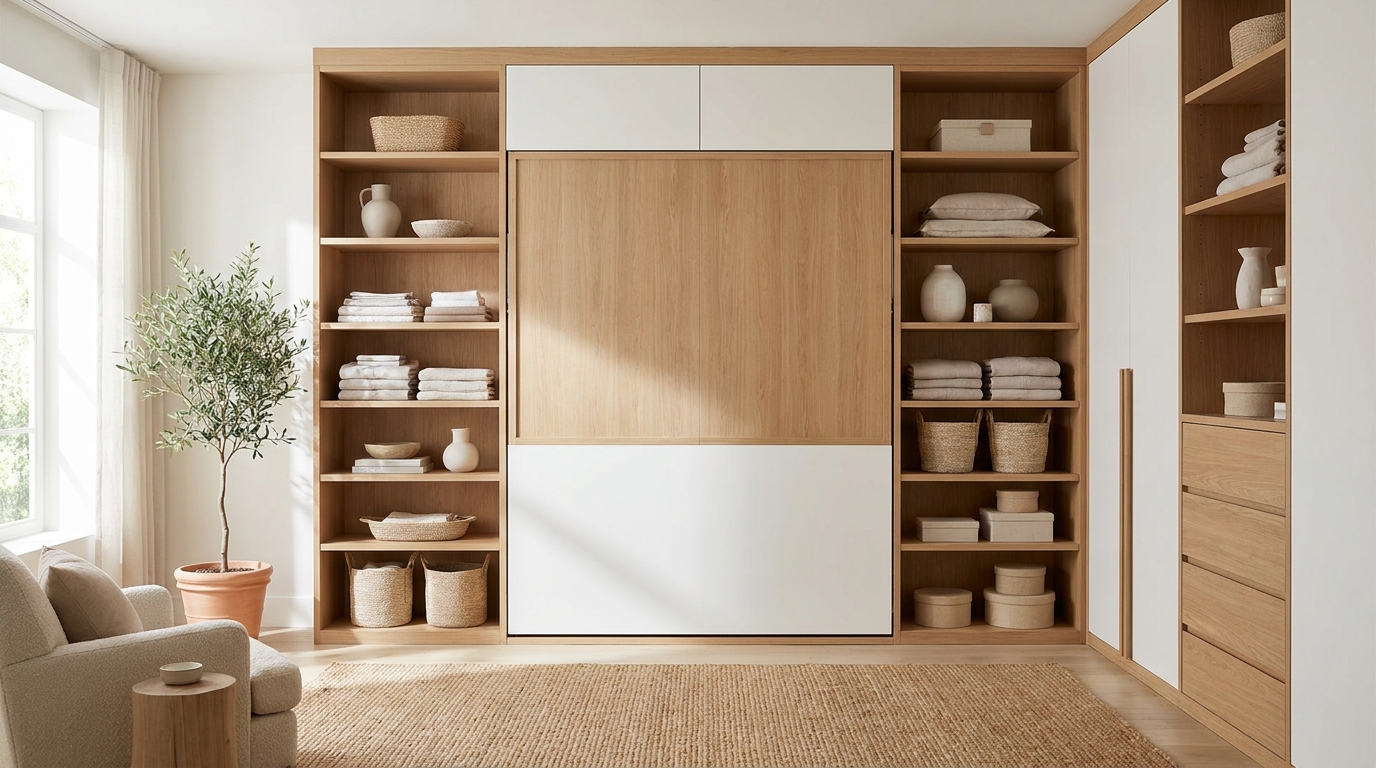
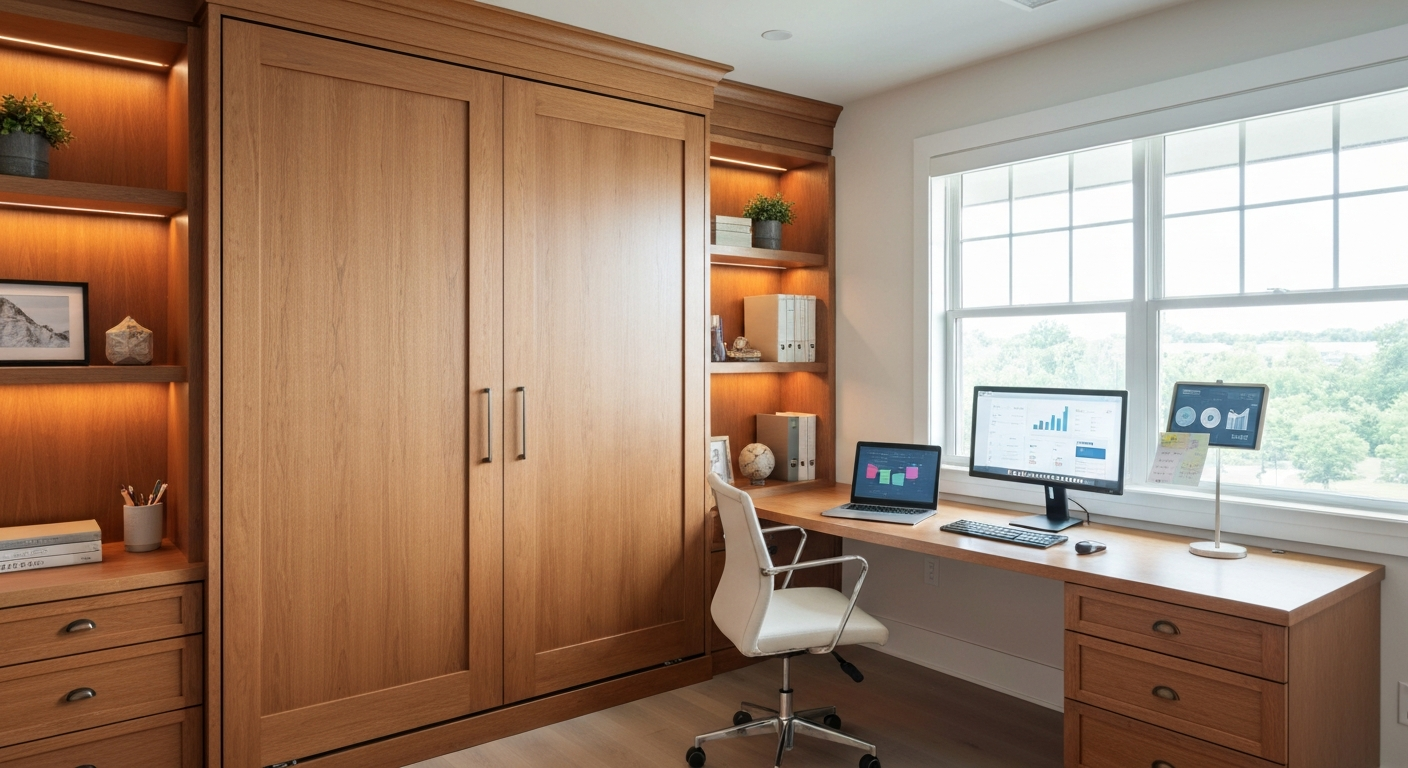
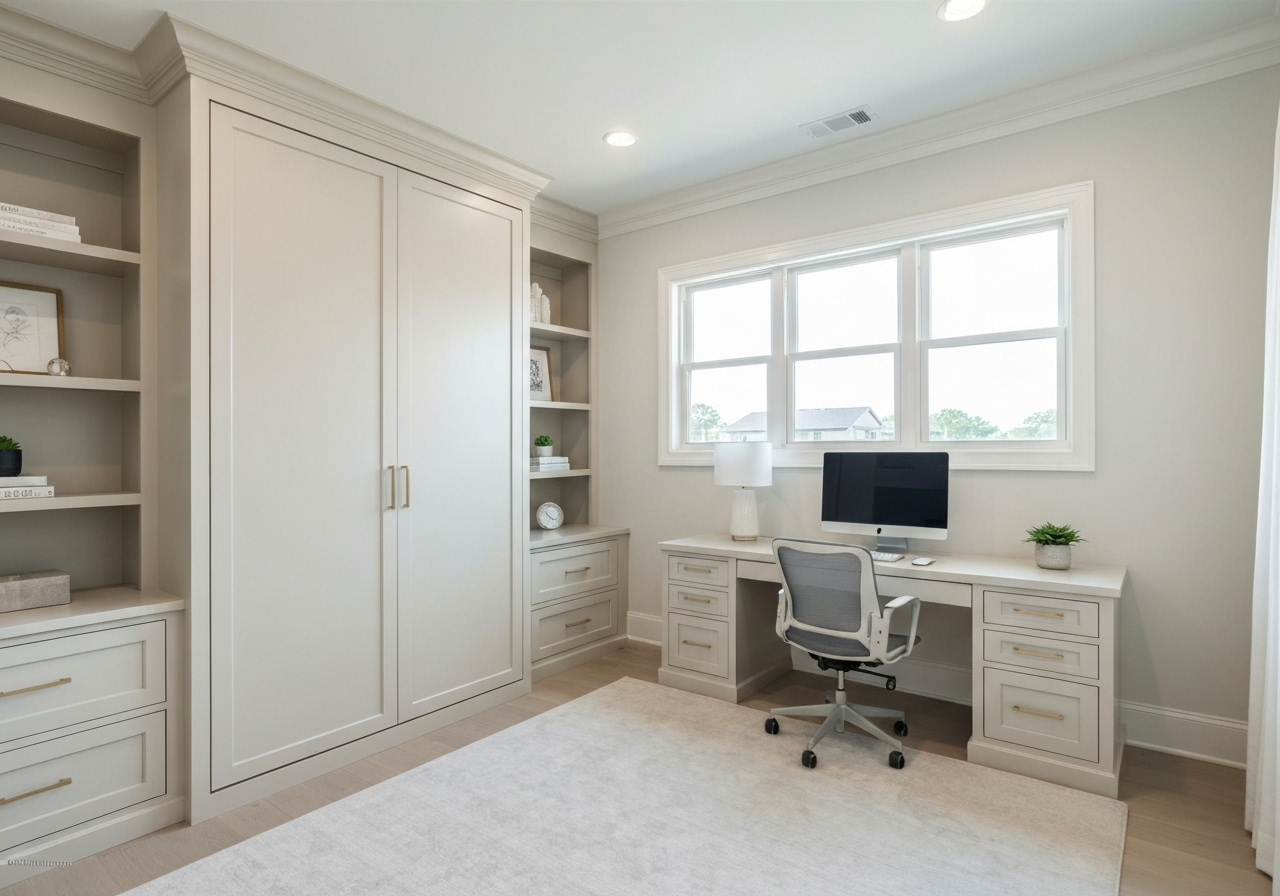
Murphy bed storage cabinets on either side of a wall bed should hold the guest sleep kit (pillows, extra sheets, a spare blanket, and overnight bags) so the room can stay a den or media space when the bed is folded up. The cabinets do the hiding. The wall bed does the sleeping. That split is what keeps a Fort Mill bonus room from looking like a spare bedroom that never got finished. When the bed comes down, those same cabinets still have to open, stay reachable, and leave a clear walk to the door, and tall cases need to be fastened so they cannot tip. [1][3]
1. Plan the cabinets for a den, not a leftover bedroom
A wall bed earns its keep only if the room still works on Tuesday afternoon. If pillows live on the sofa, extra linens sit in a laundry basket, and a guest duffel parks on the floor, the “den” is already a bedroom in disguise. Flanking cabinets fix that by giving bedding a closed home that is next to the mattress, not down the hall.
Our team designs those cabinets as part of the wall-bed run, not as leftover boxes. On our wall bed page, side cabinets are the flanking storage that frames the bed with shelves, drawers, and display. That is the point of this layout: one wall does two jobs, and the rest of the room keeps its daily furniture.
This is not a Murphy-plus-desk layout, and it is not a guest-closet overflow project. A desk combo is about weekday work. A hall closet is about bulk towels and out-of-season bedding. Side cabinets are about the night-of kit that has to appear in two minutes when someone stays over in Ballantyne or Indian Land.
What the den needs from those cabinets:
- Closed doors so folded sheets do not read as “guest room” during the day.
- Drawers or cubbies sized for standard pillow pairs, not leftover pantry bins.
- A low, open cubby or pull-out for an overnight bag so luggage never claims the sofa.
- A top display or open shelf for books, a lamp, or a plant, which is what a living space actually shows.
If the cabinets only hold decor, the bedding still has to live somewhere else. If they only hold clothes, you have built a wardrobe and lost the den.
2. Stock a sleep kit, not a second closet
The right inventory is small and specific. You are not emptying a linen closet into the wall. You are parking one guest stay plus a backup set so you are not washing sheets at midnight.
A practical sleep kit for a queen wall bed:
- Two sleeping pillows in washable covers, plus two extra shams if you like a made-bed look.
- One extra fitted sheet, one extra flat sheet, and a spare pillowcase pair.
- One light blanket or quilt that can sit on the sofa as a throw during the day, or stay folded in a cabinet.
- One set of guest towels if the nearest bath is a shared hall bath.
- A small basket for a phone charger, an extra outlet adapter, and a notepad.
Put heavier, denser items on the lowest shelves or in the lowest drawers. CPSC’s Anchor It! campaign, marking ten years in 2025, still tells households to store heavier items on lower shelves and to keep tempting objects off the tops of tall furniture so children are less likely to climb. [3][4] Guest pillows are bulky, not heavy. Extra blankets and packed duffels are the ones that belong down low.
What does not belong in these cabinets:
- Off-season family bedding for the whole house (that is hall-linen territory).
- Damp gym clothes or still-warm towels from the dryer.
- Toys, remotes, or snacks on the crown of a tall case, which CPSC flags as climb bait. [4]
- A full wardrobe of guest coats. A couple of hangers on a short rod is enough.
If you cannot name what each shelf holds before we draw it, the cabinet is too big or too vague. We would rather build two tight towers that empty in a minute than one deep armoire that swallows the den.
3. Keep a clear path when the bed is down
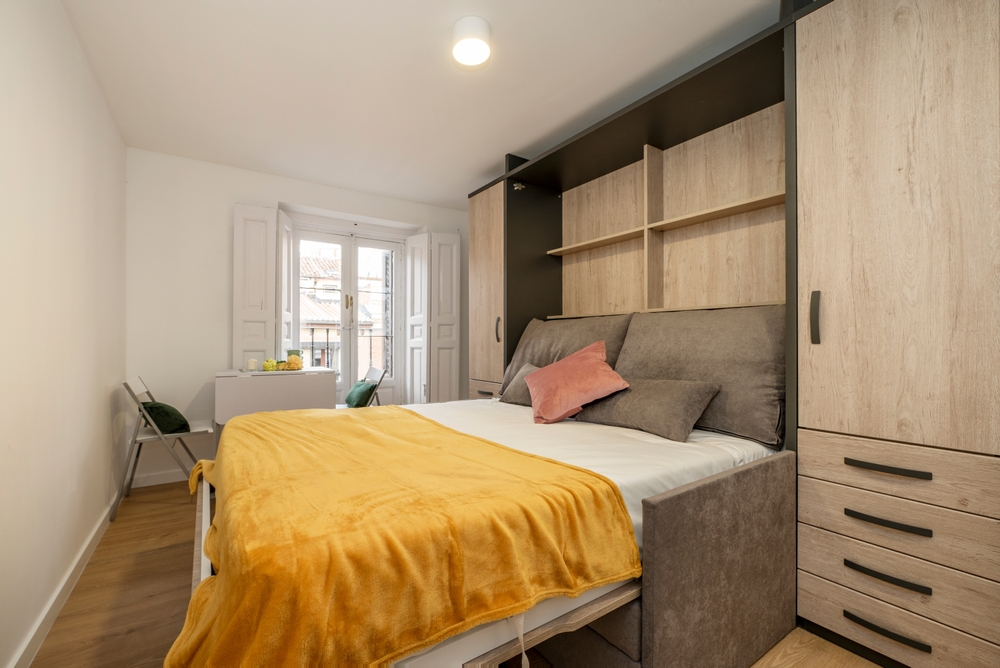
The bed-up plan is only half the job. When the mattress swings or folds down, it occupies a large rectangle of floor. Side cabinets that looked generous at noon can pinch the walkway at 11 p.m. if nobody measured the down position.
North Carolina’s residential egress rule is a useful analog here, even though a den is not a corridor. The 2018 North Carolina Residential Code, as quoted in a 2023 Office of the State Fire Marshal interpretation, requires a continuous and unobstructed path of vertical and horizontal egress travel from all portions of the dwelling to the required exterior egress door. [9] A lowered wall bed that blocks the only route to the room door, or cabinet doors that swing into that route, works against that idea.
The International Residential Code’s hallway rule is another planning analog, not a claim that your den is a hallway. A 2021 IRC means-of-egress training used by Montana building officials states that hallway width shall be not less than 3 feet. [10] We use that number as a floor for the walkway around a lowered bed: at least three feet of clear floor from the side of the mattress (or from an open cabinet door) to the opposite furniture or wall, and a clear shot to the room door.
Check these clearances in the down position, not only on a pretty elevation:
- Foot of the bed to the opposite wall or sofa. Guests still need to walk around to make the bed.
- Cabinet door swing. A 12-inch-deep door on a tall case can eat the last bit of aisle.
- Drawer extension. Full-extension drawers should not require standing in the mattress zone.
- Door to the room. The lowered bed should never become the only thing between a guest and the exit.
If the room is tight, we often specify shallower flanking cabinets (about 12 to 14 inches deep) and put bulky pillows in a wide, low drawer rather than a deep wardrobe. The wall bed can still be queen. The den still keeps a chair. The path still works.
Homes in Charlotte, Waxhaw, and Rock Hill often put wall beds in bonus rooms that also serve as the route to a hall bath. Draw the down-bed footprint on the floor before anyone picks a cabinet depth.
4. Put everyday linens where you can actually reach them
Bedding that lives on a 72-inch shelf is bedding nobody uses. The Access Board’s ADA Standards set an unobstructed forward and side reach of 15 inches minimum to 48 inches maximum above the finish floor for operable parts. [5] Those standards apply to public accommodations and other covered facilities, not to a typical private home. We still use the range as a planning guide because it matches how most adults, including guests with limited shoulder reach, actually use a cabinet. For a guest den, we treat that band as the home for the pieces a host actually grabs:
- Everyday pillows and the backup sheet set between about 15 and 48 inches.
- Overnight bag cubby near the floor, where a duffel is easy to slide in without a ladder.
- Rare extras (a winter quilt, extra shams) on the highest shelf, labeled so a host can find them.
- Pulls and door hardware that work with one hand and do not need a pinch grip. The same chapter limits operable parts to 5 pounds of force and bars tight grasping, pinching, or twisting of the wrist. [5]
When the bed is down, a high shelf becomes an obstructed reach. You are leaning over a mattress. The ADA obstructed-forward-reach rule drops the high point from 48 inches to 44 inches once the reach over an obstruction is deeper than 20 inches. [5] We treat that as a warning, not a private-home mandate: do not put the only spare pillow on a shelf you can reach only by kneeling on the guest bed.
Drawers beat deep upper cabinets for this reason. A 24-inch-wide drawer at hip height holds a folded sheet set in one motion, even when the mattress is down. Open cubbies next to the head of the bed work for the pair of pillows you actually put on the mattress. Tall display niches can stay visual. They should not be the only linen home.
5. Fasten tall cabinets so they cannot tip
Flanking cabinets are often the tallest things in the room. They also have doors and drawers that, when open and loaded, shift weight forward. That is the same pattern CPSC has spent years trying to reduce in dressers and other clothing storage.
From 2006 through 2021, CPSC estimated 84,100 tip-over-related injuries involving clothing storage units treated in U.S. hospital emergency departments, about 5,300 per year. From January 2000 through April 2022, CPSC staff were aware of 234 fatalities from clothing storage unit tip-overs, including 199 child fatalities. [1] CPSC recommends that consumers anchor furniture, including dressers, securely to the wall. [1]
Federal rule 16 CFR part 1261, in force for clothing storage units manufactured after September 1, 2023, incorporates ASTM F2057-23 and applies to free-standing units that are at least 27 inches high, at least 30 pounds, and at least 3.2 cubic feet of enclosed storage. [2] CPSC’s business guidance is explicit that built-in units intended to be permanently attached to the building are outside that scope. [2] Custom flanking cabinets that we fasten to the wall and to the wall-bed carcass are not the same product as a freestanding dresser. That is the point of building them in.
It is not an excuse to skip hardware. New clothing storage units in the federal scope must still ship with an anti-tip device that meets ASTM F3096. [2] CPSC’s Anchor It! campaign tells households to install those devices right away on new dressers and to use inexpensive anti-tip brackets on existing top-heavy furniture. [4] In 2025, CPSC said campaign efforts had contributed to a nearly 50-percent decline in tip-over-related injuries and deaths in the U.S., and it still lists a simple household rule: anchor bookcases and dressers to the wall, and keep heavier items low. [3]
How we treat flanking cabinets in a Wesley Chapel or Fort Mill den:
- Fasten tall cases to wall studs (or to the wall-bed structure) as part of the install, not as an optional kit left in a drawer.
- Load blankets and bags low, pillows in the middle, and light display up high. [3]
- Avoid placing climb-tempting objects on the crown. [4]
- Use drawer interlocks or soft-close hardware when young children use the home, even if the den is not a nursery.
The fastening is the safety feature. We plan for it on day one.
6. Store guest bedding dry, clean, and off exterior walls
Guest linens sit still for weeks. Still air plus a little moisture is how a nice sheet set turns musty. That problem is common in the Carolinas, where a closed cabinet on an exterior wall can feel fine in January and damp in July.
The U.S. Environmental Protection Agency’s current mold guide says to keep indoor humidity below 60 percent, ideally between 30 and 50 percent, and to dry wet items within 24 to 48 hours so mold does not get a start. [6] CDC’s 2024 mold page is stricter on the ceiling: keep humidity no higher than 50 percent all day, keep household air moving, and remember that mold can grow on fabric and upholstery when moisture is present. [7]
The Smithsonian’s Museum Conservation Institute, in guidance updated in September 2023, explains why bedding is a special case. Textiles made from natural fibers are hygroscopic. They take up moisture quickly and dry slowly. Stagnant air above 80 percent relative humidity will support mold on cotton and linen. Attics, basements, and closets against exterior walls are poor textile storage because temperature (and therefore relative humidity) swings there. [8]
What that means for murphy bed storage cabinets:
- Store only fully dry, fully cooled sheets and towels. A load that feels warm from the dryer still holds moisture.
- Prefer an interior wall for the wall-bed run when the room has a choice. If the only long wall is exterior, we leave a small air gap, avoid packing the cabinet back tight to a cold sheathing line, and keep the sleep kit off the back panel.
- Do not seal linens in airtight plastic. Smithsonian textile storage advice elsewhere in the same family of guidance favors air movement over sealed bags. Closed cabinet doors are fine. Vacuum bags for a spare cotton sheet set are not.
- Leave a little air space above a stacked sheet set. A cabinet packed to the hinge line cannot dry out after a humid week.
- If a guest cabinet ever smells musty, empty it, dry the linens, and fix the moisture source. CDC is clear that cleaning without fixing moisture does not finish the job. [7]
If the den regularly sits above 50 percent relative humidity, run the HVAC or a dehumidifier before you blame the cabinets. [6][7] We can specify discreet ventilation at the toe-kick. We cannot invent dry air in a closed, damp bonus room.
7. Finish the fronts so the room still looks like a living space
Once the kit, the path, the reach, and the fastening are right, the last job is visual. The cabinets should look like built-in living-room millwork, not like two bedroom armoires parked beside a hidden bed.
- Match door style and finish to the wall-bed fascia so the whole wall reads as one piece.
- Keep closed panels for linens and one small open niche for a lamp or books.
- Use the same hardware language as the rest of the house.
- Soft-close doors so a guest can grab a pillow at night without a slam.
In Waxhaw and Wesley Chapel homes we often pair a wall bed with a media wall on the opposite side of the room. Closed linen doors compete with a TV. Open shelves stuffed with extra duvets do not. The test is simple. With the bed up, a visitor should not be able to tell where the pillows live. With the bed down, a guest should be able to make the bed from the cabinets without a scavenger hunt.
Practical takeaways
- Build flanking cabinets for the night-of kit, not for the household’s entire linen inventory.
- Measure the bed in the down position and keep a clear walk to the room door. Use a 3-foot aisle as a planning analog. [9][10]
- Keep everyday sheets and pillows in the 15-to-48-inch reach band. Use drawers for the set you grab when the mattress is already down. [5]
- Fasten tall cases to the structure. Federal tip-over rules target freestanding clothing storage, and CPSC still tells families to anchor tall furniture. [1][2][3][4]
- Load heavy items low and keep climb-tempting objects off the top. [3][4]
- Store only dry linens, aim for indoor humidity at or below 50 percent, and avoid packing cotton sheets against a damp exterior wall. [6][7][8]
- Close the doors on bedding so the room can stay a den in Charlotte, Fort Mill, and Rock Hill on ordinary weekdays.
How we can help
Have more questions or want to get in touch? We design wall beds with flanking cabinets that hold guest bedding, keep the walkway clear, and look like living-room built-ins when the bed is up. Start on our contact page, call (704) 604-3870, or email design@theclosetrehab.com. We will measure the down-bed footprint in your room and plan cabinets around the way you actually host.
Citations
- U.S. Consumer Product Safety Commission, "CPSC Adopts Final Consumer Product Safety Standard to Prevent Tip-overs of Dressers and Other Clothing Storage Units" (2023-04-19)
- U.S. Consumer Product Safety Commission, "Clothing Storage Units" (2026-08-16)
- U.S. Consumer Product Safety Commission, "CPSC Anchor It! Campaign Marks 10 Years: Fewer Furniture Tip-Overs Lead to Safer American Households" (2025-07-29)
- U.S. Consumer Product Safety Commission, "AnchorIt.gov" (2026-07-22)
- U.S. Access Board, "ADA Accessibility Standards, Chapter 3: Building Blocks" (308 reach ranges; 309 operable parts)
- U.S. Environmental Protection Agency, "A Brief Guide to Mold, Moisture and Your Home" (current EPA web edition)
- Centers for Disease Control and Prevention, "Mold" (2024-09-26)
- Smithsonian Museum Conservation Institute, "Mold and Mildew on Textiles" (updated 2023-09)
- North Carolina Office of the State Fire Marshal, "2018 NC Residential Code Section R311 Means of Egress" formal interpretation (2023-10-18)
- Montana Department of Labor and Industry, Building and Safety Division, "IRC Means of Egress 2021 IRC" training (quoting IRC R311.6 Hallways)