Closet Cabinet Finishes: Melamine vs Wood Veneer
Start with the surfaces that take the hits
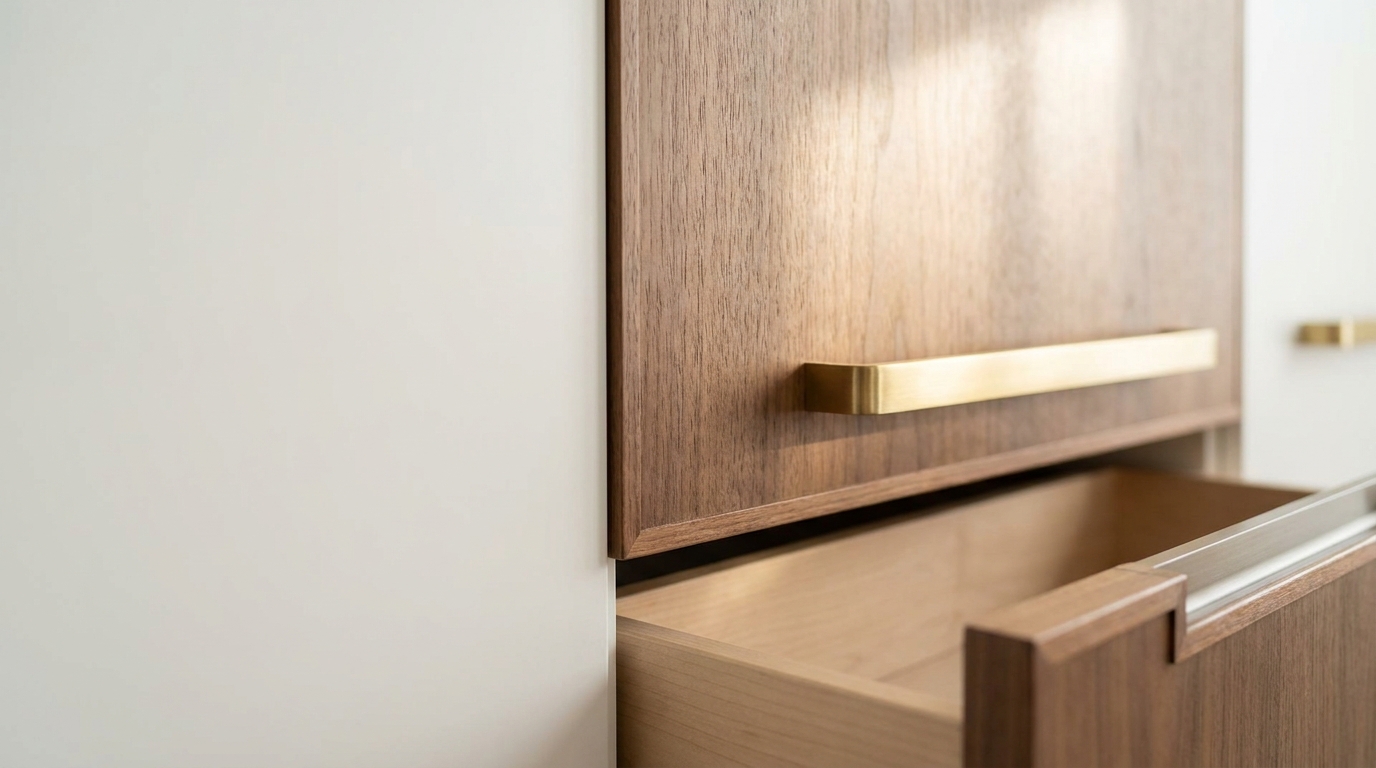
When homeowners ask us which closet cabinet finishes will still look good after years of hangers, bins, humid summers, and daily opening and closing, we keep the answer practical. Melamine (thermally fused laminate on a composite core) is usually the workhorse for shelves, interiors, and most closet boxes because it resists scuffs, wipes clean, and stays stable in typical bedroom conditions. Wood veneer is the right call when you want real wood grain and a furniture-level look, as long as edges are sealed, humidity swings are moderate, and you accept a bit more care than a plastic-coated surface. Hardware is not a cosmetic extra: hinges, slides, and pulls fail long before a good panel does if they are underspecified. Edge banding quality matters as much as the face finish, because open or thin edges are where moisture and impact damage start. In short, pick the finish for how you use the space, then match the core, edges, and hardware to that use rather than shopping for a single material name.
What “finish” really means in a closet
In closet work, “finish” is a stack of decisions, not one product label.
- Face surface – the decorative layer you see and touch (melamine/TFL, high-pressure laminate, wood veneer, paint, or a combination).
- Core – the panel underneath (particleboard, MDF, plywood, or specialty cores).
- Edge treatment – banding, solid wood edges, or laminate wraps that seal cut edges.
- Hardware and fasteners – hinges, drawer slides, rods, soft-close mechanisms, and how they attach to the core.
A pretty door face can still fail if the core swells at a cut edge, if a thin edge band peels, or if a drawer slide was never meant for heavy denim and winter coats. We design closets as systems for that reason.
Melamine and TFL: the everyday closet standard
What most people call “melamine” in cabinetry is usually thermally fused laminate (TFL): decorative paper impregnated with melamine resin, fused under heat and pressure to a particleboard or MDF core. The resin becomes part of the surface rather than a film you can peel like old contact paper.
Where melamine shines in closets
- Vertical panels, shelf faces, and interior cabinet walls that get light to moderate abrasion
- Easy cleaning with a damp cloth (spills, dust, fabric softener residue)
- Consistent color and texture across many doors and shelves
- Good cost-to-performance ratio for full walk-ins and reach-ins
Where it is less ideal
- Sharp impacts on thin edges if banding is cheap or poorly applied
- Long-term standing water (rare in bedrooms, more relevant near laundry or attic moisture problems)
- Deep gouges: the core is not solid wood, so damage can show as a light or dark scar if the surface is breached
Melamine is not “cheap particleboard with a sticker.” Quality varies by core density, resin system, surface texture (smooth vs. textured), and how carefully the shop machines and edges the parts. Two closets can both be “melamine” and age very differently.
High-pressure laminate (HPL) is a thicker cousin: kraft paper layers and melamine face sheets pressed under high pressure, then glued to a substrate. Laminate manufacturers position HPL as the tougher option for wear, scratch, and impact compared with TFL, and TFL as a strong value choice when extreme commercial-level abuse is not expected. Closet interiors and most residential vertical surfaces rarely need full HPL everywhere, but it can make sense on high-wear work surfaces, bench tops inside a dressing area, or heavily used pull-out trays.
Wood veneer: real grain with real responsibilities
Wood veneer is a thin slice of real wood bonded to a stable core (often plywood or MDF). You get authentic grain, stain and clear-coat options, and a look that many homeowners prefer next to other millwork in the home.
Strengths
- Natural appearance that plastic laminates only approximate
- Ability to match nearby doors, furniture, or trim species more convincingly
- Pleasant hand feel when finished well
Trade-offs
- Wood moves with moisture. University and lab guidance has long treated solid wood and wood products as hygroscopic: they gain and lose moisture as humidity changes, and dimensions shift with that moisture.[5][6][9]
- Veneer needs a continuous finish film (stain, sealer, topcoat) on faces and careful sealing at edges and end grain areas of related solid components.
- Scratches can be more visible than on a solid-color melamine, depending on the stain and sheen.
- Direct sunlight can shift color over years, especially with some species and finishes.
None of that makes veneer a poor closet material. It makes veneer a managed material. We recommend it when the design brief prioritizes wood character and the home’s HVAC keeps interior conditions reasonably steady. We are more cautious with raw-looking open-pore finishes in humid, poorly conditioned spaces, or where kids and sports gear will abuse every edge.
Cross-banded plywood cores help veneered panels stay flatter than solid lumber doors of the same size, because adjacent plies restrain each other’s cross-grain movement. Industry panel data used in structural panel guidance notes that plywood is more dimensionally stable than many other wood-based products for the same moisture change, with very small length/width coefficients of expansion as relative humidity shifts.[7] Closet furniture is not structural sheathing, but the same physics apply: a balanced, well-made veneered panel behaves better than a thick solid board that cups with the seasons.
Composite cores, indoor air, and what labels actually mean
Most melamine and many veneered cabinet parts start with particleboard, MDF, or hardwood plywood. Those composite products are regulated for formaldehyde emissions in the United States under TSCA Title VI. EPA’s rule covers hardwood plywood, medium-density fiberboard (including thin MDF), particleboard, and finished goods that contain them, and requires third-party certification and labeling. After March 22, 2019, products in commerce must be labeled as TSCA Title VI compliant (with transitional CARB labeling allowed only earlier in the rollout).[1]
EPA’s compliance materials list the emission standards that began applying to regulated products on June 1, 2018, including limits of 0.05 ppm for hardwood plywood (veneer or composite core), 0.09 ppm for particleboard, 0.11 ppm for MDF, and 0.13 ppm for thin MDF.[2] Those figures are chamber-test compliance limits for panels, not a promise that every old piece of furniture in a resale shop meets current rules. When we specify materials, we work with compliant panel products and finishes intended for interior cabinetry, not mystery stock from untraceable sources.
Indoor air quality is one reason sealed edges and intact faces matter beyond looks. A continuous surface and good banding reduce raw core exposure. Ventilation in the home still does the heavy lifting for overall air quality; cabinet choices are one piece of a larger picture.
Edge banding: the small detail that decides longevity
If we had to rank “silent” durability factors in closet cabinet finishes, edge banding would sit near the top.
Cut panel edges expose the core. Without a durable edge, you get:
- Moisture uptake and localized swelling
- Chipping from hangers and vacuum wands
- Peeling paper edges that look worn long before the face does
What we look for
- Thickness: thin paper or 0.4 mm films are common on budget furniture; thicker PVC or ABS banding (often about 1 mm, sometimes more on premium work) takes impact better and can take a slight radius that feels better in the hand.
- Adhesion method: industrial hot-melt (including PUR systems in many shops) and proper edge preparation beat peel-and-stick DIY strips for permanent installs.
- Color and texture match: a mismatched edge makes even a good face look like a patch job.
- Continuity: gaps at corners or seams are future failure points.
Frameless slab doors with edge banding are especially sensitive to machining quality. Industry certification commentary notes that if seams are not tight, moisture can reach the substrate and show up as swelling or finish problems.[3] Closets are not steamy kitchens, but seasonal humidity in Charlotte-area homes is still real, and bathrooms or laundry rooms that share a wall with a closet can raise the stakes.
Humidity, Charlotte homes, and why wood science still applies indoors
You do not need a greenhouse for moisture to matter. Wood products indoors still settle toward an equilibrium moisture content with room air. Extension and university guidance commonly places furniture and interior wood in roughly the 6–8% moisture content range once it has equalized in a typical home environment, and recommends drying wood intended for indoor use into that neighborhood before high-quality interior work.[5][6] Purdue Extension notes that wood at about six to eight percent moisture content is suitable for indoor use, and that interior woodwork and furniture targets often center near that band (with regional averages presented in tables for different U.S. zones).[5] Ohio State University’s drying fact sheet states that wood furniture in the home reaches equilibrium with the air at 6–8% moisture content.[6]
USDA Forest Service Forest Products Laboratory’s Wood Handbook remains the standard engineering reference for moisture relations and dimensional change in wood and wood-based materials; the handbook’s moisture chapters are the scientific backdrop for why sealed cores, balanced construction, and steady indoor humidity reduce call-backs.[9]
Practical implications for closet finishes
- Avoid installing closed cabinetry against a damp exterior wall without addressing the moisture source.
- Give new construction or major remodels time to dry before final built-in install when possible.
- Prefer fully edged, fully finished panels over raw-cut shelves in any space that sees humidity spikes.
- If you love veneer, pair it with good HVAC habits: extreme winter dryness and summer humidity both stress finishes and joints.
Plywood industry technical notes also point out that panels leave the plant at relatively low moisture content (often cited around 2–8% for structural panels at manufacture) and will change dimension as they pick up moisture in service; good design leaves systems that can tolerate those small movements rather than fighting them.[7]
Hardware that lasts as long as the finish
A closet with perfect closet cabinet finishes and weak hardware still feels like a failure within a year or two. Focus on:
Drawer slides
- Match load rating to real contents (jeans, shoes, and files weigh more than empty boxes).
- Prefer full-extension slides where access matters.
- Soft-close is a lifestyle choice, but the mechanism still needs cycle durability and correct installation.
Hinges
- Overlay, inset, or half-overlay geometry must match the door and box style.
- Soft-close dampers fail early when doors are out of alignment or overloaded with heavy mirrors.
- Screw holding depends on core type; we design fastening into solid material or use appropriate inserts where needed.
Rods, hooks, and hanging systems
- Span and support spacing matter more than finish chrome vs. matte black.
- Mid-span supports prevent sag that transfers stress into side panels.
Cabinet performance standards give a useful mental model even when a residential closet is not labeled with a kitchen seal. The Kitchen Cabinet Manufacturers Association’s ANSI/KCMA A161.1 program subjects cabinets to a battery of 14 tests covering structure, doors, drawers, and finish durability.[3] Examples KCMA publishes include loading wall cabinets in a 600-pound stress test, cycling doors and drawers 25,000 times under load, shelf and bottom loading at 15 pounds per square foot for seven days, and finish exposure to common household liquids plus a humid 120°F “hotbox” environment.[3][4] Closets are not identical to kitchen cabinets, but those numbers show what “engineered for daily use” means in the broader cabinet world: repeated motion, sustained load, heat, humidity, and stains.
For storage furniture more broadly, ANSI/BIFMA X5.9 is a widely used test suite for storage units. Independent test labs and testing centers that run the standard list evaluations that include unit strength, racking resistance, vertical load durability, stability of tall units and extendible elements, drawer (extendible element) retention and durability, and related cycle and impact tests.[8] When hardware suppliers claim cycle testing, ask what standard and load they used. Marketing words without a load and a cycle count are hard to compare.
Melamine vs. wood veneer: a plain comparison
| Factor | Melamine / TFL | Wood veneer | | --- | --- | --- | | Daily wipe-down | Excellent | Good if finish is intact | | Scratch visibility | Often lower on solid colors; texture helps | Depends on grain and sheen | | Moisture at damaged edges | Core can swell if edge fails | Core and veneer both suffer if unfinished edges drink moisture | | Visual character | Consistent, many textures | Natural grain, higher “furniture” read | | Repair | Hard to invisible-repair deep hits | Light surface issues sometimes blendable; deep damage is still hard | | Cost range | Usually lower for full runs | Often higher for premium species and finishing | | Best fit | Most closets, rentals, high-use family storage | Design-forward closets, homes with wood millwork |
Many of our projects mix the two: melamine interiors for durable storage zones, veneer or painted faces where the eye lands when doors open to the room.
How we specify finishes on real projects
Our process is not a catalog checkbox. We walk the space, talk about clothing weight, kids, seasonal storage, and whether the closet sits near a bathroom, attic, or exterior wall. Then we map finishes to zones:
- High abrasion zones (lower shelves, shoe areas, kids’ reach-ins): tougher melamine textures, thicker edge banding, fewer delicate open-pore veneers.
- Display and dressing zones: veneer or refined solid colors, carefully lit so the surface quality shows.
- Wet-adjacent zones: sealed edges, moisture-aware cores, and hardware that will not rust or seize.
- Heavy drawer banks: slides and box construction first, finish second.
We also keep an eye on color fastness, sheen consistency across dye lots, and how texture hides fingerprints. A dead-flat high-gloss door can look stunning on day one and show every palm print by day three; that is a lifestyle fit issue, not a manufacturing defect.
If you want a deeper look at how we talk about surface options in our own work, see our page on cabinet and shelf finishes.
Practical takeaways
- Treat closet cabinet finishes as a system: face + core + edge + hardware, not a single buzzword.
- Default to quality melamine/TFL for most storage surfaces; upgrade specific faces to veneer when you want wood character.
- Spend budget on thicker, well-applied edge banding; cheap edges undo good panels.
- Ask whether composite panels are TSCA Title VI compliant and properly labeled for the U.S. market.[1][2]
- Keep indoor humidity reasonably steady; wood products equalize around typical home moisture levels and move when rooms swing wildly.[5][6][9]
- Specify drawer slides and hinges with real load ratings and cycle expectations, using cabinet and storage standards as a reality check.[3][4][8]
- Seal and support long spans; sagging shelves stress boxes and hardware even when the finish still looks fine.
- Match sheen and texture to cleaning habits, not only to a sample under showroom lights.
- Fix moisture sources (leaks, unvented baths, wet basements nearby) before blaming the closet material.
- When in doubt, put the toughest surface where hands and hangers hit every day, and save delicate beauty for protected faces.
How we can help
At The Closet Rehab, our team designs and builds custom storage for Charlotte-area homes with materials chosen for how you actually live, not for a one-size brochure. We will walk through melamine, veneer, edges, and hardware with clear trade-offs, then install a system that stays straight, opens smoothly, and cleans without drama. If you are planning a primary suite, kids’ closets, pantry, or mudroom upgrade, start with how our process works or contact us to schedule a conversation. We are happy to bring samples so you can feel edge quality and surface texture before you commit.
Citations
[1] U.S. Environmental Protection Agency. Formaldehyde Emission Standards for Composite Wood Products. https://www.epa.gov/formaldehyde/formaldehyde-emission-standards-composite-wood-products
[2] U.S. Environmental Protection Agency, Office of Pollution Prevention and Toxics. Formaldehyde Emission Standards for Composite Wood Products: Small Entity Compliance Guide (general audience presentation, updated April 2018). https://www.epa.gov/sites/default/files/2018-04/documents/small_entity_compliance_for_formaldehyde_standards-general_audience_4.20.2018.pdf
[3] Kitchen Cabinet Manufacturers Association. ROI of Cabinet Durability: Reducing Project Risk With A161.1. https://kcma.org/resources/roi-durable-cabinets-a161-1
[4] Kitchen Cabinet Manufacturers Association. Why choose certified cabinetry? https://kcma.org/resources/why-choose-certified-cabinetry
[5] Purdue University Extension. Wood Moisture and Dimensional Changes (FNR-37). https://www.extension.purdue.edu/extmedia/FNR/FNR-37.html
[6] Ohio State University Extension, Ohioline. An Overview of Drying Hardwood Lumber (F-73-12). https://ohioline.osu.edu/factsheet/F-73-12
[7] APA – The Engineered Wood Association / Performance Panels. Dimensional Stability & Flatness. https://www.performancepanels.com/dimensional-stability-flatness
[8] Manufacturing Solutions Center. BIFMA X5.9 Storage Units – Tests. https://www.manufacturingsolutionscenter.org/bifma-storage-units-test.html
[9] U.S. Department of Agriculture, Forest Service, Forest Products Laboratory. Wood handbook: Wood as an engineering material (FPL-GTR-282 and related chapter records). https://research.fs.usda.gov/treesearch/62200