Tall Boot Storage: Cubbies Keep Shafts Upright
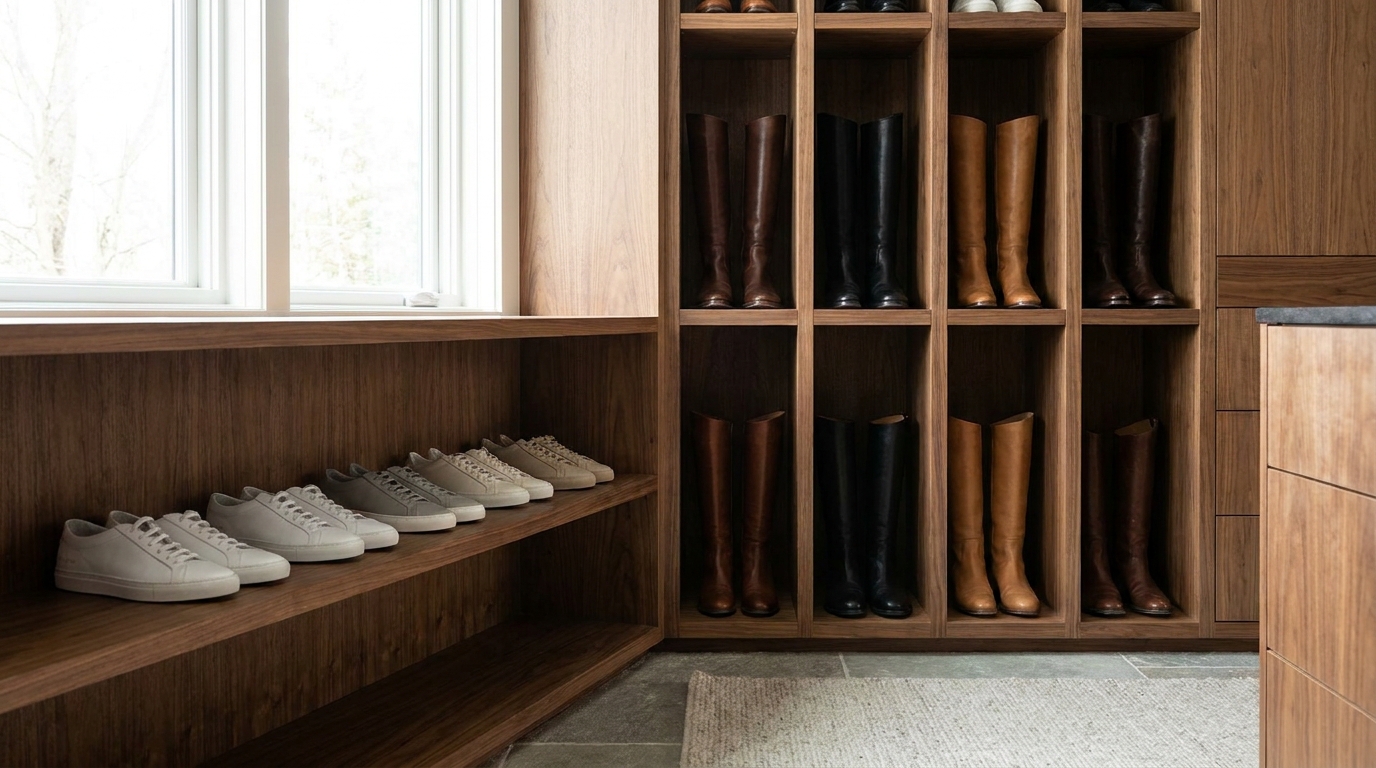
Tall riding boots, knee-high fashion boots, and winter shafts do not hold themselves up once they come off the foot. A cubby for tall boot storage holds each shaft upright, with enough height that the top does not hit the shelf above, while everyday sneakers stay on a separate shelf in the same view. Museum conservation guidance is direct about the alternative: footwear and other flexible leather goods cannot hold their shape without support, and they can set into a crease or a flattened form if that support is missing [1]. We plan that bay for the boots a household actually owns, in a master closet or at the entry, rather than as a generic shoe rack.
1. Why a tall shaft folds when nothing holds it
A soft shaft has to stand on a sole and a heel once the foot is gone. If nothing holds it, it leans, and the lean becomes a fold at the ankle or across the calf. Leave that fold for a season and it can become the shape the boot remembers.
In 2014, a conservator at the Polar Museum, University of Cambridge, described the stiff end of that problem in the museum's own boot collection. Most of those boots could not support their own weight off the foot. Stored without support, they formed harsh creases that can become weak spots. Leather and rubber had also grown rigid, so a squashed shape could set in a way that is often difficult or nearly impossible to reverse. A fitted support held each boot upright, in an as-worn position [2]. Those were expedition boots in a museum store, not a weekday pair at home. A tall shaft at home that is allowed to flop has the same problem.
The Canadian Conservation Institute made the broader point in its 2018 guidelines on leather, skin, and fur. Flexible footwear and similar pieces cannot hold their shape without support. Without it, they risk being compressed, or setting into a deformed shape [1]. Three-dimensional leather can take a permanent crease unless it has both an inner support and an outer support. Forcing a misshapen piece back into form can tear it or distort it. The better course is to keep the shape before the fold sets [1].
A 1992 CCI note on tanned leather, still the Institute's published note on this care, says leather should be fully supported even when it still has some flexibility. An object that has already sagged and stiffened while misshapen is often difficult or impossible to reshape. Sharp folds should be padded so the leather does not crack and later split [3].
The cubby is the outer support. Side walls and clear height stop the shaft from falling onto the shelf or into the next boot. If you add an inner support, keep it gentle. The 2018 guidelines say to pad boots enough to hold their shape, and not to overstuff them. Overstuffing can stretch the skin, loosen stitching, or cause tears [1]. A cubby that pinches the shaft does the same harm from the outside.
2. Size the cubby to the tallest boot in the house
There is no single shaft height we can hand you. Riding boots, western shafts, slouchy fashion boots, and insulated winter boots do not share one measurement. A published "standard cubby" would be a guess, and we will not invent one.
Measure the tallest pair you intend to keep in this closet. Stand the boot the way you want it to live, sole flat and shaft upright, not folded at the ankle. Measure from the bottom of the sole to the top of the shaft. The inside of the cubby has to clear that height. If the shelf above touches the shaft, the leather carries a constant load, and you cannot slide the boot out without bending it. Leave a small gap above the tallest shaft. The number of inches comes from your boot, not from a catalog.
Leave room at the sides, not only overhead. CCI's 2009 note on costume accessories says to stand shoes side by side, not touching, and never to stack them. Stacking soils leather, can crack it (patent leather is named in particular), and deforms the shape [4]. An open shelf where tall boots lean on each other fails that test. A divider, or an opening sized to one pair, keeps the next shaft from pressing a crease into its neighbor.
Depth follows the sole. The sole should sit fully on the deck. A heel hanging off the edge will tip, and a tipped shaft is a folded shaft. We size that deck to the longest sole in the group. If a light fashion boot and a heavy winter boot want different depths, they may need two runs instead of one compromise shelf.
Count pairs before you count openings. Left and right stay together. One boot per cell gives each shaft its own walls and uses more width. A pair per cell saves width. We choose after we see the closet and the boots. If a taller pair is likely later, say so before the openings are fixed.
Floor level is the right band for this weight. You should not lift a tall boot onto a high shelf, and you should not leave it in a heap where the next pair lands on top of it.
3. Put sneakers on their own shelf
Everyday sneakers and tall shafts do different jobs. They should not share one hole. Sneakers are what you grab on a weekday morning. If they live inside the boot cubby, the shaft becomes a shelf. Something rests on it, or you shove it aside to reach a trainer, and the fold comes back.
Keep the daily shelf in the same glance. The useful layout is one visible layer: boot cubbies along the floor, and a sneaker shelf directly above them or immediately beside them. You see both when the door opens, instead of digging through a pile that hides the boots.
The 2009 guidance against stacking is why that sneaker shelf is separate, not a courtesy [4]. A sneaker set on a boot shaft is a stack. So is a boot laid across a row of trainers. The 2018 guidelines also ask for enough horizontal and vertical space to avoid cramming, compression, and creases [1]. A separate shelf is how a working closet follows that idea without pretending the closet is a museum drawer.
Give the sneakers a height of their own. Low-top trainers need less clearance than a high-top or a bulky runner. We measure the tallest sneaker the same way we measure the tallest boot, then set that shelf so a pair can sit without another pair on top of it. Pairs stay matched. A low lip keeps them from walking off the front edge, which matters in an entry closet where the door swings and people move quickly.
This bay is not a mudroom for wet coats, and it is not a shoe wall for every pair in the house. It is a place for shafts that must stay upright, plus one companion shelf so daily shoes never become a weight on those shafts. Extra shoes belong in another part of the closet, not crammed into the boot cells.
4. Moisture, dust, and products that will not uncrease a shaft
Shape is the main problem a cubby solves. Climate is the other one. The published numbers are not identical, so it helps to say whose numbers they are.
The U.S. Environmental Protection Agency's mold house tour was first published in 2015 and last updated on September 8, 2026. It still says high room humidity can grow mold on furnishings and clothing, and it shows that risk in a bedroom closet. The page asks households to keep indoor humidity below 60 percent, and ideally between 30 and 50 percent [5]. That is home guidance about mold, not a leather-laboratory specification.
For leather, the Canadian Conservation Institute's 2018 guidelines say relative humidity above 65 percent favors mold on leather, skin, fur, and parchment. Poor air circulation makes an outbreak more likely, and mold left to grow attacks the structure and weakens it [1]. Those guidelines, drawing on earlier research, also note that prolonged warm, moist conditions can darken, stiffen, and embrittle vegetable-tanned leather [1]. Very dry air, below 30 percent relative humidity, calls for extra care, because loss of moisture can mean loss of flexibility and a higher chance of physical damage [1].
A 1992 CCI note recommended a tighter museum band: a stable 45 to 55 percent relative humidity, and about 18 to 20 degrees Celsius (roughly 64 to 68 degrees Fahrenheit). Humidity over 65 percent, it said, encourages both mold and hydrolytic breakdown of the fibers, while conditions under 30 percent dry the leather and make it brittle [3]. A 2009 note on costume accessories repeated a 45 to 55 percent storage range [4].
A lived-in closet is not a museum vault, and we do not promise vault conditions inside a cubby. Do not leave the boot bay damp, and do not set it over a heat register or against a sweating pipe. The 1992 note says not to store leather over radiators or furnace pipes, in a damp basement, or near sweating pipes, and not to put it in direct sun or daylight that dries and discolors it [3]. If the closet smells musty, or an exterior wall is cold and wet, deal with the moisture before you fill the bay [5].
Let wet boots dry in open air before they go in. Poor air circulation plus high humidity is what the 2018 guidelines flag for mold on leather [1]. A sided cubby is a poor place for a boot still wet from rain.
Skip newspaper, and do not count on oil to erase a crease. The 1992 note says to keep leather away from newsprint, which it lists with ink and pencils as troublesome to the surface [3]. It also says saddle soap is alkaline and harmful, and that routine dressings can darken leather, stiffen it later as oils oxidize, stain nearby materials, and attract dust [3].
The National Park Service updated that picture in January 2025. For collection objects, routine dressings are not best practice. They can leave a white waxy bloom, called fatty acid spew, that people mistake for mold. A white film is not automatically mold. If there has not been a water event and humidity has not risen above 65 percent, the bloom may be old dressing coming back out of the leather. Dressings can also leave a sticky, dirt-holding surface and can encourage biological growth [6]. The Park Service does allow a dressing on personal leather that still has to flex, including work boots, with diminishing returns over the life of the object. Museums, it says, rely instead on stable humidity, inert padding, and internal support [6].
We do not walk clients through oils, saddle soap, or solvent cleaning. A dressing is not a substitute for a shaft that stands up, and a sagged, stiffened shape can be difficult or impossible to bring back [2][3]. If a boot you still wear needs conditioning, follow the maker's care note. Dust is part of the same picture: the 1992 note says it attracts water vapor and can be hard to lift off a worn surface [3]. Sides on the cubby keep boots off the floor pile instead of in a heap under the hanging rod.
5. How we lay out a boot bay in a master or entry closet
Our team designs this as part of a custom closet, not as a rack you squeeze in after the fact. In a master closet, the bay usually sits at the end of a hanging run or under a short stack of shelves, where the floor is clear and the shafts stay in sight. In an entry closet, it sits where you can step out of the boots and leave them standing, with the sneaker shelf close enough for the shoes you put on next. Households around Charlotte use both versions. The measurements change with the boots and the room. The idea does not.
We start with the boots, then the closet. On a consult we want the tallest shaft, the longest sole, the number of tall pairs, and the number of sneakers that must stay in this same view. We also look at the door swing, what hangs above, and whether a heat register or a cold exterior wall is in the way. Our closets page shows how a full closet is planned. The boot bay is one zone inside that plan.
What we build follows the pair count:
- A floor-level run of cubbies, one opening per pair or per boot, tall enough for the tallest shaft with clearance above it.
- Dividers that keep shafts from leaning into each other.
- A level deck so each sole sits flat.
- A separate sneaker shelf in that same visible layer, with pairs kept together.
- Room to slide a boot out without folding the shaft on the shelf above.
We do not point people at a big-box kit as the stand-in for this. A short rack with one fixed shelf height will clip a tall shaft or leave it leaning. Open wire will let a soft shaft collapse between the wires. The cubby has to be planned to the boot you own, including the taller pair you expect to keep, not only the pair by the door today.
Practical takeaways
- Tall shafts need a cubby that holds them upright. Unsupported footwear creases and can set that way [1][2].
- Measure the tallest boot you will store, sole to the top of the upright shaft, and leave clearance above it. Do not copy a stock shelf height.
- Stand boots so they do not touch or stack. Stacking deforms leather and can crack finishes such as patent leather [4].
- Keep sneakers on their own shelf in the same view, so a daily shoe never rests on a shaft [1][4].
- EPA guidance, updated in 2026, still asks for indoor humidity below 60 percent, ideally 30 to 50 percent. Leather guidance flags mold risk above 65 percent and extra care below 30 percent [1][5]. The 1992 museum band of 45 to 55 percent is a collections target, not a promise a house closet will hit [3][4].
- Do not stuff leather with newspaper, and do not expect oil or saddle soap to lift a crease. Support the shape, and let wet boots dry in the air before they go into a cubby [1][3][6].
How we can help
Have more questions or want to get in touch?
We measure the boots and the closet together, then build the bay as part of the closet. Reach our team through the contact page, by phone at (704) 604-3870, or by email at design@theclosetrehab.com.
Citations
- Canadian Conservation Institute, "Caring for leather, skin and fur" (2018)
- Scott Polar Research Institute, University of Cambridge, "These boots were made for walking… Part 2" (2014-01-23)
- Canadian Conservation Institute, "Care of Alum, Vegetable and Mineral-tanned Leather, CCI Notes 8/2" (1992)
- Canadian Conservation Institute, "Storage for Costume Accessories, CCI Notes 13/12" (2009)
- U.S. Environmental Protection Agency, "Text Version of the Mold House Tour" (2015-03-23, last updated 2026-09-08)
- U.S. National Park Service, "Conserve O Gram 9/1: Fatty Acid Spew on Leather Objects" (2025-01, last updated 2025-07-02)