Sock Drawer Organization: Shallow, One-Layer Cells
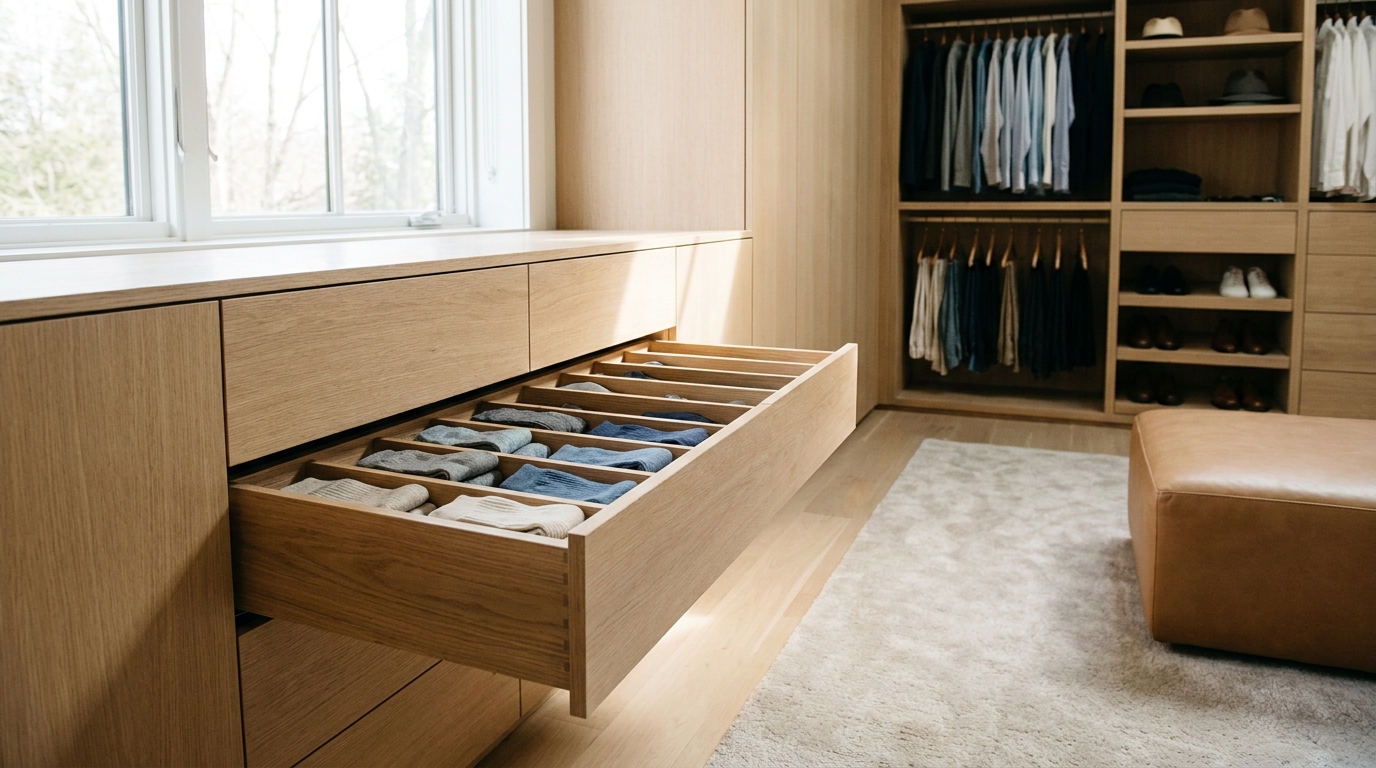
A sock and underwear drawer stays usable when it is shallow, split into cells, and filled one layer deep. Socks, briefs, and bras are small folds. If they share one open box, they become a pile you dig through, and the elastic at the bottom carries a load it does not need. We size each cell to the folded piece so a pair, a brief, or a bra has its own place and comes out without disturbing the rest.
1. Why one open drawer fails small folds
The top drawer in a primary closet is usually asked to hold everything too small to hang. Socks land on underwear. A bra gets pushed to the back. By midweek the front is a ridge of unmatched pairs, and the pieces you wear are underneath.
That pile has two costs. You cannot see a complete set, so it is easy to buy another pack of the black ankle socks you already own. The bottom layer also stays compressed.
Folded knits and elastic waistbands are not shelves. They are not meant to hold a mixed heap on the same crease day after day.
A divider does not organize a drawer by itself. It works when the cell matches the fold and the cell is not stacked with three different kinds of clothing. Sock drawer organization, treated this way, is a layout problem.
Empty the drawer before you measure it. Sort what you find into socks, underwear, and bras, and set aside anything with elastic that no longer recovers. A grid designed around a mixed pile will be the wrong grid.
2. What this drawer is for, and what it is not
This drawer is for small folded undergarments and socks: ankle socks, crew socks, no-show socks if you wear them, briefs, boxers, and bras. Thin tights can take a narrow cell when they live with the daily set. Sweaters, jeans, and shoes are a different storage problem, and they should not share this drawer. One heavy knit dropped on the socks ends the one-layer idea the same day.
Shape still matters inside the small folds. Athletic socks are thicker than dress socks. A high-rise brief folds wider than a minimal cut.
A molded-cup bra needs width and a little height so the cup is not pressed flat. If those three shapes share one cell, the largest item sets the pile and the smallest disappears under it.
Give each family its own zone. Socks run along the front, where you reach every morning. Underwear sits beside them. Bras take a wider bay, with nothing stacked on the cups.
In the primary closets we design around Charlotte, including homes in Ballantyne and Fort Mill, that top drawer is often one wide catch-all. The fix is a shallower box with walls in the right places, not a deeper bin.
3. Fold and wash so the fiber can recover
The cell is only as good as the fold you repeat. Lay one sock on the other and fold once, or twice if the sock is long, into a flat rectangle. Skip the tight ball. A cuff yanked hard around the pair is the sock stretched on itself while it sits all week.
Underwear folds into a small rectangle with the waistband out, so you can see the edge. A bra stays closer to its own shape: cups not wadded, straps tucked in, hooks turned so they do not catch the next piece.
Knits are a poor candidate for a hanger, even when the piece is small. The Woolmark Company advises folding wool clothes rather than hanging them, because a fold helps the garment keep its shape in storage, and it also says to clean garments before you put them away.[3]
Wet knits are less forgiving. Woolmark notes that line drying or drying on a hanger can stretch a knitted garment, because the moisture adds weight and the piece grows in length and loses its shape.[2] Support the piece. Do not leave it hanging from a cuff or a strap.
Laundry settings belong on the care label, not in a guess. Under the current text of the FTC Care Labeling Rule, a label that says only "Machine wash" allows hot, warm, or cold water, with hot water described as up to 145 degrees F (63 degrees C), and a label that says only "Tumble dry" allows high, medium, or low heat, while a water temperature or a drying temperature must be stated when regular use of hot water or high heat would harm the product.[6]
Read each label. In that rule, silence on temperature means the hotter option is treated as acceptable.
The American Cleaning Institute, in guidance updated in March 2026, says to wash socks after each wear and underwear after each wear.[1] Bras, in that same guidance, can be worn two or three times before washing, with a rest day between wears so the elastic can regain its shape.[1] A resting bra still needs a spot that is not the bottom of a pile.
ACI also says to separate loosely knitted garments and delicates from a regular wash load and wash them on the gentle cycle, and to use a delicate, low-heat dryer setting for lightweight or heat-sensitive fabrics because that gentler cycle helps prevent shrinking.[1]
Fold promptly, and store clothes only when they are fully dry.[1] A cuff that still feels damp does not go in a closed drawer.
4. Size the dividers to the fold, not to a generic tray
A thick hiking sock and a thin dress sock do not want the same cell. We measure the finished fold, then add a small margin so the piece lifts out cleanly.
Socks get the narrow cells. Underwear gets a slightly wider cell, still shallow. Bras get a lane wide enough for the band, with nothing pressing the cup from above.
If crew socks fold about as wide as your palm, the cell should be only a little wider than that, and only deep enough to show one or two folds of the same pair.
Take the divider to the bottom of the box. A short fence lets small folds slide underneath and rebuild the pile. Fixed dividers suit sock sizes and bra styles that stay steady. Adjustable dividers make sense when the household changes or the season swaps wool socks for thin cotton.
One layer is the rule. A second fold of the same item can sit behind the first if you can still see both faces. A third layer of mixed styles is how the drawer goes dark again. You should see the piece you want before your hand goes in.
5. One layer beats a deep stack
A deeper drawer holds more, and then none of it is easy to find. Depth suits a stack of the same folded shirt. It does not suit a dig through undergarments.
We prefer two or three shallow drawers to one deep one. Weekday pieces go in the top drawer. Less frequent pieces go in the next, still divided and still visible.
Do not mix heights in one cell. A thick wool sock beside a no-show liner makes a lumpy row, and the liner slides under. Split them. A few dress socks still deserve their own cell rather than sharing with gym socks.
Bras are the piece most often told to fit somewhere. A cup is a shaped form. Weeks under folded cotton are a good way to come back to a cup that no longer matches its pair.
We leave that bay open to the top of the drawer, with hooks facing the same direction. If you give each bra the rest day the American Cleaning Institute describes, the bay needs a few open slots, not a packed row.[1]
6. Dry, clean, and actually opened
Moisture is the quiet way a neat drawer goes wrong. The EPA, in a brief guide updated in February 2026, says to dry wet or damp items within 24 to 48 hours, because in most cases mold will not grow if drying happens in that window, and to keep indoor humidity below 60 percent, ideally between 30 and 50 percent.[5]
An EPA house tour updated in September 2026 says high room humidity can cause mold to grow on furnishings or clothing, and it gives that same humidity range for a bedroom closet.[4] A damp sock does not belong in a closed drawer. ACI says the same thing from the laundry side: store clothes only when they are fully dry.[1]
Wool socks are a special case inside an otherwise cotton drawer. A March 2026 revision of a University of Kentucky Extension fact sheet says clothes moth larvae feed on animal fibers, especially wool, fur, silk, feathers, felt, and leather, and that cotton and synthetic fabrics such as polyester and rayon are rarely attacked unless they are blended with wool or heavily soiled with food stains or body oils.[7] The same fact sheet says larvae prefer dark, undisturbed spots such as closets, chests, and boxes where woolens sit for long periods, and that clothing in regular use is seldom infested.[7] Before a long stretch of storage, susceptible items should be dry-cleaned or laundered, which kills eggs or larvae that may be present and removes perspiration odors that attract pests, then packed in tight-fitting plastic bags or containers.[7]
The drawer you open every morning is not that long-storage bin. Daily cotton socks, kept clean and dry, are in regular use. A wool pair tossed in damp, or buried for a season, is the case that guidance describes.
Wash it, dry it fully, and either return it to its cell or pack it until next winter. Do not seal the everyday grid in plastic. You need to see the folds.
Retire elastic that has given up, and refill the grid with the clean load. A cuff that stays stretched, or a waistband that rolls immediately, is using a cell a better pair should have. Fold into the cells when laundry comes back, or the grid turns into a pile again.
7. How we build this drawer into a primary closet
When we design a primary closet, folded storage is one of the first zones we plan, along with hanging length. Our custom closet systems include drawers for pieces that should stay supported and flat, and the sock and underwear bank is the shallowest of those drawers. The divider layout is part of the design, not a tray added on moving day.
The path matches the rest of the closet, which we describe on our how it works page. We look at what you own, measure the folds you will repeat, and set the drawer height to that fold plus clearance for your fingers.
Then we place the bank where your hand goes in the morning. A reach-in may get two shallow drawers under a short hang. A walk-in may get a column of three, with the bra bay in the drawer you see first.
Each drawer should open fully. A drawer that stops halfway makes the back row useless.
A reach-in in Wesley Chapel and a walk-in in Waxhaw run into the same problem, even when the footprint differs. When the room is tight, the cell count drops. We do not answer that with one deep catch-all.
Leave a little empty on purpose. A grid packed on day one has no room for the next load of laundry. A smooth interior keeps fine knits from snagging, and the front should open the full depth so the back row is a real place.
Practical takeaways
- Sort socks, underwear, and bras into separate zones, and keep sweaters and jeans out of this drawer.
- Fold socks flat instead of balling the cuff, and give bras a bay with nothing stacked on the cups.
- Wash socks and underwear after each wear, give bras a rest day between wears, and read each care label before you choose heat.[1][6]
- Store only fully dry clothes, and keep indoor humidity below 60 percent, ideally between 30 and 50 percent.[1][4][5]
- Size every cell to the fold you repeat, run dividers to the bottom of the box, and stop at one visible layer.
- Clean wool pieces before long storage, and do not leave damp wool in a closed, unused drawer.[3][7]
- Prefer two or three shallow drawers over one deep pile, and leave a few cells empty for the next load of laundry.
How we can help
Have more questions or want to get in touch? We design shallow, divided drawers for socks, underwear, and bras as part of a custom closet, sized to the folds you actually own. Visit our contact page, call (704) 604-3870, or email design@theclosetrehab.com.
Citations
- American Cleaning Institute, "Laundry Basics" (2026-03-10)
- The Woolmark Company, "How to dry a wool sweater" (n.d.)
- The Woolmark Company, "How to store wool clothes" (n.d.)
- U.S. Environmental Protection Agency, "Text Version of the Mold House Tour" (2026-09-08)
- U.S. Environmental Protection Agency, "A Brief Guide to Mold, Moisture and Your Home" (2026-02-18)
- Legal Information Institute, Cornell Law School, "16 CFR § 423.6 - Textile wearing apparel" (current CFR text; section amended 2000-08-02)
- University of Kentucky Extension Entomology, "Clothes Moths (ENTFACT-609)" (revised 2026-03)