closet organization: short sweater and jean stacks
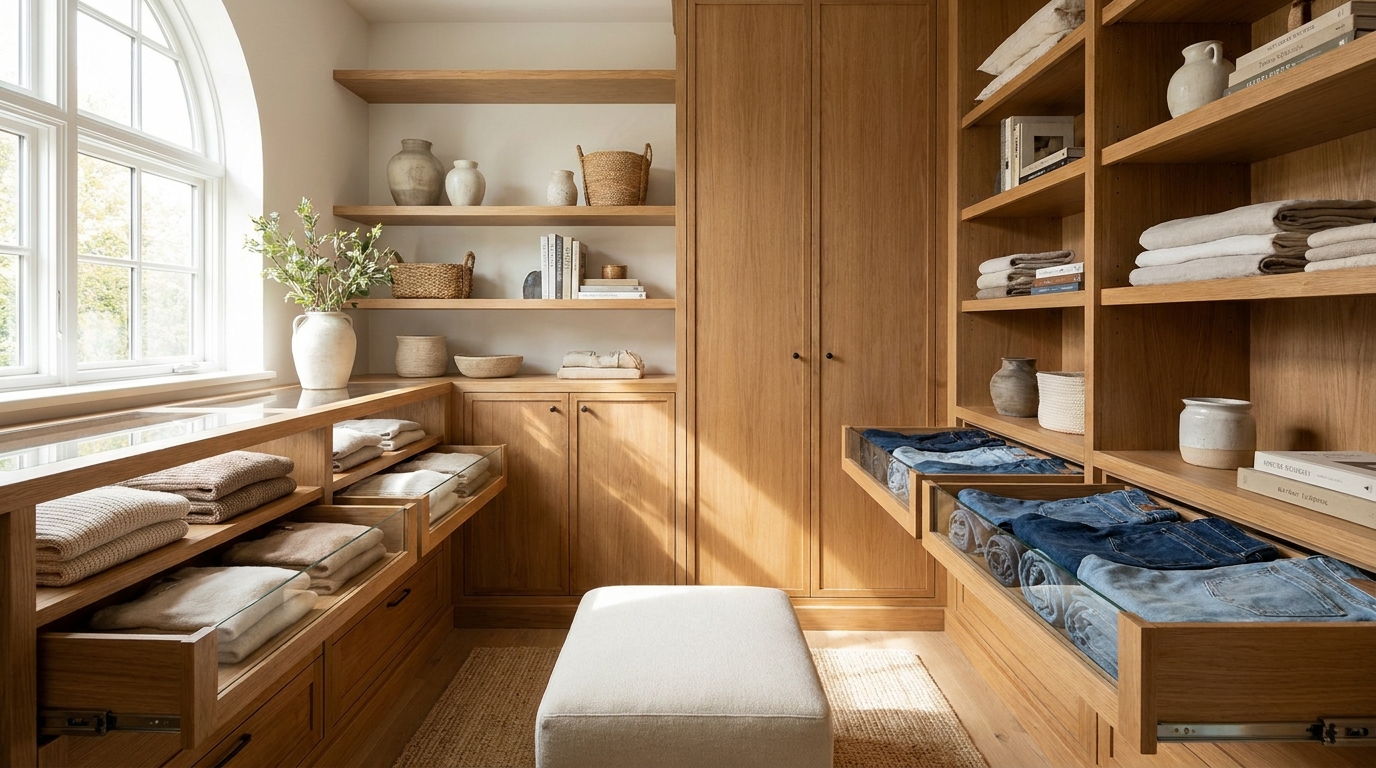
A sweater or a pair of jeans keeps its shape when it rests in a closed drawer and the stack above it stays short. Closet organization for everyday knits and denim is mostly a weight problem: the piece on the bottom should not carry a tower, and you should be able to lift it while standing. The National Park Service's December 2020 Conserve O Gram says garments that lack dimensional stability, including knits, should be housed flat in a box or cabinet drawer rather than hung, because hanging concentrates stress on the shoulders, neck, and bodice [1]. We size sweater and jean drawers around that idea, for clothes you reach for this week, not for an off-season bin on a high shelf.
1. Why the bottom sweater stretches
Hanging moves the damage to the shoulders. A knit is a looped cloth. The give that makes it comfortable also lets it sag when a narrow hanger holds the weight at two points. The Park Service note, published in December 2020 and still posted with a January 21, 2026 update line, is written for museum garments [1]. Sturdy tailored clothes may hang on a proper support. Knits should not, and they belong flat in a drawer or box [1]. The American Institute for Conservation's textile storage chapter says knitted objects should not be hung, because the weight of a hanging object leads to strain, distortion, or structural damage [2]. That chapter's final revision is dated April 2, 1998, and the wiki page carrying it was last edited on February 22, 2024 [2].
A tall stack moves the damage underneath. Museum practice would rather not stack folded textiles at all. The same chapter says placing textiles on top of one another is not recommended, because layering means more handling and more compaction, and folded objects should not be stacked in the container [2]. A 2008 University of Kentucky Cooperative Extension publication, Caring for Your Textile Heirlooms, gives the household version: store textiles flat so weight and gravity do not strain shoulder seams and waistbands, and if you layer, put the heaviest items at the bottom of the drawer [3]. University of Georgia Extension guidance adds that if you must stack, never set a larger or heavier textile on a smaller or more fragile one [4].
A working closet cannot give every pullover its own empty tray. The AIC chapter notes that compromise is a normal part of planning storage [2]. Ours is a short stack, or folds standing on edge so one sweater is not sitting on the next. When the bottom knit is crushed and you fish it out by a sleeve, you add a pull the cloth was not built to take.
No source we trust publishes one magic count. A chunky wool and a thin cotton jersey do not weigh the same, and a shallow drawer is not a deep one. If the piece on the bottom looks flattened, or you have to tug to free it, the stack is already too high. The drawer box should make that mistake hard to repeat.
2. Let the drawer box set the stack limit
Measure the fold you actually use. On an in-home visit we fold a sweater and a pair of jeans from your wardrobe and size the drawer to that parcel, with clearance at the sides so cloth is not ground against the box. University of Georgia Extension guidance says to fold a garment along natural body lines or seam lines, such as the waist or the armhole, and to bring the sleeves across the front [4]. A sleeve left hanging out catches the drawer side every time the box moves.
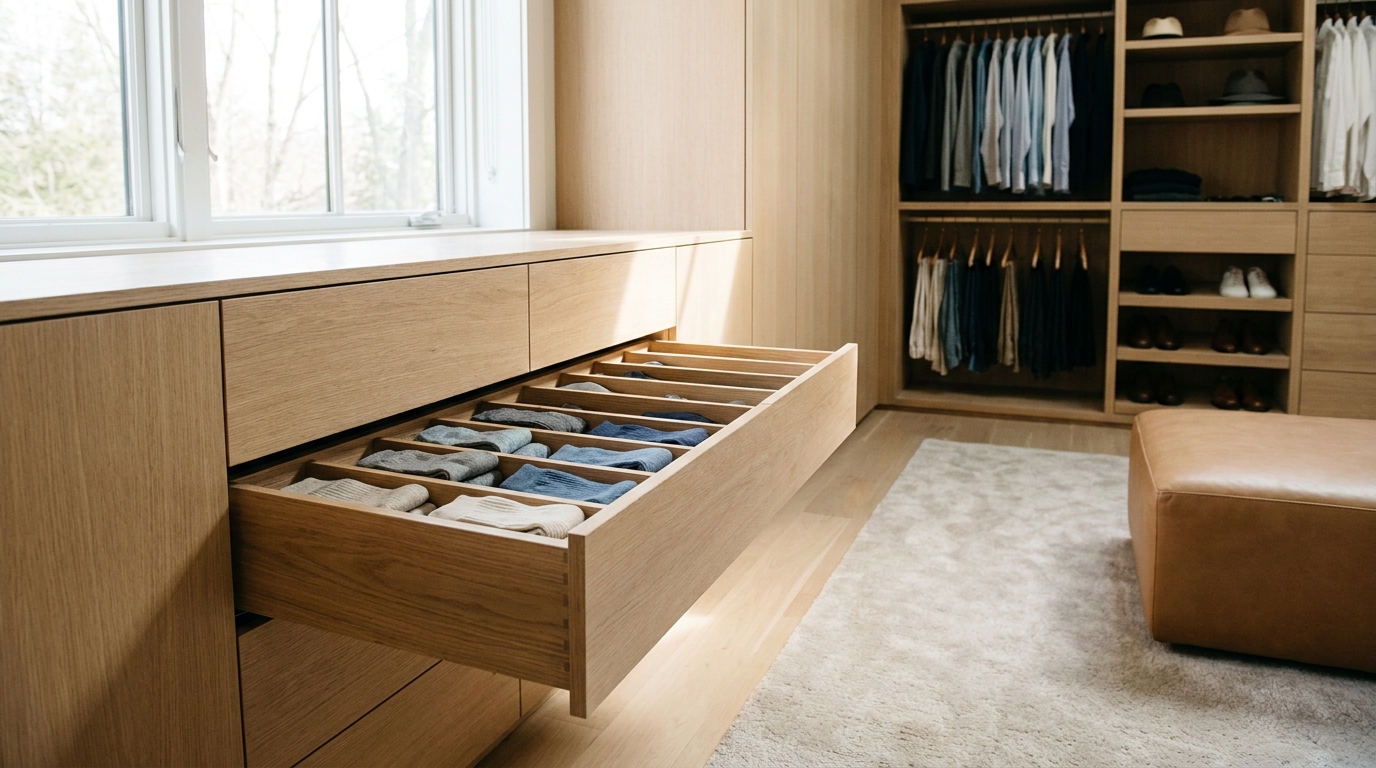
Let the box height be the rule. If the interior only holds a modest layer of folded knits, you cannot keep adding one more until the front will not close. For people who want to see every sweater, we set the drawer so folds stand on edge, like files. Nothing is piled on the knit below, which is what the conservation notes are after when they argue against stacking [2][3]. The drawer has to be tall enough for the fold to stand and snug enough that the row does not slump. A box that is too tall looks roomy on day one and becomes a heap by the second week.
Soften folds that cut in, and leave air above the stack. The George Washington University Museum and The Textile Museum says that if a textile stays folded for a long time and the folds are not padded, creases form, and pressure at the fold can weaken the cloth or break it if the piece is already brittle [5]. That warning is about collection textiles, not Saturday jeans. It still fits a soft knit that sits in the same sharp crease all season. A scrap of washed cotton at the crease is enough. The 2008 Kentucky guide says fibers can relax when a textile lies flat, and that storage should be loose enough for air to move [3]. A drawer packed until the front springs back is compressed, not full. We leave clearance so a hand can lift rather than claw.
On our closet page we plan folded storage for sweaters and jeans beside hanging clothes, because those pieces do better in a drawer than on a rod.
3. Keep jeans from sitting on the knits
Denim is the heavy neighbor. A folded pair of jeans outweighs most sweaters, and a button, a zipper, and thick seams are hard points on a soft knit. Kentucky's 2008 guide names waistbands beside shoulder seams as places where gravity strains a textile that is not stored flat [3]. Hanging jeans from the waistband, or from a thin clip, parks the weight of the pair on that band. A drawer lets the folded jean lie down so the waistband is not acting as a hook.
Put heavier cloth underneath, or give it its own drawer. If sweaters and jeans share an opening, denim goes on the bottom and knits go on top. That order follows the Kentucky instruction on heaviest-at-the-bottom and the Georgia warning against a heavier textile on a more fragile one [3][4]. In most closets we design, we would rather not share. Separate drawers keep rivets and thick seams off the knits, and they stop the slide that dumps a mixed pile on the floor when you only wanted one henley.
Do not put a damp pair away, and do not treat every crease alike. The 2008 Kentucky publication says to clean items before storing, because a soiled textile can attract insects and set stains [3]. Jeans from a warm afternoon need to dry, pockets emptied, before they go into a closed drawer. A crisp fold in denim is often the look you want. A knife-edge crease in a loose knit is not. Georgia Extension notes that textiles tend to split where the same crease and the same pressure stay in place, which is why that guidance says to reposition folds several times a year [4]. That line is about heirlooms that may sit untouched. A cardigan you wear gets unfolded on its own. The sweater that always lives on the bottom does not. When laundry goes back in, move that piece upward and shift the fold slightly.
4. Close the drawer without sealing the clothes in
A drawer front earns its keep, and it is not a plastic bag. The Textile Museum calls light one of the greatest threats to textiles, because ultraviolet from daylight and from some bulbs does the fastest damage, and the rest of the spectrum still fades dyes and makes fibers brittle [6]. A closed drawer keeps everyday sweaters and jeans in the dark and keeps household dust off them. Kentucky's 2008 guide says textiles need to breathe, and that sealing them too tightly can cause condensation [3]. It tells readers to avoid plastic bags, because air cannot circulate, moisture may condense, and aging plastic can release fumes [3]. A finished drawer with normal gaps is not a vacuum sack. We do not bag in-season knits that way, and we never bag a garment that is still damp.
Humidity matters more than a perfect photo of the closet. The same 2008 Kentucky publication describes an ideal storage climate of 65 to 70°F and 40 to 50 percent relative humidity, and it states that humidity over 55 percent promotes mildew [3]. The Textile Museum's care page, which does not display a publication date, describes that same 65 to 70°F and 40 to 50 percent band as ideal, and it stresses that a stable room beats a number you cannot hold [6]. The museum's storage page, also undated on its face, says that when humidity runs high you should move the air, even with a fan, and consider a dehumidifier, and that attics and basements swing the most [5].
We plan closets in Charlotte, Ballantyne, Waxhaw, Wesley Chapel, Fort Mill, Rock Hill, and Indian Land, where summer air is often heavy. A drawer front does not change that. It can keep a packed pocket of wool out of a room you do not heat and cool. If a closet on an exterior wall smells musty, use more air and a shorter stack.
Buffer cotton against raw wood acids. The Textile Museum's storage page says wooden drawers should be lined so cloth is not sitting on wood acids, using acid-free tissue or barrier paper, and that the lining is due for a change after two or three years [5]. That page shows no publication date, so treat the interval as the museum's stated practice, not as a new lab result. Kentucky's 2008 guide says to seal wooden drawer and shelf surfaces used for textile storage, because raw wood leaches acids that are especially hard on cotton and linen [3]. Our drawer boxes are finished cabinet parts, not bare lumber. A bottom liner still helps denim and light knits that rest in the same spot every night. Replace it when it looks soiled. Do not wait for a hole in a favorite shirt.
5. Place everyday drawers where you can stand and see
The right stack fails if you cannot reach it. A neat pile you need a stool to see becomes the pile you shove. Sweater and jean drawers belong where the person who dresses there can open the box, see the contents, and lift with two hands. We set that height to the person in that room. We do not copy a commercial reach chart and pretend it governs a private closet.
Put the heavier lift where it is easy, and make the bottom piece visible. Jean drawers usually sit just below the sweater drawers, or beside them, so you are not raising denim overhead. In a smaller reach-in, that often means one or two banks under a shorter hanging section, not one deep cavity for every folded thing you own. If you cannot see the bottom sweater, you will dig. Digging is the handling the AIC chapter wants to reduce when it warns that layered storage adds handling and compaction [2]. A modest stack you can recognize from above does that job. A label on the drawer front helps in a large walk-in. It does not replace a box you can look into.
Build for the week you are living. Off-season coats can live higher, in a box you open a few times a year. These drawers hold the jeans and sweaters that come out on ordinary mornings.
6. Reset the stack before the crease sets
Put clothes away as carefully as you folded them. When laundry comes back, return it as a rectangle, sleeves in, heavier denim under lighter knits if they share the box. The AIC chapter says folded textiles should be refolded in a different configuration when they are opened, or at least once every two years, whichever comes first [2]. That interval is from the chapter's April 2, 1998 final revision, written for objects that might sit untouched [2]. Clothing you wear gets refolded far more often. Use the spirit of the rule on the backup sweater and the knit that lives at the bottom because it is the least exciting one.
A short reset beats a weekend overhaul. Once a month, or when the drawer starts to look tight, lift the stack out instead of pulling one piece through the middle. Move the bottom sweater upward. Refold anything with a sleeve creeping out. Leave the drawer less full than you found it if the front was hard to close.
Trust the room, then trust the care label. A musty smell or a sweater pressed flat is a signal to stop adding clothes. Kentucky's 2008 guide wants storage that is cool, moderately dry, and dark, and it wants soiled textiles cleaned before they sit [3]. If the bedroom is muggy for weeks, a less crowded drawer and some air movement do more than another bin on top. Washing a wool knit hot, or hanging it wet, will stretch it before it ever meets a stack. Follow the label sewn into that garment, then fold it only once it is fully dry. A drawer front will not undo a hot wash, and three pairs of jeans will not help a knit that is already out of shape.
Practical takeaways
- Store knits flat in a closed drawer. Do not hang them from the shoulders, and do not hang jeans by the waistband if a drawer is available.
- Let the drawer height limit the stack. No single sweater count fits every home. Stop when the bottom piece looks flat or you have to yank it free.
- Keep denim under knits, or in its own drawer, so hardware and heavier cloth are not pressing on the softer fold.
- Leave air in the box. Skip plastic vacuum bags for in-season knits, and do not put damp jeans away.
- In a humid stretch, use a conditioned room, a liner on a wood drawer bottom, and a stack you rotate. Attics, basements, and packed drawers are a poor mix for wool and cotton.
- Put everyday sweater and jean drawers where you can see and lift them while standing. Stool-height shelves are for clothes you are not wearing this week.
How we can help
Have more questions or want to get in touch? Call (704) 604-3870 or email design@theclosetrehab.com, or use our contact page to request a free, no-obligation in-home design consultation. A designer comes to your home, and we measure the sweaters and jeans you actually wear before we size a single drawer.
Citations
- National Park Service, "Conserve O Gram 4/5: Storage Techniques for Hanging Garments: Padded Hangers" (published December 2020; page last updated 2026-01-21)
- American Institute for Conservation, Textile Specialty Group, "TSG Chapter VIII. Storage of Textiles, Section D. Storage Methods" (final revision 1998-04-02; wiki page last edited 2024-02-22)
- University of Kentucky Cooperative Extension, "Caring for Your Textile Heirlooms" (FSC2-707, revised 2008-03)
- University of Georgia Cooperative Extension, "Heirlooms | Textiles" (n.d.; article date not shown on the page)
- George Washington University Museum and The Textile Museum, "Storing Textiles" (n.d.; publication date not shown on the page)
- George Washington University Museum and The Textile Museum, "Caring for Textiles" (n.d.; publication date not shown on the page)