Donation Storage Shelf for Returns and Donations
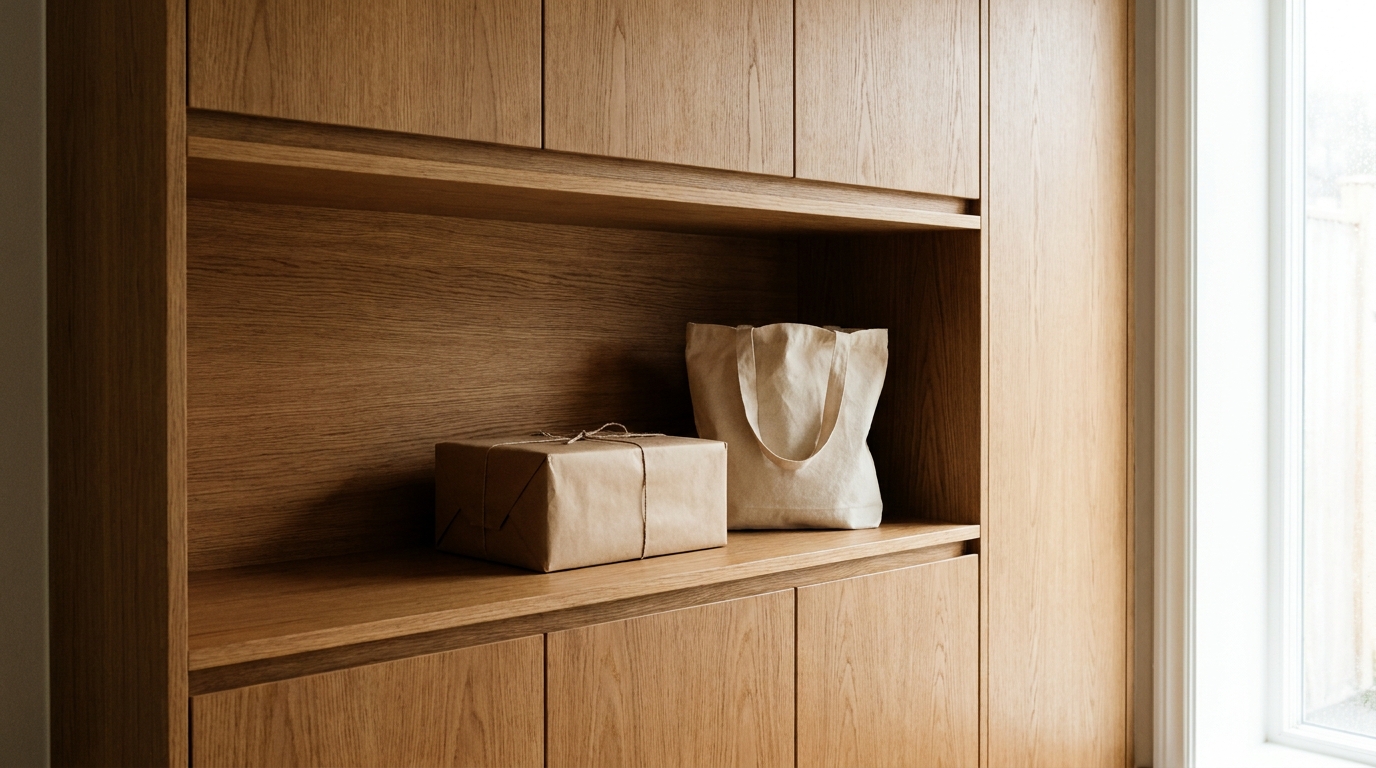
A donation storage shelf is a built-in ledge by the door or inside a closet, reserved for packages going back to a sender and for bags of clothing or household textiles on their way to a drop-off, so those items leave the kitchen counter and do not migrate back onto the shelves that hold what the household is keeping. It is not a mail desk, a charging station, or a row of family lockers. EPA's latest published textile figures, which cover 2018, estimated 17 million tons of textiles in municipal solid waste that year, and the agency noted that a large reuse stream is not included in that total [1]. A shelf does not shrink that national total, but it keeps a finished return and a giveaway bag intact until someone makes the trip.
1. Keep outbound goods off the shelves you still use
The keep closet is for clothes you still wear. Once a shirt is a return or a giveaway, it is no longer part of that inventory. If it goes back on a hanging rod "for now," it looks like a keeper, and someone makes the same decision again next week.
We see the same stall on kitchen counters. A return box sits beside the fruit bowl. A soft bag of clothes leans on a chair. Neither has a finish line, so both get pushed aside when dinner starts. An outgoing shelf is that finish line inside the house: one surface, two jobs, and no mixing with daily clothes.
That job is narrower than a mudroom drop zone. A mudroom holds coats, shoes, backpacks, and the gear people need on the way out tomorrow morning. An outgoing shelf holds things that should not come back in. Mail still to open, a family calendar, and device charging belong at a command spot of their own. If those land on the outgoing shelf, the shelf fills with inbound life and the returns never leave.
Separate the decision from the wardrobe. When a piece leaves the keep system, it should not have a path back onto a rod or a folded stack. In a custom closet, that can be a short shelf just inside the door, or a single bay at the end of a closet system you pass on the way out. The point is physical separation. It is not another sorting session every night.
2. Give returns and donations two marked zones
A return and a donation bag fail in different ways. A return fails if the label is wrong, the box is soft, or it sits until the sender will not take it. A donation fails if the bag gets damp, dirty, or so mixed that nobody wants to carry it. One open pile serves neither.
We divide the shelf into two zones, even when the run of wood is continuous:
- Returns. Sealed packages only, label up, with nothing stacked on the address.
- Donations. Closed bags or a lidded bin, dry, off the floor, and not used as a trash can.
Do not park "maybe" items here. A maybe belongs back in the closet until someone decides. The outgoing shelf is for decisions already made. That rule is what stops the shelf from turning into a second wardrobe.
A small fixed label is enough: Returns, Donations. Two words, readable from the doorway, do the work. A third label, for a library run or a tool going back to a neighbor, earns a place only when someone can name the trip that clears it. Unnamed piles stay off the shelf.
3. Stage the return before it earns a spot
A half-packed box on the shelf is still a counter problem. It has only changed rooms. The parcel earns the spot after it is ready to hand to a carrier.
Use a sound box and kill the old marks. If you reuse a carton, USPS cautions that boxes can weaken during shipping, and it tells you to cover or black out old logos, barcodes, shipping labels, and addresses [2]. Postal Explorer is stricter: totally remove or obliterate all previous labels and markings, including with a heavy black marker [3]. Leave an old barcode visible and the previous address is still on the box.
Cushion, seal, and put a second address inside. Postal Explorer says to place cushioning all around the contents, close the box, and shake it. If you hear shifting, add more [3]. Tape the opening and reinforce the seams with 2-inch-wide clear or brown packaging tape, reinforced packing tape, or paper tape. Do not use cord, string, twine, masking tape, or cellophane tape, and put a strip of clear packaging tape over the label so the address does not smear [3]. USPS asks for a packing slip, or a piece of paper inside with the recipient's name and destination address, because the outside label can be damaged [2]. Postal Explorer adds an extra label inside with both the delivery address and the return address [3].
Respect the weight limit. Packages heavier than 70 pounds cannot be mailed [3]. USPS states the same 70-pound maximum, and it notes that a parcel rides with other packages that can weigh that much [2]. For a very heavy or dense item, start with a sturdy box, brace the contents, and tape the edges with reinforced tape [3]. Postal Explorer also says sturdy paperboard or corrugated boxes are best for weights up to 10 pounds, so a thin, already-traveled carton is a poor match for a dense return [3].
We build this zone with enough depth for the carton to sit fully on the board, plus a low lip so it cannot walk off when the door swings. We set it where an adult can read the label without moving a bag. Retailers set their own return windows, and we do not guess those dates. The shelf only keeps a finished parcel in sight until someone carries it out.
4. Keep donation bags dry and matched to a real drop-off
Donation rules are not one national checklist. EPA says gently worn clothes and shoes can be donated to many charities, and it tells you to check with that charity before handing over damaged clothes or shoes [4]. Some retailers also take clothing or shoes for recycling, and EPA says to confirm that with the store [4]. The same guidance says textiles generally cannot go in a curbside recycling bin. Items a program does not accept can contaminate a load, and a contaminated load can be thrown out [4]. A shirt in the recycling cart is not a donation plan.
In Charlotte, NC, Mecklenburg County treats textiles as drop-off material, not as one of the six curbside categories, which are plastic bottles and jugs with necks, cardboard, cans, cartons, paper, and glass bottles. A November 14, 2025 county release said the drop-off program collects roughly 4,700 pounds of clothing, sheets, towels, pillows, and other textiles each month, and that those items are donated, ground, or reprocessed as rags or animal bedding [5]. That figure describes the county program. It is not a quota for one house.
Other programs draw the line in different places. Knowing the line is what the donation side of the shelf is for.
- Henderson County, North Carolina, says clothing and household textiles can go in its textile bin if they are dry and have no odor, including items that are stained, torn, overly worn, or out of date. Wet or mildewed items are refused. The county also asks people to bag everything and to remove non-textile material first [6].
- A December 2024 report from the U.S. Government Accountability Office states that, to be reused or recycled, textiles must be dry, clean, and free from hazardous chemicals or odors [7]. In the same report, GAO wrote that one East Coast collector landfills textiles that are wet, mildewed, or severely contaminated, and that Goodwill staff described retail-floor goods as free of rips, holes, stains, odors, and moisture [7].
- Campus drives show the same split. Idaho State University's February 12, 2026 request for a campus thrift store asked for clean clothing in good condition, without major wear, stains, or damage [8]. The University of North Texas Zero Waste Textile Initiative, describing its bins as of spring 2026, accepts washed clothing and some household textiles, and it refuses dirty items and used undergarments [9].
Bag it dry, then leave it closed. A bag near a door can take rain off a coat or a spill from a cup. Moisture and odor can knock an otherwise usable textile out of reuse [6][7]. We size the donation zone for a closed bag or a lidded bin, up off the floor and out of the door's drip line.
Match the bag to the place you will actually drive. A stained towel may be right for a textile bin and wrong for a thrift sales floor [4][6][7]. If those standards share one sack, the sack often comes home. Two labeled bags on one shelf are still one shelf.
The 2018 federal numbers belong next to that habit, with their limits stated. Of the textile tons EPA counted in municipal solid waste that year, the recycling rate was 14.7 percent, or 2.5 million tons. Another 3.2 million tons were combusted with energy recovery, and landfills received 11.3 million tons [1]. GAO summarized that same year as 66 percent landfilled, 19 percent combusted with energy recovery, and 15 percent recycled [7]. GAO also reported that EPA published the account in 2020 from 2018 data, had not issued a later facts-and-figures report, and that officials were concerned the method under-reported some statistics [7]. EPA adds that significant textile reuse is not included in the generation estimate [1].
Those landfill tons are not proof that giving clothes away does nothing. They describe the waste EPA counted, while a large reuse stream sits outside the total [1]. GAO's household point is simpler. People can donate, repurpose, recycle, or repair, and textiles still go out with the trash when the trip is inconvenient or the goods are not in shape to be taken [7]. A dry, closed bag on a shelf you already pass makes the drop-off the easier choice. It does not change the national total.
5. Put the shelf on a route you already walk
The useful outgoing shelf sits on the path between the closet decision and the car, not in a spare room nobody enters. In the homes we design, that is often the coat closet by the garage door, a shelf inside the primary closet on the way to the stairs, or a short run beside the door used for errands. One location is the plan. Two locations are how bags multiply.
Clear the door swing first. A shelf that blocks the door becomes a place to set things just outside it, and the pile returns to the floor. We measure the swing, a full donation bag, and the cartons you actually mail before we set the depth.
Keep the shelf plain on purpose. No mail slot, no charging cubby, and no hook for today's keys. Those belong in a mudroom. Here they invite inbound clutter. Two labels, empty space when you are caught up, and a full look that means the next errand includes this stop: that is the whole cue.
Tie the handoff to a trip you already make, such as a grocery run past a drop-off. Returns leave when the label is on and the box is sealed. Donations leave when the bag is closed and dry. If a bag slumps open, take it. Do not fold those clothes back onto the keep shelves. We size the bay for one run of returns and one or two bags, not for a season of postponed decisions. Overflow on the floor means make the trip.
6. Build the shelf into the room
A carton on the floor is a temporary pile with flaps. It sags, it hides what is inside, and it reads as something to step around. We design a fixed shelf, built into the closet or the entry storage, finished to match the rest of the work.
On a design visit we look at a short list:
- Depth for one sealed return box sitting fully on the board, with a bag beside it or on the next bay.
- A low front edge, or a separate bin, so bags do not slide off.
- A height an adult can use without a stool, and still low enough to read a shipping label.
- A surface that can be wiped, because this zone has to stay dry and should not hold odor [6][7].
- Clearance so the door, a hamper, and hanging coats do not erase the shelf.
One shelf, not a new room. If the closet is tight, we take a single bay at the end rather than shortening every rod. The clothes you wear stay on the system you use every day. The outbound bay should look like the exception when you open the door.
A bag or a lidded bin may sit on the shelf, because the programs above want textiles contained, dry, and free of stray trash [6][9]. The shelf is the system. The bag is only the container that travels. Homes that mail heavy goods may need a lower, deeper bay so the 70-pound limit is visible at home, not a surprise at the counter [2][3]. Most homes need a simpler split: still ours, or leaving.
Practical takeaways
- Give returns and donation bags their own built-in shelf so they cannot drift back onto the rods and shelves that hold keepers.
- Leave mail, chargers, calendars, and everyday mudroom gear off that shelf.
- Seal a return, black out old barcodes, cushion it, and tape it with packaging tape before it earns the spot. Packages over 70 pounds cannot be mailed [2][3].
- Keep donation textiles dry, matched to the drop-off you will actually use, and out of the curbside recycling cart [4][5][6][7].
- Mecklenburg County takes textiles at drop-off centers, not in the curbside bin. Other programs may refuse wet, dirty, or damaged goods even when a county bin would take them [4][5][6].
- Empty the shelf on a trip you already make. A full shelf is a prompt to leave, not a place to store another month of decisions.
How we can help
We measure the door swing, the closet bay, and the boxes and bags you actually send, then build an outgoing shelf that stays separate from the rest of the storage. Have more questions or want to get in touch? Visit https://theclosetrehab.com/contact-us/ , call (704) 604-3870 , or email design@theclosetrehab.com .
Citations
- U.S. Environmental Protection Agency, "Textiles: Material-Specific Data" (2018 data; page last updated 2026-03-19)
- U.S. Postal Service, "How to Prepare & Send a Package" (undated page; accessed 2026-11-02)
- U.S. Postal Service, Postal Explorer, "Preparing Packages" (undated page; accessed 2026-11-02)
- U.S. Environmental Protection Agency, "Frequent Questions on Recycling" (page last updated 2026-01-22)
- Mecklenburg County Government, "Solid Waste Encourages Residents to Refresh their Recycling Knowledge this America Recycles Day" (2025-11-14)
- Henderson County, North Carolina, "Textile Recycling" (undated page; accessed 2026-11-02)
- U.S. Government Accountability Office, "TEXTILE WASTE: Federal Entities Should Collaborate on Reduction and Recycling Efforts" (2024-12-12)
- Idaho State University, "Donate Extra Clothing or Household Items to the Campus Thrift Store: Benny's Closet" (2026-02-12)
- University of North Texas, "The Zero Waste Textile Initiative" (spring 2026 description on the page; accessed 2026-11-02)