Custom Closet Drawers for Jewelry, Socks, and Smalls
Custom closet drawers beat open shelves for jewelry, socks, underwear, chargers, and folded smalls because they keep those items in a closed box, in one visible layer, and in cells you can scan without digging. Museum and extension guidance favors flat, padded, enclosed storage for knits and small textiles, and closed storage for metals that tarnish when dust holds moisture. [3][5][7] A built-in drawer stack is also a different product from a freestanding dresser. The federal clothing-storage-unit rule that took effect in September 2023 covers free-standing bedroom furniture and excludes built-in units meant to be permanently attached to the building. [1][2]
1. Why drawers beat open shelves for smalls
Open shelves work for stacks you can see from the aisle. They are a poor home for earrings, watch bands, USB cords, rolled socks, and the spare glasses you want at 6 a.m. Those items slide, tangle, collect dust, and disappear behind a sweater.
Drawers win when the item is small, loose, or easy to crush. A pull-out box lets you look down on a tray instead of fishing under a hanging rod. Full-extension slides bring the back of the drawer into the light.
Closed storage also protects fabrics and metals. Dirt particles can cut textile fibers through friction and abrasion, which is why extension specialists start with cleaning and then proper storage. [5] Dust on metal holds moisture that can carry sulphur compounds or chlorides, and that mix can tarnish or speed corrosion. [7]
Some garments belong in a drawer, not on a hanger. The National Park Service tells collections staff not to hang knits, clothing sewn on the bias, heavy or heavily embellished pieces, or garments in fragile condition. Those pieces should live flat in boxes or cabinet drawers, because hanging concentrates stress at the shoulders, neck, and bodice. [3] Sweaters, embellished tops, and stretchy knits keep their shape better in a shallow or mid-depth drawer than on a thin hanger.
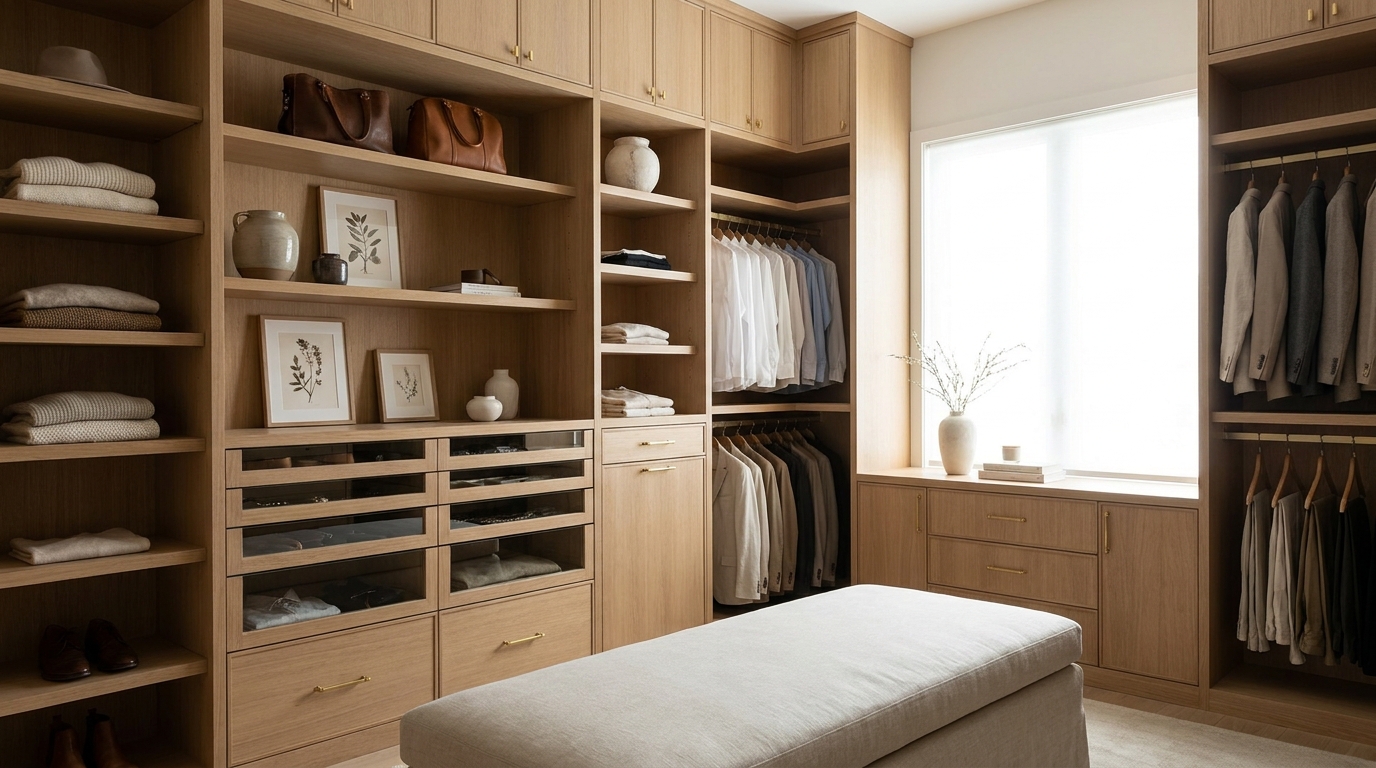
We plan custom closet drawers around those jobs first. Hang space and shelves still matter. The drawer bank is where the small, daily, easy-to-lose inventory lives.
2. Jewelry trays that keep pieces visible and separated
Jewelry does not belong in a mixed dump drawer. Rings scratch, chains knot, and one hunt through a pile puts fingerprints and grit on every piece. University of Illinois preservation guidance is blunt: fingerprints can stain metals, and objects should be supported so they do not move or tip against each other. [7]
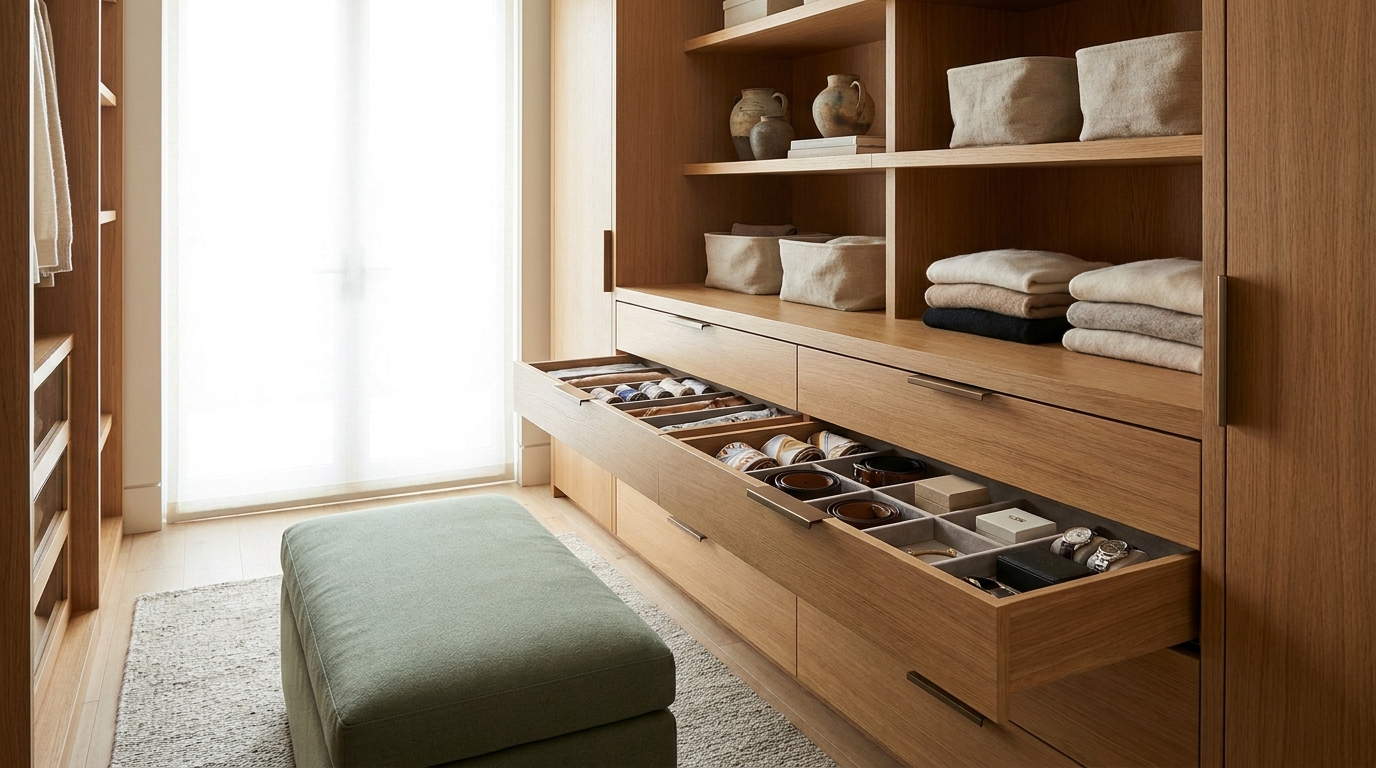
Give each category its own tray cell. Rings in a grid. Earrings in pairs. Bracelets in a longer channel. Necklaces in individual slots so clasps cannot hook neighboring chains. Watches in a slightly deeper row so the face is not pressed against the drawer above.
Keep metals out of raw, uncoated wood. Unpainted wood can release acetic acid, which can corrode metals over time. [7] Use a finished drawer box plus a liner (felt, flocked insert, or an inert tray). High humidity is another enemy. The same program states that environments over 65 percent relative humidity will corrode metals. [7]
Closed trays cut dust and handling. Dust is hygroscopic. On metal it holds the moisture that feeds tarnish. [7] A tray inside a closed drawer still beats a dish on an open shelf. You see the piece, pick only that piece, and close the box.
This is drawer interior work, not a boutique case. The goal is a morning tray you can read in two seconds. If you have a larger collection, use two shallow jewelry drawers instead of one deep box. Depth hides the bottom layer.
3. Divider layouts for socks, underwear, and tech
The same one-layer rule applies to the rest of the smalls. A wide, undivided drawer becomes a rummage bin by Thursday.
Socks and underwear want a grid, not a pile. Assign one cell per type: everyday socks, dress socks, athletic pairs, underwear, undershirts. Fold or roll so the face of each pair shows. When the cell is full, that category is full.
Tech needs its own shallow drawer. Chargers, watch cables, spare earbuds, battery packs, and travel adapters tangle the moment they share a bin. Use small square cells, or a few longer channels for coiled cords. Keep the drawer away from heat and from a damp exterior wall. Oregon State University Extension notes that lint, pet hair, and human hair collected in drawers and closets can be breeding grounds for clothes moths, and that vacuuming those areas is part of control. [8]
Folded smalls (tanks, running shorts, sleepwear) sit in slightly larger cells. They still want a single layer or a short stack. If you have to lift three items to see the fourth, the cell is too deep.
A good divider plan is written from your actual counts. During a design visit we count pairs and gadgets, then size the cells. A drawer that is pretty but one inch too shallow for a charger brick will be abandoned in a month.
4. Deep vs shallow boxes: match the stack to the item
Drawer height is a storage decision, not a style choice.
Use shallow drawers (think tray height) for:
- Jewelry, watches, cufflinks, and tie bars
- Socks, underwear, and hosiery
- Tech cords, adapters, and small cases
- Belts laid flat, pocket squares, and folded scarves
- Everyday smalls you want to see in one glance
Use mid-depth drawers for:
- Folded tees, tanks, and athletic shorts
- Sleepwear and lounge sets
- Light knits that should stay flat rather than hang [3]
Use deep drawers sparingly, and only for true stacks:
- Heavier folded knits and sweaters that should not hang [3]
- Seasonal smalls in a single category (one drawer of winter base layers, not mixed leftovers)
- Items you retrieve as a set, not as one piece from the bottom
Deep is not more storage if you cannot see the bottom. University of Georgia Extension is clear about stacking textiles: never place a larger or heavier piece on a smaller or more fragile one, and separate layers. [5] A sweater mountain repeats that mistake. The bottom knit is crushed, the crease sits in the same place for months, and you stop using anything you cannot see. If a garment must be folded, pad the fold and move the crease from time to time so the fabric does not split along one line. [5]
One visible layer is the test. If you can name every item without moving a stack, the depth is right. If you are excavating, split that box into two shallower drawers.
5. Put daily drawers where your hands already go
A perfect tray in the wrong band of the closet still fails. OSHA lists bending, reaching overhead, lifting, and awkward postures among the risk factors tied to musculoskeletal disorders, and it describes ergonomics as fitting the task to the person. [9] A closet is not a job site, but the same body mechanics apply every morning.
Park daily smalls at a comfortable standing height. Jewelry, underwear, socks, and the charger drawer should open near the middle of your reach, not at the floor and not above your eyes.
Put heavier, less frequent stacks lower. A deep sweater drawer is easier near hip height than at the top of a tall bank. Light, rarely used trays can sit higher.
Full-extension slides and stops are part of that fit. Illinois preservation guidance is simple and useful at home: drawers should have safety mechanisms so they cannot slide out all the way. [7] You want the back of the tray in view, not a drawer in your shins.
We place the jewelry tray where you actually stand to get dressed, then build the sock and tech drawers beside it. Hang space and long-term stacks fill the leftover height.
6. Built-in closet drawers are not a freestanding dresser
Loaded, open drawers change how a tall box behaves. That is why Congress and the U.S. Consumer Product Safety Commission wrote a clothing-storage-unit standard.
The May 2023 Federal Register rule that implements the STURDY law adopts ASTM F2057-23 for free-standing clothing storage units. The tests are written around real use: drawers with items in them, multiple drawers open at once, a unit sitting on a carpet-like surface, and a dynamic force meant to stand in for a child up to 60 pounds. [1] The rule applies to free-standing bedroom furniture manufactured after September 1, 2023. [2] ASTM F2057-23, as described in that rule, covers units that are at least 27 inches tall, at least 30 pounds, and at least 3.2 cubic feet of enclosed storage. It does not cover jewelry armoires, underbed drawer units, or built-in units intended to be permanently attached to the building. [1]
That exclusion matters for a custom closet. A drawer bank fixed into the closet is not the same product as a tall, empty-backed dresser a child can pull forward. We still design the stack so it is not a climbing toy, keep appealing items out of the highest open positions, and specify quality slides and stops.
If you already own a freestanding dresser in the same room, treat it as the product the federal rule describes. Do not let children climb it. Do not leave several loaded drawers pulled out at once. The test language exists because those conditions are how units become unstable. [1]
7. Keep the box itself clean, dry, and lined
A drawer only protects what you put in it if the box stays clean and the room stays dry.
Watch humidity, not just temperature. EPA guidance for homes is to keep indoor humidity below 60 percent, ideally between 30 and 50 percent, and to measure it with an inexpensive meter. [6] Georgia Extension’s textile notes sit in the same range: store near 60 to 65°F with relative humidity around 50 percent, and skip attics, basements, and rooms that are not heated in winter or cooled in summer. [5] The George Washington University Museum likewise tells collectors to avoid attics and basements because those rooms swing hardest in temperature and humidity, and to circulate air or use a dehumidifier when the season is damp. [4]
Line wooden drawers. If textiles sit in wooden drawers, provide a buffer between wood acids and the fabric. Line with acid-free tissue or barrier paper, and plan to change that lining after a couple of years. [4] Georgia Extension adds that textiles should not sit in direct contact with wood, newspaper, or ordinary boxes, and that a wooden drawer should be sealed and lined with washed muslin. [5] Finished closet cabinets plus a replaceable liner meet that idea.
Skip the plastic bag shortcut. Do not wrap everyday clothing in plastic for long storage. Plastic blocks air (a setup for mold), can give off chemicals as it ages, and (if it is clear) does not block light. [5] A closed drawer in a climate-controlled bedroom is the better daily container.
Vacuum the drawers. Clothes moth larvae feed on animal fibers such as wool, feathers, and felt. They can also chew through synthetics to reach dirt or stains of animal origin. [8] Start with clean garments and a clean box. Vacuum drawers, closets, and the lint they collect. Do not put mothballs in an open closet. Oregon State University Extension is explicit: mothballs are pesticides, they belong only in airtight containers per the label, and an open closet is the wrong site. [8]
Leave a little air in the box. A drawer packed so tight that the slide strains is not organized. It is compressed. Fill cells to a level you can still close with two fingers of clearance.
Practical takeaways
- Put smalls in drawers, not on open shelves, so dust, light, and wandering hands do less damage. [5][7]
- Use jewelry trays with one piece per cell. Separate metals from raw wood and from each other. [7]
- Give socks, underwear, and tech their own divided grids. If you have to dig, the cell is wrong.
- Match drawer height to the item. Shallow trays for jewelry and cords. Mid-depth for tees. Deep boxes only for true, single-category stacks. [3]
- Do not bury a lighter or smaller piece under a heavier stack. [5]
- Park daily drawers at a comfortable standing height. Bending and overhead reaching are extra work your body does not need every morning. [9]
- Treat a built-in closet bank as a built-in, and a freestanding dresser as the product federal tip-over tests describe. [1][2]
- Keep the room in a moderate humidity band (ideally 30 to 50 percent) and line wooden interiors. [4][6]
- Vacuum drawer interiors. Skip mothballs in an open closet. [8]
How we can help
Have more questions or want to get in touch? We design custom closet drawers with jewelry trays, divider layouts, and mixed shallow and deep boxes sized to what you actually own, then we finish the cabinets in the colors and materials that match the rest of the room. The process starts with a free in-home visit. https://theclosetrehab.com/contact-us/ · (704) 604-3870 · design@theclosetrehab.com
Citations
- Federal Register / U.S. Consumer Product Safety Commission, "Safety Standard for Clothing Storage Units" (2023-05-04)
- eCFR, "16 CFR Part 1261: Safety Standard for Clothing Storage Units" (source 2023-05-04; page current as of 2026-08-13)
- U.S. National Park Service, "Conserve O Gram 4/5: Storage Techniques for Hanging Garments: Padded Hangers" (2020-12; last updated 2026-01-21)
- The George Washington University Museum and The Textile Museum, "Storing Textiles" (accessed 2026-08-17)
- University of Georgia Cooperative Extension, "Heirlooms | Textiles" (accessed 2026-08-17)
- U.S. Environmental Protection Agency, "A Brief Guide to Mold, Moisture and Your Home" (2026-02-18)
- University of Illinois Library, Preservation Self-Assessment Program, "Metal" (accessed 2026-08-17)
- Oregon State University Extension Service, "Use mothballs safely and sparingly to control clothes moths" (accessed 2026-08-17)
- Occupational Safety and Health Administration, "Ergonomics - Overview" (accessed 2026-08-17)