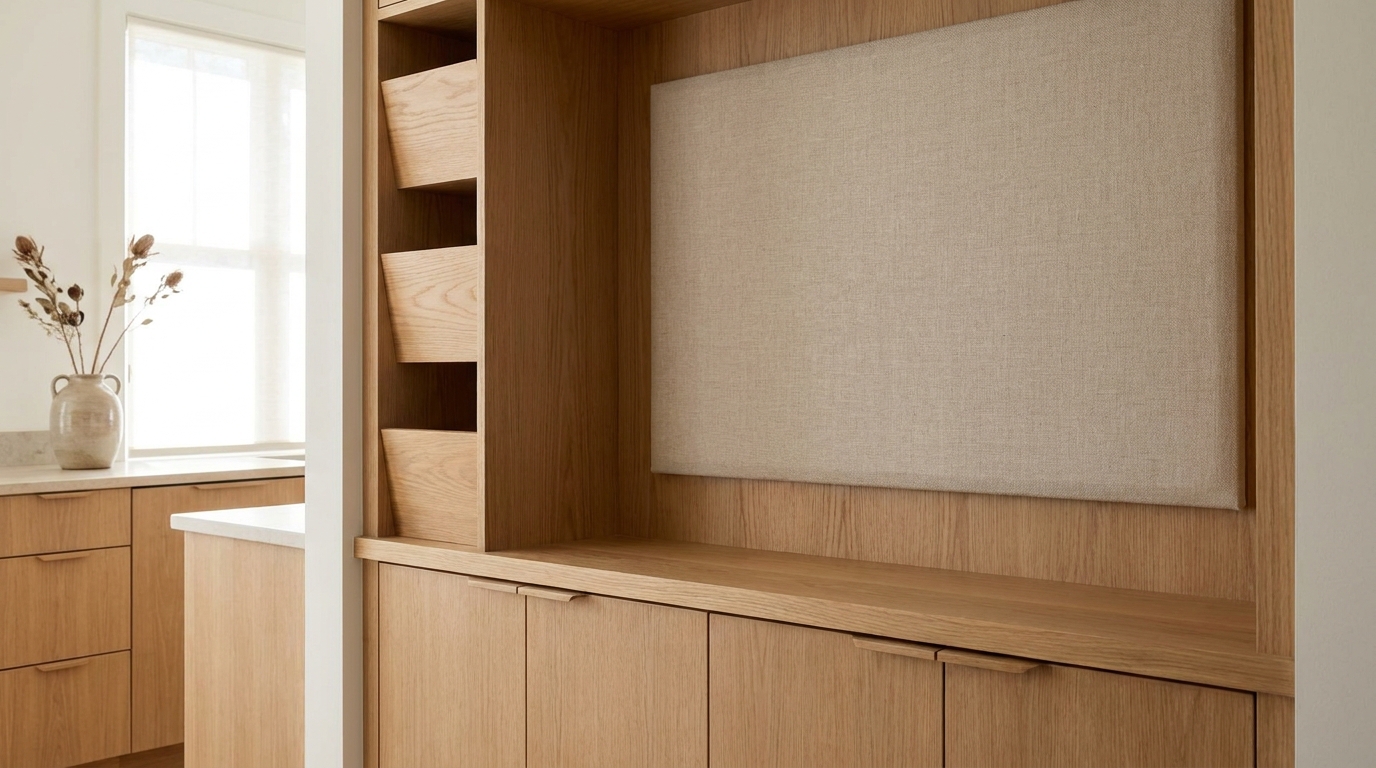
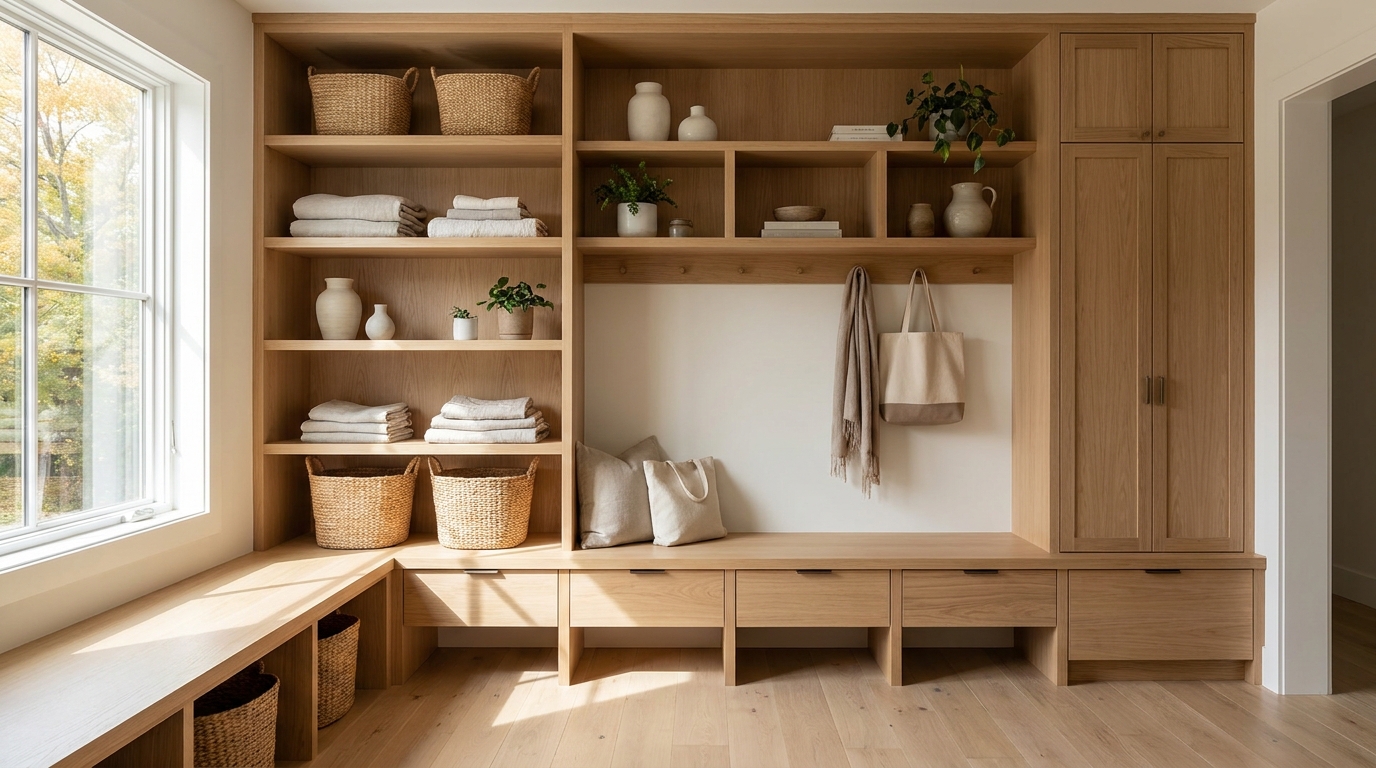
Pet Supply Storage: Sealed Bins Off the Kitchen Floor
Kibble bags, leash tangles, and grooming bottles do not belong on the kitchen floor. A pantry-adjacent or mudroom-adjacent built-in gives pet supply storage a sealed, wipeable home so food stays pest-resistant, walking paths stay clear, and medicines stay out of reach. University of California IPM tells households to store bulk goods like pet food in containers with tight-fitting lids, not plastic bags [1]. The U.S. EPA is just as plain about leftover bowls: do not leave pet food out overnight [4].
1. Why the floor pile is a pest buffet and a trip hazard
In homes from Charlotte to Fort Mill, the pet corner often starts as a bag of food beside a water bowl. Then the leash, shampoo, treats, and nail clippers join the pile, right in the aisle people use for the fridge and the back door.
Open kibble is an invitation. Pantry moths and beetles already travel in grocery packages, and they will move into pet food just as readily as cereal. UC IPM notes that the warehouse beetle feeds on foods that include pet foods, and it advises storing bulk materials such as pet foods in containers with tight-fitting lids [1]. The same guidance says to keep storage units dry, because moisture favors pantry pests while dryness discourages them [1].
A leftover bowl is a night shift for pests. EPA consumer pest-prevention advice is blunt: do not leave pet food out overnight, because food can stir up pests' appetites [4]. That is not a garage-only rule. A bowl left on the kitchen tile after dinner is still an overnight buffet for pests.
The same pile is a trip hazard. CDC's 2017 STEADI Check for Safety home fall checklist asks whether papers, shoes, books, or other objects sit on the floor, then tells households to pick those things up and always keep objects off the floor [5]. A kibble bag, a coiled leash, and a stack of bowls count as objects on the floor. The same checklist asks whether you have to walk around furniture and tells you to keep the path clear [5]. A feeding station parked in the main kitchen walkway fails that test.
Falls are not a niche worry for older adults in Ballantyne or Waxhaw who share the house with a dog. CDC's STEADI patient materials report that every year more than one in four older adults reported falling, and about 43,000 older adults die as a result of a fall [6]. Clearing the pet pile will not prevent every fall, but it removes a daily obstacle from the room people use most.
2. Sealed food bins that actually protect kibble
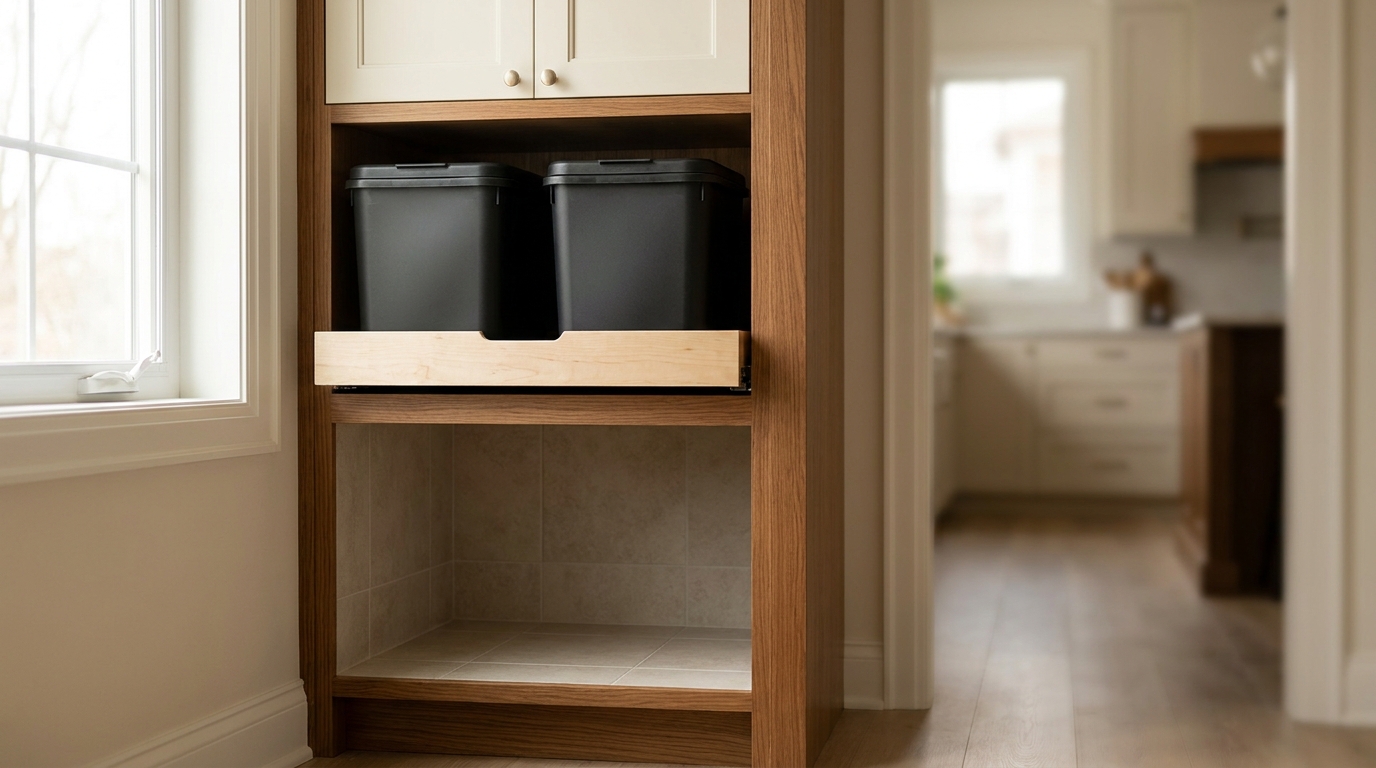
The food bay is the heart of the station. We design it as a closed cabinet with dedicated bins, not an open shelf of half-rolled bags. The goal is pest control, moisture control, and a lid your pet cannot nose open while you unload groceries.
UC IPM's prevention list is the design brief: store food and bulk goods like pet food in containers with tight-fitting lids, not plastic bags; wash old containers before filling them with new food; do not mix old and new food; and clean shelves and bins regularly [1]. FDA storage guidance lines up with that. Store dry pet food in a cool, dry place where the temperature stays less than 80 F, because excess heat or moisture can break down nutrients [2]. If you want a second container, put the entire bag into it rather than pouring the kibble out [2]. If you do pour the food, the container should be clean, dry, and fitted with a snug lid, and you should save the lot number and "best by" date, then wash the container between bags so residual fat and crumbs do not sit on the surfaces [2].
What we build around those rules:
- A lower cabinet sized for one open bag at a time, deep enough for the original bag to sit inside a lidded bin. Extra unopened bags can live on a higher shelf, still off the floor and out of the walking path.
- Tight, wipeable bins with lids that close fully. Plastic grocery bags and rolled kibble sacks are not a seal.
- A cool, dry location. We keep this bay away from the dishwasher, the oven wall, and laundry equipment that dumps heat and steam.
- A labeled scoop that never doubles as a bowl. FDA handling tips say to wash scooping utensils with soap and hot water after each use and to use a clean scoop only for pet food, not the pet's bowl [3].
We also keep human snacks on a different run. Pet food is still food, and it can carry bacteria that make people sick. FDA notes that pet food and treats, like many other types of food, can be contaminated with harmful bacteria that cause foodborne illnesses such as salmonellosis and listeriosis [3]. That is why this station is a dedicated pet bay, not a leftover corner of the cereal shelf.
3. A wipeable feeding nook that is not in the walking path
Bowls belong in a recessed, wipeable nook, not in the middle of the kitchen. The nook should be easy to clean after every meal and easy to empty at night.
FDA handling guidance starts and ends with clean hands: wash for at least 20 seconds with soap and hot water before and after handling pet food and treats [3]. Wash pet food bowls and scooping utensils with soap and hot water after each use [3]. FDA storage guidance repeats the bowl rule and adds that leftover canned or pouched food should be refrigerated promptly or thrown out, with the refrigerator set at 40 F or below [2]. Those habits only stick if the feeding surface is a hard, nonporous panel you can actually wipe, not a rug that soaks up gravy.
Layout rules we use in Charlotte-area kitchens and mudrooms:
- Pull the bowls out of the aisle. CDC's fall checklist wants a clear path through the room, not a route that weaves around furniture (or around a pair of steel bowls) [5]. A side bay beside the pantry, a knee-space under a shallow counter, or a mudroom alcove next to the back door all work better than the main walkway between the island and the fridge.
- Specify a wipeable deck. A laminate, solid-surface, or sealed-wood ledge with a slight lip catches kibble. A removable mat on top is fine if it can go in the sink. Carpet and thick rugs in this zone hold moisture, which UC IPM flags as a pantry-pest advantage [1].
- Plan a night shut-down. EPA says not to leave pet food out overnight [4]. A feeding nook with a nearby lidded bin makes that easy: scoop, serve, pick up, wipe, close the lid. Free-feeding all night is the habit that keeps pests on a trail.
- Give water its own dish, then dry the spill zone. Standing water is a separate pest and slip problem. We like a small, dedicated water tray that can be emptied and wiped without dragging a bowl across the kitchen.
4. Leash and harness hooks that do not steal coat space
Leashes on a kitchen chair, harnesses on a pantry knob, and wet towels on the floor are how a pet corner spreads. The fix is a dedicated hook rail that is not the same rail as the family's coats.
If the station sits on the mudroom side of the kitchen, we keep pet hardware on its own vertical strip: leash, harness, spare collar, waste-bag clip, and a hook for a damp towel. Human jackets stay on the coat row. That split matters in Fort Mill and Indian Land houses where the drop zone already holds backpacks and totes. A shared hook becomes a snarl on the floor, which is the trip hazard CDC tells you to clear [5].
What a good leash zone looks like:
- Hooks at adult height for daily leashes, with a lower hook only if a child is the walker and an adult still parks the hardware at night.
- A shallow tray or cubby for keys, waste bags, and a spare flashlight, so those pieces do not migrate onto the feeding deck.
- A short towel bar or peg for the wet wipe-down cloth, not the family's bath towels.
- Clear floor under the rail. Shoes, crates, and extra bags do not live in this footprint. If a crate is part of the plan, it gets its own bay so the walking path stays open [5].
We often tuck this rail on the mudroom face of a pantry-end cabinet, so you can grab the leash on the way out the door without crossing the feeding nook. For homeowners who already have a drop zone, our mudroom and drop zone systems can add a pet strip without taking over the coat cubbies.
5. A grooming caddy, with medicines and cleaners out of the snack band
Brushes, wipes, nail clippers, and ear-cleaner bottles belong in a caddy or shallow drawer, not in a jumble next to the cereal. Pet medicines, flea products, and household cleaners do not belong in that same open caddy. They need a latched, high, or otherwise secured cabinet that children and pets cannot open.
FDA's medication-storage page is written for this mix-up. Keep pet medications in their original containers with intact labels, in a secure location, because kitchen and bathroom counters and shelves may not be secure enough for a jumper or a climber [7]. Child-resistant packaging is not pet-safe packaging; pets chew through plastic vials, boxes, and blister packs [7]. Keep pet medications away from children, because a chewable or fruit-scented liquid can look like candy, and store them away from people medications so no one grabs the wrong bottle [7].
CDC's Up and Away campaign belongs in a kitchen pet station because that station sits in the same room as snacks. Approximately 100 young children are brought to the emergency room each day because they got into medicines left within reach [8]. CDC tells caregivers to keep medicines too high for young children to reach or see, and never to leave medicines or supplements out on a kitchen counter [8].
Pets get into the same bottles. In 2025, over-the-counter medications and supplements accounted for 16.9% of the exposures ASPCA Poison Control received calls about, and the group tells owners to keep prescription and OTC medications in closed cabinets that snooping noses cannot reach [9]. Veterinary products, including flavored chewable tablets and soft chews, accounted for 9.1% of those 2025 exposures, and ASPCA notes that tasty chews raise the risk of a pet eating the whole container [9]. Household products, with cleaners and paints making up a large share, accounted for 6.4% of exposures [9]. EPA also reminds households that if they use rodent baits, those baits belong in a tamper-resistant station placed where children and pets cannot touch them [4].
How we split the grooming bay:
- Open or easy-reach caddy: brush, comb, towel, nail clippers, and a roll of wipes. These are the daily tools. They stay off the floor and off the food deck.
- Latched upper cabinet or locked inner box: pet prescriptions, flavored chews, flea and tick products, disinfectant sprays, and any cleaner used on bowls or crates. Original labels stay on. People medicines never share this box [7].
- No snack-band storage. We keep this cabinet out of the zone where kids grab crackers and out of the zone where a dog can stand on a chair and nose a bottle off the shelf.
- A wipe-down kit next to the feeding nook, not under the sink with dishwasher pods. Bowl soap can live in a labeled bin. Bleach and other harsh products stay with household chemicals, not with the grooming caddy.
6. Where a pantry-adjacent pet station actually fits
The best pet supply storage is next to the work, not in a leftover gap. We look at two common spots in Charlotte-area houses.
Pantry-adjacent. If the pantry already holds bulk food, the pet bay can occupy the end of that run: sealed kibble below, scoop and bowls at mid height, medicines up high. Our custom pantry systems are built as tight, easy-to-clean storage, which matches UC IPM's advice to construct storage units so they are tight and can be easily cleaned [1]. The pet bay still gets its own doors. Mixing kibble with flour and snacks makes a pantry-pest problem harder to find and harder to clean [1].
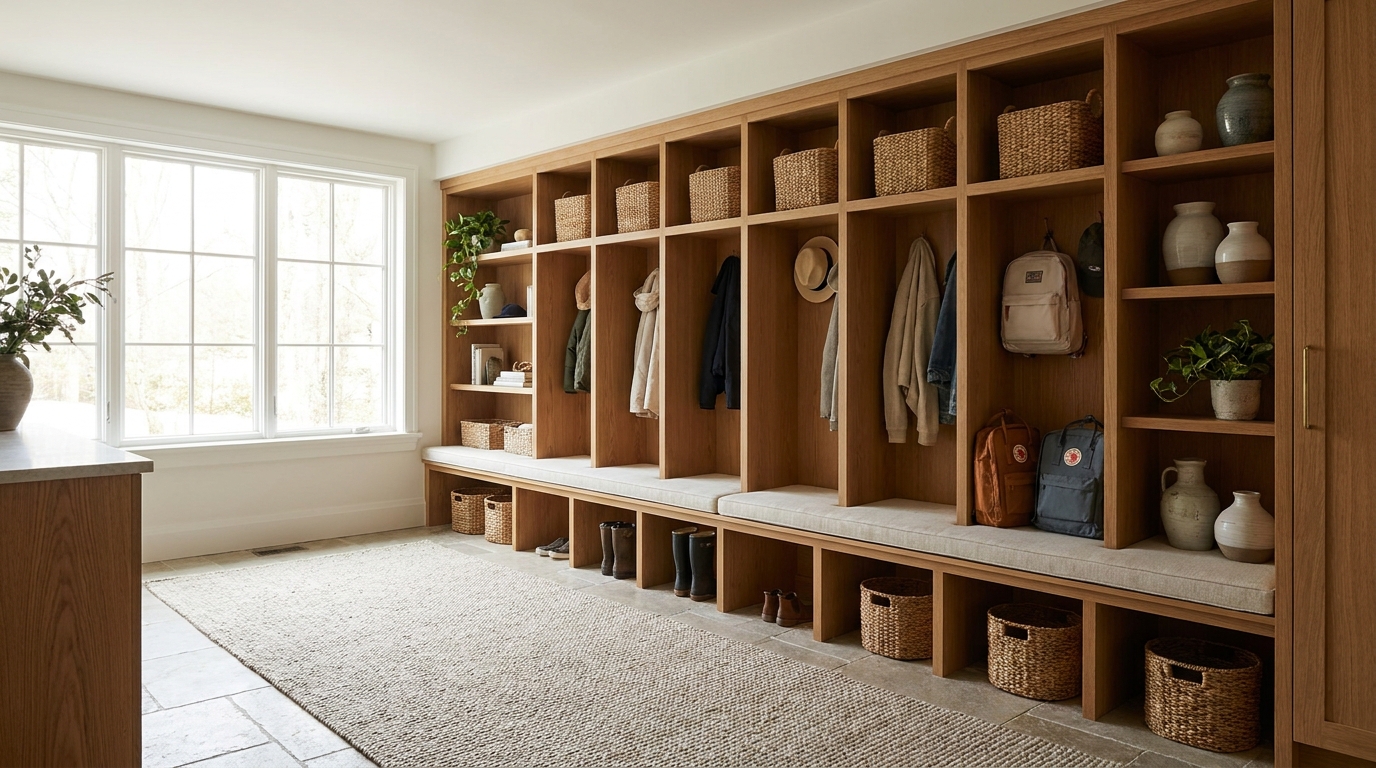
Mudroom-adjacent. If the dog comes in through the garage or the side door, the leash rail belongs on that wall, with the food cabinet a few steps away so muddy paws are not standing in the kibble bay. The feeding nook can sit on the kitchen side of that wall, still out of the main aisle.
What we do not do: we do not turn the human snack zone into a pet cabinet, we do not send the whole kit to a hot garage where FDA's "cool and dry, less than 80 F" rule is harder to keep, and we do not replace a full mudroom with a single pet cubby [2].
A built-in also gives you a wipeable interior. UC IPM says certain pests need only small amounts of food to live and breed, and it recommends soap-and-water cleaning plus vacuuming of cracks, edges, and corners [1]. Tight cabinet boxes are faster to wipe than open wire racks over a baseboard gap.
Practical takeaways
- Get kibble off the floor and into a lidded bin, ideally with the original bag still inside. UC IPM wants tight-fitting lids, not plastic bags, and FDA wants a cool, dry spot under 80 F [1][2].
- Pick up the bowl at night. EPA's pest-prevention list says not to leave pet food out overnight [4].
- Wash bowls, scoops, and hands. FDA calls for soap and hot water on bowls after each use, and a 20-second handwash before and after handling pet food [2][3].
- Keep the feeding nook out of the walking path and keep objects off the floor, following CDC's STEADI home checklist [5].
- Give leashes their own hooks so they do not steal coat space or land in a trip pile.
- Split grooming tools from medicines and cleaners. Daily brushes can live in a caddy. Pet meds, flavored chews, and household cleaners belong in a latched cabinet out of the snack band, out of kid reach, and out of pet reach [7][8][9].
- Treat the station as a small, dedicated room function, pantry-adjacent or mudroom-adjacent, not as overflow for snacks or garage clutter.
How we can help
We design pantry-end and mudroom-side pet stations for homeowners in Charlotte, NC, Fort Mill, SC, Rock Hill, SC, Ballantyne, NC, Waxhaw, NC, Wesley Chapel, NC, and Indian Land, SC. Our team measures the walking path, the heat sources, and the way your dog actually enters the house, then we build sealed bins, a wipeable feeding nook, a leash rail that leaves coat hooks alone, and a latched bay for medicines and cleaners.
Have more questions or want to get in touch? Visit our contact page, call (704) 604-3870, or email design@theclosetrehab.com.
Citations
- UC Statewide IPM Program, "Pantry Pests / Home and Landscape" (2026)
- U.S. Food and Drug Administration, "Proper Storage of Pet Food & Treats" (2024-05-23)
- U.S. Food and Drug Administration, "Tips for Safe Handling of Pet Food and Treats" (2024-05-23)
- U.S. Environmental Protection Agency, "Do you really need to use a pesticide?" (2026-02-10)
- Centers for Disease Control and Prevention, STEADI, "Check for Safety: A Home Fall Prevention Checklist for Older Adults" (2017)
- Centers for Disease Control and Prevention, STEADI, "Patient & Caregiver Resources" (2026-09-08)
- U.S. Food and Drug Administration, "Properly Store Medications to Keep Your Pet Safe" (2024-06-14)
- Centers for Disease Control and Prevention, "Up and Away Campaign Resources" (2025-07-18)
- ASPCA, "The Top 10 Toxins of 2025" (2026-03-15)