Stroller Storage Built-Ins for a Clear Door Hall
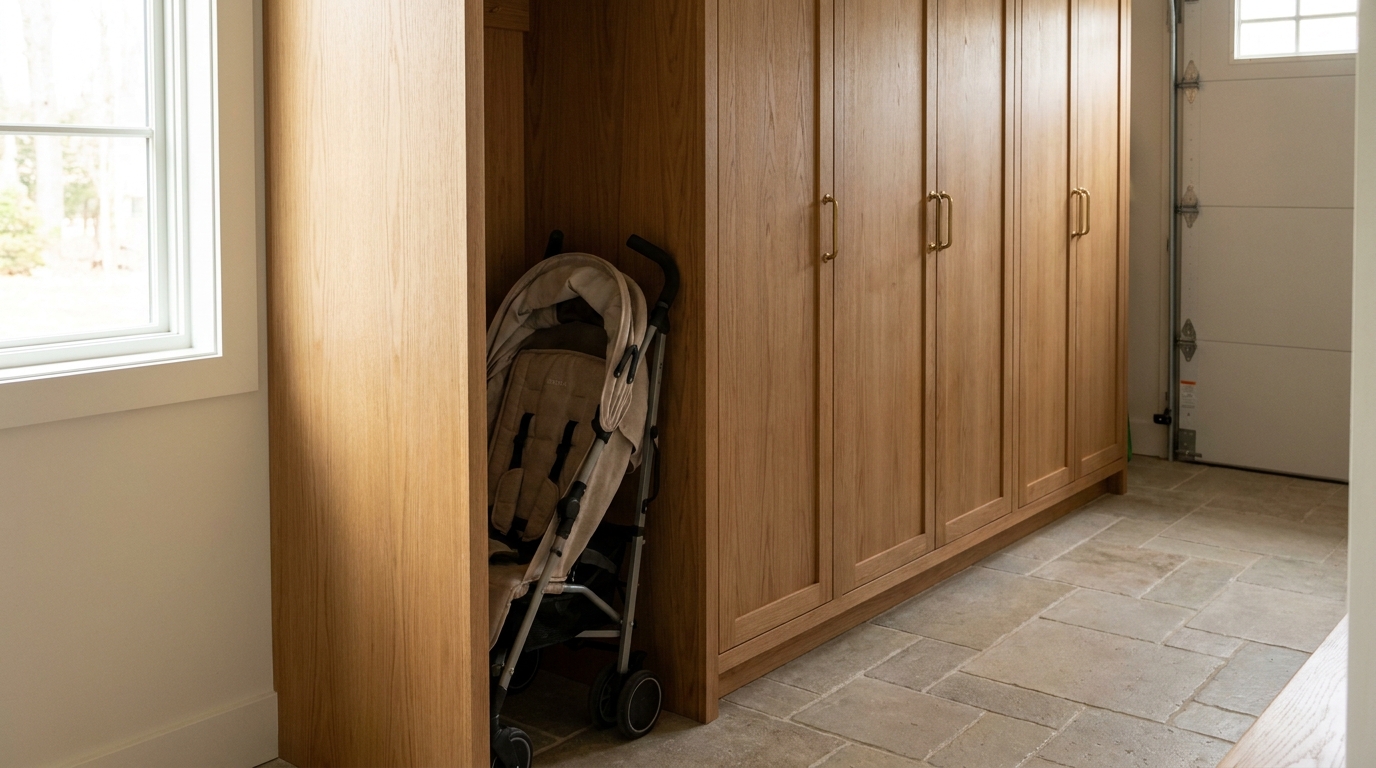
A stroller by the door, an infant car seat on the floor, and a folded play yard against the wall will close a hall faster than coats ever do. Stroller storage built-ins fix that pile by giving those three bulky pieces one niche at the garage door or the mudroom door, so the walk from the threshold stays open. The bay is sized to the gear you actually roll in, and it leaves air around a wet stroller so the fabric can dry before anyone folds it tight. Our team builds that niche as one assigned stop, not as a second nursery and not as a locker for every jacket in the house.
1. The hall is where bulky gear goes to block the path
The problem starts in the minute after you come inside. The stroller is in your hands, the carrier is heavy, and the play yard is under your arm, so the nearest wall gets all three. By the next trip, that wall is the system, and everyone steps around it.
That lane is the one adults, older relatives, and a toddler all use. Clutter there is a fall issue, not a decorating issue. CDC's Still Going Strong page, updated in August 2025, tells people to get rid of trip hazards such as throw rugs and to keep floors free of clutter [5]. In a September 2026 release, the American Academy of Orthopaedic Surgeons tells families to remove boxes, cords, and other clutter from hallways, to keep the route from the front door to the driveway free of debris and other tripping hazards, and to notice children's toys left in a walkway [6].
A parked stroller is a larger version of that obstacle. University of Nevada, Reno Extension tells households to keep shoes, boxes, and similar objects off the floor, and to remove anything blocking a hallway or passageway [7]. The extension examples include mobility equipment as well as everyday clutter. A frame with wheels is the same kind of blockage, so it belongs beside the path, not across it.
2. One niche, three pieces, nothing else
This bay holds the stroller you use, the infant carrier that rides between the car and the house, and the play yard you collapse after a visit or a trip. That is the whole assignment. It is not the nursery closet, where diapers and grow-out clothes belong, and it is not a cubby wall or a foyer locker for coats, backpacks, and mail.
Those other systems can sit nearby, but they should not steal this floor. A short label inside the bay keeps shoes, bags, coats, and a retired stroller from turning the niche into a catch-all.
3. What each piece actually is
You are parking three products, not a generic cupboard. The descriptions below explain why each one stays bulky. They are product descriptions, not a building rule for your house.
CPSC describes a stroller as a wheeled vehicle for one or more children, generally in a sitting or semi-reclined position, and says a stroller generally can be folded for storage [1]. The same guidance says strollers are normally used by children from infancy to 36 months of age [1]. Folding does not make the frame small. The handle still sticks into the hall if the opening is too shallow.
CPSC's stroller guidance also lists car seat and stroller products among the performance topics the standard covers [1]. When your carrier clicks into the stroller, the two pieces come through the door together and should land in the same bay. We do not assume every stroller accepts every seat. We size the pair you own.
A hand-held infant carrier, in CPSC's description, is a freestanding product with rigid or semi-rigid sides, intended to carry a child by handholds or a handle [2]. Carrier seats in that category often double as a car seat [2]. Installing the seat in the car is outside this project. Follow the seat manufacturer and your vehicle manual for that, and use the niche only for the empty shell.
CPSC describes a play yard as a framed enclosure with a floor and mesh or fabric sides, intended for use in or around the home and for travel [3]. It provides a play or sleep spot for a child who cannot climb out and is less than 35 inches tall [3]. When your model collapses, the bundle is still long, so this bay stores that frame in a slot rather than a lean on the hall wall. The maker's setup still governs any time a child uses the play yard.
4. Size the opening from the gear you own
A guessed opening fails the same way every time. The handle, the wheels, or the folded play yard will not go in, so half the stroller lives in the hall. We check dimensions before we draw the niche.
Check the stroller both open and folded, including the handle position you will actually leave. A compact umbrella fold and a side-by-side double do not share an opening.
Set the carrier down with the handle up, and again with the handle folded if it folds. The shelf has to clear the taller shape. Check the folded play yard on its longest side, and note whether it can stand or has to lie flat. Leave a little clearance so fabric does not scrape on every slide.
Check these before the opening is locked:
- Folded stroller. Length, width, height, and where the handle lands.
- Open stroller, if it will dry unfolded. Canopy up, wheels straight, brake set the way the maker shows you.
- Infant carrier. Handle up and handle down, plus any base you bring inside.
- Folded play yard. Longest side, and whether it stands without tipping forward.
- The door swing. Entry door, garage house door, and a car door if the bay is in the garage.
- The walking lane. Pass it with a bag. You should not have to turn sideways.
5. Leave a walking lane the wheels cannot enter
The bay sits beside the path, not in it. An adult or a small child should be able to walk from the door to the kitchen without stepping over a wheel, a carrier, or a folded frame.
The lane should stay obvious at night, not only at noon. University of Nevada, Reno Extension says to look at entranceways for proper lighting, to keep outside entrances lit, and to use a nightlight in dark hallways [7]. AAOS likewise says to keep the route between the front door, the driveway, and the mailbox well lit, as well as free of tripping hazards [6]. We put a switch at the door you enter, so nobody crosses the stroller to reach a lamp.
If you want a mat under the wheels, it has to lie flat and stay put. The extension guidance says to remove small rugs or secure them with double-sided tape [7]. CDC names throw rugs among the trip hazards to get rid of [5]. Use a mat you can lift, rinse, and set back down flat, or skip it and wipe a hard floor.
The lane stays clear when:
- Wheels stop inside the niche. Not on the line of the walk.
- The carrier is on its shelf. Not on the floor for a minute.
- The play yard is in its slot. Not tilted against the door casing.
- Cords stay off the floor. AAOS includes cords among the clutter to remove from walkways [6].
- The mat does not slide. Flat, liftable, and out of the lane [5][7].
6. Let a wet stroller dry before you fold it away
Rain and a damp path come home on the wheels and the seat. Folding that moisture into a tight bundle, then shutting it in a closed cabinet, holds water against the fabric. The next outing starts with a smell.
EPA guidance, updated on May 26, 2026, says to dry a wet area within 24 to 48 hours if possible [4]. The same page says fans or a dehumidifier can speed drying, and that you can open doors or windows when outdoor conditions allow [4]. It also says to keep indoor humidity below 60 percent, ideally between 30 and 50 percent, to limit mold growth [4]. Absorbent materials that cannot be cleaned and dried may need to be thrown away [4].
A stroller seat is absorbent, even though that page is not written about strollers. The bay should let air reach the fabric: an open niche, a slatted back, or a door you leave open until the seat is dry. If the pad comes off, dry it loose so both sides get air. Wipe the wheel wells, and park the wheels on a hard surface or a liftable mat, not on carpet that stays damp underneath.
In a humid stretch, outdoor air may be wetter than the air indoors. Opening a window is for when outdoor conditions allow, which is the condition EPA states, not an order for every rainy afternoon [4]. On those days a fan across the open seat, or a dehumidifier for that zone, matches the drying methods the page names.
A drying setup for gear that comes in wet:
- Seat left open. Air has to touch the fabric, including both faces of a removable pad.
- Wheels wiped. Mud stays in the bay, not on the hall floor.
- A liftable tray or mat. Rinse it instead of soaking a carpet.
- Air movement while it is wet. A fan or a dehumidifier can speed drying [4]. Close the bay only after the seat is dry.
7. A shelf for the carrier and a slot for the play yard
People set the carrier "just there" because it has a handle and it is freestanding [2]. Just there is usually the middle of the floor, and the next person catches a foot on the shell. Give it a shelf in the same niche, back from the walking lane, at a height you can reach while standing.
The shelf is for the empty carrier. A child is not parked there while groceries come in. If the carrier is in use, follow the manufacturer.
CPSC describes the carrier as freestanding [2]. The shell should sit fully on a level shelf, with the handle out of the lane. If the base stays in the car, tell us, and we will not build a shelf for a piece that never comes inside.
The play yard travels, and it also sets up in or around the home [3]. Between those uses, a lean against the casing puts a long edge across the path. A vertical slot or a deep shelf inside the niche keeps the folded frame with the other door gear, with a stop so it cannot tip into the lane. If your model will not stand safely, lay it flat above the stroller wheels, still inside the bay, and keep the slot to that one frame.
8. Put the niche at the door you really use
The right door is the one the stroller already uses. A handsome niche at the unused formal entry only moves the pile. In a lot of houses around Charlotte, NC, and in Fort Mill just to the south, the garage door is the real front door.
If you unload from the garage, put the bay beside the house door, out of the car-door swing and out of the walk from the car to the house. Our garage storage work already pulls tools and seasonal gear off the floor. The stroller bay is that same idea for a piece that moves every day.
If you come in through a side hall, the niche sits at that landing, next to hooks and a bench rather than instead of them. Those belong to mudroom and drop-zone storage. Cubbies sized for shoes will not swallow a folded stroller. The bulky three get their own opening.
A garage bay still has to dry. A fan or dehumidifier can speed drying, and wet material should be dried within 24 to 48 hours if possible [4]. Leave the bay open until the fold is dry. If the garage stays humid for days, the better park is just inside the house.
Choosing the door, then keeping the habit:
- Follow the stroller. The door it uses now is the door the bay serves.
- Stay out of the car-door swing. A niche you cannot reach will not get used.
- Split the jobs. Coats and shoes can use the mudroom. This niche is the three bulky pieces.
- Label and reset. Name the three spots, roll the stroller fully in, and turn a fan on if the seat is wet [4].
Put the light switch where your hand already is, and add a nightlight if that landing goes dark after dinner [7]. Leave a little spare room so a rain cover does not push the handle back into the lane.
Practical takeaways
- Give the three bulky pieces one door niche. The stroller, the carrier between trips, and the folded play yard stop living in the hall.
- Keep every other job out. Diapers, grow-out bins, coats, and shoes will refill the path if they take this opening.
- Size the opening from the gear you own. Folded and open stroller, carrier with the handle up, and the longest side of the play yard.
- Protect a walking lane. CDC, AAOS, and University of Nevada, Reno Extension point to clear floors, clear halls, and a lit route at the door [5][6][7].
- Dry the stroller before you hide it. Use the 24 to 48 hour window, a fan or dehumidifier, and the humidity range EPA names [4].
- Store the carrier empty. Follow the seat manufacturer for the vehicle. The shelf is only the landing spot.
- Use the door the stroller already uses. That is often the garage, not the formal foyer.
- Label the spots and reset them in a minute. A bay without a label becomes a ledge, and a ledge becomes the hall.
How we can help
Our team can check the stroller, the infant carrier, and the folded play yard at the door you use, then build one niche that keeps that path clear. The bay can sit with your garage storage or beside mudroom and drop-zone storage without turning into a wall of cubbies. Stroller storage built-ins work when the opening matches the gear and the walk past it stays empty.
Have more questions or want to get in touch?
Contact The Closet Rehab, call us at (704) 604-3870, or email design@theclosetrehab.com.
Citations
- U.S. Consumer Product Safety Commission, "Carriages and Strollers Business Guidance" (2026)
- U.S. Consumer Product Safety Commission, "Hand-Held Infant Carriers Business Guidance" (2026)
- U.S. Consumer Product Safety Commission, "Play Yards Business Guidance" (2026)
- U.S. Environmental Protection Agency, "Tribal IAQ Resource Directory: Mold and Moisture" (2026-05-26)
- Centers for Disease Control and Prevention, "Information for Older Adults | Still Going Strong" (2025-08-04)
- American Academy of Orthopaedic Surgeons, "Many fall hazards are hiding in plain sight at home, AAOS advises during Falls Prevention Awareness Week" (2026-09-16)
- University of Nevada, Reno Extension, "Preventing Falls in Your Home" (2024)