Garage Car Care Storage: Wash Gear Apart From Fluids
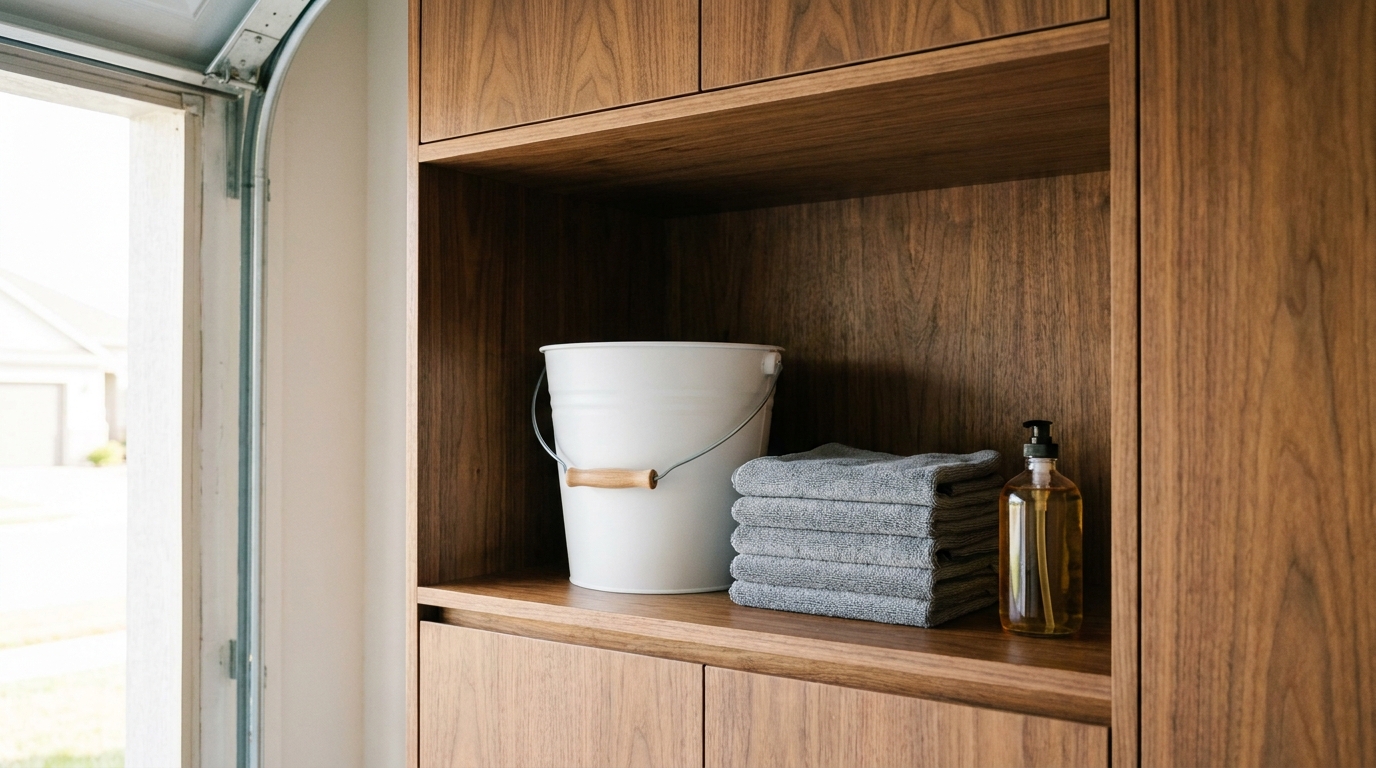
A wash bucket, a stack of dry towels, and a bottle of car soap do not belong in the same cabinet as gasoline, used oil, or paint thinner. Garage car care storage, in our work, means a closed cabinet for everyday wash gear, kept apart from fuels, auto fluids, and harsh cleaners. The U.S. Fire Administration tells households to store oil, gasoline, paints, propane, and varnishes in a shed away from the home, and to keep items that can burn on shelves away from appliances [2]. We follow that split before we draw a shelf in a Charlotte or Ballantyne garage.
1. The wash cabinet has one job
Wash gear and fluids are different hazards. A bucket and a dry towel are messy. They are not a jug of gasoline or a can of solvent. EPA's January 2023 stormwater fact sheet lists what can spill during fluid work: solvents such as degreasers and paint thinners, antifreeze, brake fluid, battery acid, motor oils, fuels such as gasoline, diesel, and kerosene, and lubricating grease [1]. Spills can send oil, grease, heavy metals, and other toxic compounds into ground and surface water [1]. That list stays out of the wash cabinet.
One shelf cannot do both jobs. A solvent next to dry microfiber means a spill soaks the cloth. The U.S. Fire Administration says not to mix household chemicals, because mixing can cause deadly gases or a fire, and it recommends locks and guardrails so stored materials do not fall [3]. A lock is useful. It does not turn gasoline, used oil, or a solvent into wash gear, so those products never go behind the wash door [1].
2. What belongs on the wash shelves
Build the shelves for a wash day. We plan buckets, wash mitts, towels that are already dry, a wheel brush with no solvent on it, and the soap you use on paint. A closed door keeps floor dust out of the bucket and the nozzle off the stall floor.
Keep the bottle the product came in. The U.S. Fire Administration says to follow the label, keep household chemicals in their original containers, and store them out of the reach of children and pets [3]. We do not pour soap into an unlabeled jug. That hides the directions and makes a mix-up too easy.
Everyday soap is a short list. EPA's January 2023 sheet asks home washers to use biodegradable, phosphate-free, water-based detergents, and to limit how much they use [1]. That is the soap we make room for. A solvent degreaser is on the same sheet beside paint thinner [1]. It does not sit with the mitt.
Wax stays only when the label allows it. The U.S. Fire Administration says not to store anything that can catch fire in the sun or near heat, and to keep that material away from the home [3]. If the wax label reads like an ordinary product, it can sit with the soap in the original container. If it says flammable, or says to keep it away from heat, it stays off the dry-towel shelf. We do not invent a temperature the label does not give.
3. Dry towels, not a damp pile
Moisture is what lets mold take a cloth. On its September 26, 2024 mold page, the CDC says mold grows where there is moisture, including on fabric and upholstery, and it says to keep indoor humidity no higher than 50 percent [9]. The same page says to dry a home within 24 to 48 hours after a flood, and to remove soaked upholstery that cannot be dried right away [9]. A garage cabinet is not a flood manual. We still do not shut a wet microfiber or cotton towel inside it.
Dry the towel, then shelve it. Towels hang where air can reach them. Once dry, they go in the cabinet in one layer so a damp one is easy to see. A closed door on a wet stack holds moisture against the cloth, which fights the CDC point about fixing moisture instead of covering it [9].
Wash towels are not paint rags. NFPA's April 2022 note says oils in oil-based paints and stains release heat as they dry, and trapped heat can start a fire [4]. Do not leave those rags in a pile. Dry them outside, away from the home, then put them in a tightly covered metal container with water and detergent [4]. They never join the wash cabinet. Soap towels are laundry. Paint and stain rags are a fire item.
4. Gasoline, used oil, and solvents stay out
Gasoline is motor fuel, not a wash-cabinet item. NFPA's April 2022 note says to use gasoline only as motor fuel, never as a cleaner, and only in a container sold for that purpose [4]. Do not bring it indoors, even in a small amount, and do not store containers in a basement or occupied space [4]. Keep them tightly capped in a detached garage or an outdoor shed [4]. The U.S. Fire Administration puts oil, gasoline, paints, propane, and varnishes in a shed away from the home [2]. A gas can does not go in the wash cabinet, and a locked cabinet in an attached garage is not the gasoline store.
Used oil leaves in its own container. EPA's used-oil page, updated June 25, 2026, says used motor oil is insoluble, slow to degrade, can contain toxic chemicals and heavy metals, and can pollute water [5]. If you change oil at home, do not spill it. Put it in a leak-proof container, take it to a recycling drop-off, and drain and recycle the filter [5]. That jug does not sit with dry towels. North Carolina bans used oil, antifreeze, and motor vehicle oil filters from landfills under General Statute 130A-309.10 [7].
Paints, solvents, and harsh cleaners are a different waste. EPA's household hazardous waste page, updated March 9, 2026, includes motor oil, automobile batteries, paints and solvents, and household cleaners among wastes that are toxic, corrosive, ignitable, or reactive [6]. Do not pour that waste down a drain, on the ground, or into a storm sewer [6]. Federal law allows it in household trash, but your state may not [6]. North Carolina's landfill bans are stricter for used oil and antifreeze [7]. A harsh cleaner or leftover paint stays with that waste, not with the bucket.
Use the county drop-off, not the towel shelf. Mecklenburg County offers free household hazardous waste drop-off for county residents at full-service centers, including Compost Central, Foxhole, Hickory Grove, and North Mecklenburg, and asks you to tell staff what you brought [10]. Business waste is not accepted, and the published numbers are 311 and 980-314-3867 [10]. Keep the original container [3]. Do not wait it out in the wash cabinet.
5. Keep wash water out of the storm drain
Where the water goes matters as much as where the soap sits. EPA's January 2023 fact sheet says outdoor washing can send detergent-rich water into storm drains, carrying nutrients, metals, and hydrocarbons from the vehicle or the detergent [1]. Most of those impacts come from residents, fleets, and charity washes that discharge to the storm drain [1].
Stock the cabinet for the tips, not against them. Use a biodegradable, phosphate-free, water-based detergent, and use less of it [1]. Wash on a driveway or in the yard, not in the street, and send the water to grass or gravel [1]. A car-wash kit can keep that water out of a nearby drain [1]. The same sheet notes that commercial washes often recycle water or treat it before a sanitary sewer [1].
Do not rinse the cabinet onto the drive. Dirty soap water is still wash water, so do not dump it at the curb [1]. A spill from the fluid list is not a hose-it-away job. Those spills can carry oil and metals into water [1], and household hazardous waste should not go on the ground or into a storm sewer [6].
6. Leave the stall, the driver door, and the charge cord clear
We do not invent a clearance number. The fire and charging pages we use do not give an inch setback for a wash cabinet, so we will not make one up. We walk the stall. The cabinet stays off the parking path and out of the driver-door swing. If you sidestep a bucket to reach the seat, it is in the wrong place.
Shelves that can burn stay off appliances. The U.S. Fire Administration says to keep items that can burn away from appliances, to plug only one charging appliance into an outlet, and not to use an extension cord when charging [2]. Dry towels can burn, so the wash cabinet does not sit against a water heater or a charger.
The charge cord is a path, not a shelf. NFPA's home EV tip sheet says not to use an extension cord, to keep the charger away from busy areas and from things that could catch fire, and, for Level 2, to keep cords off the ground [8]. Follow the directions, check the cord, and have a qualified electrician install a dedicated circuit if the panel needs one [8]. The cabinet and the bucket stay off that route.
Leave the house door clear. The U.S. Fire Administration describes a self-closing, self-latching, 20-minute fire-rated door between the garage and the house [2]. We do not set the wash cabinet in that swing. Changing the door itself is a building question for the local office, not a cabinet choice.
7. How we lay out the two zones
Zone one is the wash cabinet. On a garage storage wall we use a closed cabinet: room below for buckets, a shelf for dry towels, a latching door, and a label inside so a solvent does not migrate in later. Shelves adjust, because a bucket and a folded towel do not want the same opening.
Zone two is not a gas can with a lock. Paint, harsh cleaners, and auto fluids stay out. Gasoline still follows the shed or detached-garage rule, not a bay inside an attached garage [4][2]. Used oil goes to recycling in a leak-proof container [5][7]. A locked cabinet for products the label allows can stay locked and apart from the towels [3]. It is not the gasoline plan. We mark the parking path, the driver-door swing, and the cord route first, and the wash cabinet takes what is left.
Practical takeaways
- Put buckets, dry towels, and everyday car soap in a closed cabinet. Keep gasoline, used oil, solvents, paint, and harsh cleaners out [1][2].
- Keep soap and wax in the original container and follow the label. A flammable wax does not share the towel shelf [3].
- Shelve towels only after they are dry. The CDC's September 26, 2024 page says mold grows on damp fabric and advises indoor humidity no higher than 50 percent [9].
- Keep oil-based paint and stain rags out of the wash cabinet. NFPA's April 2022 note says those oils can heat up and start a fire in a pile [4].
- Wash on a driveway or yard, not the street, and send water to grass or gravel. Use less of a biodegradable, phosphate-free, water-based detergent [1].
- Store gasoline in a container made for it, in a detached garage or outdoor shed [4][2]. Recycle used oil in a leak-proof container [5]. North Carolina bans used oil, antifreeze, and motor vehicle oil filters from landfills [7].
- Keep the cabinet off the parking path, the driver-door swing, and the charge cord. Do not use an extension cord on an EV charger [8][2].
How we can help
Have more questions or want to get in touch? Visit our contact page, call (704) 604-3870, or email design@theclosetrehab.com. We design garage storage with a closed wash cabinet, kept apart from fuels and harsh products, and placed so the stall and the charge cord stay usable. Tell us how you wash the car and what you refuse to park next to a towel, and we will measure the garage and draw the two zones.
Citations
- U.S. Environmental Protection Agency, "Stormwater Best Management Practice: Vehicle Maintenance and Washing" (2023)
- U.S. Fire Administration, "Basement and Garage Fire Safety" (2026)
- U.S. Fire Administration, "Home Hazardous Materials" (2026)
- National Fire Protection Association, "As warmer weather nears, NFPA offers 6 key tips to safely tackle spring cleaning" (2022)
- U.S. Environmental Protection Agency, "Managing, Reusing, and Recycling Used Oil" (2026)
- U.S. Environmental Protection Agency, "Household Hazardous Waste and Demolition" (2026)
- North Carolina Department of Environmental Quality, "North Carolina Landfill Disposal Bans" (2026)
- National Fire Protection Association, "Electric Vehicles: Safe Charging at Home" (2026)
- Centers for Disease Control and Prevention, "Mold" (2024)
- Mecklenburg County Solid Waste and Recycling, "Household Hazardous Waste Disposal" (2026)