Craft Room Storage: Fabric on End, Counter, Paint
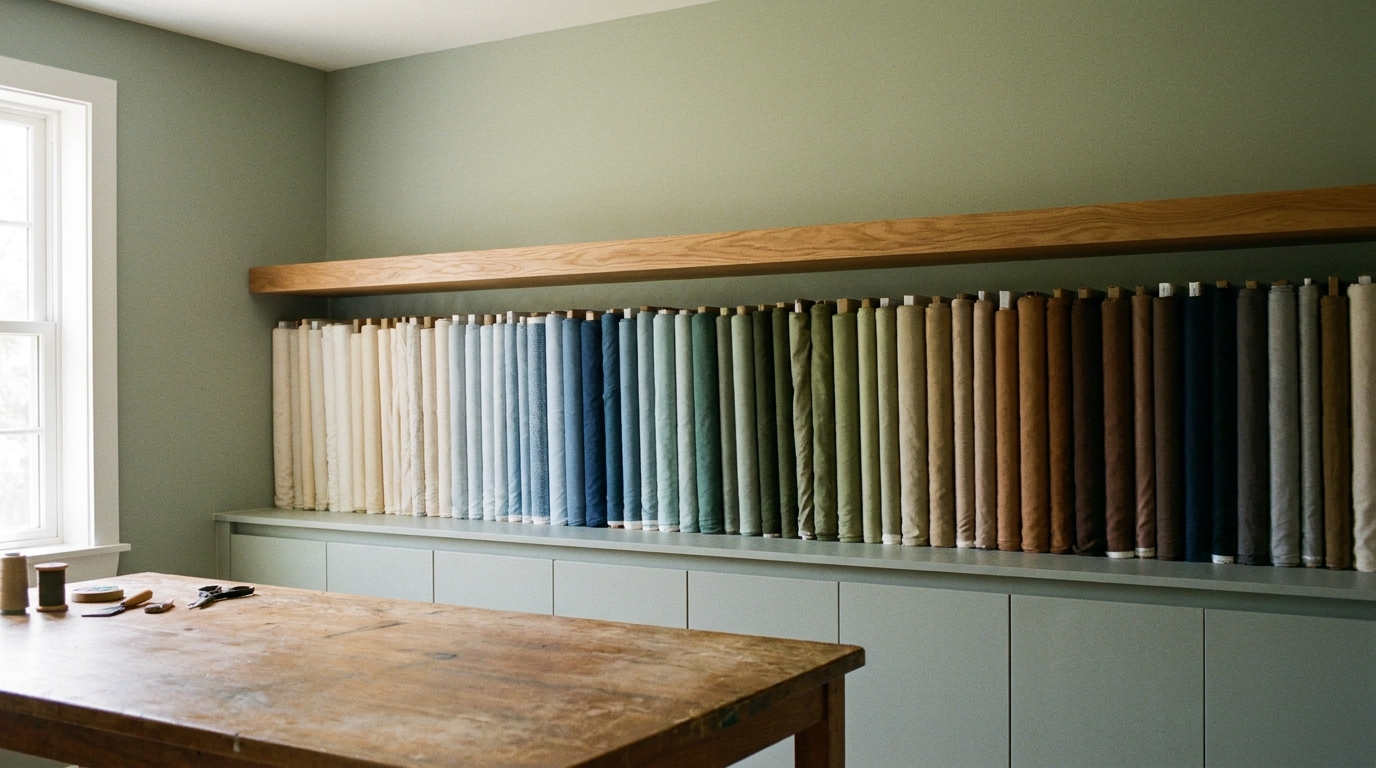
Craft room storage works when one wall does three jobs: fabric bolts stand on end so you can see the cloth, cutting has a real counter, and paint and solvents sit behind a door that latches. A spare bedroom of tubs, a dining table borrowed for the mat, and open cans beside the cotton is not a system. We build that wall as custom built-in storage, sized to the yardage you own and to the person who stands there to cut.
1. Why the spare room stops working
The hobby usually arrives before the furniture. A quilter or a weekend refinisher claims a bedroom, then adds a wire shelf, a folding table, and a bin.
The room stalls when three materials share one surface. Fabric needs to stay clean, dry, and visible. Cutting needs a stable top that does not make you hunch. Paint, thinner, spray finishes, and strong glues need a closed place, their original labels, and a plan for what should leave the house.
We see the same pile in Charlotte houses. The good cotton sits under muslin, and a cracked can of thinner has been poured into a food tub. That last habit is the one to stop. A 2011 U.S. Consumer Product Safety Commission sheet tells households never to put paints or solvents into cups, glasses, or bottles used for food or drinks, and never to move a dangerous product into a container without a child-resistant closure. [3]
This is not a playroom, a gift-wrap closet, or a closet of holiday bins. Those rooms store different things.
2. Fabric on end, in air that can move
Upright storage is a working method, not a museum rule. A bolt on its end shows the cloth, and one piece comes out without unstacking a pile.
The cubbies have to match the cloth. Fat quarters want a shallow tray. Full bolts want divided columns wide enough for the roll, with the pieces you use most often in the easy reach, not against the ceiling. We measure what you own.
Clean and dry matters more than the orientation. An April 1998 University of Missouri Extension guide, reviewed again in September 2017, explains that mildew molds need moisture and flourish where it is damp, warm, and short on moving air, including in closets. [5] Soil on a dirty article can feed mildew, soiled textiles are more likely to mildew than clean ones, and a closed bag plus dampness and hot weather is an ideal setup for those molds. [5] A poorly ventilated closet gets damp and musty in a long wet spell. [5]
A sealed tote in a sticky corner is a poor home for cotton you care about. In a September 2024 answer, the Library of Congress Preservation Directorate says not to store objects of value in a basement, attic, or garage, because of poor temperature and humidity control and a higher risk of leaks and floods. [6] A plastic container in a high-humidity place increases mold risk, and the plastic does not protect against those swings. [6]
Working yardage belongs in the heated and cooled part of the house, standing where air can move, not sealed while damp. Clean it before a long pause. We do not use the chemical mildew treatments that the 1998 guide also describes. [5] Afternoon sun should not bake the bolt wall, and a finished quilt is not a bolt.
3. A cutting counter set to the person who cuts
A cutting counter is not a spare desk and not the island you clear on Sunday. Rotary work needs a top that does not rock, a depth that holds the mat you already use, and a front edge you can stand against. If the mat is larger than the top, you will keep cutting on the floor.
We do not publish one counter height for every house. At the visit, the person who cuts the most stands at the wall with the mat they mean to keep. We set the top so the shoulders can stay down and the wrists are not bent up for the whole project. If pinning happens seated, we leave knee room for a stool.
The counter has to stay a counter. Thread, clips, rulers, and the cutter live in a drawer or on a shallow rail, within easy reach, not in a bin overhead. The chemical cabinet does not go under this top if a leak would run onto the mat. We end the run with its own latched door, and a tray or lip so a drip stays in the bay.
4. Paint and solvents behind a door that actually closes
Paint, thinner, mineral spirits, spray finishes, and some craft glues stop being ordinary supplies when they share a shelf with cotton. The U.S. Environmental Protection Agency treats some leftover household products that can catch fire, react, corrode, or poison as household hazardous waste, and it names paints among products that can contain hazardous ingredients. [1] Left in the open, they can also be a hazard to children and pets. [1]
Keep the package you bought. EPA says to follow the label, keep hazardous products in their original containers, and never remove the labels. [1] Do not mix leftovers. Incompatible products might react, ignite, or explode, and a mix may no longer be something a program can take. [1] An empty container can still hold residue. [1] The 2011 CPSC sheet says the same about paints and solvents, and it tells people to store household products in a cabinet with a child safety latch or lock, out of sight. [3]
A March 2023 CPSC childproofing publication says latches and locks on cabinets in kitchens, bathrooms, and other areas help keep children from household cleaners and similar products. [4] Child-resistant caps are often not childproof, so the products should still be locked away. [4] No device is fully childproof, and a latch works only if it is put back after every use. [4] We size the door so an adult can open it, and so it actually latches when you walk away.
The door is not a vapor seal. EPA says paints, varnishes, solvents, and many hobby products can release organic compounds while you use them and, to some degree, while they are stored. [2] Gases can leak from closed containers, so what you keep should sit in a well-ventilated area and out of children's reach. [2] If the label says a well-ventilated area, EPA's example is outdoors, an exhaust fan, or open windows. [2] The cabinet holds a closed, labeled can. It is not a booth for stripping or spraying.
Buy less. EPA says to buy limited quantities of occasional products such as paints and strippers, and to send old partial containers to a collection program rather than the kitchen trash. [2] Some strippers, adhesive removers, and aerosol spray paints contain methylene chloride, which has caused cancer in animals, and EPA says to use those outdoors when you can. [2] EPA identifies benzene as a known human carcinogen, lists paint supplies among indoor sources, and includes discarding supplies you will not use right away among the steps that cut exposure. [2]
If you suspect a child was exposed, those CPSC materials point to Poison Help at 1-800-222-1222. [3][4]
Use the local program, not the drain. EPA says to ask your local environmental, health, or solid waste agency, and not to pour these wastes down a drain, onto the ground, or into a storm sewer. [1] Mecklenburg County offers free household hazardous waste disposal for county residents at full-service drop-off centers, asks them to tell the staff, and does not accept hazardous material from a business. [7] A December 2023 county post pointed homeowners to craft rooms and closets for paint thinner, glues, and paint, and it described latex and oil-based paint up to 100 pounds. [8] Confirm the current list. That weight is from the 2023 post. [8] Outside Mecklenburg County, including Fort Mill and Rock Hill, ask your own county. [1] For the trip, the 2023 post says to keep the original container, a clear label, no mixes, and the cans away from heat. [8]
5. What this wall is not
This wall holds yardage you cut, a surface you cut on, the small tools beside that work, and a closed bay for finishes that still have a job. It is not a playroom toy wall. Toys and paint thinner should not share a cabinet.
It is not a gift-wrap closet, and leaning paper rolls on the cotton steals the cutting aisle. It is not a holiday decor closet. Ornaments want a door you open in November, not a counter you need on Tuesday. A few pattern envelopes can live in a narrow slot. The attic bins do not. Seasonal goods belong in their own built-in.
6. How we plan the wall
We start with an inventory. We count bolts, folded yardage, and pieces you are keeping rather than cutting. Cans that are unlabeled, mixed, or already unwanted are a drop-off errand, not a reason to add a shelf.
Then we place three zones. Fabric columns you can see. A counter set to the person who cuts, deep enough for the real mat. A latched bay at the end of the run, cans upright and separate from the cloth. If the room is small, we cut the wish list before we shrink the counter into something you cannot cut on.
You can see that order, from the in-home measurement through installation, on our how it works page. The same sequence covers a craft room in Charlotte and in nearby houses in Waxhaw, Fort Mill, or Rock Hill. The wall changes with the cloth and the person. The order of the work does not.
Practical takeaways
- Split the wall into three zones. Fabric you can see, a counter you can cut on, and a latched bay for paint and solvents.
- Keep working bolts in the conditioned room, with air around them. A 1998 Missouri Extension guide, reviewed in 2017, ties mildew to moisture, soil, and still air. A 2024 Library of Congress answer says basements, attics, and garages are poor storage, and that plastic in high humidity raises mold risk. [5][6]
- Keep the original can and the label. Do not pour paint or solvents into a food container, and do not mix leftovers. [1][3]
- Close the latch every time. A March 2023 CPSC guide says these devices have to be reengaged, and that none of them is fully childproof. [4]
- Do not treat the door as a vapor seal. EPA says these products can release compounds in storage, and that gases can leak from closed containers. Ventilate when you use them, and buy only what you will use. [2]
- Match the drop-off to your county. Mecklenburg County residents have full-service centers for household hazardous waste. If you live elsewhere, ask that county, and confirm the current list before you go. [1][7]
How we can help
Have more questions or want to get in touch? Tell us about the room and we will plan craft room storage that holds the fabric on end, sets the cutting counter to the person who uses it, and puts paint and solvents behind a door. Reach us through our contact page, call (704) 604-3870, or email design@theclosetrehab.com.
Citations
- U.S. Environmental Protection Agency, "Household Hazardous Waste (HHW)" (2026-06-01)
- U.S. Environmental Protection Agency, "Volatile Organic Compounds' Impact on Indoor Air Quality" (2026-06-23)
- U.S. Consumer Product Safety Commission, "Young Children Will Eat or Drink Almost Anything!" (2011-03)
- U.S. Consumer Product Safety Commission, "Childproofing Your Home: Several Safety Devices to Help Protect Your Children from Home Hazards" (2023-03)
- University of Missouri Extension, "How to Prevent and Remove Mildew: Home Methods" (reviewed 2017-09; first reviewed 1998-04)
- Library of Congress, "Is it okay to store my collections in the basement/attic/garage if I put them in plastic bags or bins?" (2024-09-10)
- Mecklenburg County Solid Waste and Recycling, "Household Hazardous Waste Disposal" (2026)
- Mecklenburg County, "Five Places You May Find Hazardous Waste in Your Home" (2023-12-01)