Custom Floating Shelves: Short Display, Solid Framing
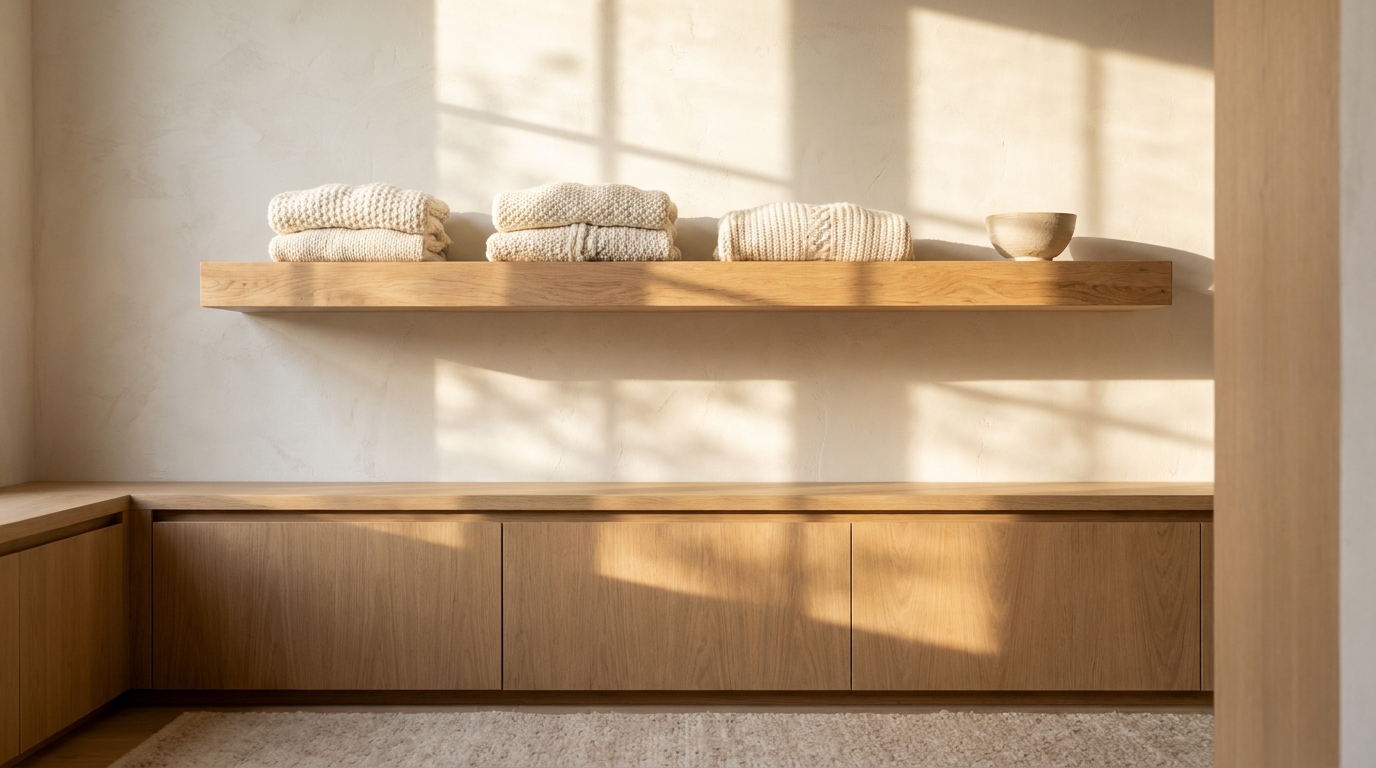
Custom floating shelves earn a place in a closet, office, pantry, or bath when they hold a short, dry display and the wall behind them can carry a hidden bracket into solid framing. The span and the thickness have to match that load, or the ledge bows and stops being useful. Open shelves give less protection from light, dust, and pests than enclosed storage, so everyday bulk and anything that should stay clean belong behind a door. [6]
Where an open ledge earns a place
An open ledge is a display, not a warehouse. It is the right tool when you want a few objects in sight and you are willing to wipe them. It is the wrong tool when the shelf is asked to hide clutter, hold damp textiles, or carry a load that never comes off.
Homeowners around Charlotte and Fort Mill usually meet that choice in four rooms. In a closet, the ledge shows one edited group, and the rest of the wardrobe stays in the closed system. In an office, it holds a frame, a plant, or a small object, not a library. In a pantry, it holds a short row of jars you actually use. In a bath, it holds dry accessories set away from splash. If the honest answer is "I will pile it up and forget it," that item belongs behind a door.
We build this as a designed, installed shelf, not as a bracket kit. The shelves on our specialties page are made to the measurements of the wall, from 1-3/4 inches to 6 inches thick and up to 8 feet long, in more than a dozen finishes, including white oak, walnut, maple, teak, and paint-ready options. Hidden steel brackets leave no visible hardware. That range is what we can build. It is not a suggestion to use the longest, thinnest board the wall will accept.
The rest of this piece is the planning conversation we have before that shelf is specified. It is not an installation recipe. Fasteners driven only into gypsum, or a guessed-at bracket from a hardware aisle, are how a ledge pulls loose. Attachment is part of the installation we do.
1. Tie the hidden bracket to the framing
Start with the wall, not the finish. A floating shelf looks unsupported because the steel bracket is concealed inside the board. The load still has to go somewhere. In a wood-frame house, the members that carry wall loads are the studs. The American Wood Council describes studs as the vertical load-bearing members used to support elements in walls and partitions. On exterior walls, spacing is normally 16 inches. Spacing of 24 inches on 2x4 studs is acceptable in a one-story building when the sheathing or siding is thick enough to bridge the studs. [7] Interior partitions, older houses, and walls that have been opened for plumbing do not always follow that rhythm.
We locate the framing that is actually there. During design we note wood studs, masonry, tile, and any stretch of wall where a stud does not land where the shelf wants to sit. A bracket that misses solid material and trusts the gypsum skin is not a plan we will sign. If the studs and the desired length do not agree, the install may include solid backing placed while the shelf goes in. That is a framing decision for our crew. It is not a plastic anchor, and it is not a weekend hole in the drywall.
Thickness and the bracket are one decision. The bracket has to disappear inside the shelf, which means a pocket or a bore in the board. The Wood Handbook is plain about what that does to a beam: holes and notches increase deflection because they reduce the effective cross section. [2] A thin shell left around a deep pocket will telegraph both sag and a wavy front edge. The reason we offer stock from 1-3/4 inches up to 6 inches is so the concealed bracket and the remaining wood can be chosen together. A paint-ready shelf in a bath and a walnut shelf in an office can use different thicknesses even when the length looks similar.
Long runs need a path at more than one point. An 8-foot shelf is something we can build. It still needs a bracket line that reaches solid structure at sensible intervals, not one hopeful fastener at each end. Masonry and tile change the fastener and the layout. We sort that out on site, before the shelf is cut, rather than asking the finish to do structural work.
2. Size the span for the load you will keep
Length is the sensitive number. The Forest Products Laboratory gives the deflection of a straight beam of constant cross section as two parts: bending and shear. For a uniformly loaded beam on simple supports, the bending term is proportional to total load times span cubed, divided by stiffness. [2] When the weight is spread along the shelf, total load itself grows with the span, so that bending term grows with the fourth power of the span. [2] A floating shelf is not that textbook beam. The hidden bracket changes the supports. The lesson still holds. Unsupported length is where sag comes from, and the same weight per foot on a long run bows far more than it does on a short one.
Thickness resists bending much faster than a small change suggests. For a rectangular section, the moment of inertia is width times thickness cubed, divided by 12. [2] In that formula, doubling the thickness multiplies the bending stiffness by eight, if the other terms stay the same. [2] Shear deflection is a separate term and does not shrink on the same schedule. This is why we would rather add thickness, or shorten the span between solid attachment points, than hope a decorative face will stay flat under books or jars.
Wood keeps moving after the first day. When a wood member is loaded it deforms at once. If the load stays, more deformation follows. The Wood Handbook calls that creep. Creep happens even at low stress, and it can continue for years. At typical design levels, after several years the added creep deformation may approximately equal the first elastic deformation. Ordinary changes in temperature and humidity increase it. [1] For initially dry timber, it has been customary to set the first-day sag at about two-thirds of the sag you are willing to accept later, if long-term deflection is meant to stay inside a limit. [2] A shelf that looks level on installation day is not finished proving itself. A sustained load, such as a full row of books that never comes down, is the case we plan against.
Species changes stiffness, and it is not the whole story. Clear-wood averages at 12 percent moisture content, from tests on small clear specimens, put white oak near 1.78 million pounds per square inch, sugar maple near 1.83 million, and black walnut near 1.68 million. [1] Those are laboratory averages, not a rating on a finished shelf, and real boards vary. Our finishes include white oak, walnut, and maple, among others. A stiff species does not rescue an overlong, thin ledge with a pocket cut out of it.
Most interior wood wants to be installed near the moisture content it will see in service. For interior woodwork, flooring, and furniture in most areas of the United States, the handbook recommends an average of about 8 percent at installation, with individual pieces between 6 and 10 percent. [3] That target keeps seasonal swelling and shrinking smaller. A steamy bath is a different service than a closet. We do not treat every room in the house as the same moisture environment.
3. Keep the styled row short enough to dust
Dust is settled material, and an open surface collects it. The U.S. Environmental Protection Agency describes indoor dust as settled particulate matter from soil tracked inside, skin and hair, pollen, cooking, and other ordinary activity. Cleaning, vacuuming, and walking can send it back into the air. EPA's practical step for hard surfaces is to dust often with a damp cloth, because a damp cloth holds the dust instead of launching it. [4] A ledge you cannot reach at the back edge will not get that wipe. It becomes the dust ledge the title is warning about.
Museums treat open shelving as the less protected choice. National Park Service guidance says shelving suits sturdy objects that are less vulnerable to pests and light, and that shelves give less protection from light, dust, and pests than enclosed storage furniture. [6] Your closet is not a museum vault. The distinction is still the right one for a house. Put the sturdy, dry, wanted objects in the open. Put the vulnerable ones behind a door, in a drawer, or in a closed cabinet.
Leave air around the objects. A styled display is a short row with space between pieces, not a packed windowsill. You should be able to lift each object with one hand and wipe the board under it. If a piece is too heavy, too tall, or too crowded to move, it is storage pretending to be display.
What belongs on the ledge:
- A few dry, sturdy objects you are glad to see every day.
- Pieces you can lift down without a struggle.
- In a pantry, jars with lids that you finish and replace, not a permanent archive of bulk goods.
- In a bath, dry accessories set out of the splash zone.
What belongs behind a door:
- Everyday clothing, which stays in the closet system rather than on a parade of open boards.
- Paper, photographs, and fabrics that should stay out of light and dust. [6]
- Anything damp, including towels that never quite dry, because moisture is what lets mold grow. [5]
- A sustained heavy load, such as a long run of books, unless the span is short and the section is thick enough that creep will not show as a visible bow. [1] [2]
- Medicines and other items you want out of sight and off a surface you wipe in passing.
Edit on a schedule. The ledge stays usable if the rule is rotation, not accumulation. When a new object goes up, one comes down. If you cannot name the objects that will sit there, the shelf is early. We would rather shorten the display than build a longer board and watch it fill with mail.
4. Give each room a different job
Closet. Use one or two floating shelves as the open moment in an otherwise closed closet. A hat you wear, a small folded stack you rotate, or a single object at the end of a run can sit in the open. The clothes you reach for every morning stay inside the closet system, where dust and light are less of a tax. [6] The shelf is the edited edge of that room, not a substitute for the closed storage.
Office. A home office in Fort Mill or Charlotte often wants one clean line above a desk. That line can hold a framed photo, a small plant in a dry saucer, and one object with blank board around it. It should not become a second bookcase. Books are a permanent load. Creep under a load that never leaves can, over several years, add about as much deformation as the shelf showed on day one. [1] A quantity of books needs a different support. A floating shelf that tries to be a library will show it.
Pantry. One open shelf for the jars you cook from this month is a pleasure. A wall of open food is a dust project. Keep the row short, keep lids on, and put bulk, backup packages, and anything you touch once a season inside a cabinet. Cooking is also a source of indoor particles, and those particles settle. [4] A shelf directly beside a busy range will ask for more wiping than a shelf on the quiet wall. We place the open run where you can see it and still reach the back edge with a damp cloth.
Bath. Keep the shelf out of the shower splash and off the path of a wet towel. EPA's mold guidance is moisture control: dry wet materials quickly, and where possible hold indoor relative humidity below 60 percent, ideally about 30 to 50 percent. [5] A bath fan and a shelf location do that work together. The wood itself should be specified for the room it will live in. Interior woodwork in most of the country is installed near 8 percent moisture content so it is already close to ordinary indoor service. [3] A bath that stays humid after showers is not ordinary closet air, and temperature and humidity swings increase creep. [1] We look at ventilation and at how wet the room stays before we choose thickness, finish, and how close the shelf sits to the shower.
Same bracket logic, different load. In every one of these rooms the questions repeat. What is behind the finish? How long is the unsupported stretch? What stays on the shelf for months, and what is only visiting? A light display on a well-fastened 8-foot line can be right. The same length loaded with books, dishes, or a crowded pantry is a different shelf, or it is not a floating shelf at all.
Practical takeaways
- Treat the floating shelf as open display. If you will not wipe it, or you cannot see the back edge, the item belongs behind a door.
- The hidden steel bracket has to reach studs or other solid backing. Gypsum is the finish, not the structure we count on.
- Span drives sag. The same weight per foot on a longer board bows much more, and a sustained load keeps creeping for years. [1] [2]
- Thickness and the concealed bracket are chosen together, because a pocket in a thin board leaves a weaker section. [2]
- The build range, 1-3/4 inches to 6 inches thick and up to 8 feet long, is what we can make. The right shelf is often shorter, or thicker, than the maximum.
- Closet clothing stays in the closed system. A quantity of books needs different support. Pantry bulk and bath moisture stay off the open ledge.
How we can help
Have more questions or want to get in touch? Visit our contact page, call (704) 604-3870, or email design@theclosetrehab.com.
Citations
- U.S. Forest Products Laboratory, "Chapter 5: Mechanical Properties of Wood, Wood Handbook (FPL-GTR-282)" (2021)
- U.S. Forest Products Laboratory, "Chapter 9: Structural Analysis Equations, Wood Handbook (FPL-GTR-282)" (2021)
- U.S. Forest Products Laboratory, "Chapter 13: Drying and Control of Moisture Content and Dimensional Changes, Wood Handbook (FPL-GTR-282)" (2021)
- U.S. Environmental Protection Agency, "Sources of Indoor Particulate Matter (PM)" (2026-03-10)
- U.S. Environmental Protection Agency, "Tribal IAQ Resource Directory: Mold and Moisture" (2026-05-26)
- National Park Service, "Conserve O Gram 4/1b: Museum Storage Shelves" (2026-07-08)
- American Wood Council, "Lumber Studs" (2026-01-26)