Patio Cushion Storage in Closed Garage Cabinets
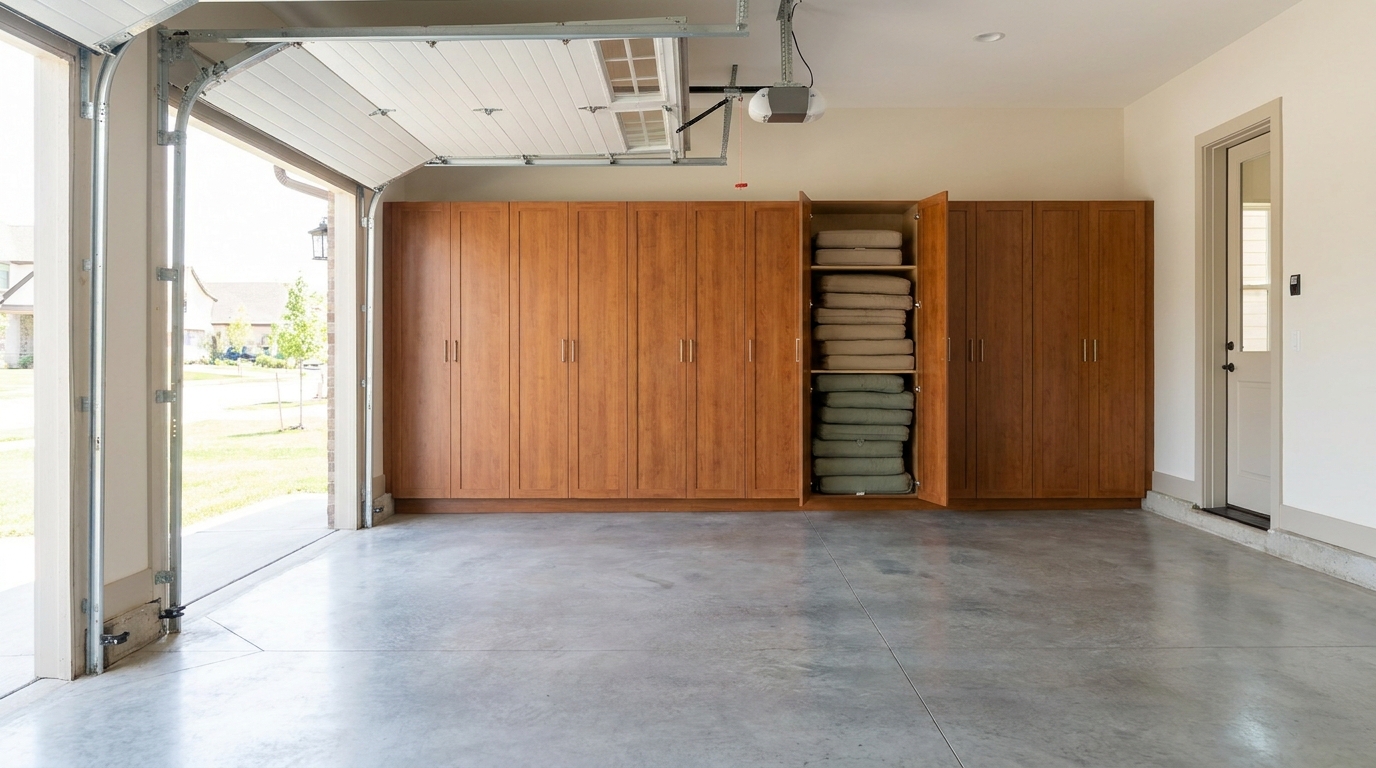
Closed patio cushion storage belongs on a garage wall only after the cushions are dry, with grill tools in a separate bay and both parking spaces left clear. The propane cylinder does not go in either cabinet. North Carolina's LP-gas guidance says tanks that contain propane, or that ever had propane in them, are to be stored outdoors, and it lists indoor storage as a do-not. [1]
1. Two cabinets, two jobs
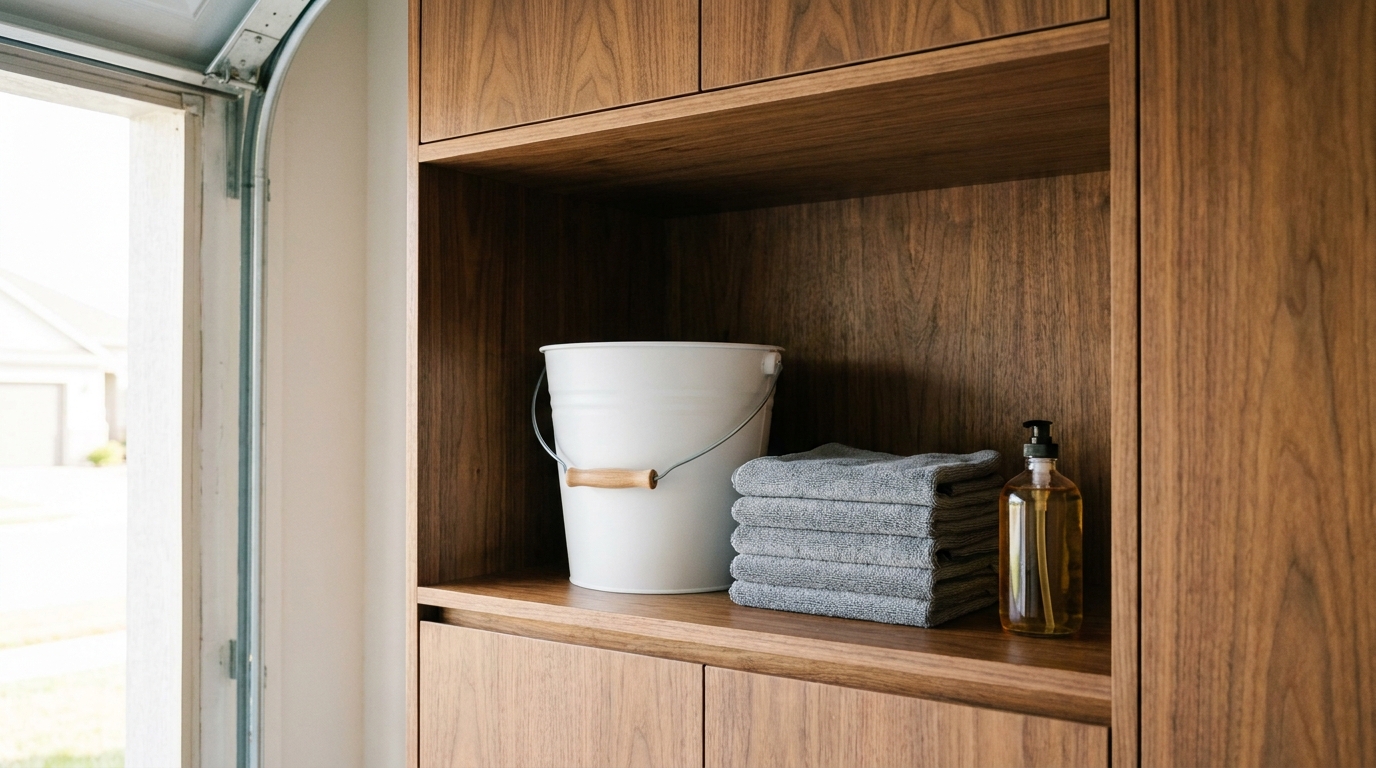
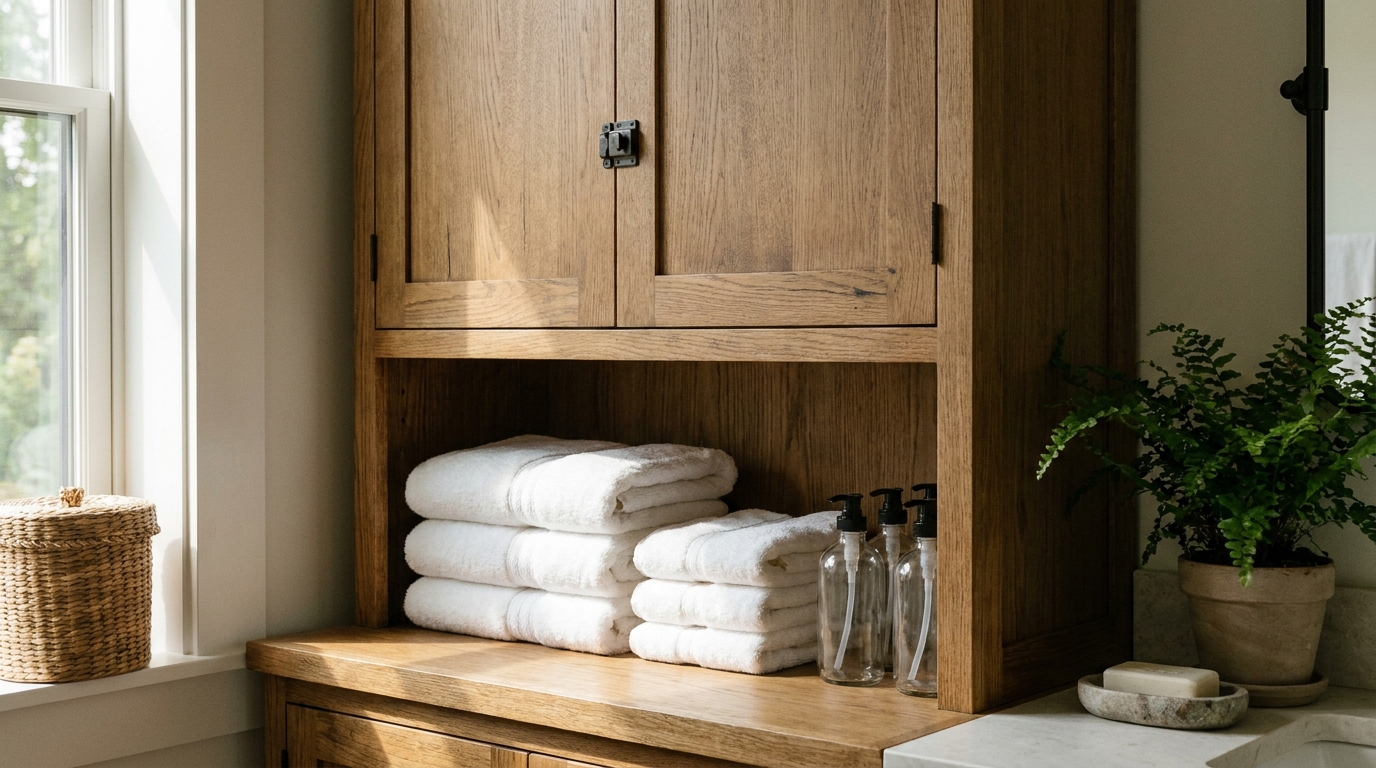
A patio set does not belong in a heap on the second parking bay. Seat cushions, back cushions, and loose outdoor pillows need a closed cabinet so pollen and garage dust stay off the fabric. Grill tongs, gloves, a clean brush, and a dry cover need a door of their own. A greasy tool on a cushion, or foam crushed under metal, is what happens when those loads share a shelf.
We size the cushion cabinet for the pieces you own. Deep lounge cushions need a wide shelf or a vertical slot. Leave a little air between pieces so the edges are not pressed into a damp seam. The door keeps garage dust off the fabric. It is not there to vacuum-pack the foam.
The tool bay is smaller on purpose. Hooks, a glove bin, and a brush tray are enough. A clean, dry grill cover can hang here. A wet cover stays out until it is dry. This bay is not for gasoline, paint, or the fluids you use on the car. Those belong in a separate locker.
Leave the cylinder out. A closed cabinet is the wrong place for a propane cylinder, full or empty. The state standards page says to store tanks outdoors when they contain propane or ever had propane in them, and indoor storage is on its do-not list. Standing upright on the foot ring is marked as a state-law requirement that references NFPA 58, the LP-Gas Code. [1] A September 19, 2025 note from the same department says containers should always be stored outdoors even if they are empty, and should not be brought indoors or kept in crawl spaces, under houses, or other low-ventilation spaces. [2] On October 16, 2024, the department told residents not to store, place, or use a propane cylinder indoors or in an enclosed area such as a basement, garage, shed, or tent. [3]
That last line answers the compromise people ask us for. A cabinet inside the garage is still inside the garage. We will not add a "propane shelf" to make the tank look tidy. The cylinder stays outdoors, standing upright, where it will not be knocked over, and out of a child's reach. [1] [2]
2. Dry the cushions before the doors close
Moisture is what lets mildew start. The U.S. Environmental Protection Agency says the key to mold control is moisture control. If wet or damp materials are dried within 24 to 48 hours after a leak or spill, in most cases mold will not grow. The same guide says to keep indoor humidity below 60 percent when you can, and ideally between 30 and 50 percent. [5]
A garage in a humid summer will not hold that indoor range by itself. A cushion is also not a puddle on a hard floor. The cover can feel dry while the foam underneath is still cool and heavy. We treat the EPA window as a reason to start drying right away, not as a timer that makes a damp cushion safe to shut in a cabinet. If you close the door on wet foam, you have built the condition the cabinet was supposed to prevent.
University of Missouri Extension, in a home guide reviewed in April 1998, explains that soil on dirty articles can supply enough food for mildew when moisture and temperature are right. The guide says to keep fabrics dry, and to wash or dry-clean household textiles before storage when they do not have a mildew-resistant finish, because soiled articles are more likely to mildew. It also notes that a closed bag, dampness, and hot summer weather make ideal growing conditions for molds. Many synthetic fibers resist mildew, but soil on those fabrics can still feed it. [6]
That 1998 guide is old, and we are not repeating its chemical treatments here. The part that still matches the way cushions fail is simple. Clean them. Dry them. Do not seal damp fabric in a closed space and hope the door will fix it.
Dry both faces. Stand cushions on edge, or flip them so the underside gets air. Open zippers if the care label allows it, and check the seam and the filling. Brush off pollen and crumbs. Follow the fabric label for any wash. We do not hand you a homemade cleaner recipe.
Around Charlotte, a lake weekend makes this step obvious. Dock chairs and boat-day seats often come home wetter than cushions that stayed on a covered patio. Let those dry before they join the cabinet. Towels from the water are a different load. They do not belong piled on the foam.
Skip airtight plastic bags. Missouri Extension's 1998 note about a closed bag, dampness, and summer heat is why. [6] A breathable cover is fine once the cushion is dry. If a storm hits and you need the cushions off the furniture, bring them under cover and leave the cabinet door open, or stand them where air can move, until the thick parts are dry. "Just for tonight" inside a shut cabinet is how a musty smell shows up later.
3. Grill tools in their own bay, grill outside
The tool cabinet holds what you carry to the grill. It does not hold the grill, and it does not hold the fuel.
NFPA, in a May 19, 2025 release, reported that between 2019 and 2023 gas grills were involved in an average of 9,287 home fires per year, including 4,682 structure fires and 4,605 outdoor fires. In roughly one-fifth (20 percent) of those fires, the grill had not been cleaned. The same release, citing U.S. Consumer Product Safety Commission data, said an annual average of 21,682 patients went to emergency rooms because of grill-related injuries between 2020 and 2024. [4]
Those figures are about fires and injuries, not cabinet layout, and they still shape the tool bay. Wipe the brush, tongs, and cover before they go back in a closed cabinet. A grease-caked tool should not dry against a cushion next door. That is one more reason the doors are separate.
NFPA's same list asks you to check a propane grill tank for leaks, keep the grill clean, and place the grill far from the home, deck railings, eaves, and overhanging branches. Open the lid before lighting a gas grill, keep children and pets at least three feet from the grilling area, and do not leave the grill unattended while it is in use. [4] We point you to that guidance. We do not walk through hose repairs, valve changes, or a gas-line hookup. If a connection needs service, that work belongs with your propane supplier or another qualified technician, not with a cabinet plan.
North Carolina's storage page says not to keep a spare tank under or beside a gas grill that is in operation, and to keep spare tanks away from the grill. That point is marked as a state-law requirement referencing NFPA 58. [1] The 2025 department note says the same idea in plain language: do not store spare tanks near an in-use gas grill or other heat sources, keep them standing upright on the foot ring, and keep them out of direct sunlight when you can. [2] The standards page also says not to store tanks in the hot sun, especially beside a southern-facing masonry or dark wall. [1]
The grill does not roll into the cabinet. The October 16, 2024 state warning says to use charcoal or gas grills outdoors, and not to use those appliances in garages. [3] Our team designs storage for the tools and the dry cushions. We do not enclose the grill, and we do not build a bay that implies you can cook inside the garage.
When the season pauses, close the cylinder valve, leave the cylinder outdoors and upright, and put only the hand tools away. If the tank shows deep pitting, the 2025 note says it should be replaced. If the collar or foot ring is corroded, both that note and the standards page say to seriously consider replacing the tank. [1] [2] We stop at that warning. We do not service cylinders.
4. Park both cars, then draw the cabinets
A garage that stores the patio and cannot park the cars has failed the job. We start with the vehicles that actually sit in the bays, including a second car that is real. Mirrors, door swing, and the walk from the driver's door to the house all have to work after the cabinets are in.
Draw the parking first. On a visit, we mark the floor the way the cars sit, then we place both cabinets on the wall that remains, usually a side wall already clear of the bumper. If a tall cushion cabinet forces you to pull forward until the bumper meets the box, the run is too deep or too far into the bay, and we move it. We do not publish a universal clearance number. The gap depends on your cars, your garage door, and the wall you have.
Overhead racks are a different part of the plan. Cushions are easy to forget while they are still damp if they go up high. We prefer a reachable closed cabinet so you can see the foam and leave the door open on a wet day. The tool bay can sit beside it or closer to the door you use on the way out to cook. The path should not cross the middle of a parking bay. If an open door blocks the car, we change the hinge side.
Wall storage, a workbench, and overhead racks can share the room. That wider layout is on our garage storage page. This patio pair is one zone inside it, and it should not steal the floor the cars need.
5. Keep this zone separate from the rest of the garage
Patio cabinets fail when they become the catch-all. The cushion side stays a dry-fabric cabinet. The tool side stays a hand-tool bay.
- Garden tools and a mower bring soil and fuel smells. Soil on fabric can feed mildew when the air is damp and warm. [6] They do not share a shelf with seat cushions.
- Sports gear stays on its own racks. Bikes, golf bags, and bats can share a wall, not the inside of the cushion cabinet.
- Car-care fluids stay in a locker meant for them, apart from fabric and from anything you cook with.
- Trash and recycling belong in a corral by the bin door. A cushion cabinet is a poor trash closet.
- Lake towels and wet swimsuits need a drying spot of their own, then a linen or mudroom cabinet. They do not go on top of the foam "until later."
Label the doors in plain language: "Cushions" and "Grill tools." A label will not replace the cylinder rule, so we say it in the design meeting. Nothing with propane goes in these doors. [1] [2] [3]
6. A short season routine
The cabinet only works if the habit matches the hardware. This is the order we walk through with homeowners.
- Brush off leaves, pollen, and food before any cleaning.
- Clean cushions and tools the way their labels and the grill maker describe. Wipe grease off tools before they go back in the bay. NFPA ties unclean grills to a large share of grill fires. [4]
- Dry cushions in moving air until the thickest part, not only the cover, is dry. Flip them. Check zippers and seams. [5] [6]
- Then put them in the cabinet with space between pieces. Skip airtight plastic bags. [6]
- Leave the propane cylinder outdoors, upright on its foot ring, valve closed, away from the grill while the grill is in use, and out of the garage. Even a light cylinder stays outside. [1] [2] [3]
- On a wet week, use the open-door pause. Under cover is fine. Shut and damp is not.
Once a month in warm weather, open the cushion cabinet and look. A musty edge means that piece comes back out, gets cleaned the way the label allows, and dries fully. At the end of the heavy cookout months, do the same pass on the tool bay. Do not store a cover that is still wet. The grill itself stays outside, well away from the house, railings, eaves, and branches. [4]
If you ever smell gas, or you think a cylinder is leaking, do not hunt for the leak with a flame and do not carry the tank into the garage to deal with it later. Step away and call your propane supplier or the fire department. Cabinet design does not include a repair.
Practical takeaways
- Use closed patio cabinets for cushions that are already clean and dry, with air space between pieces, not airtight bags.
- Put grill hand tools in a separate bay. Keep grease off them before they go back in. Leave the grill outdoors.
- Store every propane cylinder outdoors and upright, including one that feels empty. Do not put it in a cabinet, a garage, a shed, a basement, or a tent. [1] [2] [3]
- Place the cabinets only after both cars still park and the doors still open.
- Keep mowers, garden soil, sports gear, car-care fluids, trash, and wet towels out of this zone.
How we can help
Our team measures the bays, the cars, and the cushion stack, then we design a closed cushion cabinet and a separate grill-tool bay that leave the floor for parking. The cylinder stays on the outdoor plan, not in the drawing. You can see the wider garage approach on our garage storage page.
Have more questions or want to get in touch?
Reach us through contact, call (704) 604-3870, or email design@theclosetrehab.com.
Citations
- North Carolina Department of Agriculture and Consumer Services, "Standards - Proper Storage of Propane Containers" (page last modified 2025-09-03)
- North Carolina Department of Agriculture and Consumer Services, "Working with or storing propane? Here are some requirements and tips you should know" (2025-09-19)
- North Carolina Department of Agriculture and Consumer Services, "NCDA&CS advises caution: Outdoor grills and heating devices not safe for indoor use" (2024-10-16)
- National Fire Protection Association, "NFPA provides top grilling safety tips for Memorial Day and beyond" (2025-05-19)
- U.S. Environmental Protection Agency, "A Brief Guide to Mold, Moisture and Your Home" (page last updated 2026-02-18)
- University of Missouri Extension, "How to Prevent and Remove Mildew: Home Methods" (reviewed April 1998)