Family Command Center Built-Ins Off the Kitchen

A family command center built-in is a shallow wall station just off the kitchen for the day's mail, school papers, one household calendar, and a charging shelf an electrician plans before the cabinet closes. It is not a locker row, a cubby for every person, a file tower, or a backpack niche. The U.S. Postal Service's 2025 Household Mail Survey found that households sent or received an average of 637 pieces of mail that year, and advertising mail accounted for 62 percent of household mail [1]. The station has to sort that flow quickly, then get out of the way of cooking.
1. A shallow station beside the kitchen
The problem is the counter where dinner gets made. It is also where backpacks open, permission slips land, and phones charge beside the sink, because that outlet is the one everyone can see. By evening the island is a second mailbox.
The fix we build is a shallow built-in on the wall beside the kitchen, on the path from the door people actually use. In the houses we measure around Charlotte, Ballantyne, Waxhaw, and Wesley Chapel, that door is often the garage or side entry, and it lands at the kitchen edge. The station belongs there, close enough to catch the paper before it hits the counter, and thin enough that two people can still pass.
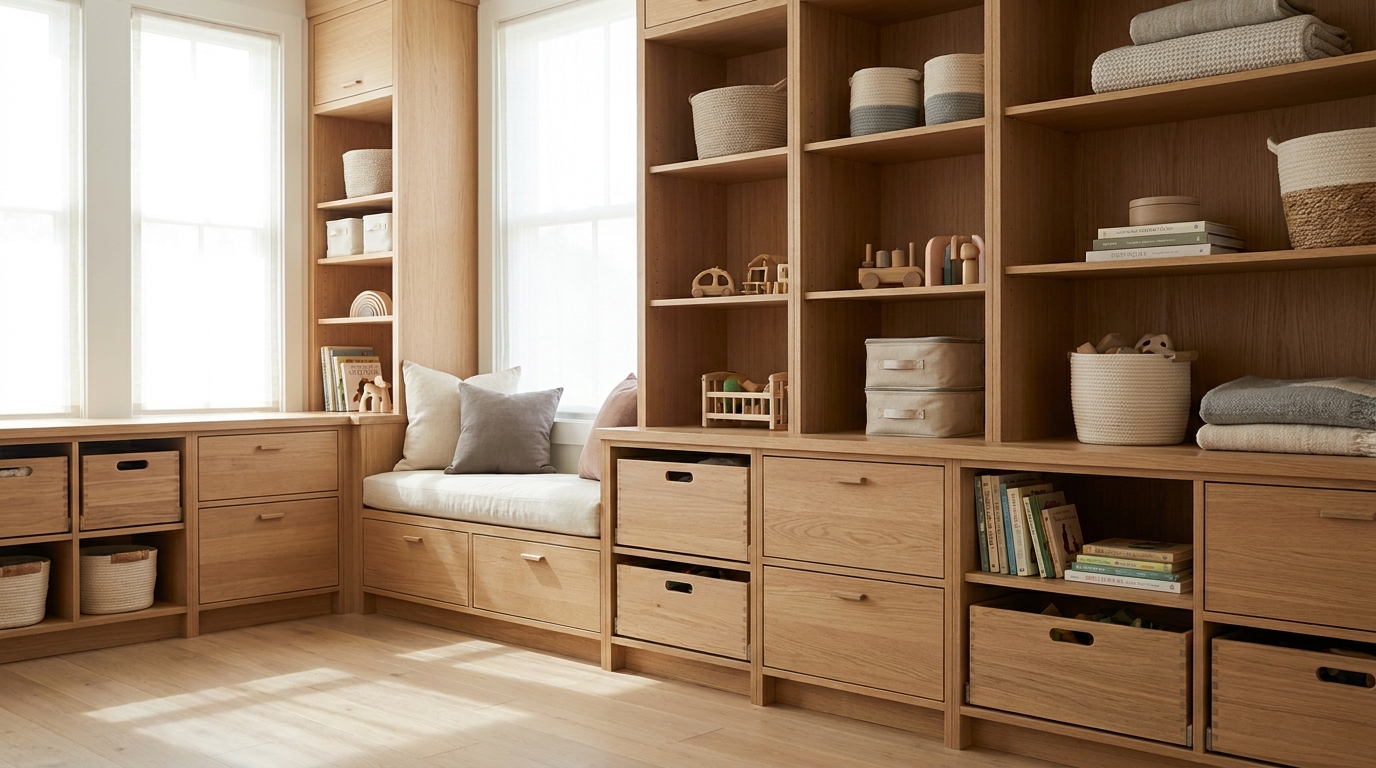
Family command center built-ins in this spot do three jobs and stop. Mail slots take what came in today. A calendar nook holds one household calendar and the slips that belong to this week. A charging shelf holds the phones, tablets, and earbuds that leave in the morning. Long-term files, coats, and sports bags live somewhere else. If the bay starts storing those, it has stopped being a command center and started being a closet that blocks the kitchen.
We keep the depth modest on purpose. A letter standing on edge, a tablet lying flat, and a hand reaching in should be the whole story. A deep cabinet invites the pile to hide. A shallow one makes the unfinished decision visible, which is the point.
2. Mail slots that sort, then empty
Paper still arrives, even in houses that pay almost everything online. In that same 2025 survey, 55 percent of household bills and statements were still received by mail, while 77 percent of household bills were paid electronically [1]. The slot is for the paper that shows up, not for a desk where you sit and write checks.
Most of what arrives is not a bill. Advertising was the largest share of household mail in 2025 [1]. A good mail bay assumes that, and it gives the ads a fast exit. We usually divide the opening into four plain jobs:
- Today. Unsorted mail lands here the minute it comes inside, not on the island.
- Decide. Bills, school forms, and anything with a date sit in a short slot you can see at a glance.
- Out. One outgoing spot for the envelope that still has to leave.
- Recycle or shred. Ads and spent envelopes leave the same day, instead of nesting under the good mail.
USAGov tells people to collect mail every day, and to place a hold when they will be away from home [2]. It also lists a low-tech theft path that still works: someone goes through the trash for bank statements or tax documents [2]. Daily pickup is why the bay sits on the path you already walk. A small "shred this week" pocket, emptied into a shredder or taken to a community shred day, beats a cute bin that keeps intact statements until the bag is full. The pocket is not a vault.
Tax and property records should not grow old there either. The IRS says you generally keep records that support an item of income, a deduction, or a credit until the period of limitations for that return runs out, and that the common period is 3 years when the longer situations on its list do not apply [3]. It also says that when a record is no longer needed for tax purposes, you should check whether an insurance company or a creditor wants it longer [3]. Those papers need a closed file somewhere else in the house. The command center is a landing zone with a deadline. That is how it stays different from an office file tower.
Labels should be words a guest can read. If Decide is full on Thursday, the bay is doing its job. The sheet due Friday stays standing, date out. The rest of the school packet does not.
3. One calendar nook, out of the sun and the steam
Three calendars is how a game gets missed. The phone has practice, the fridge has a party, and a paper flyer on the counter has picture day. We design for one household calendar in a nook the whole family can see, plus a narrow ledge for this week's slips. A second sports calendar can hang in a bedroom. It does not get a twin slot in the kitchen bay, or the nook turns into a bulletin board.
Light is the quiet enemy of that paper. Cornell University Library's preservation tutorial says intense light fades inks and colors, darkens and yellows paper, and weakens fibers, that all direct light is damaging to some degree, and that materials are most vulnerable on long-term display or in front of a window [4]. A calendar has to be seen. We still refuse the sunny ledge. The nook gets a back and a small side cheek, plus a task light on a switch rather than a lamp left on the page. When the room is empty, the light is off.
Moisture is the other enemy, and a kitchen-adjacent wall can be a damp wall. The EPA's guide for homeowners says to keep indoor relative humidity below 60 percent if possible, ideally between 30 and 50 percent [5]. It also says that if wet or damp materials are dried within 24 to 48 hours after a leak or spill, in most cases mold will not grow, and it tells people to vent moisture-producing appliances such as stoves to the outside where possible [5]. We read that as a placement rule, not as a promise that a cabinet controls the house. The paper bay stays out of the steam path from the range, out of the sink splash, and off the back of a dishwasher. If the only free wall is an uninsulated exterior that sweats in a Carolina summer, we say so before we box paper against it.
The nook is a shelf or shallow tray for one paper calendar or a tablet in a stand. Our practice is to place that daily view between about counter height and eye level, then check it against the shortest person who needs to read the date. We set that height in the room, not from a chart. A lip keeps the calendar from walking off. One clip holds the permission slip. A short key hook can sit at the edge, but a long key rail will crowd the date.
4. A charging shelf the electrician owns
Phones do not belong in a bowl on the counter, and they do not belong on a strip taped inside a closed cabinet. The devices people carry every day use lithium-ion batteries. The National Fire Protection Association's 2025 safety sheet says those batteries supply power to phones, laptops, and many other products, and that if they are not used correctly, or if they are damaged, they can catch fire or explode [6].
Those rules shape the shelf. Use a device listed by a nationally recognized testing laboratory, follow the manufacturer's instructions, use the cord that came with it, do not charge it under a pillow or on a bed or couch, and stop when it is full [6]. Keep charging at room temperature, not below 32 degrees Fahrenheit (0 degrees Celsius) or above 105 degrees Fahrenheit (40 degrees Celsius), and store batteries away from anything that can catch fire [6]. If a battery shows an odor, a change in color or shape, too much heat, leaking, or odd noises, stop using it, and if it is safe, move it away from anything that can burn and call 9-1-1 [6].
The shelf that follows from that is a hard, open ledge, not a fabric-lined bin and not a cubby of mail. Paper and a warm phone should not share a pile. The shelf stays in sight so a hot or swollen device is noticed, and the plug stays reachable so a full charge can mean unplugged [6]. A cord buried behind a fixed panel fails that test.
This shelf is for small daily devices. The same NFPA sheet treats e-bikes as a different problem: charge them in a flat, dry area away from children, direct sunlight, liquids, and tripping hazards, where the bike is not at risk of falling [6]. A kitchen-side niche is the wrong place for that battery.
The feed for the shelf is electrical work, and we do not guess at it. The North Carolina Office of State Fire Marshal describes the State Electrical Code as an adopted version of the National Electrical Code plus state amendments [7]. On that page, the 2020 State Electrical Code is listed as effective November 1, 2021, and as the current code, with a note that one- and two-family dwellings are excluded from that description and are addressed in Amendments 10.1 and 10.2 [7]. The same page says the 2023 State Electrical Code was accepted by the Building Code Council on December 12, 2023, and by the Rules Review Commission on February 28, 2024, then given an indefinite delay from its original January 1, 2025 date under Session Law 2025-2 (House Bill 47), Section 5.12 [7]. A house in Charlotte is not a place to assume the newest model edition is the rule on the wall.
A June 30, 2024 article in IAEI Magazine explains that the 2023 edition of the National Electrical Code, at section 210.8(A)(6), simply says "kitchens," and that in that edition, receptacles supplied by a single-phase branch circuit (120 volt, 120/240 volt, or 120/208 volt) in a dwelling-unit kitchen require ground-fault protection, no longer limited to countertops or to within 6 feet of a sink [8]. That describes the model code. It does not say what North Carolina is enforcing, and it does not cross the state line. In Fort Mill, Rock Hill, or Indian Land, the electrician works to the edition that jurisdiction has adopted. We do not copy a Charlotte note onto a South Carolina wall.
The sequence is the same in every one of those towns. We mark the shelf. A licensed electrician decides whether the spot counts as a kitchen, whether it is near a sink, what protection the receptacles need, and whether the circuit can take the load. We do not hide a chained power strip and call it permanent wiring. We build a removable panel or an open back so a receptacle can be reached after the cabinet is up. Junction boxes do not disappear behind a glued panel.
Children change the receptacle choice. The U.S. Consumer Product Safety Commission says that if you are replacing receptacles, use a tamper-resistant type, that outlet protectors should not be easy for children to remove and should be too large to choke on, and that no device is completely childproof [9]. Loose plastic caps disappear from a shelf at kid height. We ask the electrician for tamper-resistant receptacles where the adopted code or the household calls for them. The shelf is still not a babysitter.
A few habits keep it honest. Give each device air, not a pile. Keep drinks on the kitchen side of the wall. Route cords off the walkway. Skip a door that would hide heat or block the plug. If a device smells odd, runs very hot, or changes shape, stop using it [6].
5. How the visit decides the wall
We start where you enter, not where a catalog photo put the cabinet. On a design visit we walk from the door you use to the place you drop your hands. If that path misses the first wall we liked, the station moves.
Then we count a normal Tuesday, not the first week of school. A few envelopes, one calendar, a short stack of slips, and the devices that charge overnight is a common list in our work. A printer, a laptop dock, or years of tax folders means a different room. The IRS periods above are one reason those folders leave [3].
Height is checked in place, including the fridge door and the path a dish takes from the range. The calendar and the Decide slot stay readable. The charging shelf stays where a plug can be pulled. Finish comes last: match the kitchen trim, use a surface that wipes clean, and keep daily mail in the open. A door, if you want one, belongs on the thing you rarely touch.
Our design process is the sequence we use for other built-ins: a free in-home visit, measurements, and a design you can review before anything is built. For this station, the electrician's plan is part of that review. We would rather pause a drawing than close a cabinet around a cord we hope will be fine.
Practical takeaways
- Put the station on the path from the door you use, just off the kitchen, and keep it shallow so the walkway stays clear.
- Give mail four jobs (today, decide, out, and recycle or shred) and empty the advertising the day it arrives.
- Keep one household calendar out of direct sun and out of range steam, with this week's slips in front of it.
- Separate paper from charging. Use the device's own cord, on a hard open shelf, and unplug when the charge is done [6].
- Have a licensed electrician set the receptacles to the code edition your town actually uses, including tamper-resistant devices where they apply [7] [9].
- Do not store tax files, coats, or large batteries in this bay. It works because it stays small.
How we can help
Have more questions or want to get in touch? Call (704) 604-3870, email design@theclosetrehab.com, or reach us through our contact page at https://theclosetrehab.com/contact-us/. A free in-home design consultation is the right first step for a command center. Our team will stand in the real doorway, mark the mail path, and plan the charging shelf with the electrical work in mind before we build the cabinet around it.
Citations
- United States Postal Service, "The Household Mail Survey: Mail Use & Attitudes 2025" (2026-03)
- USAGov, "Identity theft | USAGov" (2025-07-22)
- Internal Revenue Service, "How long should I keep records? | Internal Revenue Service" (2026)
- Cornell University Library, "Climate Control - Library Preservation and Conservation Tutorial" (2026)
- U.S. Environmental Protection Agency, "A Brief Guide to Mold, Moisture and Your Home | US EPA" (2026)
- National Fire Protection Association, "Lithium-Ion Battery Safety" (2025)
- North Carolina Office of State Fire Marshal, "State Electrical Code and Interpretations | OSFM" (2026)
- IAEI Magazine, "Kitchens and Areas for Food or Beverage Preparation and GFCIs – IAEI Magazine" (2024-06-30)
- U.S. Consumer Product Safety Commission, "Childproofing Your Home - Several Safety Devices to Help Protect Your Children from Home Hazards | CPSC.gov" (2026)