Acoustic Slat Wall Panels: Less Echo, Not Soundproof
A home office feels quieter when speech stays clear and the room stops ringing, not when the wall has been sealed like a vault. Acoustic slat wall panels, the felt-backed wood finish we install, can take some of the bounce out of a hard wall. They do not keep sound from traveling through that wall into the next room. A 2024 federal facilities standard treats absorbing finishes and noise-isolating construction as two separate requirements, and a finish layer covers only one of them. [1]
1. Quieter, for speech, is not the same as a sealed room
Most requests we hear are about speech, not hearing damage. A voice comes back muddy on a video call, the kitchen leaks into a desk in the living room, or talk in the hall comes under the door.
NIOSH sets a recommended exposure limit of 85 A-weighted decibels averaged over an eight-hour workday. For each 3 dBA increase above that, it says to cut the exposure time in half. Sounds around 85 dBA often make you raise your voice to be heard 3 feet away. [2] A normal desk conversation is not that case. If you must shout across the room, the source is loud, and a wood finish is not hearing protection.
Everyday annoyance sits much lower, and the old figure is easy to misuse. On April 2, 1974, the U.S. Environmental Protection Agency identified 70 decibels over 24 hours as the level tied to preventing measurable hearing loss over a lifetime, and 45 decibels indoors and 55 outdoors as the levels tied to activity interference and annoyance. It tied 45 decibels to homes, hospitals, and schools, and to conversation, sleep, work, and recreation. Those are averages over hours and years, not peaks, and EPA called them information for later judgments, not a product rating. [3] We do not install a panel to "hit 45 decibels."
What this means for the office: echo, harshness, or a voice that sounds farther away than it is points toward absorption. Sound from the next room, the hall, or the street points at the building, and a finish on this side of the wall will not close that path.
2. What the felt backing can change inside the room
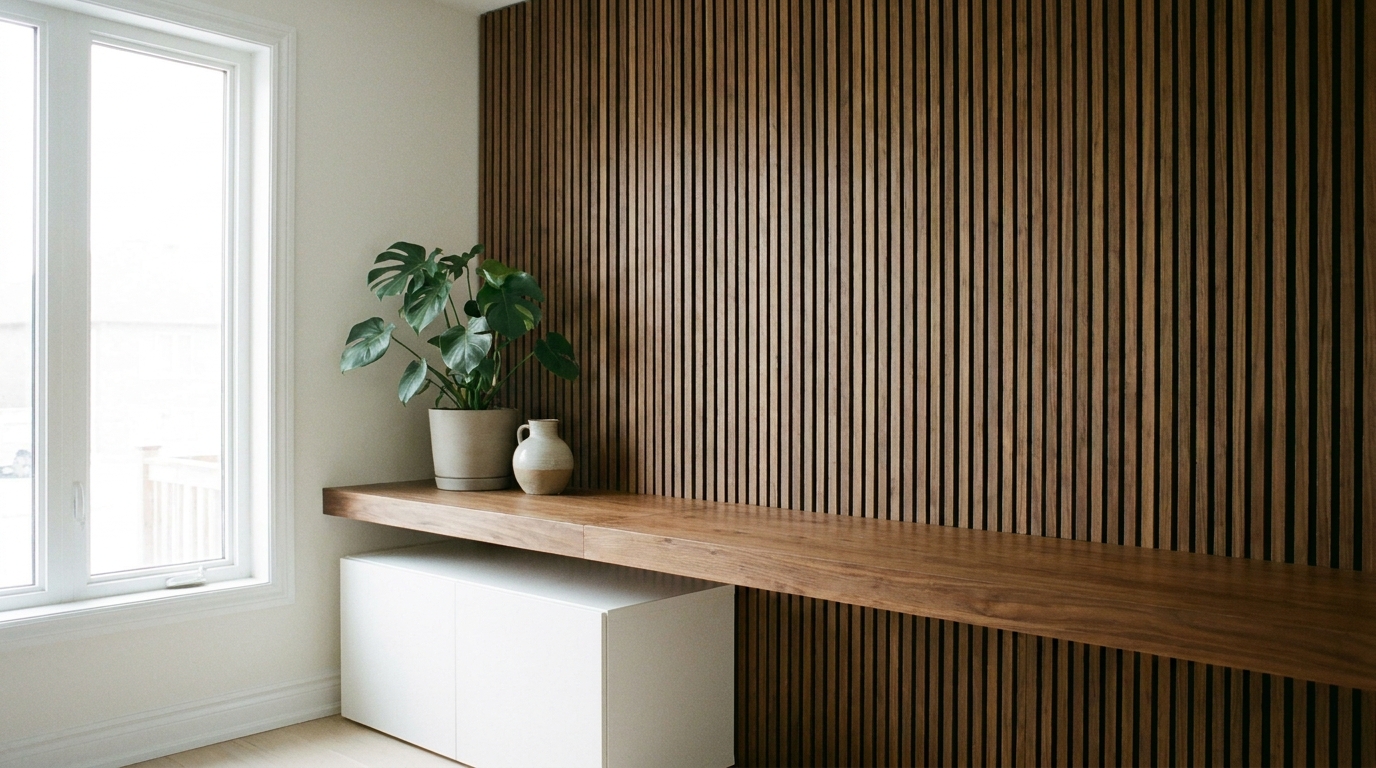
Real wood veneer slats sit on a felt backing made from recycled materials. Each panel is about 8 feet tall, and we cut it to the wall. Finishes include natural oak, walnut, and black, plus snow white, dusty gray, and midnight blue. We install them in living rooms, bedrooms, offices, and home theaters. That is a product description, not a lab score. Our specialties page does not publish a decibel reduction or a noise reduction coefficient for the panel, and we will not invent one.
At a boundary that is neither fully hard nor fully soft, part of a wave is reflected and the rest is absorbed or transmitted into the next material. [4] Felt is porous, so some energy is lost in the layer. The slats are the wood you see. The felt is not a second wall.
What can change is the tail of sound in the room you occupy. Reverberation time is how long sound takes to drop 60 decibels. In its May 2024 facilities standard, the General Services Administration averages the 500, 1,000, and 2,000 Hz bands for its absorption targets, and it calls for sound-absorbing finishes so speech stays intelligible, sound travels less far in an open plan, and the room has fewer distractions and lower noise levels. [1] That is an in-room effect. It is not a promise that a meter beyond the wall will fall by a stated amount.
One soft surface can help and still miss a tidy forecast. In 2001, Daniel A. Russell measured a cement-block room before and after carpet. His 1,000 Hz reading, on a page updated in 2024, was about 3.3 seconds empty and about 1.6 seconds with carpet. A Sabine estimate for that band was about 2.6 and about 0.93 seconds, about 0.7 seconds shorter than the measurement. He traces that gap mainly to ceiling pockets the formula ignores, and he also notes that the formula assumes absorption spread around the room, which a carpeted floor alone is not. [5] Those times are for that room and that carpet, not for felt in a house.
Pitch matters in the same table. Carpet on concrete is listed at 0.02 at 125 Hz and 0.60 at 2,000 Hz, while painted block stays between 0.05 and 0.10 across 125 to 4,000 Hz. [5] Felt is in the porous family. It is not that carpet, and it does not inherit those coefficients. Bass from a subwoofer, a dryer, or traffic is a weak match for a thin porous layer. Speech consonants sit higher, which is why a hard room can muddy talk without being loud.
A fair expectation: less echo on a call in a hard room. Not a studio, and not relief from a low hum.
3. What the panel cannot do between rooms
GSA separates the jobs in one chapter. Speech privacy depends on background sound, absorptive finishes, and the isolation of interior and exterior assemblies together. Absorption controls reverberation. Isolation is the exterior construction, partitions, floors, doors, and windows that limit transfer between rooms. [1] A panel supplies only the finish.
The isolation examples are heavy and sealed. The NIC 40 office example is a single stud wall with two gypsum layers on one side, one on the other, batt insulation, and a height to the slab or at least above the ceiling, with a comparable door once the partition is at NIC 40 or above. Higher examples at NIC 45, 48, and 53 add gypsum, and the upper ones use staggered or double studs run slab to slab. [1] Felt behind slats has little mass, is not airtight, and sits on a wall you already have.
Privacy also moves with background sound. A partition that covers speech while the mechanical system runs may not cover it when the system cycles off. [1] A slat panel does not make that background, seal a door gap, or add gypsum.
GSA calls STC 40, a lab rating under ASTM E90 for elements such as walls, doors, and windows, the onset of privacy. At STC 45, loud speech is barely audible. At STC 50, loud speech is not audible and shouting is barely audible. The same section notes that a field rating, NIC, can come in lower than lab STC because sound also travels around the partition. [1] Those numbers describe assemblies, not this panel.
A GSA workplace guide updated March 25, 2026, keeps the two jobs on different lines. Sound-absorbing materials, carpet included, are listed to dampen open offices and to support speech intelligibility and speech privacy. High sound transmission class and noise isolation class walls are listed separately to limit sound leaving conference rooms and private offices. [6]
Say the limit before you buy. These panels do not stop sound passing through the wall, a hollow door, or a window on a road.
4. One accent wall still leaves five other surfaces
Carpet on one of six surfaces still left Russell's room fairly live: about 1.6 seconds at 1,000 Hz. [5] A single slat wall leaves the ceiling, floor, glass, desktop, and the other walls reflective.
GSA's May 2024 table shows the scale used for federal workplaces. A baseline private office is listed at 0.6 seconds, with a ceiling noise reduction coefficient or sound absorption average of 0.80 over the full ceiling where masking is used, or 0.75 where it is not. The wall column is marked n/a on those office rows. Meeting rooms add 0.8 on 25 percent of the walls, on two adjacent walls. Frequent video rooms tighten to 0.5 seconds, a 0.90 ceiling, and the same wall share. A footnote says still more absorption may be needed to hit the time. [1]
Those targets are not a score for our panels, and a house does not have to meet them. They show that speech, especially on camera, is asked to use a lot of area, much of it overhead. One run about 8 feet tall is a contribution, not a 0.6 or 0.5 second result. Glass and a bare desktop keep reflecting. A rug or an upholstered chair is simply another porous surface, which is why a furnished room rarely sounds empty. We will not give you a blanket, foam, or homemade-panel recipe. If this finish belongs, we size and install it. If the ceiling is the bigger reflector, we will say that.
Place it where the voice hits. The wall behind the desk, or the wall a sofa faces, matters more than a panel hidden behind the door.
5. Pair the panel with closed storage
A slat wall has no drawer and no home for the router. Cabinets on that wall, or on the return, are how it still holds daily life. Sound and storage are neighbors, not the same job.
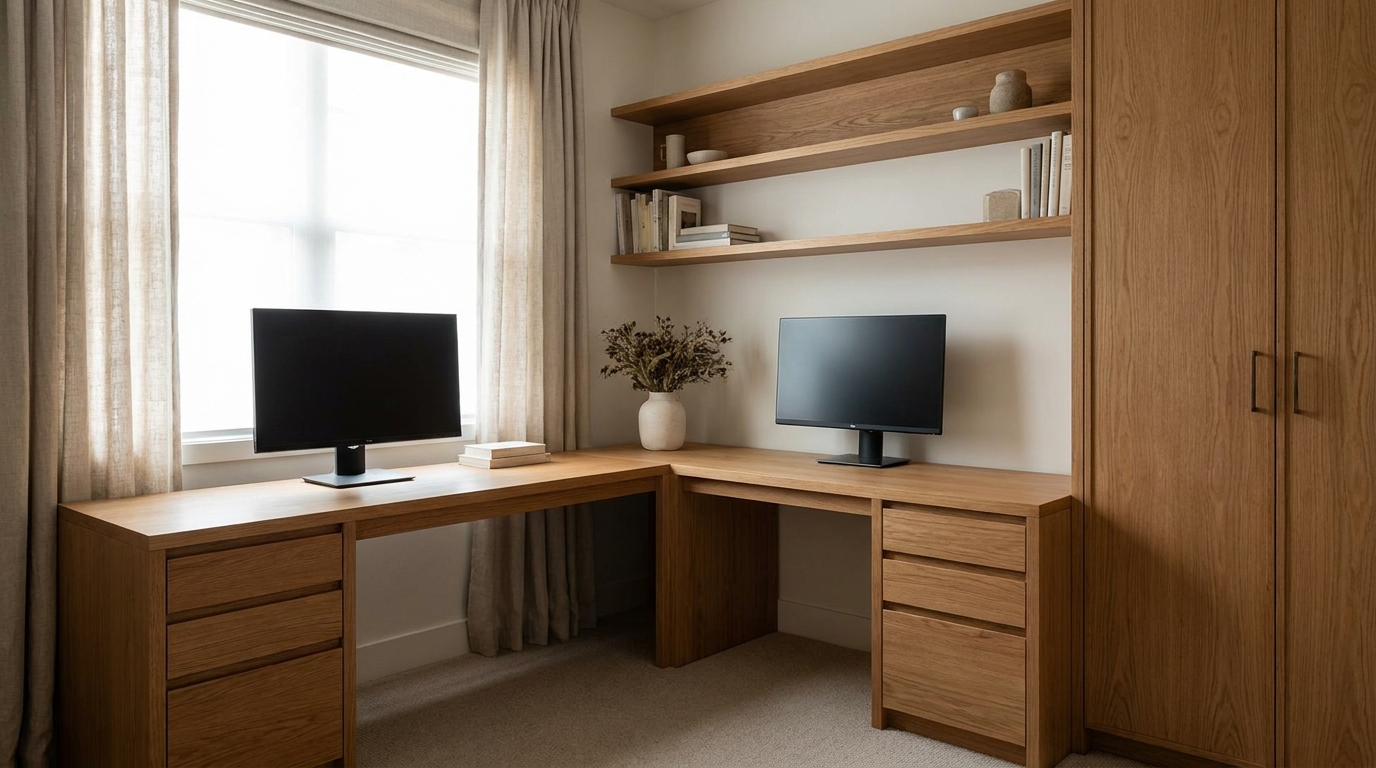
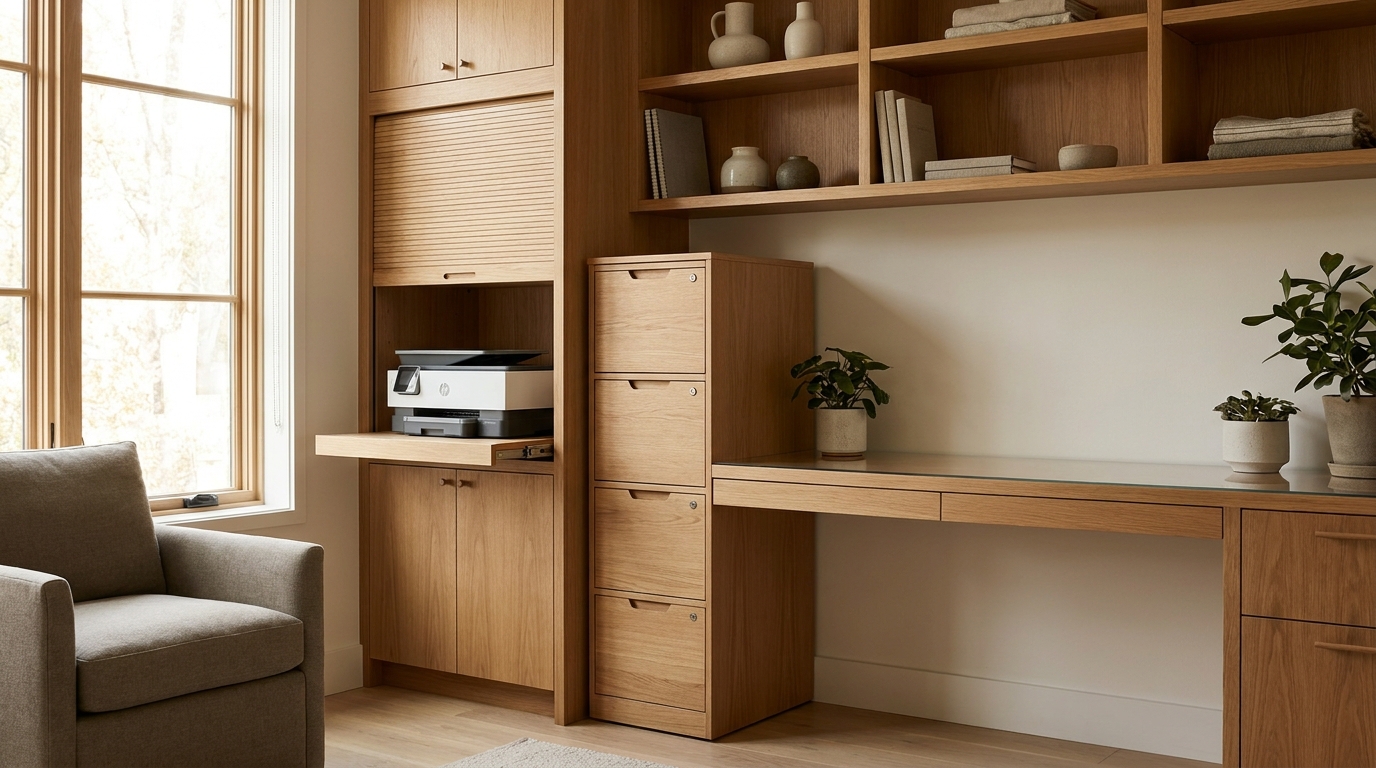
An office usually has to hold books worth seeing, books to hide, paper and supplies, and the cable knot. Open shelves do the first. They fail the rest. A power strip on an open shelf does nothing for echo. Doors and drawers get those items off the desk. Our office and living space work covers desks, files, shelves, and a cable path. The cabinets are what let the slats stay a finish instead of a shelf for clutter.
A layout we draw often looks like this:
- A felt-backed slat field on the wall that faces the voice, stopped where the desk, a window, or a door needs the space.
- Base cabinets or a credenza under or beside that field, with a door for the cables and a drawer for supplies.
- A short run of open shelves only for books and objects you want on view.
- A desktop with a grommet or a rear channel, so cords drop into the closed bay instead of across the slats.
Cabinet faces are hard, so they reflect. A door is not the felt, and the felt is not a cabinet. Together, the wall can look finished and still hide the pile that usually lands on the desk.
A living room splits the same way. Controllers and a console need a door. Speech from the sofa, and a screen bouncing off a bare wall, are the reflection question. A slat field beside the screen can calm the wall people face. This is not a cabinet-and-cable tour. One job is the bounce. The other is whether the equipment has a door.
Oak or walnut can sit with a warm wood box. Black or midnight blue can sit with paint. Snow white and dusty gray suit a light room. Color does not change the felt. It decides whether the slats and the doors read as one wall.
Leave room for the switch, the vent, and the door swing. We measure before a full-height run. The cable door has to clear the chair, and the desk outlet has to stay usable.
6. How we decide whether the panel belongs
On a visit we listen for two things. If the room stays lively after you stop talking, felt can help the reflection. If you hear the next room while this one is quiet, that path is the building, and we will say so. Many houses around Charlotte, including in Ballantyne, share the office wall with a living area or a bedroom. A clearer call and privacy from the bedroom are two projects. We design the first. We do not sell the panel as the second.
We also look at what the wall must hold. Slats with no cabinet lose to files and a printer. A wall that is already closed storage, with a hard face over the desk, may need the absorptive field rather than another shelf. Photos help. They do not replace the measure, the door swing, or the sound of someone talking.
We install the work ourselves. We publish no decibel claim, because these sources do not support one for this product, and because the ceiling, the glass, and the door decide more than a coefficient. If the room should hold the work and sound less harsh while you are in it, the panel and the closed storage are a pair we can draw. Silence on the other side of the wall is a different scope, and we will say so before you spend the money.
Practical takeaways
- Felt-backed slats work on reflections in the room. They do not stop sound leaving or entering.
- NIOSH's 85 dBA workday limit, the level where you often must raise your voice at 3 feet, is a hearing-risk line, not an echo problem. [2]
- EPA's 1974 indoor figure of 45 decibels is an identified long-term average for activity and speech, not a panel result. [3]
- One soft surface can shorten the tail and still leave a live room. Carpet in a 2001 test cut 1,000 Hz decay from about 3.3 seconds to about 1.6, and the formula missed. [5]
- Federal criteria keep finishes separate from walls, doors, and windows, and they name a 0.6 second private-office target only with broad ceiling absorption. [1]
- Cabinets hold books, supplies, and cables. Hard doors do not replace the felt.
- Rumble, street noise, and the next room need the source and the building.
How we can help
Have more questions or want to get in touch? We design and install the panel and the closed storage as one wall, and we would rather talk through the room than guess from a photo. Reach us at https://theclosetrehab.com/contact-us/, call (704) 604-3870, or email design@theclosetrehab.com.
Citations
- U.S. General Services Administration, "Facilities Standards for the Public Buildings Service (P100), 2024" (2024-05)
- National Institute for Occupational Safety and Health, CDC, "Noise-Induced Hearing Loss" (2024-01-30)
- U.S. Environmental Protection Agency, "EPA Identifies Noise Levels Affecting Health and Welfare" (1974-04-02)
- Daniel A. Russell, Penn State Graduate Program in Acoustics, "Reflection of Sinusoidal Waves from Boundaries" (2011-10-08, HTML updated 2025-07-25)
- Daniel A. Russell, Penn State Graduate Program in Acoustics, "Reverberation Time in a Small (but very reverberant) Room" (measurements 2001; page updated 2024-01-16)
- U.S. General Services Administration, "Space reconfiguration, renovation, and construction" (2026-03-25)