Home Office File Storage: Printer Garage and File Tower
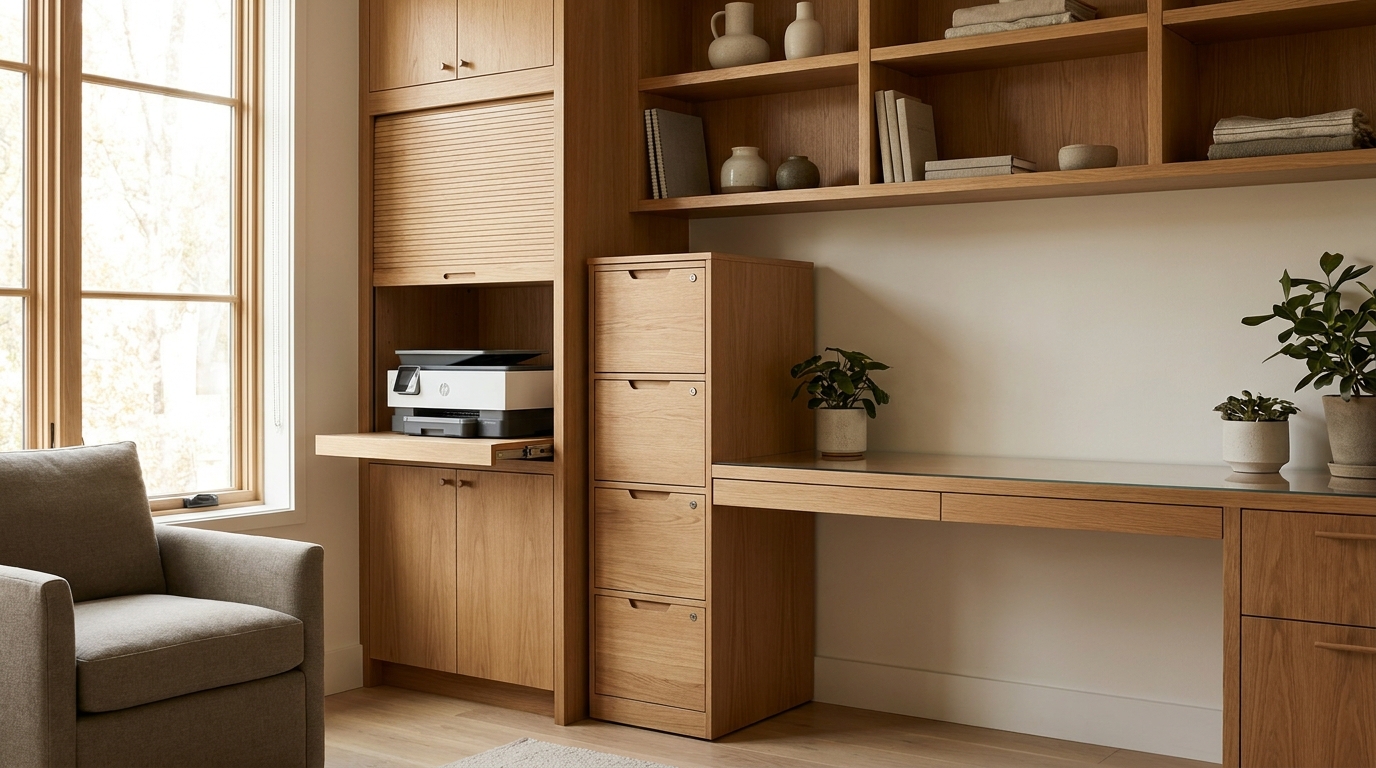
Home office file storage works when paper, toner, and the printer leave the desk. A closed printer garage hides the machine, holds noise and dust off the work surface, and still lets air move when the unit runs. A lockable file tower next to it holds tax returns, titles, and identity documents so the desktop stays a keyboard, a mouse, and the page you are actually using. That pair is not a full office wall system and it is not a craft-room supply cabinet. It is two jobs: park the printer, lock the records.
1. Why the desk fills with paper, toner, and the printer
A home office in Charlotte, Fort Mill, or Ballantyne often starts as a spare bedroom with a table. The printer lands on the desk because that is the only surface with an outlet. Paper reams stack beside the monitor. Tax envelopes, warranty packets, and school forms land in a pile "for later." Toner boxes and a shredder crowd the knee space. Within a month the desk is a staging table, not a work surface.
OSHA's computer-workstation guidance is blunt about that pattern. Limited space on the work surface can push the mouse, keyboard, and monitor into awkward positions. OSHA even labels one diagram "Poor mouse and keyboard placement because of desktop clutter."[8] Under the desk is not a substitute archive. Clearance under the work surface should stay free of files, computers, books, and storage so you can change posture and keep your legs clear.[8] A CPU, a paper crate, or a file box under the knees is the same problem in a different place.
The printer makes the clutter worse because it is both a machine and a supply dump: the unit, the reams, the toner, and the output stack all compete for the same rectangle. None of that belongs in the primary work zone (the arc where your hands already reach the keyboard and phone).[8] The garage and the file tower take those items off the surface without turning the room into a built-in office wall.
2. What a printer garage actually does (and what it is not)
A printer garage is a closed cabinet, niche, or pull-out bay sized for one all-in-one or laser unit, with a shelf or drawer for paper and consumables. Doors close when you are not printing. They open, or they stay louvered, when the job is running. It is the office cousin of an appliance garage, but it is not a pantry cabinet and it is not a hobby-supply wall.
What the garage is for:
- Hide the machine so the desk face stays a work surface.
- Contain noise so a print job does not sit next to the phone.
- Contain dust and paper grit so toner and trimmings do not spread across the keyboard.
- Stage paper and toner on a dedicated shelf, not on the blotter.
What it is not:
- A sealed box with no airflow.
- A full-height office wall of cabinets, a desk, and display shelves.
- A craft station for glue, markers, and project bins.
OSHA treats office equipment noise as a layout problem, not a personality problem. Sound levels should be considered when you choose and place equipment. Loud machines belong where they do less harm (OSHA's example is a shredder kept away from people on the phone). Barriers, walls, or dividers can isolate a noise source.[7] A printer garage is that divider with a door. Put the bay on a side wall or at the far end of a run, not under your monitor.
Typical hardware we specify as a set:
- A closed cabinet or niche deep enough for the printer plus cable slack, with doors that open fully so you can clear jams.
- A pull-out shelf or tray so the unit slides forward for toner changes without dragging the whole cabinet.
- A paper shelf above or below the machine, sized for a ream plus envelopes, not a warehouse stack.
- A small locked drawer for spare toner and a backup drive, so consumables are not sitting in the open.
- Louvers, a slotted back, or doors that stay open during a job so heat and emissions can leave the box.
3. Ventilation, heat, and noise around a closed printer bay
Closing the doors is the point of a garage. Sealing the machine in still air is not. EPA lists copiers, printers, and fax machines among office equipment that can give off pollutants and odors, and it says those items need adequate and sometimes separate ventilation.[9] Printing and copying also produce particles that can stay in the air.[9] EPA's VOC pages name office equipment such as copiers and printers as indoor sources, and they note that concentrations of many VOCs are consistently higher indoors (up to ten times higher) than outdoors.[10][11]
That is why a printer garage has to breathe:
- Do not block room supply vents or return grilles with the cabinet, a paper stack, or the printer itself. EPA tells occupants to keep vents unblocked so the HVAC system is not thrown off.[9][13]
- Give the machine clearance on the sides, back, and top so its own fans can move air. A tight, solid-door box with no gaps fights that.
- Open the doors (or use louvers) while a job is running. EPA's steps to reduce VOC exposure start with increasing ventilation when products that emit VOCs are in use, and with providing plenty of fresh air.[11]
- Keep heat-producing equipment away from a thermostat. EPA notes that computers and other heat-producing gear placed near an HVAC sensor can trick the system into overcooling the room.[9]
- Place the garage with air circulation in mind, not only with looks in mind. EPA asks office managers to place furniture, partitions, and equipment so air can circulate, temperature can be controlled, and pollutants can be removed.[9]
Copying machines show up on EPA's list of common office pollutant sources.[13] A home office is not a print shop. It still benefits from the same idea: isolate the source, then ventilate it. In a closed Fort Mill or Wesley Chapel spare bedroom, that often means a louvered garage on an interior wall, not a printer sitting under a supply vent or crammed into an unvented closet. Open the door for the job. Close it when the pages are in the output tray.
4. The lockable file tower: records that must leave the desk
The second half of the pair is home office file storage in a lockable file tower: a tall, narrow unit of letter or legal drawers (or a mix of file drawers and a locking cupboard) that stands beside the desk, not on it. The tower holds active paper. The desk does not.
The Federal Trade Commission is direct about paper that carries identity. Keep financial records, Social Security and Medicare cards, and any other documents with personal or financial information in a safe place. When you no longer need them, shred them before you throw them away.[4] In a June 2025 consumer alert, FTC staff framed the job as what to keep and lock up versus what to shred or delete.[3] MIT's records-management guidance, written for campus offices but useful in a house, says to store active records onsite in a secure, stable environment and to use lockable file cabinets and desk drawers for medium- and high-risk information. "Two lock" storage is best: a lockable drawer inside a lockable work area.[12]
FTC's "keep forever, and lock up" list is the core of a locked tower, not a desktop tray:[3]
- Birth certificates or adoption papers
- Social Security cards
- Valid passports and citizenship or residency papers
- Marriage licenses and divorce decrees
- Military records
- Wills, living wills, powers of attorney, and retirement and pension plans
- Death certificates of family members
- Vital health records (especially those that pre-date electronic records)
For disaster readiness, FTC also recommends a lockable, fireproof file box in a secure, handy place so you can grab it and go, plus a safe-deposit box for originals you rarely need (except a will, which FTC says to leave with an attorney).[5] A file tower can hold that box on a low shelf. It should not replace the box for the handful of documents you would carry out of the house.
Assign drawers instead of a heap: a locked top or cupboard for passports, Social Security cards, and the fireproof box; active files for this year's receipts and insurance; a tax drawer for returns you are still required to keep; a property drawer for titles, deeds, home-improvement receipts, leases, and warranties you keep while you own the item;[3] and a shred-staging bin emptied on a set day. OSHA's office-safety rules add a physical layer. Filing cabinet drawers must stay closed when not in use. Heavy objects belong at low levels. Aisles stay clear of obstructions.[7] An open file drawer in a Waxhaw hallway is a trip hazard. A closed, locked drawer is storage.
5. How long records stay in the tower
A lockable tower is not a museum. It is a timed archive. The IRS states that how long you keep a document depends on the action, expense, or event it records. In general, keep records that support income, deductions, or credits until the period of limitations for that return runs out.[1] IRS Topic 305 repeats that you must keep receipts, canceled checks, and other supporting documents as long as they may become material, which generally means until that limitations period expires.[2]
IRS periods that apply to income-tax returns (years after the return is filed, with returns filed early treated as filed on the due date):[1]
- 3 years if the longer periods below do not apply.
- 3 years from filing or 2 years from payment, whichever is later, if you file a claim for credit or refund after you file.
- 7 years if you claim a loss from worthless securities or a bad-debt deduction.
- 6 years if you do not report income you should have reported, and it is more than 25 percent of the gross income shown on the return.
- Indefinitely if you do not file a return, or if you file a fraudulent return.
- At least 4 years for employment-tax records, after the tax becomes due or is paid, whichever is later.
Property records follow a different clock. Keep records relating to property until the period of limitations expires for the year you dispose of it, because you need them to figure basis, depreciation, and gain or loss.[1][2] FTC's June 2025 alert lines up with that: keep titles, deeds, home-improvement receipts, leases, and major-appliance warranties while you own the item, and keep tax returns and related documents at least three years (longer when the IRS says so). If you can reach the same records electronically, FTC says to consider shredding the paper copies.[3] When the date is past, shred ATM receipts, credit offers, cleared checks (after 14 days), credit reports, expired warranties, and expired IDs.[3] The tower holds what is still live. It should not become a permanent pile.
6. Tip-over, one-drawer use, and anchoring a tall file unit
A lockable tower is useful only if it stays upright. CPSC staff's February 2024 report on product instability (injuries for 2020 through 2022, fatalities reported from January 2013 through July 2023) describes how furniture becomes unstable: a small footprint, a top-heavy load, carpet or another sloped surface, unused or defective tip-over restraints, heavy objects on top, or multiple open drawers.[6] Those are file-tower conditions, not only dresser conditions.
From 2020 through 2022, U.S. emergency departments treated an estimated annual average of 17,800 people for tip-over injuries related to televisions, furniture, and appliances. About 14,500 of those injuries (82 percent) involved furniture. Children under 18 accounted for about 7,800 injuries (44 percent), even though they were about 22 percent of the population in those years.[6] Among furniture-related injuries to children, CPSC staff estimated about 1,000 involved shelving, a shelving unit, or a bookcase, and about 1,200 involved other furniture, including cabinets and stands.[6] We do not treat a file tower as a clothing dresser under the STURDY clothing-storage rule. We do treat it as tall furniture with drawers that can go over if it is top-loaded or pulled open too far.
Build and use the tower so it stays put:
- Anchor the case to wall studs with a proper restraint. CPSC staff lists unused restraints as an instability factor.[6]
- Open one drawer at a time. Multiple open drawers are named in the same report.[6]
- Load heavy files low. OSHA says heavy objects should be stored at low levels.[7] Put dense paper and the fireproof box in the bottom, not on the crown.
- Do not park extras on top. Heavy objects on top of furniture are another named factor.[6] A printer on a file tower stacks tip-over risk with blocked airflow.
- Close drawers when you walk away, which also keeps aisles clear.[7]
- Watch carpet and slope. CPSC staff notes that carpet or another unstable surface can affect stability.[6] A level, anchored install in an Indian Land or Rock Hill carpeted bedroom matters more than a decorative crown.
A two- or three-drawer tower beside the desk is easier to keep stable than a six-drawer stack. If you need height for years of paper, we still specify a low center of gravity, an anti-tip interlock when the hardware allows it, and a wall anchor. The lock protects privacy. The anchor protects people.
7. A two-piece layout that keeps the desk a work surface
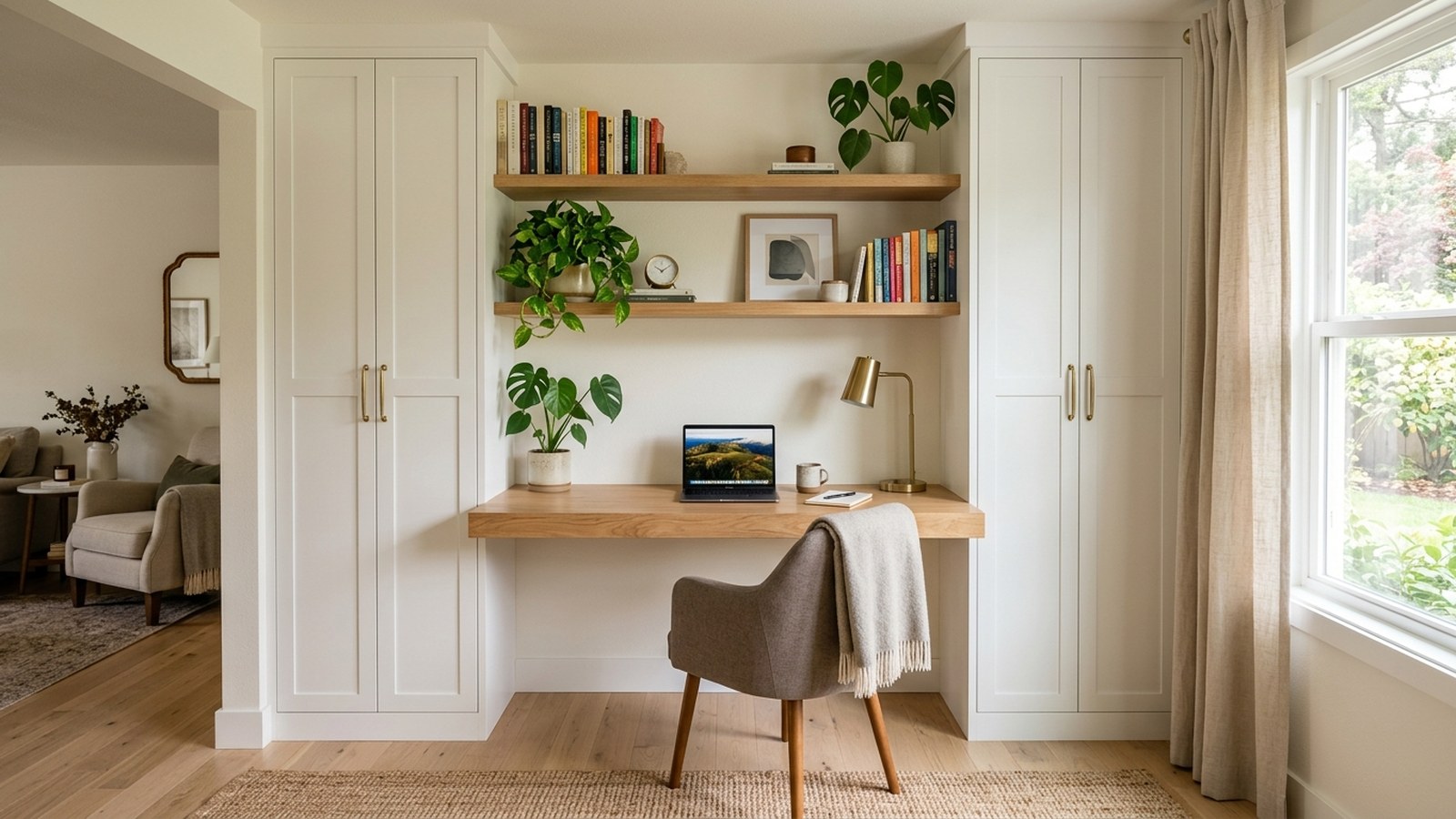
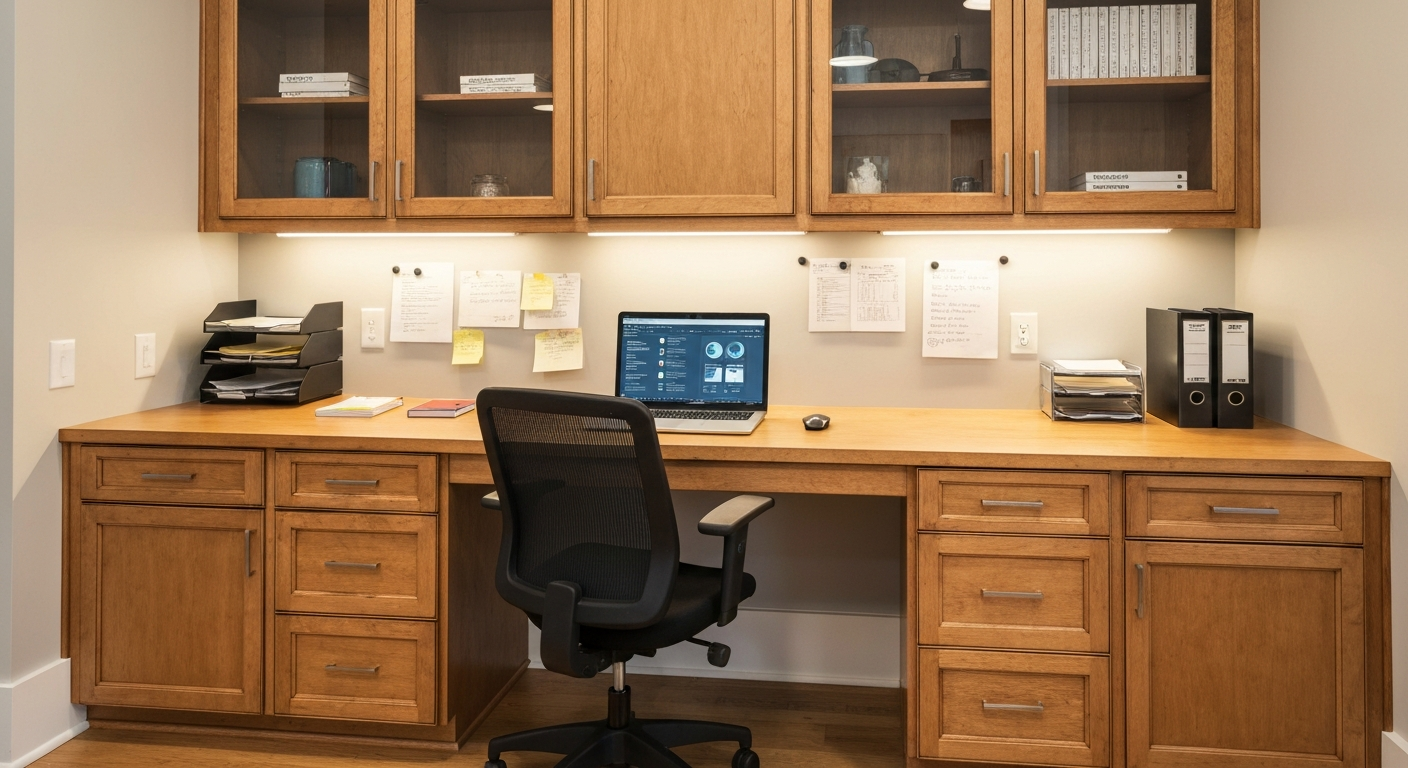
On our lifestyle home office work, filing drawers and document storage are already part of the kit. The layout we mean here is narrower than a full built-in office wall. It is a desk that stays clear, a printer garage on one flank, and a lockable file tower on the other (or both functions in one short run).
- Desk: monitor, keyboard, mouse, a document holder, a lamp. No printer. No ream of paper. No tax pile.
- Printer garage: closed when idle, ventilated when running, paper and toner inside the same bay.
- File tower: locked drawers for identity and tax paper, a low shelf for the fireproof box, a shred-staging spot.
- Knee space: empty, matching OSHA's under-desk clearance so files and CPUs are not living under your legs.[8]
- Path: drawers that do not open into the walkway, doors that do not swing into the chair.
Homes in Wesley Chapel, Waxhaw, and Ballantyne often give us a spare-bedroom wall that is only eight or nine feet wide. That is enough for this pair. It is not the brief for a floor-to-ceiling office library. Craft supplies belong somewhere else. Tax returns and a laser printer do not share a cubby with scrapbooking. Measure the printer and the hanging-file rails before you size either piece, leave service clearance, and put the lock where you will use it every day.
Practical takeaways
- Give home office file storage its own locked tower so the desk is not the archive.
- Park the printer in a closed garage with louvers or doors that open during a job. Do not seal the machine in a dead box.[9][11]
- Keep paper, toner, and output off the primary work zone.[8]
- Lock up identity documents and shred what has passed its date.[3][4]
- Keep tax records at least three years (longer when IRS rules say so) and keep property records until you dispose of the property plus the limitations period.[1][2][3]
- Anchor a tall file unit, load heavy drawers low, open one drawer at a time, and keep extra weight off the top.[6][7]
- Use a lockable, fireproof grab-and-go box for the few papers you would carry out in an emergency.[5]
- Two jobs, two pieces of furniture. Not a full office wall. Not a craft-room cabinet.
How we can help
Our team designs printer garages and lockable file towers as part of a home office that still looks like a room you want to sit in. We measure the machine, the files, and the wall, then build a closed bay and a locked tower that leave the desk clear. If you work from a spare bedroom in Charlotte, Fort Mill, Rock Hill, or nearby towns, we will plan the pair around the way you actually print and file, not around a catalog wall of unused cabinets.
Have more questions or want to get in touch?
https://theclosetrehab.com/contact-us/
(704) 604-3870
design@theclosetrehab.com
Citations
- Internal Revenue Service, "How long should I keep records?" https://www.irs.gov/businesses/small-businesses-self-employed/how-long-should-i-keep-records
- Internal Revenue Service, "Topic no. 305, Recordkeeping." https://www.irs.gov/taxtopics/tc305
- Federal Trade Commission, "Protecting your personal information: Which documents to keep and which to shred" (June 10, 2025). https://consumer.ftc.gov/consumer-alerts/2025/06/protecting-your-personal-information-which-documents-keep-which-shred
- Federal Trade Commission, "What To Know About Identity Theft." https://consumer.ftc.gov/articles/what-know-about-identity-theft
- Federal Trade Commission, "How To Organize Your Important Papers Before a Disaster Strikes." https://consumer.ftc.gov/articles/how-organize-your-important-papers-disaster-strikes
- U.S. Consumer Product Safety Commission staff, "Product Instability or Tip-Over Injuries and Fatalities Associated with Televisions, Furniture, and Appliances: 2023 Report" (February 2024). https://www.cpsc.gov/s3fs-public/2023_Annual_Tip_Over_Report_Posted_2024Feb_FINAL_0.pdf
- Occupational Safety and Health Administration, "Field Safety and Health Management System (SHMS) Manual, Chapter 6: Office Safety and Health." https://www.osha.gov/shms/chapter-6
- Occupational Safety and Health Administration, "eTools: Computer Workstations, Workstation Components, Desks." https://www.osha.gov/etools/computer-workstations/components/desks
- U.S. Environmental Protection Agency, "An Office Building Occupant's Guide to Indoor Air Quality." https://www.epa.gov/indoor-air-quality-iaq/office-building-occupants-guide-indoor-air-quality
- U.S. Environmental Protection Agency, "What are volatile organic compounds (VOCs)?" https://www.epa.gov/indoor-air-quality-iaq/what-are-volatile-organic-compounds-vocs
- U.S. Environmental Protection Agency, "Volatile Organic Compounds' Impact on Indoor Air Quality." https://www.epa.gov/indoor-air-quality-iaq/volatile-organic-compounds-impact-indoor-air-quality
- MIT Libraries, Records Management, "Storage of records." https://libraries.mit.edu/records-management/tips-best-practices/storage/
- U.S. Environmental Protection Agency, "Do You Suspect Your Office Has an Indoor Air Problem?" https://www.epa.gov/indoor-air-quality-iaq/do-you-suspect-your-office-has-indoor-air-problem