Craft Room Storage That Keeps the Work Surface Clear
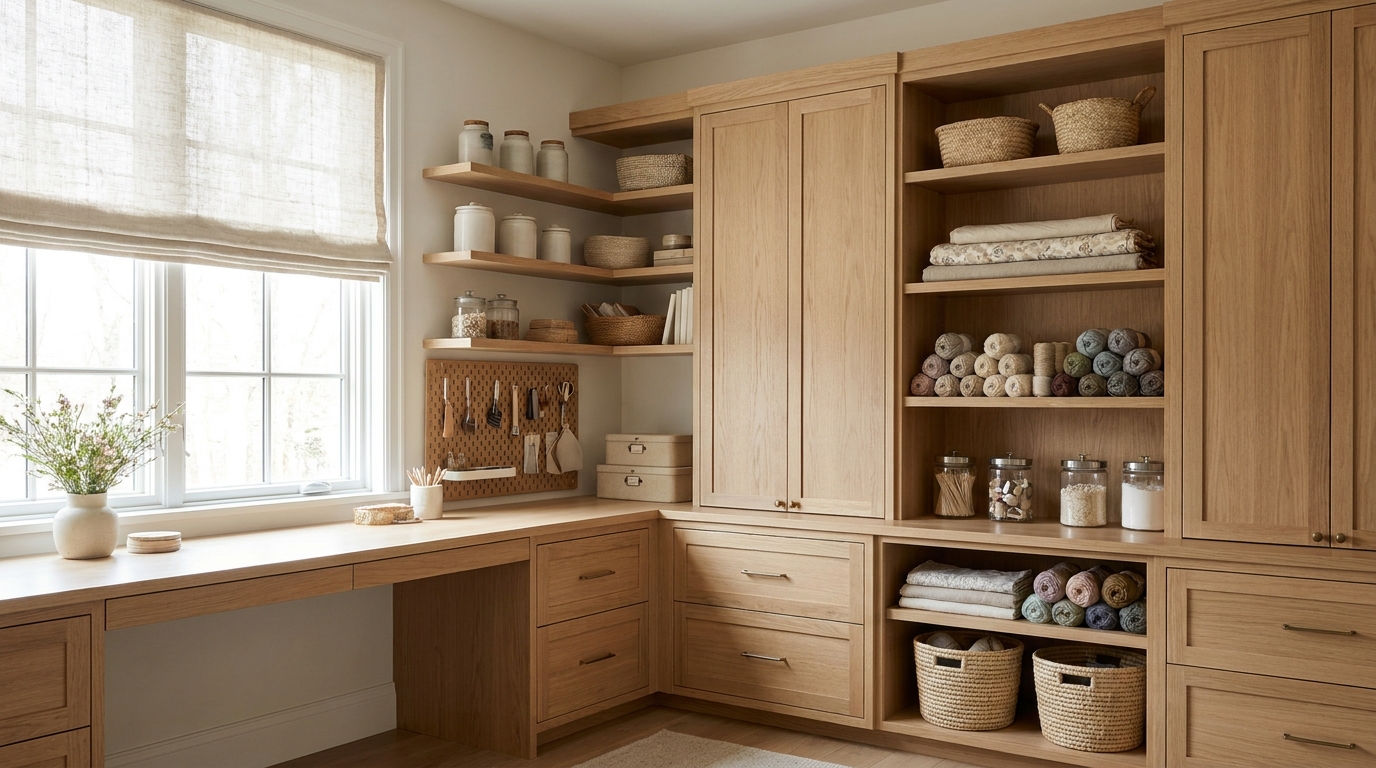
A craft room stays usable when paper, tools, fabric, and kits live in closed, labeled homes and the work surface holds only the project in front of you. Open tubs park inventory on the table. Built-in craft room storage assigns each category a drawer, cubby, or locked box so the desk is a work plane, not a dump zone. Paper wants a cool, relatively dry, dark cabinet, not an attic shelf. [4] Hobby products and craft adhesives can release indoor air pollutants while they sit on a shelf, not only while you use them. [2] Children's materials belong in labeled containers, stored after each session, and kept apart from adult solvents. [1][5]
1. Why a hobby room fills the table
Most failed craft rooms fail the same way. Supplies arrive faster than homes get assigned. Paper leans in a pile. Rotary cutters share a mug with markers. A kit's leftover parts sit in the shipping box on the only clear stretch of desk.
The table becomes storage because nothing else is specific enough. A wide open shelf holds everything and protects nothing. You pull three items to reach the fourth.
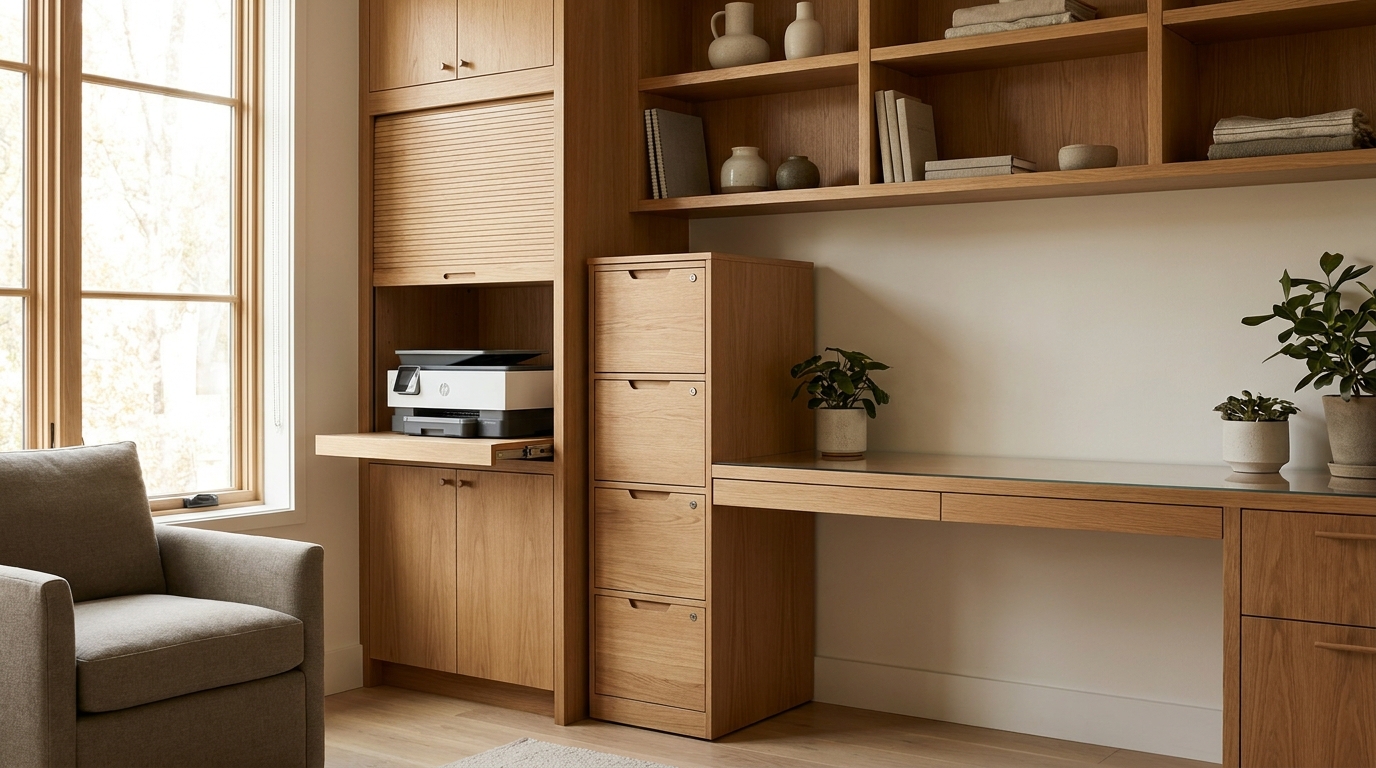
Containment is a layout decision, not a bin shopping trip. We start with the work surface and then build around it: shallow drawers for tools, vertical slots for paper, closed cabinets for fabric, and a lockable box for anything with a warning label. That is the idea behind the craft stations we design for home offices and hobby rooms: a work plane plus storage sized to the materials. If you need fifteen minutes to make room before you can sew or paint, the storage is wrong.
2. Paper, cardstock, and patterns belong flat and dark
Paper yellows, curls, and acid-burns its neighbors when it is stored like leftover mail. The Library of Congress treats documents, drawings, prints, and maps as works that last longer in good storage: cool (room temperature or below), relatively dry (about 35 percent relative humidity), clean, and stable. [4] Attics and basements are on the avoid list because they leak and swing hard in temperature and humidity. [4]
Keep paper off the work surface and out of the sun. LOC guidance calls for minimal exposure to all kinds of light and no exposure to direct or intense light, plus distance from radiators and vents. [4] A closed cabinet on an interior wall does that job. A stack on the windowsill does not.
Store sheets flat, or roll the oversize pieces. LOC recommends unfolded, flat storage, or rolled storage for oversized sheets, inside supportive enclosures such as acid- and lignin-free folders, mats, and document boxes. [4] Vertical slots sized to common pad sizes keep scrapbook paper and cardstock from slumping. Wide, shallow drawers work for patterns and cutting mats you want to see from above.
Isolate the acidic stuff. Newspaper, cheap construction paper, and old clippings can migrate acid into better sheets. LOC asks for individual or isolated storage of acidic papers so they do not contaminate the rest of the stack. [4] Give newsprint and school-paper leftovers their own box.
3. Fabric, yarn, and unfinished textiles need air and a liner
Dirt particles can cut fibers. Plastic bags trap moisture. Raw wood can acidify what sits on it. [7] University of Georgia Extension is direct: never wrap textiles in plastic, because plastic blocks air (a setup for mold and mildew), can give off chemicals, and (if it is clear) does not block light. [7] Do not let textiles sit in direct contact with wood, newspaper, or ordinary boxes. [7]
Closed cabinets beat open cubes for yardage. A door cuts light and dust. The George Washington University Museum tells collectors to store textiles in a cool, dry room and to avoid attics and basements, which usually lack climate control and swing the most. [6] Do not store pieces on the floor, where pests like the gap between carpet and the back of a rug. [6]
Pad folds. Do not press a hard crease for months. Flat storage without folds is the best method when space allows. If you must fold, UGA says to pad the folds with crumpled tissue or washed muslin, use as few folds as possible, and reposition those folds several times a year because textiles split where the same crease sits under pressure. [7] GWU adds that unpadded folds can weaken or break a brittle foundation. [6]
Line wooden drawers and shelves. GWU wants a buffer of acid-free tissue or barrier paper between wood acids and the textile, changed after two or three years. [6] UGA adds that a wooden interior should be sealed and lined, and that cotton, linen, and rayon should not sit in a cedar chest. [7] A finished cabinet plus a replaceable liner is the home version of that advice.
4. Tools, kits, and small hardware need one-layer drawers
Scissors, rotary cutters, needles, punches, and leftover kit parts disappear the moment they share a deep bin.
Give daily tools a shallow drawer at standing or seated reach. Full-extension slides bring the back of the drawer into the light. If you have to lift three tools to see the fourth, the box is too deep.
Kits stay together until they are done, then they get broken down. An unfinished kit is a project. A finished kit's leftovers are inventory. We plan a working-kits shelf at eye level, then a parts drawer (beads, findings, spare screws, extra yarn) once the kit is closed out. Mixing those two states is how the desk collects orphan bags.
Label the cell, not only the cabinet. Put a label on the drawer face and, for smalls, on the insert so the item goes back in one motion instead of landing on the table "for now." CPSC's art-and-craft safety rules for children include keeping food and drinks out of the art area. [1] That rule is good adult practice too.
5. Glues, solvents, paints, and finishes need a closed, labeled cabinet
This category should never live on an open shelf above the desk or in a cup on the table.
EPA lists hobby supplies, plus graphics and craft materials such as glues, adhesives, permanent markers, and photographic solutions, among household sources of volatile organic compounds. [2] Those products can release organic compounds while you use them and, to some degree, while they are stored. [2] Concentrations of many VOCs are consistently higher indoors (up to ten times higher) than outdoors, and gases can leak even from closed containers. [2] Follow the label, use fresh air, buy only what you will use soon, dispose of unused containers properly, and keep what you keep out of reach of children. [2]
Leave products in the original container. University of Georgia Extension's household-product guidance (revised in 2025) says to leave the product in its original container with the original label, and never store household products in food or beverage containers. [8] CPSC says the same for studio chemicals: avoid food containers, keep containers tightly closed, and never remove or deface a manufacturer's label. [1]
Lock the hazardous set. CPSC tells studios to store toxic materials in a locked cabinet, keep children out of rooms where toxic chemicals are used, and store surplus materials away from children. [1] UGA tells households to store hazardous products on high shelves or in locked cabinets, out of reach of children and animals, and to keep volatile products in a well-ventilated area. [8]
Treat flammable solvents as a fire problem, not a drawer problem. CPSC says to buy and store the smallest amounts of flammable or combustible materials needed, keep heat and ignition sources away, and store those solvents in fire safety cans in an OSHA-approved fireproof cabinet, kept closed and vented if local codes require it. [1] Solvent-soaked rags can heat themselves and ignite. They belong in a covered container that does not allow air in or vapors out. [1] We put that lockable cabinet next to the work surface, not mixed with paper or fabric.
6. If children use the room, split the inventory
A family craft room is two rooms that share a table: a kids' supply set and an adult supply set.
CPSC recommends that parents buy only art materials labeled "Conforms to ASTM D 4236" and that do not carry cautionary warnings. [1] HealthyChildren guidance from the American Academy of Pediatrics (updated July 2024) repeats that ASTM D-4236 check, adds the Approved Product seal from the Art and Creative Materials Institute as a useful extra, and tells parents not to buy materials labeled "Keep Out of Reach of Children" or carrying the words poison, danger, warning, or caution. [5] Water-based supplies are the better default because they do not contain chemical solvents. [5]
Kids' materials get their own low, labeled drawers. HealthyChildren says to supervise children, wash hands with soap and water, and make sure supplies are properly labeled and stored when the project is done. [5] CPSC adds: store surplus away from children, give only small amounts, and have adults mix powdered or extremely dusty materials. [1]
Adult solvents, spray paints, and anything with a hazard label go in the locked cabinet. HealthyChildren tells home painters to keep children and other family members out of studios and other locations where potentially hazardous materials are used, stored, or thrown away. [5] CPSC notes that children can be affected even when they are not the ones using the materials. [1] HealthyChildren also warns against donated or found materials unless they are in the original containers with full labeling. [5]
7. Light the work, not the stored inventory
The work surface needs light. The stored paper and fabric do not.
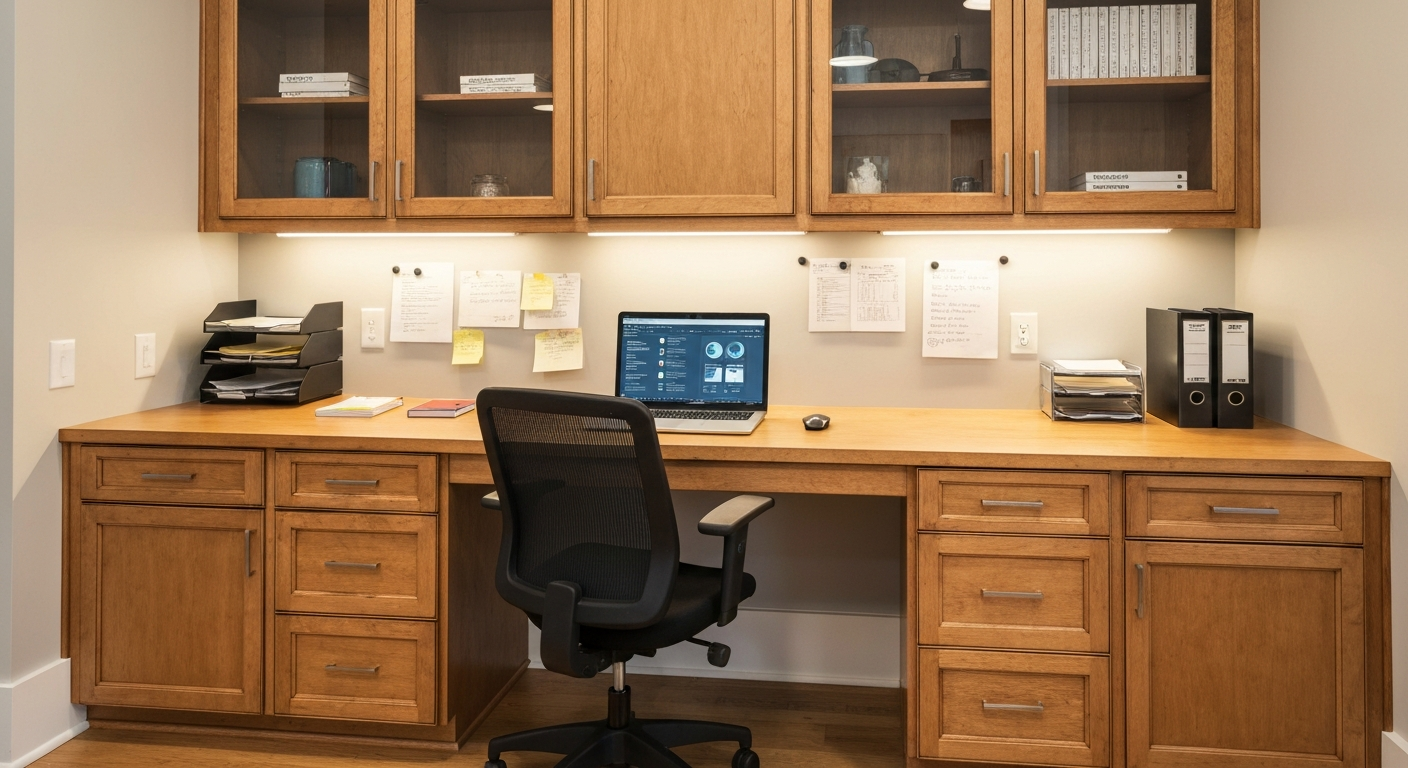
A 2019 California Lighting Technology Center guide, written around IES-linked practice for indoor spaces, describes task lighting as a supplement to ambient light that places light closer to the work area so users can switch it on when needed. [9] It should be bright enough to prevent eye strain without causing glare. Multiple sources can cast shadows that make close work harder. [9] Under-cabinet lights aimed at the cutting mat or sewing throat do that job.
Keep stored goods in the dark. LOC wants paper away from direct or intense light. [4] UGA wants textiles stored away from light because ultraviolet in sunlight and fluorescent lamps damages fibers. [7] Closed doors solve both. Park daily tools in a shallow drawer under the front edge of the work surface so the next pair of scissors is a drawer-pull away, not a climb.
8. Put the room in the conditioned part of the house
A bonus room over the garage, an unfinished basement, or a hot attic closet will undo a good cabinet plan.
LOC, GWU, and UGA all steer paper and textiles out of attics and basements and out of rooms that are not heated and cooled with the rest of the house. [4][6][7] EPA's home mold guidance (updated February 2026) says to keep indoor humidity below 60 percent, ideally between 30 and 50 percent relative humidity, and to measure it with an inexpensive meter. [3] That band sits next to UGA's textile target of about 50 percent and LOC's drier paper target of about 35 percent. [4][7]
Watch exterior walls and floor-level stacks. EPA treats condensation on windows, walls, or pipes as a cue to dry the surface and cut the moisture source. [3] Do not park paper or fabric on the floor. [6]
Ventilate when you use the smelly products, then close the cabinet. CPSC defines adequate ventilation as clean air flowing toward you and contaminated air flowing away. A fan that only stirs room air is not enough. [1] EPA says to increase ventilation when you use emitting products and to meet or exceed label precautions. [2] Use the spray can or solvent at a window or outdoors, then return the closed container to the locked cabinet so it is not sitting next to stored paper.
Practical takeaways
- Treat the work surface as a work surface. If it holds inventory, the cabinet plan is unfinished.
- Give paper a cool, dark, relatively dry cabinet. Aim near LOC's about-35-percent humidity note, store sheets flat or rolled, and isolate acidic papers. [4]
- Keep fabric and yarn in closed, lined cabinets, not plastic bags, not on raw wood, and not in the attic or basement. [6][7]
- Use shallow, divided drawers for tools and kit parts so you can see one layer.
- Store glues, solvents, and spray products in original, tightly closed, labeled containers in a locked cabinet, in small quantities, away from heat. [1][2][8]
- Split kids' ASTM D-4236 supplies from adult hazard-labeled products. Supervise, label, and store after each session. [1][5]
- Light the table, not the stored goods. Task lighting belongs on the work plane. [9]
- Keep indoor humidity ideally between 30 and 50 percent and keep the room out of unconditioned storage spaces. [3][6]
How we can help
Have more questions or want to get in touch? We design craft room storage as built-in cabinets, drawers, and a clear work surface sized to the paper, fabric, tools, and kits you actually use, finished in the cabinet colors and materials that match the rest of the house. The process starts with a free in-home visit. https://theclosetrehab.com/contact-us/ · (704) 604-3870 · design@theclosetrehab.com
Citations
- U.S. Consumer Product Safety Commission, "Art and Craft Safety Guide" (Pub. No. 5015; accessed 2026-08-17)
- U.S. Environmental Protection Agency, "Volatile Organic Compounds' Impact on Indoor Air Quality" (2026-06-23)
- U.S. Environmental Protection Agency, "A Brief Guide to Mold, Moisture and Your Home" (2026-02-18)
- Library of Congress, Preservation, "Care, Handling, and Storage of Works on Paper" (accessed 2026-08-17)
- American Academy of Pediatrics / HealthyChildren.org, "Choosing Safe Art & Craft Supplies for Children" (2024-07-16)
- The George Washington University Museum and The Textile Museum, "Storing Textiles" (accessed 2026-08-17)
- University of Georgia Cooperative Extension, "Heirlooms | Textiles" (accessed 2026-08-17)
- University of Georgia Cooperative Extension, "Hazardous Household Products: What's in Your House?" (2025-10-07)
- California Lighting Technology Center, UC Davis, "2019 Nonresidential Lighting Guide" (2019)