Athletic Wear Closet Storage: Gym Gear Off Dress Rods
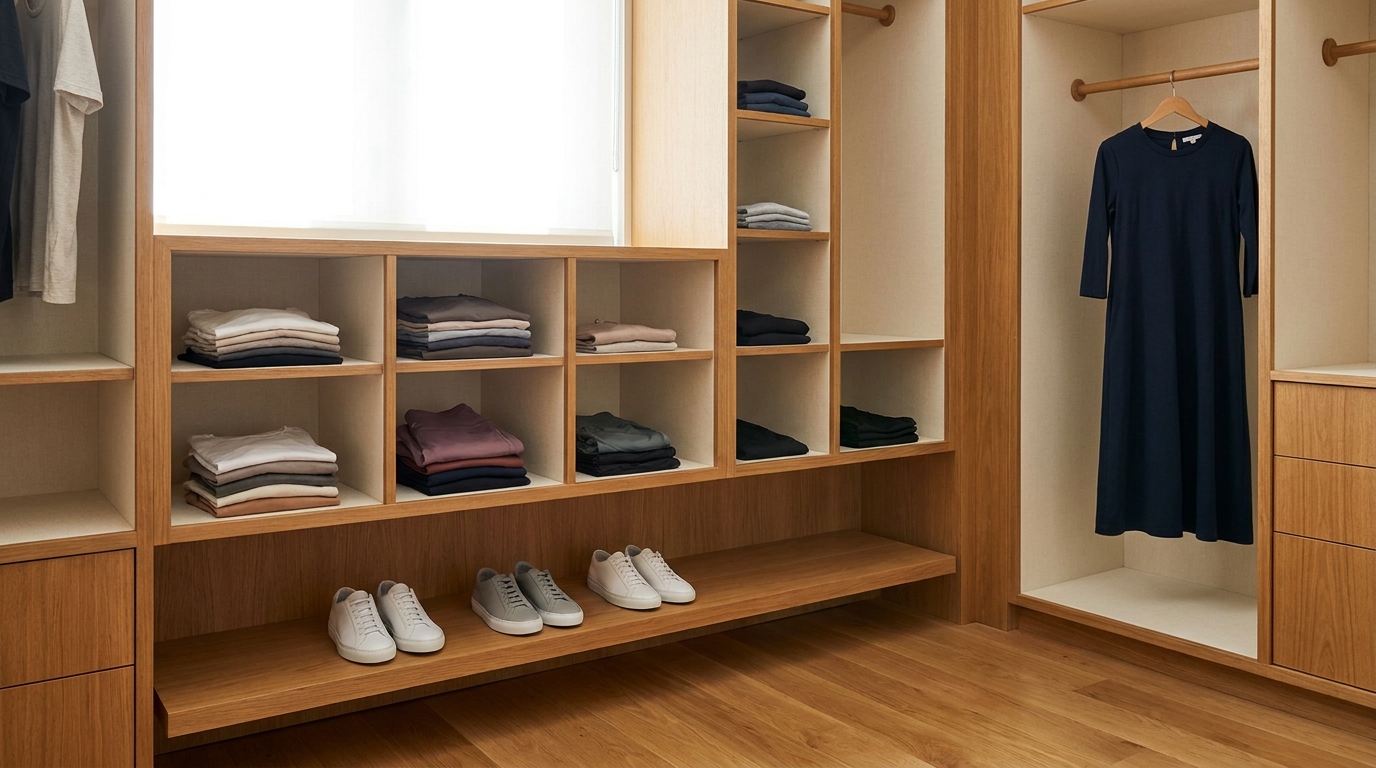
A planned athletic wear closet storage zone keeps gym clothes, one gym bag, and one or two daily sneakers in a ventilated pocket of the master closet, so sweat gear never shares a rod with dress clothes. Damp kits belong in a breathable dirty bin with a short path to the washer, because indoor mold control starts with moisture control and wet items should be dried within 24 to 48 hours [1]. We design that bay as a small, well-aired station, not as a full shoe wall, a valet tray, or a garage sports rack.
1. Why gym clothes need a closet of their own
In many homes we visit around Charlotte, NC, and Fort Mill, SC, the workout kit lives wherever it landed. A damp shirt hangs next to a blazer. A gym bag sits in the aisle. Sneakers wait on the floor by the dress shoes.
That mix is hard on clothes and hard on the closet. Sweat and soil stay in synthetic fibers if they sit too long, and Iowa State University Extension notes that the longer sweat and stains sit, the harder they are to clean [4]. Dress rods also pick up odor and humidity they were never meant to hold.
The fix is a dedicated zone, usually at the end of a walk-in or on one side of a reach-in, with three jobs only:
- Hold clean wash-and-wear pieces on shelves or in drawers.
- Park one gym bag on a hook, not on the floor.
- Stage one or two daily sneaker pairs on a small ventilated shelf, then send everything else to the laundry.
That is athletic wear closet storage in practice. It is a daily-use bay, sized for what you grab before a class or a run, not a warehouse for every pair you own.
2. Moisture, mildew, and why damp kits cannot go in a closed stack
Sweat is water. A closed closet is a still pocket of air. Put those two together and you have the conditions mold likes.
The U.S. Environmental Protection Agency is direct: there is no practical way to eliminate all mold spores indoors, and the way to control indoor mold growth is to control moisture [1]. EPA also asks households to keep indoor humidity in a 30 to 60 percent range, ideally between 30 and 50 percent, and to clean and dry damp materials and furnishings within 24 to 48 hours [1][2].
Kansas State University Extension, in a 1995 home-mold guide still published by Riley County, Kansas, applied the same idea to clothing. Store textiles dry and clean. Always dry textiles that are damp or wet before storing, and do not store laundry in damp places. Dry soiled, damp laundry before placing it in a laundry hamper. Do not store textiles in plastic bags for long periods, because condensation can form in the bag [3].
We use that as a layout brief, not a scare story:
- Do not drop a wet kit into a sealed drawer or a zippered plastic bin.
- Do give the dirty side of the zone open weave, a mesh hamper, or a ventilated pull-out, so air can move.
- Do keep the clean stack physically separate, so yesterday’s run does not sit on tomorrow’s clean tights.
- Do leave a little space. The same 1995 Kansas State guide notes that overfilled closets reduce air circulation, and that louvered doors or doors opened often help discourage mildew [3].
EPA also recommends venting clothes dryers and other moisture-generating appliances to the outside, and increasing ventilation or air movement when practical [2]. A master-closet athletic bay cannot replace a vented dryer. It can keep damp fabric from waiting in a dark, packed rod until wash day.
If you live in humid stretches of Rock Hill, SC, or Indian Land, SC, that air gap matters. Closets on exterior walls run cooler. Cool surfaces plus humid air is how condensation starts. EPA lists condensation on cold surfaces as a moisture source to watch, and it recommends acting quickly if moisture collects [2]. We keep this zone from becoming a packed, door-shut locker.
3. Athletic wear closet storage: the clean stack and the dirty-kit bin
We split the bay into two lanes.
Clean zone. Folded shorts, tanks, sports bras, and tights on shallow shelves or in drawers, one category per stack. Iowa State Extension notes that most sport uniforms are polyester or a cotton-polyester blend, that polyester wicks sweat away from the skin, and that heat can shrink it, so the garment tag (including any spandex in the mix) should guide how you wash and dry [4]. Folded storage respects that. It also keeps stretch knits from hanging by the straps all week.
Dirty-kit bin. A ventilated hamper, mesh bag, or open-front pull-out used only for worn athletic pieces. Kansas State’s 1995 guidance is to dry soiled, damp laundry before it goes in a hamper, and to keep damp towels and clothes from sitting in hampers long enough to grow mildew [3]. We still specify a hamper here because real life includes a 6 a.m. class. The bin is a short hold, not storage. If a kit is soaked, it airs on a hook or goes straight to the washer.
A few layout rules we use in Ballantyne, NC, and Waxhaw, NC, homes:
- Place the dirty bin nearest the closet door so you are not carrying sweat through dress clothes.
- Use breathable sides (mesh, slats, or a vented tilt-out), not a sealed plastic tub.
- Keep the clean drawers above or beside the dirty bin, never underneath a dripping bag.
- Label the bin. A mixed hamper of gym clothes and work shirts is how odor travels.
This is not a full laundry-hamper article. The hamper is one piece of this zone, sized for a day’s kit, with a clear next stop.
4. Hang vs fold: keep the dress rods for dress clothes
Athletic pieces are wash-and-wear. Dress clothes are not. Mixing them on one rod is the fastest way to crowd the suits and load the knits.
Iowa State Extension’s sport-laundry notes start with the care tag: identify the fiber, watch for spandex, air-dry when you can, and get sweat and stains to the laundry room as soon as possible [4]. Protein stains such as sweat can set if they meet hot water, an iron, or a dryer [4]. That is laundry-room work. In the closet, the job is simpler.
What we fold
- Compression tights, shorts, and sports bras.
- Lightweight polyester tees.
- Anything whose label points to a gentle cycle and low or no heat.
What we hang, if we hang it at all
- A zip jacket or a thicker warm-up whose shoulder can sit on a wide hanger.
- A clean kit on a short valet-style rod inside this zone only, for tomorrow morning, not as long-term storage.
What never belongs on the dress rod
- Damp shirts.
- Sports bras by the straps.
- A gym bag hung from a wooden clothes rod.
Dress rods stay for dresses, shirts, and tailored pieces. That is also how we keep double-hang space honest in a custom closet. If the athletic bay needs a short rod, we specify a separate, lower bar so it cannot creep into the dress section.
Follow the sewn-in care label when you wash. Iowa State’s textile writers treat that tag as the first step, and Kansas State’s 1995 mold guide says the same when cleaning textiles [3][4]. Our storage plan does not replace the label. It keeps the clean stack folded, dry, and off the dress hangers.
5. One gym-bag hook and one or two daily sneakers
The bag and the shoes are the items that usually land on the floor. That is a trip hazard as much as a clutter problem.
University of Nevada, Reno Extension, in fall-prevention guidance that cites current CDC figures, tells households to keep things off the floor, including shoes, boxes, and other clutter, and to minimize tripping hazards on stairs and walking paths [5]. That office also notes that one in four older adults report falling each year [5]. We are not claiming that a closet zone treats a medical condition. We are saying gym bags and sneakers do not belong in the aisle.
Gym-bag hook
- One sturdy hook or a short peg rail at standing height, just inside the athletic bay.
- Room for one bag, the one you actually carry.
- A small shelf above or beside it for a water bottle, a sweat towel, and keys.
If you own three bags, the extras go to a high shelf or out of the master closet. A hook that holds a week of bags becomes a floor pile again.
Daily sneakers, not a shoe wall
- A ventilated shelf, a pair of cubbies, or a slatted rack sized for one or two pairs.
- Space around the shoes so they can dry.
- No stacking damp pairs in a closed box.
The rest of the collection belongs on the main shoe run, or in a mudroom if that is how you enter the house. This zone is the pair you grab with the kit. A full shoe wall is a different project, and we keep it that way so the athletic bay stays small and easy to wipe.
Place the shelf where you can reach it without a chair. Nevada Extension also flags standing on a chair to reach closet items as a fall risk, and it recommends keeping frequently used items within easy reach [5]. Daily sneakers are a daily item. They stay at hand height.
6. A clear path from the closet to the laundry room
The athletic bay only works if wash day is close. Iowa State Extension’s first “must” for sport clothes is to get them to the laundry as soon as possible [4]. EPA’s 24 to 48 hour drying window is the moisture clock behind that habit [1][2].
We plan a path, not a second laundry:
- Dirty-kit bin by the closet door.
- A straight walk to the laundry room, without a detour through the dress hanging.
- In the laundry, a sorting hamper and an air-dry rod for pieces that should not go in a hot dryer.
Polyester can shrink with heat, and Iowa State flags fabric softener on some moisture-wicking fabrics because it can reduce wicking [4]. That is why an air-dry bar in the laundry, plus folded return shelves in the closet, is a better loop than a stuffed dress rod.
If the laundry is a floor away, we still keep the closet bin small. A three-day stack of damp shirts is not a system. It is a delay. Homes in Wesley Chapel, NC, and Waxhaw, NC, with upstairs closets and downstairs laundry do well with a lidded, ventilated tote used only for the trip downstairs, then emptied. The tote is a carrier. It is not long-term storage. Kansas State’s 1995 note about plastic bags and condensation is the reason we prefer a breathable carrier over a sealed sack [3].
EPA also calls out unvented dryers as a humidity source [2]. Pairing this closet zone with a vented laundry room is the moisture plan. The closet cannot do the dryer’s job.
7. What this zone is not (and how a tall cabinet should sit)
It helps to name the nearby projects we are not designing here.
- Not a full shoe wall. One or two daily pairs only.
- Not a valet or jewelry run. Belts, watches, and trays belong on their own wall.
- Not a garage sports rack. Balls, bats, and helmets stay in the garage.
- Not the whole house hamper plan. The bin in this bay is a dirty-kit hold, then laundry.
If the athletic zone uses a tall, free-standing hamper cabinet, tip-over rules may apply. In 2023 the U.S. Consumer Product Safety Commission adopted ASTM F2057-23 as the federal safety standard for clothing storage units, to protect children up to 72 months of age from tip-over death or injury [6]. That standard covers free-standing bedroom clothing storage that is at least 27 inches high, at least 30 pounds, and at least 3.2 cubic feet of enclosed storage, and it includes tests that simulate the weight of children up to 60 pounds [6]. The same Federal Register notice states that ASTM F2057-23 does not cover laundry storage or sorting units, or built-in units intended to be permanently attached to the building [6].
Our custom closet work is typically built in and fastened to the structure, which is the category that standard sets aside. If a household still wants a separate free-standing piece in this corner, we treat height, weight, and how it is secured as a design question, not an afterthought. Either way, the aisle stays clear.
Practical takeaways
- Give gym clothes their own ventilated bay so dress rods stay for dress clothes.
- Split clean folded stacks from a breathable dirty-kit bin. Do not store damp textiles in a closed plastic box [3].
- Dry wet kits within 24 to 48 hours, and keep indoor humidity in the EPA’s 30 to 60 percent band, ideally 30 to 50 percent [1][2].
- Fold stretch knits. Read the care tag, watch for spandex, and air-dry when the label allows [4].
- Hang one gym bag on a hook. Keep one or two daily sneaker pairs on a ventilated shelf, off the floor [5].
- Size the hamper for a short hold, then walk it to the laundry. Do not let the closet become a second washer.
- Keep this zone small. A shoe wall, valet wall, or garage sports wall is a different job.
How we can help
We design master closets for homeowners in Charlotte, Ballantyne, Waxhaw, and Wesley Chapel, NC, and in Fort Mill, Rock Hill, and Indian Land, SC. If your gym bag is living on the dress rod, we can plan a compact athletic bay with folded storage, a ventilated dirty bin, a bag hook, and a two-pair sneaker shelf, then connect it to a laundry path that actually gets used.
Have more questions or want to get in touch? Visit https://theclosetrehab.com/contact-us/, call (704) 604-3870, or email design@theclosetrehab.com.
Citations
- U.S. Environmental Protection Agency, "What are ten things I need to know about mold?" (2026-09-08)
- U.S. Environmental Protection Agency, "A Brief Guide to Mold, Moisture and Your Home" (page current as of 2026)
- Kansas State University Agricultural Experiment Station and Cooperative Extension Service / Riley County, Kansas, "Controlling Mold Growth in the Home" (MF-2141, September 1995)
- Iowa State University Extension and Outreach, AnswerLine, "Dealing with Sport Stains" (2026-05-11)
- University of Nevada, Reno Extension, "Preventing Falls in Your Home" (updated content citing a July 2024 CDC report)
- Federal Register / U.S. Consumer Product Safety Commission, "Safety Standard for Clothing Storage Units" (88 FR 28403, 2023-05-04)