Baking Pantry Storage: Cool Drawer, Bowls on a Shelf
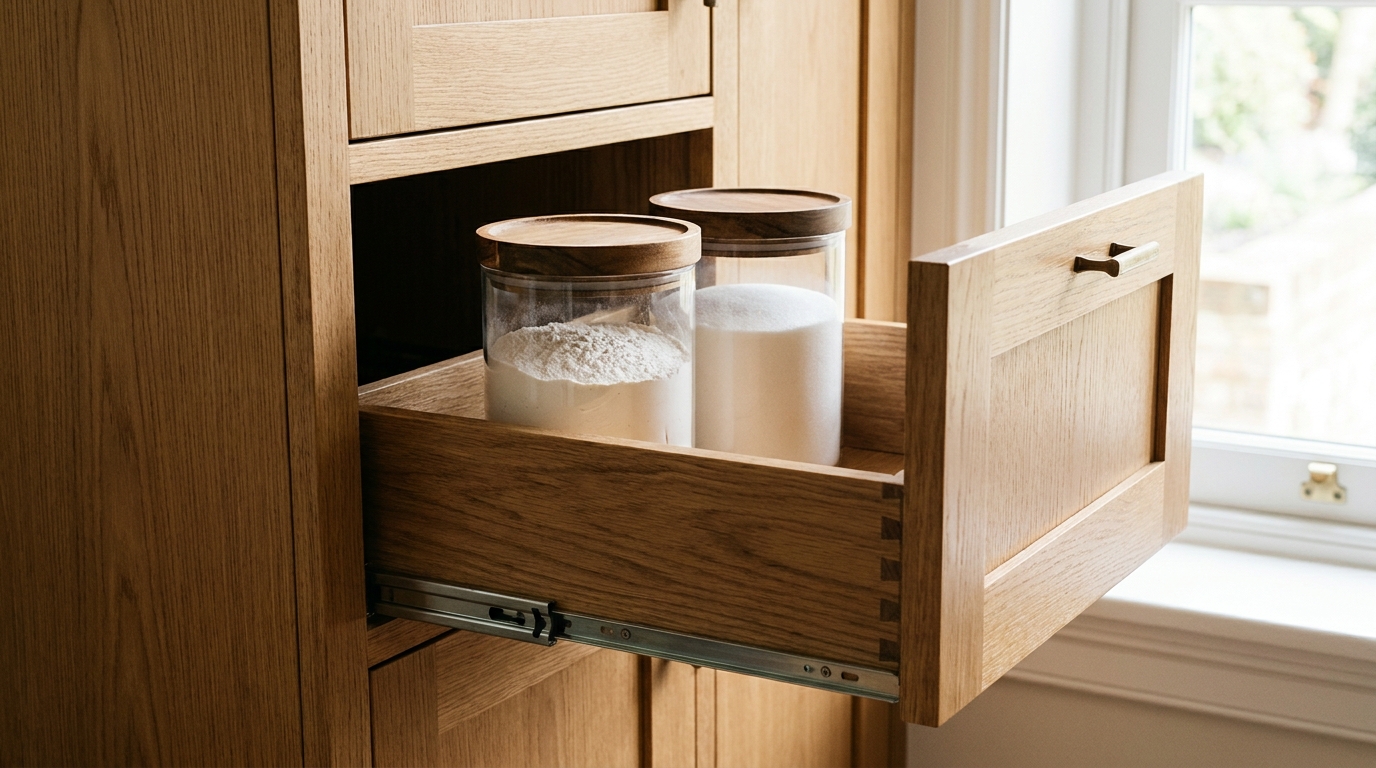
Flour, sugar, and a stack of mixing bowls take over a counter because they never get a spot of their own. Baking pantry storage, for us, means a cool, dry drawer or pull-out for those staples in sealed containers, with a shelf beside it for the bowls you actually use. That bay has one job. It is not the warehouse-club bulk shelving, not the spice and oil pull-outs, not an appliance garage, and not the produce bin for onions and potatoes.
1. Give flour and sugar a bay, and park the bowls next to it
Start with what you scoop. All-purpose flour, bread flour, granulated sugar, and brown sugar are the core. Baking powder and baking soda can share the drawer if the measuring spoon stays dry, which is how Penn State says to handle those containers [1]. Bowls do not go in the drawer. They go on a shelf you can reach without climbing.
Keep the working canister separate from a backup sack. Penn State Extension, in guidance updated August 9, 2024, says that if you buy flour in bulk, leave it in the bag and store that bag in a large covered container [1]. The drawer holds the container you scoop from. A second covered, dated bag can live on another cool shelf if you will actually use it. It should not bury the canister.
2. Put the drawer where the air stays cool and dry
Heat and moisture decide the wall. Clemson University's Home and Garden Information Center, in a pantry fact sheet revised March 27, 2020, says storage near oven ranges, hot water pipes, or heating ducts should not be used, because heat and moisture can cause food to lose quality more rapidly [2]. The same fact sheet says high temperature or humidity may reduce storage time considerably [2]. Kansas State University Extension's cupboard guide, revised June 2026, says to store food in a cool, dry, dark place away from heat sources such as appliances and the sun [3]. An interior pantry wall beats the range, the dishwasher, and a sunlit corner. Penn State says flour stored in a warm place is likely to attract insects [1]. A canister left on top of the refrigerator fails that test.
Flour exchanges moisture with the air. Penn State's 2024 guidance says to store flour in airtight containers to preserve moisture content [1]. Low humidity may dry flour, and flour may take up moisture from humid air [1]. Those changes may affect baking results [1]. Brown sugar that dries out turns into a hard block [1]. A tight lid is the storage step. An open bowl on the counter is not.
Hot, humid weather calls for less flour at room temperature. Penn State says that in hot humid weather, buy flour in small amounts and keep it in the refrigerator or freezer [1]. Kitchens in Charlotte and Fort Mill see long stretches of that weather, so the drawer is for ordinary weeks, not for a hot spell that calls for the refrigerator.
Whole wheat does not live here year-round. Penn State says whole wheat flour contains natural oils that can turn rancid quickly at room temperature, and that it should be stored in the refrigerator year-round [1]. White flour stored at room temperature keeps longer than whole wheat flour or specialty flours [1]. Kansas State's June 2026 chart lists whole wheat flour at 6 to 8 months in the 70°F column, and the comment on that row says to keep it refrigerated or frozen, in an airtight container [3]. Clemson's March 2020 chart lists whole wheat flour at 3 months and notes that the refrigerator or freezer is best [2]. A matching canister is not a reason to leave it in this drawer.
Keep strong smells out of the bay. Penn State says flour absorbs odors and should not be stored near soap powders, medicines, or onions [1]. That is why this drawer stays off the produce bin and away from cleaning supplies. Onions and potatoes already need a ventilated spot of their own. This bay is not that spot.
3. Read the month counts with the temperature attached
Do not average the charts into a number we invented. The times below are quality guides. Each one has a temperature, or a storage place, and a year.
- At 70°F, Kansas State's June 2026 chart lists white flour at 6 to 8 months in an airtight container [3].
- Clemson's March 2020 fact sheet, which lists a February 1994 Rutgers Cooperative Extension publication among its sources, puts white flour at 10 to 15 months in a tightly sealed or airtight container [2].
- Penn State's August 2024 guidance says all-purpose and bread flour will keep up to two years at 40°F in the refrigerator and can be stored indefinitely in the freezer [1].
Penn State attaches that two-year figure to refrigerator storage at 40°F [1]. A pantry drawer is not that place. Clemson's 2020 fact sheet also says pantry foods may still be safe past a recommended time, while flavor, texture, and nutritive value drop [2]. That sentence is general. It does not make raw flour safe to taste, and a closed drawer does not cook it.
Sugar charts disagree on the calendar and agree on the lid. Clemson's March 2020 chart lists granulated sugar as keeping indefinitely in a tightly sealed container, and brown or powdered sugar for 18 months [2]. Kansas State's June 2026 chart, written for 70°F, lists granulated sugar at 2 years when covered tightly, brown sugar at 18 to 24 months in an airtight container, and confectioners' sugar at 18 to 24 months in an airtight container [3]. We will not tell you that sugar never spoils, because those two guides do not say the same thing. Both of them do describe a cover. If a block has already hardened, Penn State describes warming it in a slow oven, 250°F to 300°F, then measuring it while warm, because it firms up again as it cools [1].
Let cold flour warm up with the lid on. Penn State says refrigerated or frozen flour should reach room temperature before baking, so the cold does not affect baking powder or yeast [1]. Use the bowl shelf for that closed container. Do not open the bag on the counter while it warms.
4. Use containers insects and humidity cannot stroll through
A thin bag is a purchase package, not a storage plan. The National Pesticide Information Center, on a page updated February 7, 2025, says larvae can chew through plastic bags and thin cardboard, so even unopened packages may become infested [4]. Adult females can lay hundreds of eggs on or near food, and flour is among the foods they attack [4]. NPIC says to store bulk foods in thickly walled glass or plastic, and to move them out of plastic and zipper bags, because larvae can chew through those bags [4].
University of Maryland Extension, on an Indian meal moth page updated October 17, 2024, says to keep food in glass jars, plastic containers, or metal canisters with tight-fitting lids [5]. It calls glass jars that pressure-seal with rubber gaskets the best option, because many pantry pests are small enough to crawl under a loose lid [5]. Do not rely on plastic bags or cardboard boxes, which the insects can chew through [5]. Eggs can come into the house in a package, and an infestation can spread from package to package in the cupboard [5].
The original bag can stay if a real container is around it. Penn State says to leave bulk flour in the bag and put that bag in a large covered container [1]. NPIC still wants that sturdy outer container, because larvae can chew through a thin bag [4]. A canister you can scoop is the easier choice for a drawer you open every week. Clemson's 2020 fact sheet says to use the oldest products first, and to write a date on packages that do not already show one [2].
Do not scent the drawer or spray it. NPIC says mothballs should not be used around food or food preparation areas [4]. University of Maryland Extension says not to spray insecticides in food storage areas, and it notes that most stored-product pests multiply faster at higher humidity [5]. If you see webbing, clumps, or holes, remove that food, move clean food into airtight glass or plastic, vacuum, and wash with soap and water [4]. A week in the freezer can kill eggs and larvae [4]. That step is about insects, not about making raw flour safe to eat. Larvae can also live on a small flour or sugar spill, so wipe the drawer seams [4].
5. Treat flour as a raw food that spreads
A lid limits the dust. The U.S. Food and Drug Administration, on a page current as of March 5, 2024, says flour is a raw food [6]. Flours most often used in home baking are made directly from raw grains, and processing those grains into flour does not kill harmful bacteria [6]. The grains may be exposed to Salmonella and pathogenic E. coli [6]. The FDA says never to eat or taste raw flour, dough, or batter [6].
The same page says that since 2009 there have been several outbreaks involving raw flour or raw flour-containing products such as cake mixes and cookie dough, resulting in 168 known illnesses and 20 hospitalizations [6]. Keep raw flour separate from ready-to-eat food, because the powder spreads easily [6]. A lidded container in a drawer limits that spread. It does not cook the flour.
Wash the bowl before it goes back on the shelf. After you work with flour or raw dough, the FDA says to wash hands with soap and running water, and to wash bowls, utensils, pans, cutting boards, and countertops with warm, soapy water [6]. A bowl with a flour film is a spill, not storage. Do not heat-treat flour at home to make it safe to eat raw. The FDA says those home treatments may not kill all bacteria and do not make flour safe to eat raw [6].
Webbing is enough reason to empty the canister. NPIC says to remove infested food and clean before the rest goes back [4]. University of Maryland Extension's October 17, 2024 page describes the adult Indian meal moth as 5/8 inch long and the larva as about 1/2 inch long [5]. You do not need the field guide to justify starting over with clean containers.
6. Set the bowls where the mixing actually happens
If the bowls live across the kitchen, the flour will move back to the counter. We set a shelf directly above or beside the baking drawer for the bowls, a measuring cup, and maybe a bench scraper. The stand mixer stays in its own zone, with room for the cord and the crumbs. This bay is ingredients and bowls, not an appliance garage.
The shelf follows the bowls you own. A heavy stoneware bowl and a nested set of steel bowls need different clearances. On a design visit we measure those bowls and place the shelf where you can lift them without a step stool. There is no single inch height that fits every pantry, so we do not invent one.
Counter height usually beats a drawer at the floor. Lifting a full sugar container from a toe-kick gets old, and it tempts you to leave the container out. In a walk-in, the same drawer can sit under a short counter used to stage a recipe, not to store the ingredients. Our custom pantry organization is a set of zones. The baking bay is one of them, and it should not swallow the rest of the pantry.
7. Keep the wrong items out, then keep a short routine
Leave these out.
- A club-size sack stays covered, on a separate cool shelf, only if you will use it while quality holds. In hot humid weather, buy less and use the refrigerator or freezer [1].
- Spices and oils get their own pull-out. Kansas State says to keep spices airtight, dry, and out of sunlight and heat [3].
- Mixers stay in the appliance zone.
- Onions, potatoes, and other produce stay in a ventilated bin. Flour picks up onion odor [1].
- Cleaning products stay out. Store food away from chemicals [3].
After groceries, look for holes or clumps before the new flour joins the rest [4]. Write the date, and put the newer container behind the older one [2]. Wipe the drawer seams, because larvae can live on a small spill [4]. Seat the lid. Small pests can crawl under a loose one [5].
Once a month, pull the drawer fully out. Look for webbing. Return whole wheat flour to the refrigerator [1]. In a long humid spell, move working flour to the cold and let it warm with the lid on before you bake [1]. When you are in doubt, throw it out [3]. Do not taste raw dough to decide [6].
"Flour" on a lid is not a date. Follow the package date when there is one, and follow one chart instead of blending them. The drawer earns its keep when the counter is clear, the flour is covered, the sugar still scoops, and the bowls are clean and close.
Practical takeaways
- Keep all-purpose flour, bread flour, granulated sugar, and brown sugar in airtight containers in a cool, dry drawer, with bowls on a shelf beside it.
- Leave club-size cases, spices, oils, appliances, and produce out of that bay.
- Keep the drawer away from the oven, hot pipes, heating ducts, and direct sun [2][3].
- White-flour quality times depend on the guide and the temperature, as the figures above show [1][2][3]. Penn State's time of up to two years is for all-purpose and bread flour held at 40°F [1].
- Refrigerate whole wheat year-round, and refrigerate or freeze other flour in hot humid weather [1].
- Use thick-walled glass, rigid plastic, or metal. Larvae can chew through thin bags and cardboard [4][5]. Do not use mothballs or sprays in the food drawer [4][5].
- Never taste raw flour or dough, and wash bowls before they go back on the shelf [6]. Date containers and use the oldest first [2].
How we can help
Our team designs the baking bay as one zone inside a pantry, not as a catch-all cabinet. We measure the containers and the bowls you already use, place the drawer on a cool wall, and leave bulk storage, the spice and oil pull-outs, the appliance zone, and the produce bins to do their own jobs. If you are planning custom pantry organization, we will look at the pantry you have and draw the bay so it does not steal room from the rest of the storage.
Have more questions or want to get in touch?
Contact The Closet Rehab to request a free in-home design consultation. You can also call us at (704) 604-3870 or email design@theclosetrehab.com.
Citations
- Penn State Extension, "Storing Staple Ingredients in the Kitchen" (2024)
- Clemson Cooperative Extension, "Food Storage: Pantry" (2020)
- Kansas State University Research and Extension, "Safe Food Storage: The Cupboard" (2026)
- National Pesticide Information Center, "Pantry Moths" (2025)
- University of Maryland Extension, "Indian Meal Moth" (2024)
- U.S. Food and Drug Administration, "Handling Flour Safely: What You Need to Know" (2024)