Pantry Cookbook Storage: Ledge Off the Prep Counter
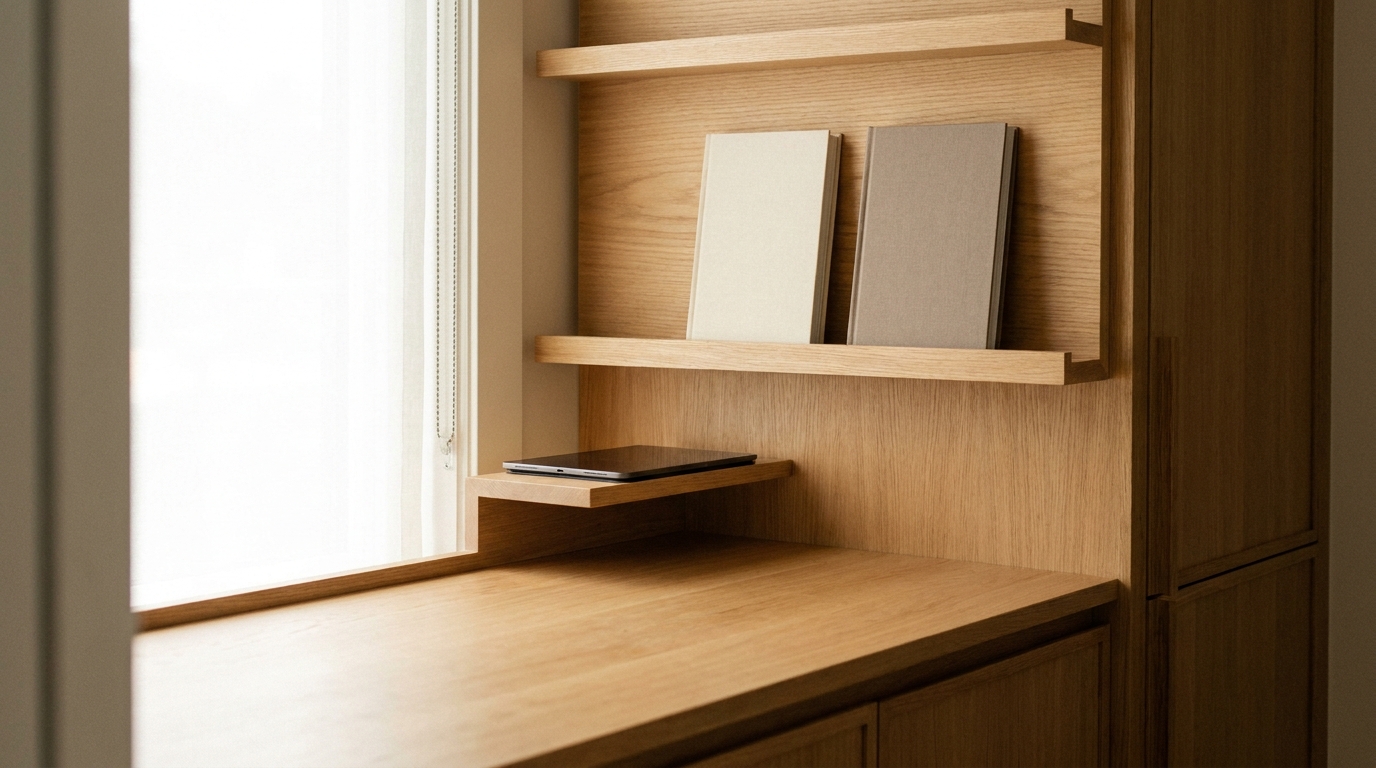
Pantry cookbook storage is a shallow shelf and a small ledge at the pantry landing, sized for one open cookbook or a tablet, so the prep counter stays free for the knife and the bowl. The page has to be lit, or the ledge is only a pretty place to lose a recipe. A lip or a stop keeps the book from walking off, and the books you rarely open belong in a closed cabinet nearby, not in a pile at your feet. We measure the cook, then we set that ledge where the recipe can be read without bending over the burners.
1. Move the open book off the prep counter
The prep counter is a work surface, not a bookshelf. Flour, a wet board, and a hot pan are a poor home for paper. The U.S. Fire Administration tells households to keep a 3-foot safety zone around stoves and grills, and to keep anything that can catch fire, including paper towels, oven mitts, wooden utensils, food packaging, towels, and curtains, away from the stovetop [1].
An open cookbook is paper. We do not park it on a ledge over the burners, and we do not lean it on the backsplash where a sleeve can knock it forward.
A pantry landing is the better spot. In a walk-in pantry, that landing is often the built-in counter just inside the door, or a short return wall beside it. In a reach-in pantry, it may be a shallow shelf at the side of the opening, clear of the door swing.
Our custom pantry designs already include counters for sorting groceries and staging a meal. The cookbook ledge is a smaller piece of that same idea. It holds one open book or a tablet, and it leaves the kitchen counter for the food.
If the pantry opening is tight against the range, the ledge moves. The 3-foot zone is a fire-safety message, not a cabinet code, and we still keep the book off the cooktop. [1] A tablet can share the ledge once the surface is clean. The Library of Congress says to plan a clean, unobstructed landing before you open a book, and not to force the book completely flat. [2] Prop the covers so the spine is not wrenched, and wipe splatters first.
2. Keep the ledge one or two books deep
One or two books deep is the depth we use. A ledge that holds a dozen cookbooks on their faces becomes a dust stack, and the book you want is always at the bottom. That depth is our practice, not a published standard. It is there so the ledge stays a reading spot instead of a second library.
Dust is the quiet reason to stay shallow. The Library of Congress says regular dusting matters, because dust can discolor books, attract pests, and absorb moisture from the air, which can lead to mold. [3] A shallow ledge is easy to wipe in the same pass as the pantry shelf. A deep pile hides the grime until a cover sticks.
Upright books need neighbors or a stop. The same storage guide says shelves should be completely flat and solid, not latticed or slatted, and that upright books should not lean. Support them with book-ends if they would slump [3].
On a short ledge, one or two books of similar height can hold each other. A single paperback needs a book-end or the lip in the next section. The book needs a solid surface under it, not a wire rack.
Shallow also protects the spine. The Library of Congress says to grip both sides of the spine at the middle, after pushing the neighbors in, instead of tugging the top. [2] That grip works when the row is one or two books deep. Keep the copy you cook from on the ledge, and put duplicates in the closed cabinet.
3. Give the book a lip or a stop
A lip or a stop keeps the book from walking off. An open cookbook wants to close, and a tablet wants to slide when you tap the screen. We add a low front lip, a small raised stop, or a book-end, sized to the books and the tablet you actually use. We do not pull that height from a desk chart. The Library of Congress makes the same point for upright books: support them so they do not lean or slump [3].
The lip should not hide the recipe. If the stop is tall, it covers the last line on the page. We keep it high enough to catch a cover or a tablet edge, and low enough that the text stays visible. You should not have to lift the book to read the yield or the oven temperature.
Heavy books can lie flat if the shelf supports them. Books too large to stand can be stored flat and horizontal, fully supported underneath. If a book must stand, the spine goes down, never up, because gravity can pull the pages out of the cover [3]. A family binder often prefers that flat pose, so the ledge gets a solid bottom. Leave a little side room so you can grip the spine without scraping the wall [2].
4. Park the rarely opened books in a closed cabinet
The open ledge is for the book in use. The rest of the library goes in a closed cabinet in the same pantry, so you are not crossing the kitchen with an armload. Holiday books and the titles you open twice a year do not need to sit in the light every day.
The Library of Congress says books should have minimal exposure to light, and ideally no direct or intense light. Shades, curtains, or boxes are options it names for sensitive books [3]. A cabinet door is the kitchen version of that idea. The book you cook from will still see light while dinner is underway.
Heat and humidity are the other reason for the door. The same page says a cool setting, 70 degrees Fahrenheit or below, and a relatively dry range of 30 to 55 percent relative humidity, is safe for most books [3]. It also says to avoid vents, radiators, and long stretches of warmth and high humidity [3].
A pantry beside a range will not hold a library climate, and we do not pretend it will. We still keep the closed cabinet off a hot vent and out of the steam path when the plan allows. The everyday book goes back in the cabinet when the meal is done.
This is not the coffee station or the baking drawer. Weeknight books can sit within an easy reach inside the cabinet. The once-a-year titles can go higher or lower. The cabinet is overflow for books, not a second project.
5. Set the height to the person who cooks
We measure the person who will stand and read. A ledge that is right for one cook is a stoop for the next. OSHA's hospital food-service page, which is workplace guidance and not a home kitchen code, says frequent reaching above the shoulders, or high extended reaches for supplies or heavy containers, can cause back and shoulder injury [4].
It also calls for work surfaces that let people keep elbows close to the body, and for putting the work in front of the person rather than reaching above or behind [4]. We borrow that idea at home. The open book sits in front of the cook, near a comfortable reading height, so you are not bent over the burners.
Do not copy a desk height and call it a kitchen rule. A seated desk is built for a chair and a monitor. A pantry landing is built for someone standing, often with a hot pan nearby. On the visit, we watch you hold the book where you can read it, then we mark that height. If two people cook, we favor a height that neither person has to hunch or reach overhead to use.
Wheelchair reach limits are real, and they are not a standing reading height. The U.S. Access Board's ADA Accessibility Standards set an unobstructed forward reach of 15 inches minimum and 48 inches maximum above the floor, and the figure shows a person using a wheelchair [5]. Where the reach passes over an obstruction deeper than 20 inches, the high forward reach drops to 44 inches, and the reach depth stops at 25 inches [5].
A separate table covers children. The high reach maximum is 36 inches for ages 3 and 4, 40 inches for ages 5 through 8, and 44 inches for ages 9 through 12 [5]. Elements meant for adults, or for children over age 12, stay within the adult ranges [5].
Those figures are not a standing cook's eye height, and they are not a kitchen code. If someone who uses a wheelchair will read here, we use the adult range that fits their approach. For a standing cook, we measure that person, and we mark the door swing so the shelf is not clipped.
6. Aim the light at the page
Light has to land on the page, not on the back of the cook. A single ceiling light in the middle of the pantry puts your shadow on the recipe. A 2012 U.S. Department of Energy Building America guideline, using Illuminating Engineering Society values for ages 25 to 65, lists 50 footcandles of horizontal light for a kitchen prep counter, measured at the work surface, typically about 3 feet [6].
The same guideline says undercabinet lights prevent shadows from a person working at the counter, and it says to place recessed downlights above the front edge of the counter [6]. A small shielded light under the shelf above washes the page. This is not a living-room media wall, and it is not a whole-pantry lighting project.
Task light can stay modest when the room is softer. Department of Energy purchasing guidance updated in June 2023 says task lamps and under-cabinet work surface lighting should be used with lower ambient overhead light, and it lists shelf-mounted task lights mounted under overhead cabinets [7]. That page is for federal buyers, not a house code.
A dimmer lets you raise the light for paper and lower it when a tablet screen is enough. The 50 footcandle figure is the 2012 prep-counter number for ages 25 to 65, and the guideline points other ages to the handbook [6]. Tuck the bulb toward the front of the shelf above so you see the words, not the glare, and put the switch at the landing.
7. Keep the walking path and the burners clear
Cookbooks do not belong on the floor. The CDC's older-adult falls page, reviewed in September 2026, says more than one out of four older people falls each year, and it lists throw rugs or clutter that can be tripped over among home hazards [8]. A 2019 NIH News in Health article says to keep the home tidy and well-lit to avoid stumbling over objects, and to skip small area rugs you could trip on [9].
A stack of cookbooks in the pantry aisle is clutter in the walking path. It goes on the ledge or in the cabinet, not at your feet. We do not invent a count of how often people cook from books. The floor is simply the wrong shelf.
Keep the aisle as open as the shelf is shallow. You should not step over a book to reach a pot, and you should not read while leaning across a burner. The landing keeps paper off the stovetop. The Fire Administration's point is to keep anything that can catch fire away from that surface, and it notes that grease on the stove can catch fire [1].
Wipe the ledge when you wipe the counter. A short projection, held by the lip, leaves a clear path. If a rug wants to live at the pantry threshold, the NIH caution about small rugs is reason enough to leave that spot bare [9]. On the visit we mark who reads, where the stove zone falls, and where the light hits the page.
Practical takeaways
- Give one open cookbook or a tablet a shallow ledge at the pantry landing, off the prep counter and off the stovetop.
- Stay one or two books deep so the ledge does not turn into a dust stack.
- Use a solid shelf, and add a low lip, stop, or book-end so the book cannot walk off or hide the last line of the recipe.
- Keep the books you rarely open in a closed cabinet nearby, off a hot vent when the plan allows.
- Set the height to the person who reads there. Do not treat a desk height, or a wheelchair reach chart, as a kitchen code.
- Aim a shielded light at the page so your body does not shadow the recipe, and put the switch at the landing.
- Keep cookbooks off the floor, out of the aisle, and away from anything that can catch fire at the stove.
How we can help
Have more questions or want to get in touch? We design the pantry landing with you, including the cookbook ledge, the closed book cabinet, and the light on the page, during a free in-home design consultation for homeowners in Charlotte, Ballantyne, Waxhaw, Wesley Chapel, Fort Mill, Indian Land, and Rock Hill. Reach us on our contact page, call (704) 604-3870, or email design@theclosetrehab.com.
Citations
- U.S. Fire Administration, "Pictographs: Cooking" (2026-09-03)
- Library of Congress, "Handling Your Books" (2026-07-23)
- Library of Congress, "Storing Your Books" (2026-07-23)
- Occupational Safety and Health Administration, "eTool: Hospitals, Food Services, Work-related Musculoskeletal Disorders" (n.d.)
- U.S. Access Board, "ADA Accessibility Standards, Chapter 3: Building Blocks" (2026-07-23)
- U.S. Department of Energy, Building America, "Strategy Guideline: High Performance Residential Lighting" (2012-02)
- U.S. Department of Energy, Federal Energy Management Program, "Purchasing Energy-Efficient Light Fixtures (Luminaires)" (2023-06)
- Centers for Disease Control and Prevention, "Facts About Older Adult Falls" (2026-09-08)
- National Institutes of Health, News in Health, "Preventing Falls" (2019-09)