Pantry Coffee Station: Beans, Tea, Mugs, and a Kettle
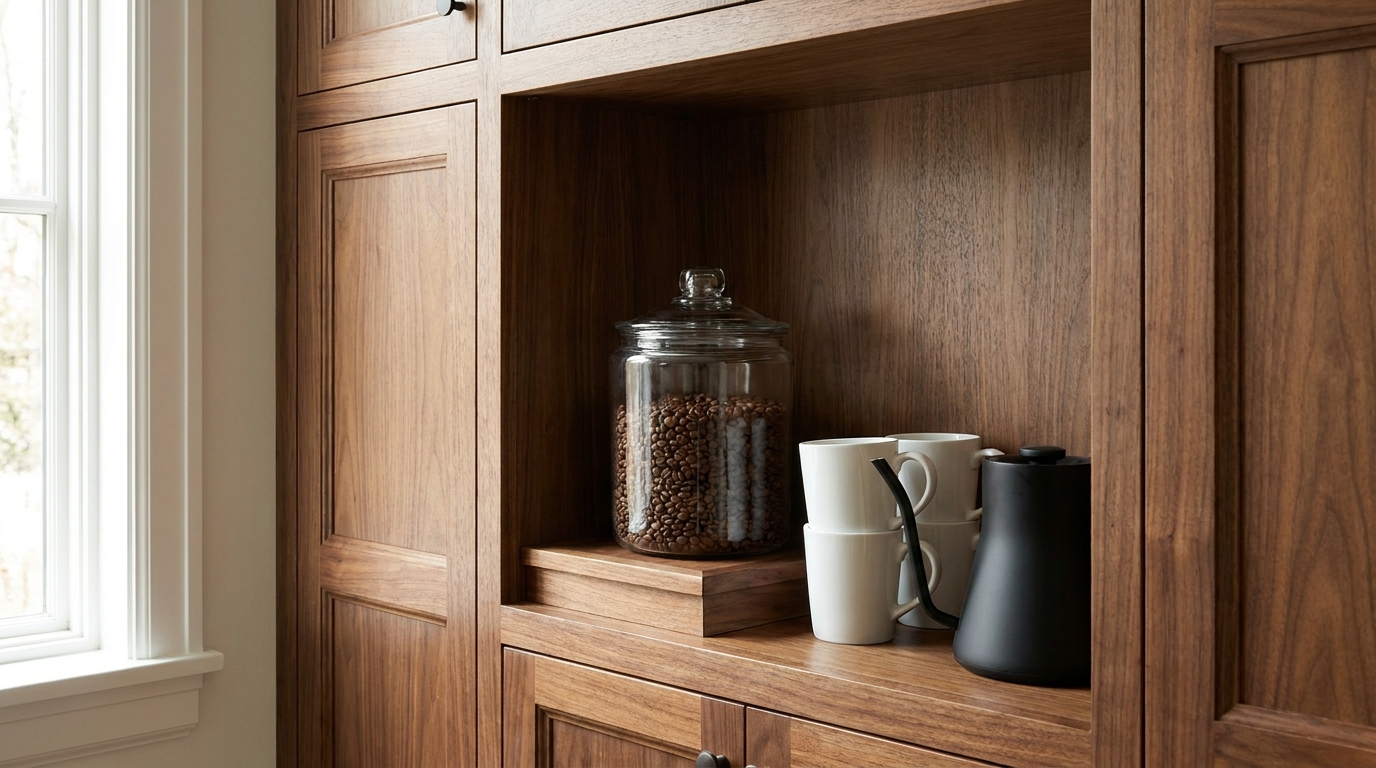
A pantry coffee station is a closed bay for coffee, tea, everyday mugs, and a kettle landing, kept off the snack shelf and out of the flour drawer. The National Coffee Association's consumer guide tells brewers to protect roasted coffee from air, moisture, heat, and light, and to treat a clear jar of beans as decoration rather than as storage [1]. We build that bay as its own zone, with the kettle off the counter when you are done, and with no shared bin for baking staples or the lunchbox shelf.
1. Give the station one job
The counter is bright, near the sink, and it collects whatever walked in with the mail. A pantry bay can be dark and shut. In a Charlotte kitchen, we look for a reach-in or a walk-in section that is not the cabinet beside the oven and not the one over the dishwasher. The National Coffee Association says to avoid cabinets near the oven or the dishwasher, and to avoid strong afternoon sun, because those places get too warm [1].
One bay, four groups. These share a wall. They do not share a bin.
- Coffee, in an opaque container that actually seals, or still in a bag only until you move it into one
- Tea, in its own tin, not loose in the coffee canister
- Everyday mugs, filters, a scoop, and spoons
- A kettle or mug-warmer landing that is empty of steam when brewing is done
What stays out:
- Crackers and cereal stay on the snack shelf, not under the grinder.
- Flour, sugar, and the other baking staples stay in their drawers. Virginia Tech's storage guide, revised October 2025, treats flour, crackers, cake mixes, seasonings, and canned goods as dry foods that belong in the original package or in a tightly closed container, below 85°F, and best between 50°F and 70°F [2]. Humidity above 60 percent may let those foods take on moisture, then cake or go stale [2]. A kettle that vents steam is a poor roommate for that drawer.
- Spice pull-outs stay spices. Coffee takes up moisture, and it also takes up odors and tastes from the air around it [1]. A bay open to onion, garlic, or a loose spice shelf will not stay neutral.
- The lunchbox and water-bottle station is for leaving the house. Bottles, ice packs, and tomorrow's lunch do not belong with the beans.
- The mixer and air-fryer garage is for bulky appliances that come out for a job and go back. We do not park the air fryer on the mugs.
USDA's Food Safety and Inspection Service, on its shelf-stable page updated October 24, 2024, includes rice, pasta, flour, sugar, spices, oils, and many canned foods among products that can stay at room temperature and do not require refrigeration until after opening [3]. Not every can qualifies. Some canned ham and some seafood are labeled "Keep Refrigerated" and are not safe at room temperature [3]. They do not move into the coffee bay just because they fit.
2. Beans, grounds, and tea
Buy a short run of coffee, then close it. The association's guide says coffee starts to lose freshness almost immediately after roasting, and it suggests buying enough for one or two weeks [1]. It wants an airtight container, especially for pre-ground coffee, and an opaque one. Clear canisters let in light. The line on the page is direct: use a pretty jar of beans as décor only [1]. Retail bags are often not built for long storage, so the guide's step is to move the coffee into a container that seals, and to carry the roast name and the package date onto the tin [1].
Peak flavor and a quality chart are not the same number. In that guide, with images on the page from 2024, the freshness table assumes opened coffee has been moved into airtight containers. It lists roasted beans at room temperature as retaining freshness for 1 to 3 weeks, and ground coffee at room temperature for 1 to 2 weeks [1]. Pods and instant coffee are listed through the best-by date on the package [1]. After that peak, the page says, most roasted beans are not unsafe to brew unless moisture has let mold develop. What fades is aroma. The cup tastes stale [1].
Virginia Tech's chart, revised October 2025, lists recommended storage times from the date of purchase when conditions are good [2]. Whole beans are listed at 3 to 5 months in the pantry, opened or unopened, and opened whole beans at 3 to 4 months in the refrigerator [2]. Ground coffee is listed at 2 years unopened in the pantry, at 2 weeks once opened in the pantry, and at 1 month opened in the refrigerator [2]. Instant coffee is listed at 1 year unopened and at 2 to 3 months opened, both in the pantry column [2].
The overlap that matters for a daily bay is opened ground coffee. Both sources put it on a short leash, on the order of two weeks [1][2]. The whole-bean numbers do not match, because one table is a freshness window and the other is a general quality window. Follow the package date, keep the container sealed and dark, and do not invent a third number to split the difference.
Cold storage is a condensation problem, not a pantry feature. The association notes that views differ on freezing and refrigerating. Coffee is hygroscopic. It holds moisture, and it holds odors and tastes [1]. The guide says a cold container is most useful in a humid climate, and only if it is truly airtight, because condensation can build up in the refrigerator [1]. If you do keep beans cold, take out no more than about a week at a time and put the rest back before condensation forms on the coffee [1]. We do not design the coffee bay as a refrigerator. Milk belongs across the kitchen.
Tea bags are not every tea. Virginia Tech lists tea bags at 18 to 36 months unopened in the pantry and at 6 to 12 months once opened, and instant tea at 2 to 3 years unopened and at 6 to 12 months opened [2]. Those are quality windows under the chart's good conditions, not a safety date, and they are the only tea windows we will cite. We will not assign a number to loose leaf, to green tea, or to teas stored so they keep changing. Tea gets its own opaque tin with a lid that closes, out of the sun and out of the kettle's steam. A strong tea does not share that tin with a mild one, and coffee does not share it either [1].
The printed date is a quality mark, with one hard exception. Virginia Tech notes that dates on food labels almost always refer to quality, not safety. Infant formula is the exception and should not be used past the printed date [2]. Tape the day you opened the tin on the lid, and put newer packages behind the one you are using [2]. If the coffee smells moldy, or the tin shows moisture you did not put there, that is the association's mold warning, not a "stale but fine" cup [1].
3. Mugs, filters, and the foods that stay next door
Mugs are a shelf, not a stack. Daily mugs sit in reach, one layer deep. Extras go higher so the daily set does not become a pile. We do not hang mugs over the kettle, where a sleeve or a cord can catch a handle. Filters, a scoop, and spoons live in a shallow tray so grounds do not sift into the tea.
Pods can share the bay. Liquid dairy cannot. Pods and instant coffee follow the package date on the association's table [1]. Liquid coffee creamer has no pantry time on the Virginia Tech chart. It is listed for the refrigerator, at 3 weeks [2]. Powdered creamer is the dry one: 2 years unopened in the pantry column, and 2 to 3 months once opened [2]. Milk, half-and-half, and anything else the label says to refrigerate goes back to the refrigerator. FDA's consumer update, current as of January 18, 2023, states the two-hour rule: food that needs refrigeration should not sit out more than two hours, or one hour if the air is above 90°F [4].
Keep cleaners out of the food bay. That same January 2023 FDA update says not to store non-perishable food near household cleaning products and chemicals [4]. Virginia Tech's 2025 guide says the same for cleaners and insecticides, because contamination of food or of a utensil can poison someone [2]. The spray bottle does not get a hook under the mugs.
Do not vent steam onto dried food. Home-dried fruit and vegetables are not roasted coffee. The National Center for Home Food Preservation, drawing on the University of Georgia bulletin So Easy to Preserve (6th edition, 2014), says dried foods should be stored cool, dry, and dark, that higher temperatures shorten quality, and that food which seemed bone dry can still spoil if it takes moisture back up [5]. Each opening lets in air and moisture, and moldy food should be discarded [5]. The fruit times on that 2014 page, about a year at 60°F and about six months at 80°F, are for dried fruit, not for coffee [5]. We use them only to place the kettle: the landing should not blow steam into the dried-fruit jars or the flour drawer. Glass lets you see moisture on dried food [5]. It does not make a clear jar a good home for beans [1].
4. The kettle landing, without a wiring lesson
The landing is a dry, stable shelf or a short counter where the kettle sits fully on the surface, cord included. It is not the snack shelf, and the cord should not hang into the aisle.
Unplug it when the cup is poured. CPSC Publication 513, a July 2008 staff checklist the agency still hosts, says to unplug countertop appliances when they are not in use. Unattended, plugged-in appliances may create an unnecessary risk of fire [6]. The cover notes that staff prepared the checklist and that it may not reflect a formal Commission position. The same page says to keep cords off hot surfaces such as an oven, a range burner, or a toaster, because a cord can melt and expose wires [6]. Keep the kettle away from the sink, or use a GFCI-protected outlet if it has to be near water. Mixing electricity and water can shock or start a fire, and a countertop appliance can be knocked into the sink or sprayed [6].
Do not make an extension cord the pantry's power supply. The 2008 checklist says an extension cord used as a permanent hookup should be replaced by having new outlets installed where they are needed, or by moving the appliance closer to an outlet. Extension cords are not as safe as permanent house wiring [6]. A separate CPSC alert, Publication 5032 from April 2012, says extension cords should only be used temporarily, because overloading or damage can overheat them and cause a fire [7]. Unplug one when it is not in use [7]. Do not run cords under rugs, through doorways, or under furniture [7]. A tightly wrapped cord traps heat and can melt or weaken the insulation, so do not coil the kettle cord around the handle while it is plugged in [6].
If the bay needs an outlet, an electrician does that work. We design the shelf and the cord path. We do not add a receptacle, change a circuit, or describe which wire to pull. If an outlet or a switch is not working properly, or if an outlet is unusually warm, the 2008 checklist says to stop and have an electrician check it [6]. If an appliance has given anyone a shock, do not touch it until an electrician has checked it, and turn the power off to that appliance at the breaker [6]. A qualified electrician handles the circuit.
A stovetop kettle can still have a landing. It boils on the cooktop, then comes back only after the outside is dry. The landing is not a second burner. The same checklist says the area above the cooking range should stay free of potholders, paper, and plastic utensils [6].
5. How the bay sits in the rest of the pantry
In our custom pantry work, this station is one zone, not the whole room. A walk-in can take a short counter, with closed storage above for the opaque canisters and a closed shelf for tea. A reach-in can take a pull-out tray for the kettle, a shelf for daily mugs, and a bin for pods that does not steal the baking drawer. Shelves need to move, because a bag of beans, a tin of tea, and a row of mugs are different heights.
Leave a path for the hand, not a pile. Daily items sit in front. Backup bags sit behind, dated. The grinder has its own footprint so grounds do not dust the snack shelf. The air fryer and the mixer stay in the appliance garage. Spices stay in their pull-out, where their smell is not the air the coffee is breathing [1].
We measure where the range, the dishwasher, and the sink already throw heat and moisture, then draw the bay on the cooler, darker wall. The shelves and the landing are the design. Sealed tins, a refrigerator for anything the label says to chill, and an unplugged kettle are what make the bay worth the space.
Practical takeaways
- Give coffee, tea, mugs, and the kettle their own bay. Snacks, baking staples, spices, lunchboxes, and the mixer or air-fryer garage stay in theirs.
- Store coffee opaque and airtight, away from the oven, the dishwasher, and afternoon sun [1]. Opened ground coffee is the short window on both charts, about two weeks [1][2].
- The association's 2024 freshness guide and Virginia Tech's October 2025 quality chart do not agree on whole beans. Follow the package date. Do not average the two tables [1][2].
- Tea bags and instant tea have pantry windows on the Virginia Tech chart. We do not assign a timeline to loose leaf or to teas meant to keep changing [2].
- Liquid creamer and milk go back to the refrigerator. FDA's update, current as of January 18, 2023, still uses the two-hour rule for food that needs refrigeration [4]. Keep cleaners off the food shelves [2][4].
- Unplug the kettle when the cup is poured. Do not feed the bay with a permanent extension cord. A qualified electrician handles any new outlet [6][7].
How we can help
Have more questions or want to get in touch? We will look at the pantry with you and design the bay around the way you actually brew. Visit our contact page, call (704) 604-3870, or email design@theclosetrehab.com.
Citations
- National Coffee Association, About Coffee, "Storage and shelf life" (2024)
- Virginia Cooperative Extension, Virginia Tech, "Food Storage Guidelines For Consumers" (revised October 2025)
- USDA Food Safety and Inspection Service, "Shelf-Stable Food Safety" (updated October 24, 2024)
- U.S. Food and Drug Administration, "Are You Storing Food Safely?" (content current as of January 18, 2023)
- National Center for Home Food Preservation, University of Georgia, "Packaging and Storing Dried Foods" (from So Easy to Preserve, 6th ed., 2014)
- U.S. Consumer Product Safety Commission, "Home Electrical Safety Checklist" (Publication 513, July 2008)
- U.S. Consumer Product Safety Commission, "Household Extension Cords Can Cause Fires" (Publication 5032, April 2012)