Pantry Wrap Storage: Foil and Bags, Cutter in Reach
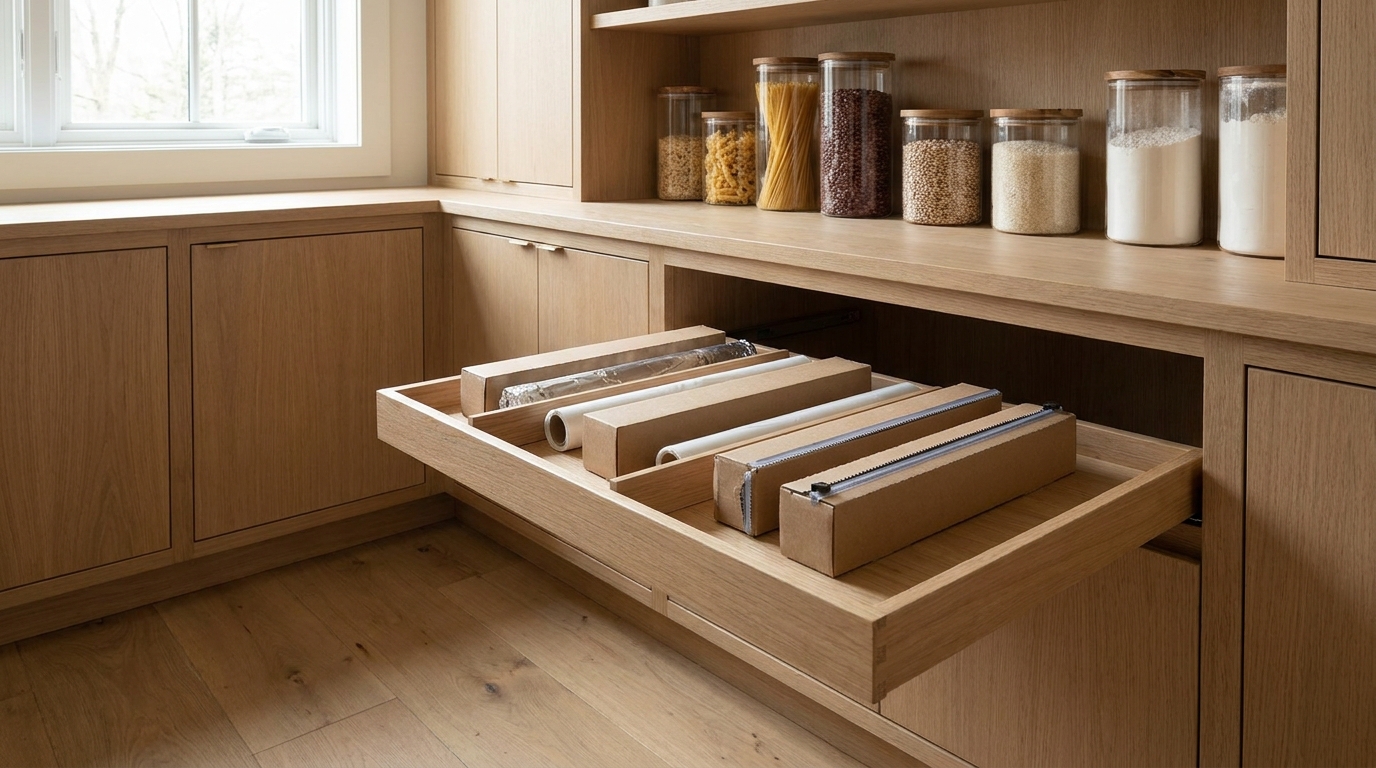
Pantry wrap storage is a small bay for foil, parchment, plastic wrap, and food-storage bags, set on their side or standing in a slot. The box your household buys sets the opening, and the cutter faces the cook so one sheet comes free in a single pull. That bay belongs in the dry pantry, not under the sink and not beside the oven or the cooktop. Loose bags stay where a small child cannot pull one over the head.
1. Give foil and bags a bay of their own
A wrap box is a different object from a spice jar or a can of tomatoes. It is long, light, and easy to crush, and the useful part is the edge you tear. When it shares a crowded shelf, it slides to the back and the cutter ends up against the wall.
Give these rolls their own bay. We do that in Charlotte, NC, and Ballantyne, NC, and in kitchens in Fort Mill, SC, and Waxhaw, NC. The bay holds foil, parchment, plastic wrap, and the bags you use for food.
It does not borrow the spice pull-out, the sheet-pan slot, the produce bins, the baking-staple drawers, the coffee station, the lunch-bottle shelf, the recycling pull-out, or the small-appliance garage. Those jobs already have homes. Mixing them makes every one of them harder to use.
A full custom pantry is a set of zones, not one deep shelf. Pull-outs for cans, a spice rack, and a spot for small appliances can sit beside this bay. They should not swallow it.
In a reach-in, the wrap slot often lives on the door or on the first shelf at counter height. In a walk-in, our team places it beside the prep counter so you can grab a sheet on the way back to the work surface.
The test is simple. You should see the roll you need before you move anything else. If finding foil means lifting a bin of snacks, the bay is not finished.
2. Size the slot to the box you buy
Measure the box in your hand, not a box from a catalog. Standard foil, heavy-duty foil, parchment, and plastic wrap do not share one footprint. A freezer-bag box is usually taller than a sandwich-bag box.
If the opening is too tight, the cardboard bows and the cutter jams. If it is too wide, the box twists and the loose end disappears inside.
We size the opening to the box you use. That measurement is our practice, not a published standard. During the in-home visit we look at the brands already in the house, including the oversized club-store roll if that is what you buy.
A vertical slot works when the box is sturdy and the bay is tall enough for the lid. A sideways slot works when the box is soft, or when a reach-in pantry has limited height. Either way, the box should slide in without a shove and lift out when you replace it.
- Leave a little clearance. The box needs room to drop in and lift out, not a press fit that tears the cardboard.
- Support the whole length. A rail or a full deck keeps a sideways box from sagging in the middle.
- Plan for two openings if you buy two kinds. A household that keeps both regular foil and a heavy-duty roll needs two slots, not one compromise that fits neither.
Dividers should be movable. Brands change, and a fixed opening that only fits last year's box becomes a frustration. We build the bay so a divider can shift when the box in your hand changes, without rebuilding the whole pantry.
3. Face the cutter toward the cook
The serrated edge should meet your hand. If the box lies on its side, the cutter sits on the front lip, not against the back panel. If the box stands, the tear bar faces the aisle.
You should see the cutting edge before you reach in. Turning the box around to hunt for it is how a sheet tears in the wrong place and then comes out crumpled.
A shallow lip or a small stop keeps the box from walking forward when you pull. The stop should not cover the cutter. We also leave a clear path so the sheet can hang for a moment without dragging across the shelf below and picking up crumbs.
- Do not bury the cutter behind another rack. If a spice strip or a bag of chips crosses the tear bar, the bay is too crowded.
- Keep the roll in its sleeve. The cardboard is the guide. A naked roll in a bowl looks tidy for a day and then unspools.
- Put the same edge out every time. After you load a new box, check that the cutter still faces you. A reversed box wastes the whole idea of the slot.
This is a small detail with a daily payoff. The cook who tears foil while a pan is hot should not have to rotate a box with the other hand full.
4. Keep loose bags away from small children
Thin plastic film is not a plaything. In an October 18, 2022 safety release, the U.S. Consumer Product Safety Commission told shoppers to properly dispose of thin plastic bags and packaging, because children can suffocate. [1] Food-storage bags are a kitchen tool, and they belong in a closed box. They do not belong in an open bin where a child can pull one loose and put it over the head.
Close the box, and set it where a small child cannot rake it open. We use a slot with a front stop. We place it high enough that a toddler cannot reach the opening, and low enough that an adult can pull a bag without a step stool.
We do not treat that height as a research number. We set it in the kitchen we are standing in, with the adults and children who live there. Loose bags left from a grocery run go in the trash, tied shut, the same day. They do not collect beside the wrap bay.
The U.S. Fire Administration says to place objects so they cannot be pulled down or knocked over. [2] It also calls for a kid-free zone of at least 3 feet around the stove. [3] A bag box on an open shelf beside a hot cooktop fails both of those instructions. A child reaches, the box tips, and film or paper lands in the one place it should not be.
5. Keep the bay off the cooktop and out of a wet cabinet
Cooking equipment accounts for a large share of home fires. The National Fire Protection Association reports that, from 2020 to 2024, an annual estimated 48 percent of home structure fires, 35 percent of home fire injuries, and 16 percent of home fire deaths involved kitchen and cooking equipment. [4]
The U.S. Fire Administration says to keep anything that can catch fire, including food packaging, away from the stove top. [5] A wrap box is paper around a roll of film or foil. It does not belong on the counter at the back of the range, and it does not belong in a drawer stacked against the oven.
A 2020 Clemson Extension fact sheet says storage areas near oven ranges, hot water pipes, or heating ducts should not be used, because heat and moisture can cause food to lose its quality more rapidly. [6] The same sheet says high temperature or humidity may reduce storage time considerably. [7] FoodSafety.gov, on a page last reviewed on September 20, 2023, says the ideal location for canned or dried food is a cool, dry, dark place, and that the best temperature is 40°F to 70°F. [8] That page also says to store foods away from ranges or refrigerator exhausts, because heat causes many foods to spoil more quickly. [9]
Put the wrap bay in that same dry pantry, not under the sink. Around Rock Hill, SC, Indian Land, SC, and Wesley Chapel, NC, our practice is to keep a paper wrap box out of a wet under-sink cabinet, where humidity can make the box slump. That slump is our design observation, not a lab figure.
The sink cabinet also collects cleaners. Wrap that touches food should not share a damp cabinet with those products. The dry pantry keeps the cardboard stiff and the cutter straight.
The same rule covers the wall beside the oven. Heat from the appliance and steam from the sink are a poor pair for a paper sleeve. A tall pantry on an interior wall, or a cabinet a step away from the range, is the better home.
6. Stock the wraps that match the food job
The bay earns its space at the end of cooking, when leftovers need a cover. USDA leftovers guidance, last updated on July 31, 2020, says to cover leftovers, wrap them in airtight packaging, or seal them in storage containers. [10] Those steps help keep bacteria out, retain moisture, and prevent leftovers from picking up odors from other food in the refrigerator. [10] When you reheat in a microwave, that same guidance says the covering must be microwave safe. [11]
Match the roll to the job, and do not ask one product to do every job. A Clemson Extension fact sheet updated on June 30, 2026, lists parchment paper among safe microwave containers, along with wax paper, microwave cooking bags, and microwave-safe paper towels. [12] It says not to use thin plastic storage bags, or aluminum foil containers unless the microwave manufacturer specifically approves them. [13] It says those unsuitable containers may melt, warp, or allow chemicals to migrate into food when heated. [13]
Freezer storage is a different test. A Clemson freezing fact sheet revised on July 15, 2020, says heavy-duty aluminum foil, along with moisture- and vapor-resistant bags and sheets, is suitable for dry-packed vegetables, fruits, meats, fish, or poultry. [14] The same sheet says lightweight household aluminum foil, wax paper, and bread wrappers are not moisture- and vapor-resistant enough for long-term freezer storage. [15]
If you freeze meat, soup, or extra servings, the heavy-duty foil and the freezer bags get their own slots. The thin foil you use to tent a roasting pan is not the freezer roll.
- Use parchment when the cover must go in the microwave. The June 30, 2026 Clemson sheet lists it among safe microwave containers. [12]
- Use heavy-duty foil for the freezer jobs that sheet describes. Lightweight household foil is not the stand-in for long freezer storage. [14] [15]
- Use plastic wrap and food bags for the refrigerator. Cover or seal leftovers as the 2020 USDA guidance describes, and keep thin plastic storage bags out of the microwave. [10] [13]
Wax paper can sit in this bay if you use it as a microwave cover, which that 2026 sheet allows. [12] It should not be the roll you trust for a long stay in the freezer. [15] Labeling the slots in plain words keeps those jobs from getting swapped on a busy night.
7. Make the daily pull one motion
One reach, one tear, and the box closed again. The open roll sits in front. A spare box, if you keep one, sits behind it or on the shelf above, still in the dry zone. We label the slot by what it holds, so a guest does not open the parchment while looking for foil.
In Weddington, NC, and in the other towns we serve, the complaint we hear is rarely that the pantry has no foil. It is that the foil is trapped behind a bin. A divided bay fixes that.
Each opening is only as wide as its box. Nothing else fits, so nothing else gets stuffed there on grocery day.
- Keep the spare in the same bay. A backup roll in a distant closet rarely makes it back when the first roll ends.
- Wipe the cutter. Crumbs and grease on the serrated edge tear the next sheet in a jagged strip. A dry cloth is enough.
- Replace a crushed sleeve. Once the cardboard fails, the roll will not track. Slide a new box into the same opening.
If the household changes brands, we adjust the divider. The slot is built for the box you use now, and a custom pantry can be refit when that box changes. That is the point of sizing it in the house rather than guessing from a generic opening.
The cook should not have to think about the bay. The sheet should simply be there, cutter out, in the dry part of the pantry.
Practical takeaways
- Give wrap its own bay. Foil, parchment, plastic wrap, and food bags do not share the spice pull-out, the sheet-pan slot, or the small-appliance garage.
- Size the opening to the box you buy. A sideways slot or a vertical slot both work when the cutter faces you and the box can slide in and out.
- Keep bags closed and out of a small child's reach. A 2022 CPSC release says to dispose of thin plastic bags and packaging because children can suffocate. [1]
- Keep paper boxes in the dry pantry. Keep food packaging away from the stove top. [5] Do not park a paper sleeve in a wet under-sink.
- Match the roll to the food job. Heavy-duty foil is the long freezer wrap [14], parchment is a microwave-safe cover on the 2026 Clemson list [12], and plastic wrap or bags cover leftovers in the refrigerator [10].
How we can help
Have more questions or want to get in touch? We design custom pantries for homes in Charlotte and the surrounding towns, including a wrap bay sized to the boxes you use, and we offer a free in-home design consultation and professional installation. Reach us on our contact page, call (704) 604-3870, or email design@theclosetrehab.com.
Citations
- U.S. Consumer Product Safety Commission, "CPSC Reminds Early Holiday Shoppers to Follow These Top Safety Tips" (2022-10-18)
- U.S. Fire Administration, "Burn Prevention, First Aid and Calling 911" (2026)
- U.S. Fire Administration, "Burn Prevention, First Aid and Calling 911" (2026)
- National Fire Protection Association, "Safety with cooking equipment" (2020-2024)
- U.S. Fire Administration, "Pictograph: Keep Anything That Can Catch Fire Away From Your Stove Top" (2026)
- Clemson Cooperative Extension, "Food Storage: Pantry" (2020-03-27)
- Clemson Cooperative Extension, "Food Storage: Pantry" (2020-03-27)
- FoodSafety.gov, "Food Safety in a Disaster or Emergency" (2023-09-20)
- FoodSafety.gov, "Food Safety in a Disaster or Emergency" (2023-09-20)
- U.S. Department of Agriculture, Food Safety and Inspection Service, "Leftovers and Food Safety" (2020-07-31)
- U.S. Department of Agriculture, Food Safety and Inspection Service, "Leftovers and Food Safety" (2020-07-31)
- Clemson Cooperative Extension, "Microwave Food Safety" (2026-06-30)
- Clemson Cooperative Extension, "Microwave Food Safety" (2026-06-30)
- Clemson Cooperative Extension, "Freezing Basics" (2020-07-15)
- Clemson Cooperative Extension, "Freezing Basics" (2020-07-15)