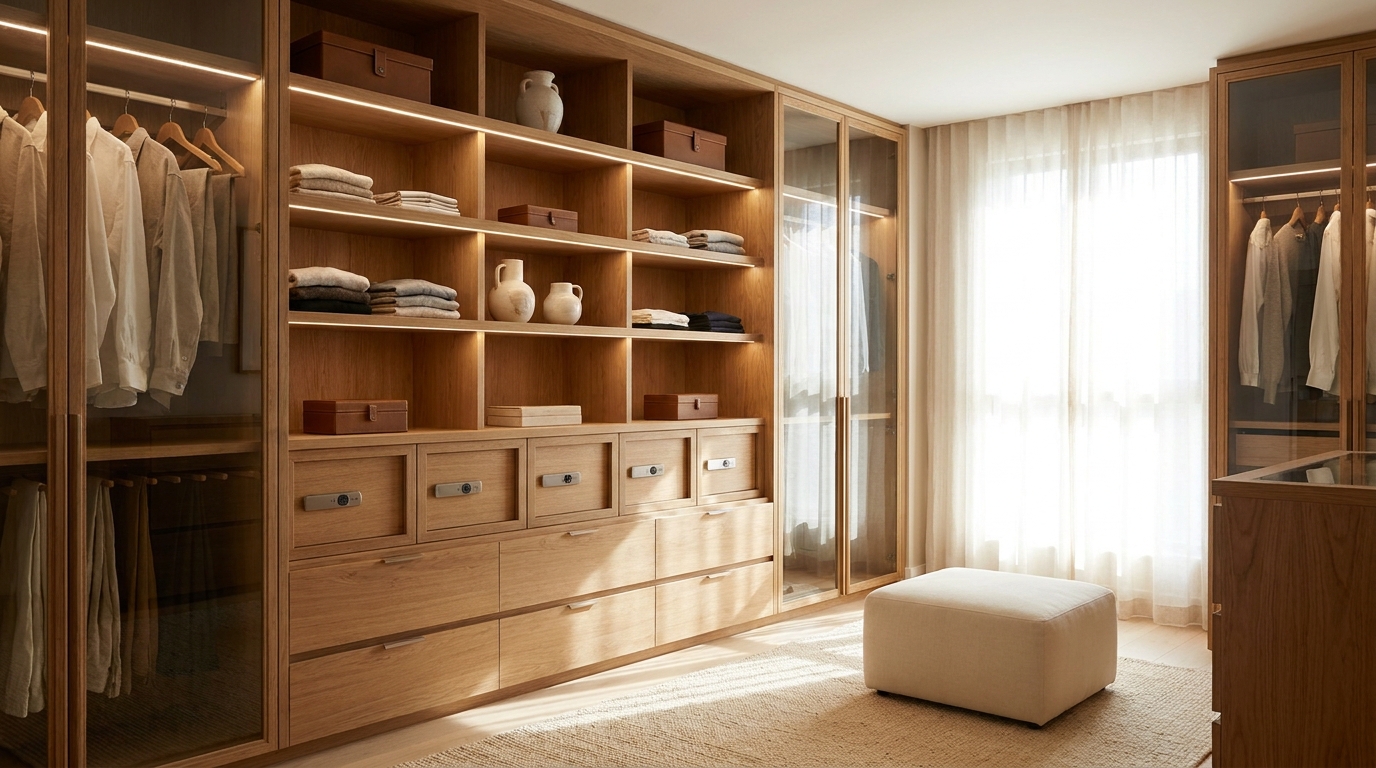
Custom Cabinetry Drawer Walls for Hanging Closets
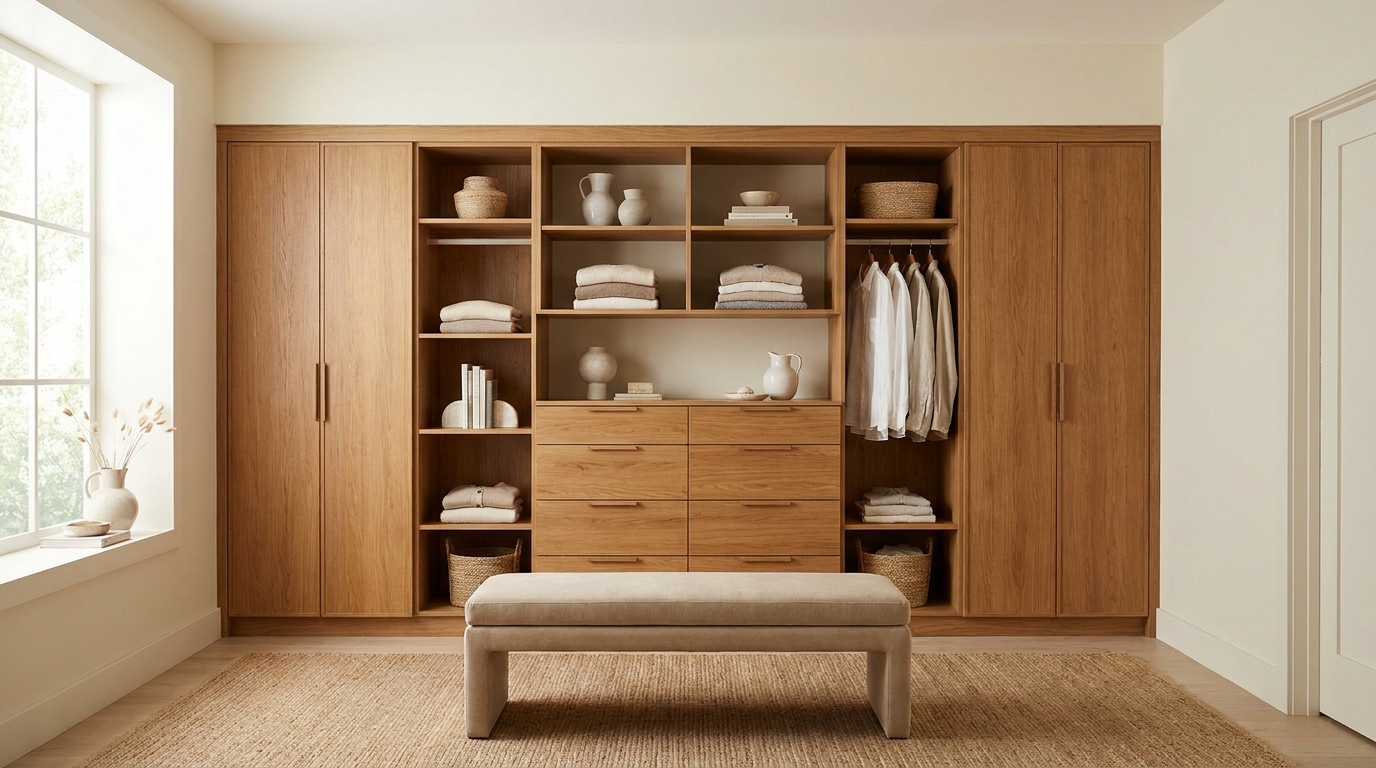
A bedroom dresser built-in is a wall-fastened drawer bank that takes over for a freestanding chest when the closet is already a hanging room. Folded everyday clothes live in that drawer wall. Shirts, jackets, and long garments stay on the rods. We build the bank as custom cabinetry and fasten it to the wall, because the Consumer Product Safety Commission still tells households to anchor furniture, including dressers, securely to the wall [1].
A hanging closet cannot also be the dresser
Many bedrooms we work in around Charlotte, Fort Mill, and Rock Hill were planned around a rod, not around a chest of drawers. The closet opening is wide enough for shirts and jackets. The floor inside is not wide enough for a real dresser, and the bedroom already has a bed, a door swing, and a path to the window. Folded clothes then end up in a stack on the closet floor, in a basket that never gets emptied, or in a freestanding dresser that crowds the room.
That split matches how garments hold their shape. A National Park Service Conserve O Gram, published in December 2020 and still posted by the agency, says sturdy structured or tailored garments in good condition can hang on a properly sized padded hanger [5]. It also says not to hang knits, bias-cut clothing, heavy pieces, or fragile garments, and to house those flat in boxes or cabinet drawers, because hanging stresses the shoulders, neck, and bodice [5]. A family wardrobe is not a museum collection. The sorting rule is still the useful one: structured shirts, jackets, and long garments on the rod, and sweaters, tees, and other knits folded.
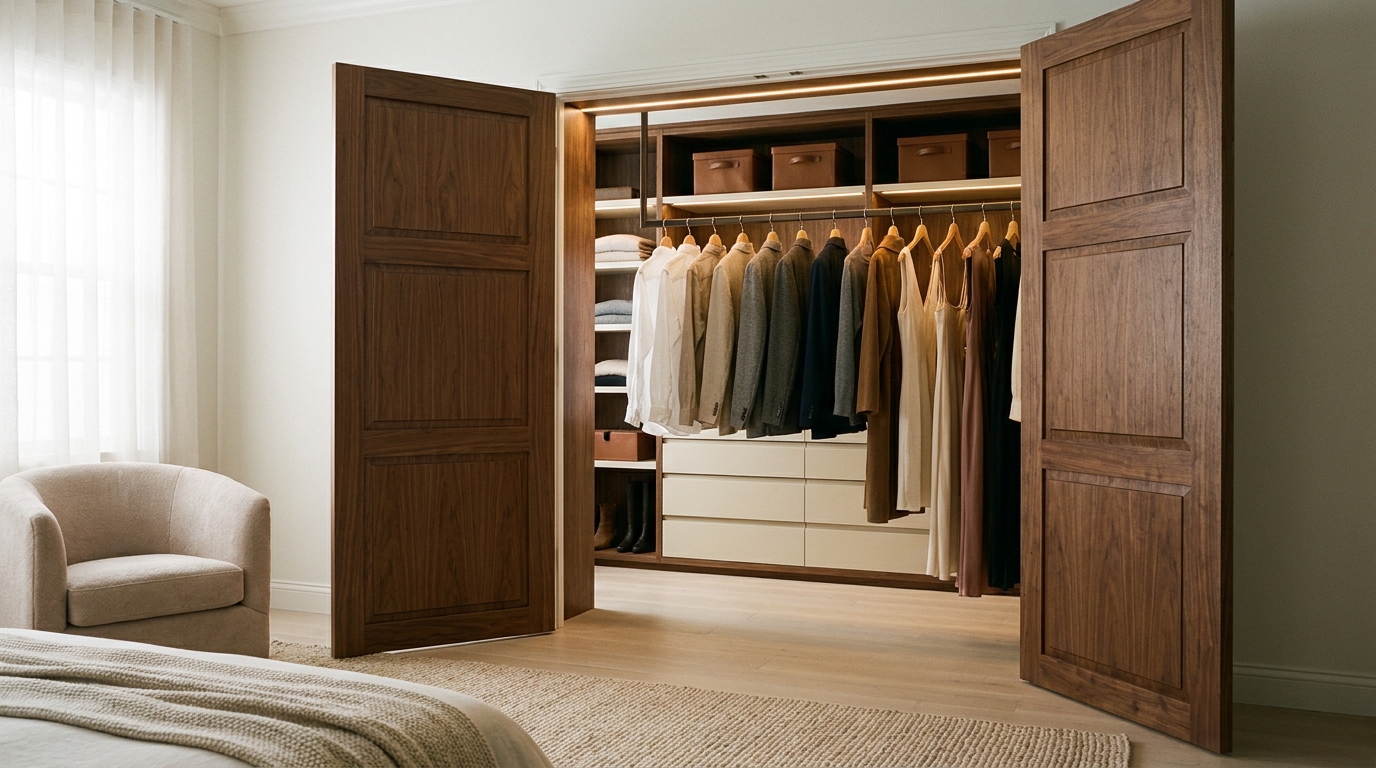
If the closet itself needs a new rod plan, that is a different project. Our custom closet systems can reset the hanging room. This article is the other choice. Leave the closet for shirts, jackets, and long garments, and move the dresser job onto a bedroom wall.
A freestanding dresser looks easy until several drawers are open at once, the piece sits on carpet, or a child climbs. In an April 19, 2023 release, CPSC staff reported 234 fatalities from clothing storage unit tip-overs from January 2000 through April 2022, including 199 child fatalities, and estimated 84,100 tip-over injuries treated in United States hospital emergency departments from 2006 through 2021, an estimated annual average of 5,300 [1]. Injury figures in that release stop in 2021, and the death count stops in April 2022, so this is not a current-year tally [1]. It is still why we do not treat a loose chest as a harmless place to park jeans.
That 2023 release also explains what the STURDY law required for a standard protecting children up to 72 months old: tests on carpet, tests with loaded drawers and with multiple drawers open, and tests that simulate the weight of children up to 60 pounds [1]. The rule took effect September 1, 2023 [1]. In a July 29, 2025 release, CPSC said campaign efforts contributed to a nearly 50-percent decline in tip-over-related injuries and deaths in the United States, and it still told households to anchor dressers, keep toys and remotes off the top, and store heavier items lower [3].
1. Sort the wardrobe before you draw a single drawer
Hang what has a shoulder. Button-down shirts, jackets, blazers, and coats in sound condition belong on hangers that fill the shoulder. A thin wire lets the garment collapse onto a narrow line. The December 2020 Park Service note says hanging stress concentrates on the upper body, so the hanger should match the shoulder [5]. Give those pieces enough rod width that sleeves are not crushed into the side wall.
Fold what will stretch. Knits do not hold shape the way a tailored jacket does, which is why that guidance says not to hang them [5]. Sweaters, T-shirts, sweatshirts, and leggings are the drawer-wall load. Jeans can go either way. If you like them folded, they live in the bank. If you like them hung, they stay with the shirts. Decide once. A second copy of every category in both places fills the closet again and leaves the new drawers half empty.
Keep long garments in the closet. Dresses, robes, long coats, and jumpsuits need vertical clearance. A drawer wall is the wrong home for them. We do not shrink that list to inflate a drawer count. A coat that is too heavy or too fragile to hang can be stored flat, which is the same Park Service caution [5]. That is a special case, not the plan for every work jacket.
Do not solve this with the wrong built-in. A drawer wall is not a pair of bedside cabinets. It is not a jewelry tray or a sock insert inside the closet. It is not a run of open shelves in a reach-in, and it is not an island in a walk-in. Those can be good projects when the closet is large enough to hold folded storage of its own. They are a different answer from the one this room needs: a dresser that stays on the wall and leaves the closet for hanging.
2. Fasten the bank to the wall on purpose
The drawer wall we install is custom cabinetry: a run of drawers fastened to the wall during installation, finished to the bedroom rather than hidden behind the closet door. Folded clothes that you reach for on a normal morning live there. The closet door can stay a hanging door. You open it for a shirt or a jacket, not for a hunt through a pile of tees.
Fastening is the design, not a kit you might add later. CPSC business guidance defines a clothing storage unit, for the federal stability rule, as bedroom clothing furniture with drawers and/or hinged doors that is free-standing, at least 27 inches high, at least 30 pounds, and at least 3.2 cubic feet of enclosed storage [2]. A unit has to meet all of those criteria to fall under the rule [2]. The same page lists products outside that scope, including built-in units intended to be permanently attached to the building [2]. The regulation, 16 CFR part 1261, uses the same free-standing definition and says the requirements are meant to protect children up to 72 months of age [4]. Units manufactured after September 1, 2023 are subject to that part [4].
Read that as scope, not as a promise that any box touching a wall is safe. The exclusion is for built-in units intended to be permanently attached [2]. A chest shoved against drywall, or half-fastened with a random screw, is not that product. We fasten the bank during installation to the wall we actually find. We do not publish one screw size for every house. A stud wall and a masonry wall are different, and a guess damages both the cabinet and the finish.
If a freestanding dresser stays in the room for now, use the anchor hardware that came with it and follow the maker's instructions. CPSC said in July 2025 to anchor bookcases and dressers to the wall, and the April 2023 release says the same about dressers [3][1]. We would rather build the drawer wall than suggest a weekend experiment on a chest meant to stand on its own.
Covered freestanding units are also tested with drawers open. If more than half the storage volume is extended, one test fills the enclosed storage with 8.5 pounds per cubic foot and holds for 30 seconds [2]. Another, the carpet-and-child-weight test, hangs a 60-pound apparatus on the front [2]. That is a lab method, not a home project, and it matches the ordinary failure: several loaded drawers open on a soft floor while a child pulls or climbs. A fastened bank is meant to stay put. It is not a license to leave toys or remotes on top. The 2025 release says to avoid that and to keep heavier items lower [3].
3. Load the drawers the way the week actually works
Put weight down low. Jeans, sweaters, and other heavy folds go in the lower drawers. Lighter tees and pajamas can sit higher. That follows the July 29, 2025 CPSC advice to store heavier items lower, written for shelves and equally sensible for a drawer bank in a room children use [3]. We are not applying workplace or public-building reach rules to a private bedroom. We are keeping the heavy stack where a climb is less tempting and a full drawer is easier to push closed.
Group by use, not by a catalog count. We do not start with a fixed number of drawers. We start with the folded categories you own: work tees, weekend knits, jeans, workout clothes, sleepwear, and out-of-season folds if the rod is already full. Some banks are a short run beside the closet door. Some take a longer wall. The count follows the clothes and the clear wall in that room, not a stock chest in a photo.
Leave the drawer able to close. A drawer packed so the front will not meet the frame is not extra storage. It is a drawer that stays open. Open, loaded drawers are exactly the condition the freestanding stability tests examine [2]. Fold once, stack only as high as the box can hold, and stop. If a category needs another drawer, that is a design change we can make before we build. Forcing the fit later bends the slide and trains everyone to leave the drawer out.
Put clothes in dry. High room humidity can grow mold on furnishings and on clothing. EPA's mold-house guidance, updated September 8, 2026, says to keep indoor humidity below 60 percent, ideally between 30 and 50 percent [6]. Workout clothes, and anything damp from rain, do not go straight into a closed drawer. Let them dry in the room first. A drawer wall will not fix a wet house. If bedroom windows show condensation, deal with the moisture before you blame the cabinet.
4. Give the closet air, and keep folded clothes out of the cold corner
Closets are often colder than the rooms they open into. EPA moisture guidance updated February 18, 2026 says to open doors between rooms, especially closet doors, so circulation can carry heat to those colder surfaces [7]. A hanging closet with the door shut all week, packed so tightly that air cannot move, is the pocket that stays cool and still. Shirts and jackets still belong in there. They need a little space on the rod, and the door should not be the only place damp air can sit.
Folded everyday clothes do not have to live in that colder pocket. That is the reason for a drawer wall in the bedroom, in the air you already live in. The September 2026 EPA note is about the room: high humidity can grow mold on clothing [6]. We still keep the bank off a jammed exterior corner, and we do not ask the rod to hold the sweaters too.
None of this is a mold cleanup. If you already see growth on a wall or on fabric, fix the water source and clean it properly. Cabinetry does not dry a leak, and it does not replace a dehumidifier when the whole house is damp. What we can do is stop using the closet floor as a hamper. Around Ballantyne, Waxhaw, Wesley Chapel, and Indian Land, we often see damp clothes go into a closed drawer while the closet door stays shut. Dry first, then fold.
5. Choose the wall before you choose the finish
Walk the bedroom before you fall for a picture of a drawer wall. We look for a clear run that does not block the closet door, the bedroom door, a window, a supply vent, or the path around the bed. Outlets and switches stay usable. The bank has to sit level, because a racked box makes drawers bind. Carpet is part of that check. CPSC's freestanding tests include stability on carpet for a reason [1]. A fastened bank still needs fronts that line up and drawers that travel straight. We check that on site. We do not hand you a shim recipe.
The better wall is often the one the headboard is not using. Sometimes it is beside the closet. Sometimes it faces the closet, so hanging and folded clothes are across from each other and the bed stays clear. We will say so if the wall you like hits a door. Finish and pulls come after the clothes list. Custom cabinetry can match the trim or stay quiet. That is a design choice, not a safety claim. What matters first is that the bank is the dresser, the closet stays the hanging room, and the piece is a built-in intended to stay attached to the building [2].
If children use the room, keep toys and remotes off the top. That is the July 29, 2025 CPSC caution for storage they might climb [3]. A lamp belongs on a real nightstand. The end of a tall drawer wall is not a bedside table, and two little cabinets are not this project.
Practical takeaways
- Use the closet for shirts, jackets, and long garments, and use a wall-fastened drawer bank for folded everyday clothes.
- Fold knits. A December 2020 National Park Service note says not to hang knits or heavy, fragile garments [5].
- Anchor any freestanding dresser you still own, as CPSC said in April 2023 and again in July 2025 [1][3].
- A built-in sits outside that clothing-storage rule only when it is intended to be permanently attached to the building, which is the exclusion CPSC describes [2].
- Keep heavier folds low, keep climbable objects off the top, and put clothes away dry [3][6].
- Open the closet often enough for air to move. EPA notes that closets can be colder than the rooms around them [7].
- Let the drawer count follow the folded clothes and the clear wall, not a stock chest.
How we can help
Have more questions or want to get in touch? We plan drawer walls for bedrooms whose closets should stay hanging rooms, and a designer will come to your home for a free, no-obligation in-home design consultation. Visit https://theclosetrehab.com/contact-us/, call (704) 604-3870, or email design@theclosetrehab.com.
Citations
- U.S. Consumer Product Safety Commission, "CPSC Adopts Final Consumer Product Safety Standard to Prevent Tip-overs of Dressers and Other Clothing Storage Units" (2023-04-19)
- U.S. Consumer Product Safety Commission, "Clothing Storage Units" (2023)
- U.S. Consumer Product Safety Commission, "CPSC Anchor It! Campaign Marks 10 Years: Fewer Furniture Tip-Overs Lead to Safer American Households" (2025-07-29)
- Electronic Code of Federal Regulations, "16 CFR Part 1261, Safety Standard for Clothing Storage Units" (2026-10-20)
- National Park Service, "Conserve O Gram 4/5: Storage Techniques for Hanging Garments: Padded Hangers" (2020-12)
- U.S. Environmental Protection Agency, "Text Version of the Mold House Tour" (2026-09-08)
- U.S. Environmental Protection Agency, "What are the main ways to control moisture in your home?" (2026-02-18)