Utility Closet Storage: Vacuum Dock, Slots, Caddy
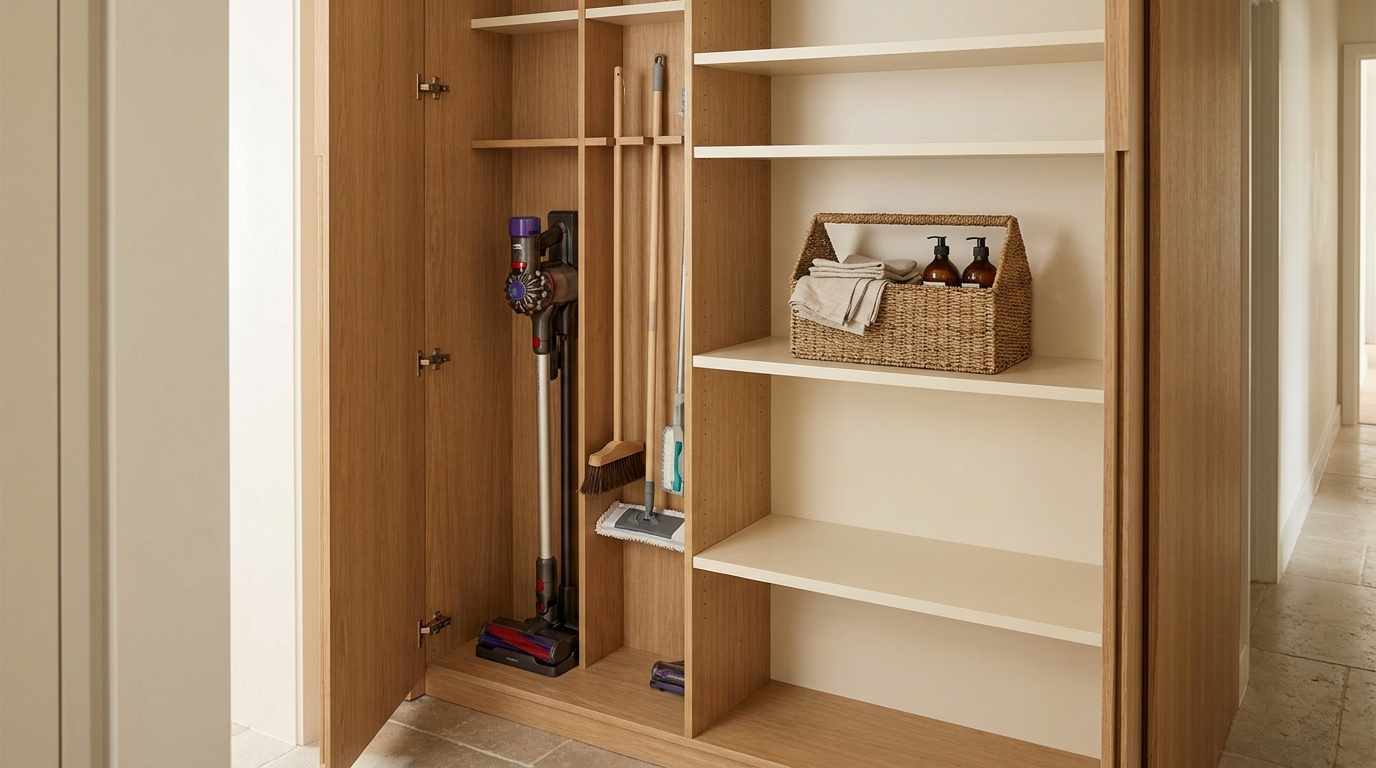
A hall broom closet becomes useful utility closet storage when it works as a small utility bay: a vacuum dock, tall slots for brooms and mops, and a caddy you can grab without hunting. In Charlotte, Fort Mill, and nearby towns, we still see these closets stuffed with leaning handles, a vacuum cord across the doorway, and concentrated cleaners on the floor. That layout is not only messy. Household cleaning substances accounted for 87,031 cases, or 10.1 percent of substances reported in poison-center-managed exposures among children age 5 and under in 2024 [1]. Peak unintentional poisoning still clusters around one- and two-year-olds, and 99.2 percent of exposures in children younger than 6 were unintentional [1]. A working bay keeps daily tools in reach, keeps wet mops in air, and keeps the strong stuff locked.
2. What belongs in a hall utility bay (and what does not)
This is a hall or utility broom closet, not a laundry five-zone room, not a linen closet, and not a pantry. The job is short: park the vacuum, stand the tall tools, grab a caddy, and put concentrated cleaners where a toddler cannot reach them. Towels belong with linens. Cereal belongs in food storage. Washers, dryers, and folding counters belong in a laundry room.
Our team typically plans the bay around four daily jobs:
- Park and charge the vacuum without a cord across the hall.
- Stand brooms, mops, and dusters so handles cannot fall into the walkway.
- Grab a caddy with the products you actually use each week.
- Lock drain opener, oven cleaner, concentrated bleach, and similar caustics.
Ballantyne townhomes and Waxhaw ranches both have these shallow closets. The footprint is small. The system has to earn every inch. We design custom closets for that kind of tight, high-use space, and a broom closet is one of the highest-use spots in the house.
3. Build a vacuum dock instead of a dangling cord
The vacuum is the bulky item that ruins a broom closet when it has no assigned home. An upright or stick vacuum needs a dock: a clear floor pad or wall cradle, a dedicated receptacle, and a place for the charger and extra tools. The dock is not a pile of boxes with a cord snaking out under the door.
The U.S. Consumer Product Safety Commission is direct about household extension cords. They can overheat and cause fires when used improperly, usually from overloading or from connecting appliances that draw more watts than the cord can handle [4]. Damaged cords can also cause fires [4]. Extension cords should only be used temporarily [4]. That is why we plan a receptacle in the closet instead of treating a cord run as permanent wiring.
CPSC also tells households not to run extension cords under carpets, through doorways, or under furniture [4]. A broom closet that feeds a vacuum through the door gap is doing exactly that. If any part of a cord is hot in use, that is a warning it may be overloaded [4]. Unplug a cord when it is not in use; a plugged-in cord is energized and can overheat if shorted [4]. Protect young children by keeping them away from cords and unplugging when you are done [4].
A dock that works in a Charlotte or Rock Hill hall closet usually includes a dedicated outlet on the side wall, a cord hook or wrap so the cord never sits in the door swing, and a charger shelf for cordless sticks kept off the floor. Leave air around the battery pack. Do not bury the charger under coats, shopping bags, paper, or rags.
Poison Control also warns against leaving aerosol cans on a stove, radiator, furnace, in direct sunlight, or near other heat sources because of toxic fumes and fire hazards [9]. The charging niche is not a catch-all for spray cans.
4. Give brooms and mops tall, assigned slots
Tall tools fail when they lean. One broom falls, the mop follows, and the closet becomes a trap. Tall-tool slots solve that. Vertical dividers, a hang rail, or both keep handles upright and heads off the floor.
We separate wet tools from dry tools. A mop that just cleaned a Wesley Chapel kitchen should not drip onto the vacuum filter. A simple drip tray, a slatted shelf, or a hang rail with space under the head lets water fall where you can wipe it. The slot is sized to the handle, not to a jumble of leftover wrapping paper and sports gear.
Give each tool its own slot. Hang wet heads so they can drip. Keep a short hook row for dustpans, lint rollers, and refill bags. Leave a floor you can see, so a fallen handle is obvious before someone trips.
This is still a hall closet. Handles should not project into the circulation path. The U.S. Access Board’s guide to operable parts uses an unobstructed reach range of 15 to 48 inches for the parts you actually operate [5]. We use that range as a practical guide for the items you grab daily. Extra bulk packs can sit higher. The broom you use three times a week should not.
5. Keep a grab-and-go caddy at mid-reach
A working bay has a caddy you can lift with one hand. Glass cleaner, bathroom spray, microfiber cloths, gloves, and a small trash bag live in that caddy. You take it to the room, then put it back. You do not pour the economy-size jug into a drinking glass so it is “easier to carry.”
National Capital Poison Center is blunt: keep cleaning products in original containers, always [2][10]. Leave original labels on and read them before using [10]. If you must transfer a product to a smaller container, copy the original label and the poison center number (1-800-222-1222) onto it, and keep it away from children, especially if the new container is not child-resistant [10]. Store household cleaning products away from foods and medications [10]. Keep them in cabinets with child-resistant latches [10]. Food-scented cleaners raise the risk that children and adults will swallow them by mistake [10].
EPA’s household hazardous waste guidance matches that packaging rule. Never store hazardous products in food containers. Keep them in original containers and never remove labels [3]. When leftovers remain, never mix household hazardous waste with other products. Incompatible products might react, ignite, or explode [3]. Follow the use and storage instructions on the label [3].
The caddy shelf belongs at mid-height, inside that 15-to-48-inch daily-use band [5]. Operable parts should work with one hand, without tight grasping, pinching, or twisting of the wrist, and without more than 5 pounds of force [5]. A U-shaped pull on a caddy cubby beats a tiny knob. In Indian Land and Fort Mill homes with kids, that mid-reach cubby is for the mild daily products, not for lye or oven cleaner.
6. Lock concentrated cleaners on a dedicated shelf
The lockable shelf is the part many broom closets skip. Drain openers, oven cleaners, rust removers, toilet bowl cleaners, and some concentrated bleaches are caustics. Poison Control notes that caustic substances do their damage instantly. Injury cannot be reversed, only treated [2]. Store those products in original containers with the child-resistant cap on tightly [2]. Never transfer them into food or beverage containers [2]. Buy only the amount you need, and store them locked, out of sight and reach of children and pets [2].
Spring-cleaning guidance from the same poison center adds a layout rule we use in every utility bay: store cleaning products in cabinets with child-resistant latches [9]. One of the most dangerous places to store cleaners is an unlocked, low kitchen or bathroom cabinet [9]. A hall closet with the same low, unlocked shelf has the same problem. Never mix household cleaning products. Mixing can produce poisonous fumes and serious breathing problems [9]. Ventilate small spaces by opening a window or door and running an exhaust fan [9].
EPA treats leftover paints, cleaners, oils, batteries, and pesticides as household hazardous waste when they can catch fire, react, explode, or prove corrosive or toxic [3]. Those products need special care in storage and disposal [3]. They can present hazards to children and pets if left around the house [3]. Even empty containers can pose hazards because residual chemicals may remain [3].
A lockable upper cabinet, a lockable drawer, or a small lockbox on a high shelf keeps the concentrated products out of the caddy. The caddy holds what you use weekly. The lock holds what you use rarely and what can burn on contact.
7. Ventilate damp mops so the closet does not stay wet
A broom closet with a wet mop sealed behind a tight door is a moisture box. EPA’s mold guidance is consistent: the key to mold control is moisture control [6]. Dry water-damaged areas and items within 24 to 48 hours to prevent mold growth [6]. If wet or damp materials are dried in that window after a leak or spill, mold will not grow in most cases [6]. Keep indoor humidity below 60 percent, ideally between 30 and 50 percent relative humidity [6].
That is why we do not design an airtight utility bay for wet tools. A louvered door, a generous door undercut, or a vented panel lets the mop head dry. A hang rail beats a plastic tub with a lid. If you close a soaked mop in a tub, you have built a damp chamber on purpose.
If you later need to clean mold on a hard surface, EPA says never mix chlorine bleach solution with other cleaning solutions or detergents that contain ammonia, because toxic fumes could be produced [6]. Always ventilate the area and exhaust air outdoors if you use a disinfectant [6]. Poison Control repeats the same mixing ban and calls out small rooms, including bathrooms, as spaces that need a window, a door, or an exhaust fan [9]. A hall closet is a small room too.
EPA’s Safer Choice program is useful when you restock the caddy. Safer Choice restricts volatile organic compound content to minimize indoor air pollution and associated respiratory concerns [8]. Before a product can carry the label, EPA reviews all chemical ingredients, regardless of percentage in the product [8]. That does not make a product safe to mix or safe to store on a low open shelf. It does give households in Charlotte and Rock Hill a clearer way to choose daily cleaners that are easier on indoor air.
8. Keep oily rags and leftover solvents out of the pile
Hall closets collect “just for now” rags after a furniture-oil job or a stain wipe. NFPA’s 2019 oily-rag tip sheet is the reason we keep those rags out of the broom closet. Wet rags can ignite on their own [7]. Oils used in oil-based paints and stains release heat as they dry. If that heat is not released into the air, it builds up. A pile of oily rags can trap the heat until it causes a fire [7]. NFPA’s 2019 sheet reports an average of 1,700 home fires per year caused by spontaneous combustion or chemical reaction, and an average of 900 home fires per year started when oily rags catch fire or are ignited [7].
NFPA’s handling steps are specific:
- Never leave cleaning rags in a pile. Take them outside to dry [7].
- Hang them or spread them on the ground, weighed down, not in a pile, and away from buildings [7].
- Put dried rags in a metal container with a tight cover, filled with a water and detergent solution to break down the oils [7].
- Keep those containers in a cool place, out of direct sunlight and away from other heat sources [7].
Flammable and combustible liquids belong in original containers, tightly capped or sealed, never in glass [7]. Gasoline should never be used as a cleaner and should never come indoors, even in small amounts [7]. A hall utility closet is occupied space. It is not a solvent locker.
ADA Standards section 811, as published by the Access Board, is a useful measuring stick even in a private home. Storage should have clear floor space, storage elements should fall in at least one of the reach ranges in section 308, and operable parts should comply with section 309 [11]. We are not claiming a private hall closet must meet public-building rules. We are saying a bay you can stand in, reach, and operate is safer than a jammed cubby.
9. Practical takeaways
- Treat the hall broom closet as a utility bay, not overflow storage for linens, food, or laundry.
- Give the vacuum a dock with a dedicated receptacle. Do not run a cord under the door or treat an extension cord as permanent wiring [4].
- Assign tall-tool slots so brooms and mops stand, drip, and dry instead of leaning.
- Keep a grab-and-go caddy of daily products in original, labeled bottles at mid-reach [5][10].
- Put concentrated and caustic cleaners on a lockable shelf, not on a low open cabinet [2][9].
- Let damp mops dry in air within 24 to 48 hours. Aim for indoor humidity below 60 percent, ideally 30 to 50 percent [6].
- Never mix cleaners, and never store leftovers in food or drink containers [3][9].
- Keep oily rags out of the closet pile. Dry them outside and use a metal container if you must hold them [7].
- Leave a clear floor so you can grab the vacuum without moving a stack of bags.
How we can help
Our team designs hall and utility closets as working bays: vacuum docks, tall-tool walls, mid-reach caddies, and lockable cleaner storage for homes in Charlotte, Ballantyne, Waxhaw, Wesley Chapel, Fort Mill, Indian Land, and Rock Hill. We measure the closet you already have and plan the dock, the slots, and the lock so daily cleaning does not spill into the hall.
Have more questions or want to get in touch? https://theclosetrehab.com/contact-us/ · (704) 604-3870 · design@theclosetrehab.com
Citations
- National Capital Poison Center, "National poison center statistics, 2024" (2024)
- National Capital Poison Center, "Caution with caustics: Tips for preventing chemical burns" (accessed 2026-09-14)
- U.S. Environmental Protection Agency, "Household Hazardous Waste (HHW)" (2026-06-01)
- U.S. Consumer Product Safety Commission, "Household Extension Cords Can Cause Fires" (Publication 5032, 2012-04)
- U.S. Access Board, "Guide to the ADA Accessibility Standards, Chapter 3: Operable Parts" (accessed 2026-09-14)
- U.S. Environmental Protection Agency, "A Brief Guide to Mold, Moisture and Your Home" (accessed 2026-09-14)
- National Fire Protection Association, "Safety with Oily Rags wet with flammable or combustible liquid" (2019)
- U.S. Environmental Protection Agency, "Learn About the Safer Choice Label" (2026-09-01)
- National Capital Poison Center, "Top tips for a safe spring cleaning" (accessed 2026-09-14)
- National Capital Poison Center, "Uh oh...that wasn't orange juice! Why container transfers are dangerous" (accessed 2026-09-14)
- U.S. Access Board, "ADA Accessibility Standards, Chapter 8: Special Rooms, Spaces, and Elements (811 Storage)" (accessed 2026-09-14)