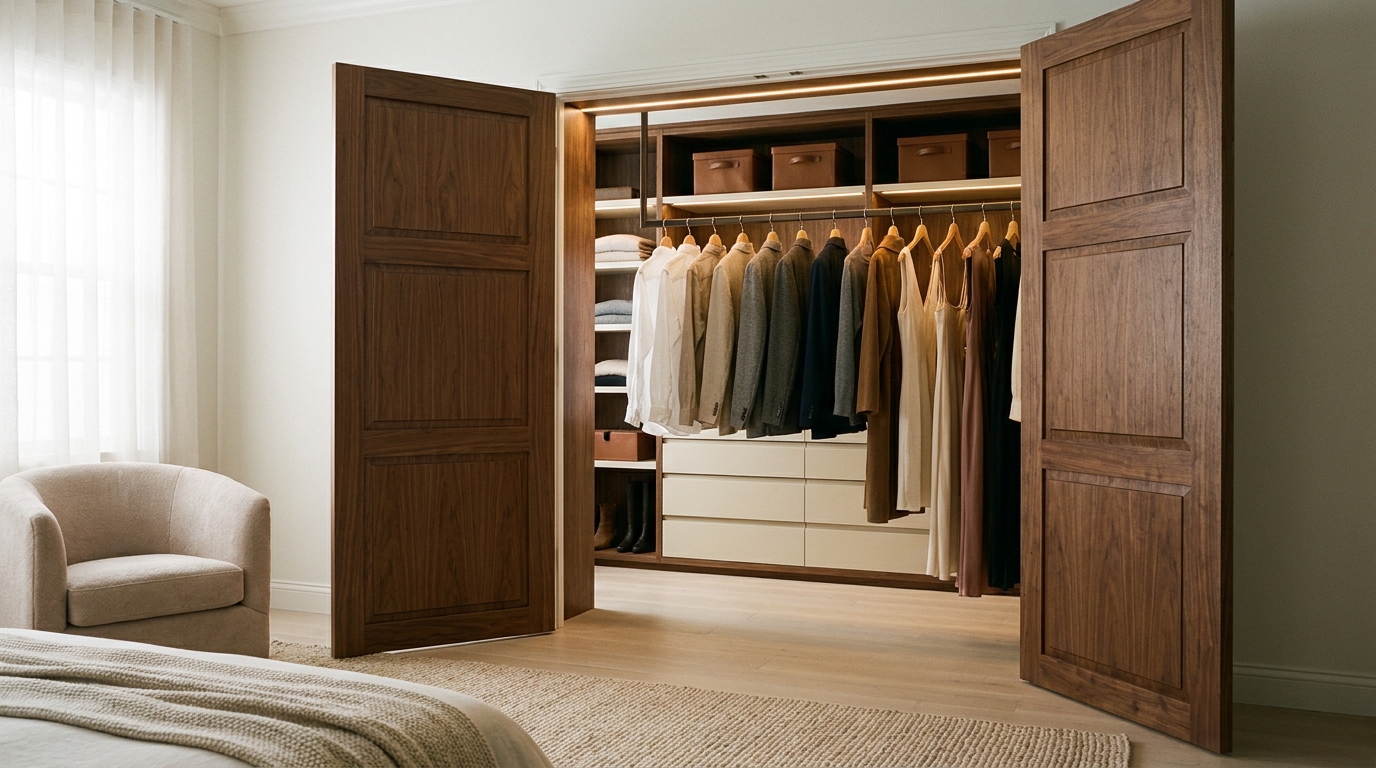
custom closet design for a locked paper bay
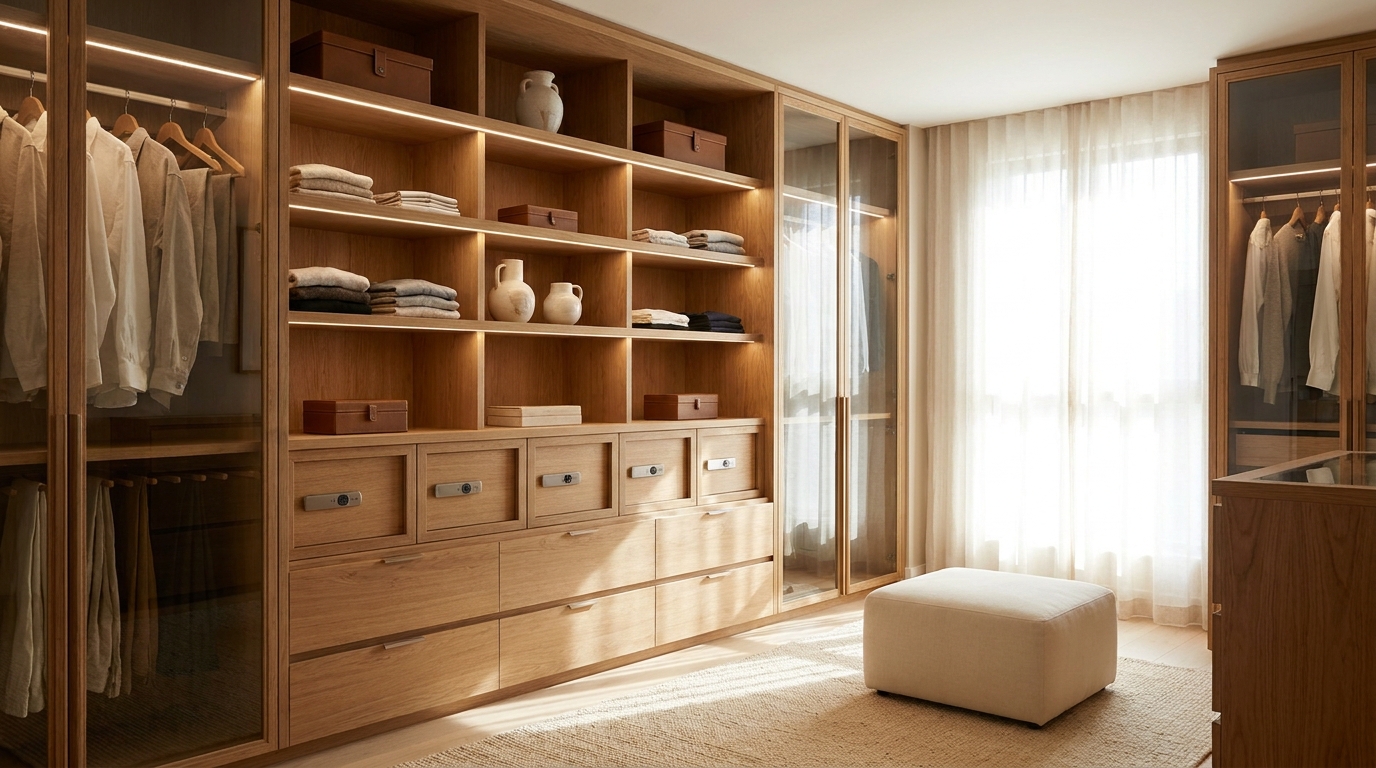
A closet safe bay is a small locked niche in the primary closet for passports, a backup drive, and a compact safe. It is not an open jewelry tray, and it is not the lockable garage cabinet people use for paint and fluids. In custom closet design, that niche is a closed compartment built into the closet, with a door the household can lock and a shelf that can hold a small safe. USA.gov, in guidance last updated on July 22, 2025, says to store personal information, including your Social Security card, in a safe place, and not to carry the card in your wallet [1].
1. Give the papers a door of their own
The usual problem is a good habit with no home. A passport lands on the dresser. A Social Security card stays in a purse "for this week." Tax folders slide behind the sweaters, and the result is a pile, not a plan.
USA.gov describes identity theft as someone using your personal or financial information without your permission, including a name and address, a credit card or Social Security number, a bank account number, or a medical insurance account number [1]. The same page says scammers may steal a wallet or purse for identification and cards, or go through the trash for bank statements or tax documents [1]. A locked bay does not stop every scam. It does take the card out of the everyday wallet, and it keeps the statements you still need off the kitchen counter.
What belongs in the bay. We size it for a short list.
- Passports. USA.gov says that if your passport is lost or stolen, you must report it to the State Department right away, and that replacement depends on whether you are inside or outside the United States [2]. A known shelf beats a search on the morning of a flight.
- Cards you should not carry. The Social Security card is the clear case in that July 22, 2025 USA.gov guidance: a safe place at home, not the wallet [1].
- A compact safe. The safe is a second lock inside the bay for originals. The closet door is not a substitute for reading what the safe is built to do.
- One backup drive. It gets its own cubby so it is not loose against the safe.
What the bay is not. It is not an open tray, and it is not a jewelry system. The door closes, and the papers are the point. If everything goes in, nothing is findable, so we build the opening to that short list.
2. Keep the records the law still cares about, and shred the rest
A locked door only helps if the right papers are behind it. The IRS page on keeping records, last reviewed on June 30, 2026, says to hold the records that support income, deductions, or credits until the period of limitations for that return runs out [3]. That period is the time when you can still amend a return, or the IRS can still assess more tax.
The clocks are not all the same. Keep records for 3 years if the longer situations the page lists do not apply. Keep records for 3 years from the date you filed the original return, or 2 years from the date you paid the tax, whichever is later, if you file a claim for credit or refund after you file.
Keep records for 7 years if you claim a loss from worthless securities or a bad debt deduction. Keep records for 6 years if you do not report income you should have reported, and that income is more than 25% of the gross income shown on your return [3].
Property is its own file. The IRS says to keep records relating to property until the period of limitations expires for the year in which you dispose of the property, so you can figure depreciation and the gain or loss when you sell [3]. Closing papers and improvement receipts often belong in the bay. A grocery receipt does not.
When the tax period ends, the IRS says not to discard the records until you check whether someone else, such as an insurer or a creditor, needs them longer [3]. Shredding still matters for copies that have finished their job. The Office of the Comptroller of the Currency tells bank customers to shred documents such as bank statements, credit card offers, and old tax records, and to share a Social Security number only when necessary and store it securely [4]. We read "old" through the IRS clocks above, not as "anything with a date on it."
Three stacks before we build.
- Bay. Passports, Social Security cards, the property file, and the tax years you still must hold [3].
- Shred. Offers, expired statements, and copies you have checked against those retention rules [3][4].
- Carry. A thin set of copies you could take if you had to leave. The originals stay in the bay.
3. Park the backup drive where it is actually offline
Paper and a drive fail in different ways. NIST's December 2016 Guide for Cybersecurity Event Recovery, written for organizations rather than for closets, says recovery notes should include off-site storage details: any arrangement for storing specific records or media at an offline or offsite location. It flags that step because ransomware can encrypt data and hold the decryption key for payment [8].
A backup that stays plugged in sits on the same path as the files you hope to save. When the copy is finished, the drive comes off the cable and goes into the bay, not into a basket of chargers. We leave a cubby for the drive in its case, with room so it is not wedged against the safe.
An unplugged drive is not a credit freeze, and a freeze is not a closet. The Consumer Financial Protection Bureau, on a page last reviewed on September 5, 2025, explains that a credit freeze, also called a security freeze, prevents prospective creditors from accessing your credit file [5]. The page says these freezes are free, that you have a right to them by law, and that they can be useful in preventing an identity thief from opening a new credit account in your name [5].
It also says a freeze keeps you from opening accounts while it is on, because creditors typically will not offer credit if they cannot see the file [5]. You freeze and unfreeze for free at Equifax, Experian, and TransUnion, and you contact each company yourself [5].
The bay holds the card, the passport, and the unplugged drive. The freeze limits new credit, and the closet lock does not place it [5]. If the drive holds scanned closing papers, know which years are on it, because one device can fail. The NIST point is a copy that is not on the machine under attack, not a promise that one drive is a full archive [8].
4. Respect fire without calling a closet a vault
A lock answers privacy. It does not answer heat. The U.S. Fire Administration's 2024 national estimates for residential building fires list 343,000 fires, 2,975 deaths, 9,225 injuries, and $11,561,100,000 in dollar loss [6].
From 2015 through 2024, those estimates show an 8% decrease in fires, a 9% increase in deaths, a 13% decrease in injuries, and a 25% increase in dollar loss after each year is adjusted to 2024 dollars [6]. Those are national residential building figures, not a forecast for one house in Fort Mill or Rock Hill, and they are why we will not call a closet door fire protection.
What we will and will not claim.
- The cabinet is a cabinet. Wood or laminate keeps dust and casual hands off the folder. We will not invent a fire rating for it.
- The safe is a separate product. If you place a compact safe in the bay, read the label for what was tested and for how long. Paper and a hard drive do not handle heat the same way. We measure the safe so the door still closes. We do not pick a rating from a slogan on the box.
- A carry set still helps. A thin packet of copies can leave with you, while originals stay in the bay. That is a habit of order, not a claim that a folder survives a fire.
5. Build the bay into the closet instead of loading a dresser
A dresser drawer is a common wrong answer. It may lock, and the safe may feel tucked among the clothes, but the weight does not belong on a light pull-out.
On May 4, 2023, the Consumer Product Safety Commission published a Federal Register notice on the safety standard for clothing storage units [7]. The notice describes ASTM F2057-23 as applying to free-standing clothing storage units, including chests, drawer chests, armoires, and dressers, that are 27 inches or greater in height, 30 pounds or greater in mass, and that contain 3.2 cubic feet or greater of enclosed storage [7]. It describes tests, under the STURDY legislation, that simulate the weight of children up to 60 pounds, placement on carpet, loaded drawers, and more than one drawer open [7]. The notice quotes the standard as not covering jewelry armoires, and as not covering built-in units intended to be permanently attached to the building [7].
Read that scope as a product description, not as a permission slip. The 2023 notice is about certain free-standing clothing storage units. A jewelry armoire is outside the quoted scope, and so is a built-in meant to be permanently attached to the building [7].
Our paper bay is that second kind of thing: a compartment in the closet system, fastened with the rest of the closet, not a freestanding chest and not a jewelry tray. The safe sits on a fixed shelf with a solid bottom. It does not ride a pull-out that extends a heavy box past the face of the cabinet. If a freestanding dresser stays in the room, follow that piece's own stability instructions.
How the niche sits in the closet. On our closet systems, the paper bay is one decision in the layout, not a gadget added at the end.
- Reach without a climb. We place the bay where the adult who uses it most can open it while standing, usually between waist and chest height. That is comfort, not a code number for a private house.
- A fixed shelf, then a door. The safe bears on the shelf. The folder stands beside it. The drive sits in its cubby. The door closes over all three without forcing the safe forward.
- A clear approach. We do not bury the bay behind a garment bag. If you have to unpack the closet to reach a passport, the bay has failed.
- A lock the household can operate. A key or a simple code for the adults who need it is enough. We do not build trick panels into the trim. Spare access stays with the household keys you already control.
In many two-story houses around Ballantyne and Wesley Chapel, the primary closet is upstairs, away from the garage and the laptop. Passports stay out of the cabinet you open for yard tools, and the rest of the closet goes back to clothing.
6. Keep paint, fuels, and cleaners out of this niche
A locked closet door and a locked garage door are not the same assignment. Paint, solvents, fuels, and cleaners do not belong with passports or a backup drive. This is not a garage chemical guide. The paper bay stays a paper bay.
On design visits we sometimes find one keyed cabinet doing every job, with a tax folder beside a paint can. Liquids do not belong with a house file. In the primary closet, the bay is only for the documents, the drive, and the compact safe.
Boundaries we hold.
- No liquids in the paper bay. If it can spill, it does not sit above a passport.
- No daily clutter. Sunglasses can live in an open tray. The locked niche stays boring on purpose: one door, the folder, the drive, and the safe.
Practical takeaways
- Name the niche. Use it for passports, cards you should not carry, records you still must keep, an unplugged backup drive, and a compact safe. It is not a jewelry tray and not a paint cabinet.
- Follow the clocks before you shred. The IRS page reviewed on June 30, 2026 includes a 3-year baseline, longer 6-year and 7-year cases, and the case where unreported income is more than 25% of the gross income on the return, plus property records through the year you dispose of the property [3].
- Store the card, do not carry it. USA.gov's July 22, 2025 guidance says to keep personal information, including your Social Security card, in a safe place and out of your wallet [1].
- Unplug the drive. A 2016 NIST recovery guide for organizations flags offline or offsite media because ransomware can encrypt files the system can still reach [8].
- Freeze credit separately. A security freeze is free in the CFPB explanation last reviewed on September 5, 2025, and it concerns new credit, not a passport shelf [5].
- Do not call the closet a fire rating. The U.S. Fire Administration's 2024 residential building fire estimates are a reason to stay honest about heat [6].
- Keep the safe on a fixed shelf. The May 4, 2023 Federal Register notice describes a standard for certain free-standing clothing storage units, and it quotes exclusions for jewelry armoires and for built-ins attached to the building [7].
How we can help
Have more questions or want to get in touch? We plan this kind of locked paper bay as part of a primary closet, with the shelf, the door, and the reach worked out before anything is built. The consultation is free, with no obligation, and a designer comes to your home. Call (704) 604-3870, email design@theclosetrehab.com, or write to us on our contact page.
Citations
- USAGov, "Identity theft" (2025-07-22)
- USAGov, "U.S. passports" (accessed 2026-10-21)
- Internal Revenue Service, "How long should I keep records?" (2026-06-30)
- Office of the Comptroller of the Currency, "Identity Theft" (accessed 2026-10-21)
- Consumer Financial Protection Bureau, "What is a credit freeze or security freeze on my credit report?" (2025-09-05)
- U.S. Fire Administration, "Residential Building Fire Estimate Summaries (2015-2024)" (2024 estimates)
- GovInfo, Federal Register, "Safety Standard for Clothing Storage Units" (2023-05-04)
- National Institute of Standards and Technology, "NIST Special Publication 800-184, Guide for Cybersecurity Event Recovery" (2016-12)