Bulk Pantry Storage: Deep Bays That Still Rotate Food
Bulk pantry storage is the deep bay that absorbs a warehouse-club run without burying last month's cans behind this week's case. It is not a family cooking-zone layout, and it is not a slim pull-out tower for spices and single cans. First-in, first-out rotation is the rule food-storage programs teach at home: use the oldest products first, and put new stock behind what is already on the shelf. [6][8] Deep drawers, can risers, and a weekday-front zone make that rotation visible.
1. Warehouse-club volume is a different pantry job
Cooking-zone pantries put oils, spices, and tonight's pasta next to the stove. Slim towers file a vertical row of cans in a narrow gap. Neither layout is built for a 30-pack of tomatoes, a sleeve of tuna, a 25-pound bag of rice, and two club-size cereal boxes that arrive in one cart.
The failure mode is depth without a front. Stacked cases look tidy for a week. Then the new case goes on top, the older cans sit in the dark, and nobody sees a date until soup night. Kansas State University Extension, in a June 2026 cupboard-storage guide, tells households to check dates, use the oldest products first, and buy only what they can actually use if they want the best quality. [8] A bulk bay that cannot show you the oldest can is working against that advice.
2. Date labels are quality notes, not a dumpster clock
Warehouse-club packs often carry a "Best if Used By" date, a "Use-By" date, or a closed can code that looks like a secret. Those marks are easy to treat as expiration stamps. They usually are not.
Federal dating is optional on almost every food. The USDA Food Safety and Inspection Service (FSIS) states that, except for infant formula, product dating is not required by federal regulations. Dates are not a safety indicator. Manufacturers add them to help you and the store judge peak quality. [1]
Read the phrase next to the calendar. A "Best if Used By/Before" date marks best flavor or quality. It is not a purchase or safety date. [1] A "Sell-By" date tells the store how long to display the product. [1] A "Use-By" date is the last date recommended for peak quality, and it is not a safety date except on infant formula. [1] Closed can codes are packing numbers for the manufacturer, not a consumer quality date. [1]
Confusion about those phrases is expensive. FDA consumer guidance, current as of March 2024, says confusion over date labeling accounts for an estimated 20 percent of consumer food waste. [4] FSIS recommends that manufacturers who date products use "Best if Used By," and notes that foods not showing signs of spoilage may still be consumed beyond that date. [1] EPA's April 2025 consumer-cost report finds that over one-third of food in the United States is never eaten, and estimates the cost of food waste at $728 per U.S. consumer per year, or $2,913 a year for a household of four. [3]
FIFO still matters, even when the can is safe. Quality does decline. FSIS says high-acid canned foods such as tomatoes and fruits keep their best quality for 12 to 18 months, while low-acid canned foods such as meats and vegetables keep theirs for two to five years. [1][2] Rotation is how you eat the food while it still tastes like food.
3. Cool, dry, dark, and off the floor
A bulk pantry next to a range, a water heater, or a sunny garage wall is a warm pantry. Warm storage shortens quality, even when the seal is intact.
Treat 70°F as a cupboard planning number, not a trophy. Kansas State's June 2026 guide stores cupboard foods at 70°F and tells readers to keep them in a cool, dry, dark location away from heat sources such as appliances and the sun. [8] Utah State University Extension says to store canned food in a cool, dark, dry space away from furnaces, pipes, and uninsulated attics, and not to let sealed cans or jars freeze. [6] If your only overflow is a garage slab or an attic, that is storage for boxes, not for food you still intend to cook.
Keep metal off damp floors. USU warns that metal cans stored on the floor, especially bare concrete, can rust as moisture wicks up. [6] FSIS tells you to discard cans that are dented, rusted, or swollen. [1] USU adds: before opening, discard badly dented, bulging, rusty, or leaky cans, and jars with broken seals. [6] A bulk bay with a finished, raised bottom beats an open rack on a slab.
Not every can belongs in a dry bay. FSIS notes that not all canned goods are shelf stable. Some canned ham and seafood are labeled "Keep Refrigerated" and are not safe at room temperature. [2] Those club packs go in the refrigerator, not in the deep pantry drawer.
4. Deep bays that still rotate: drawers, risers, weekday-front
The bulk pantry we design has three jobs a single deep shelf fails at once: you must see the back, you must move the oldest food first, and you must keep this week's cooking stock from disappearing into last month's case.
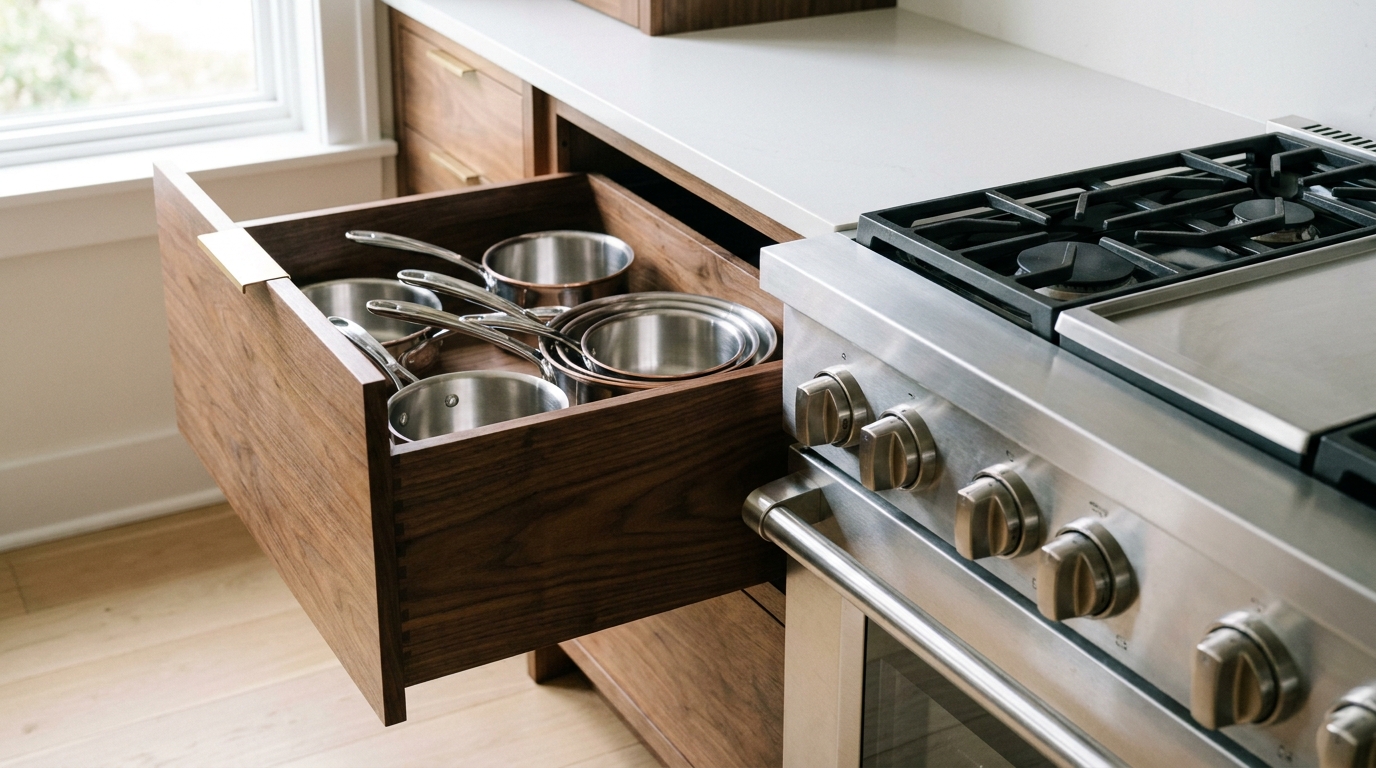
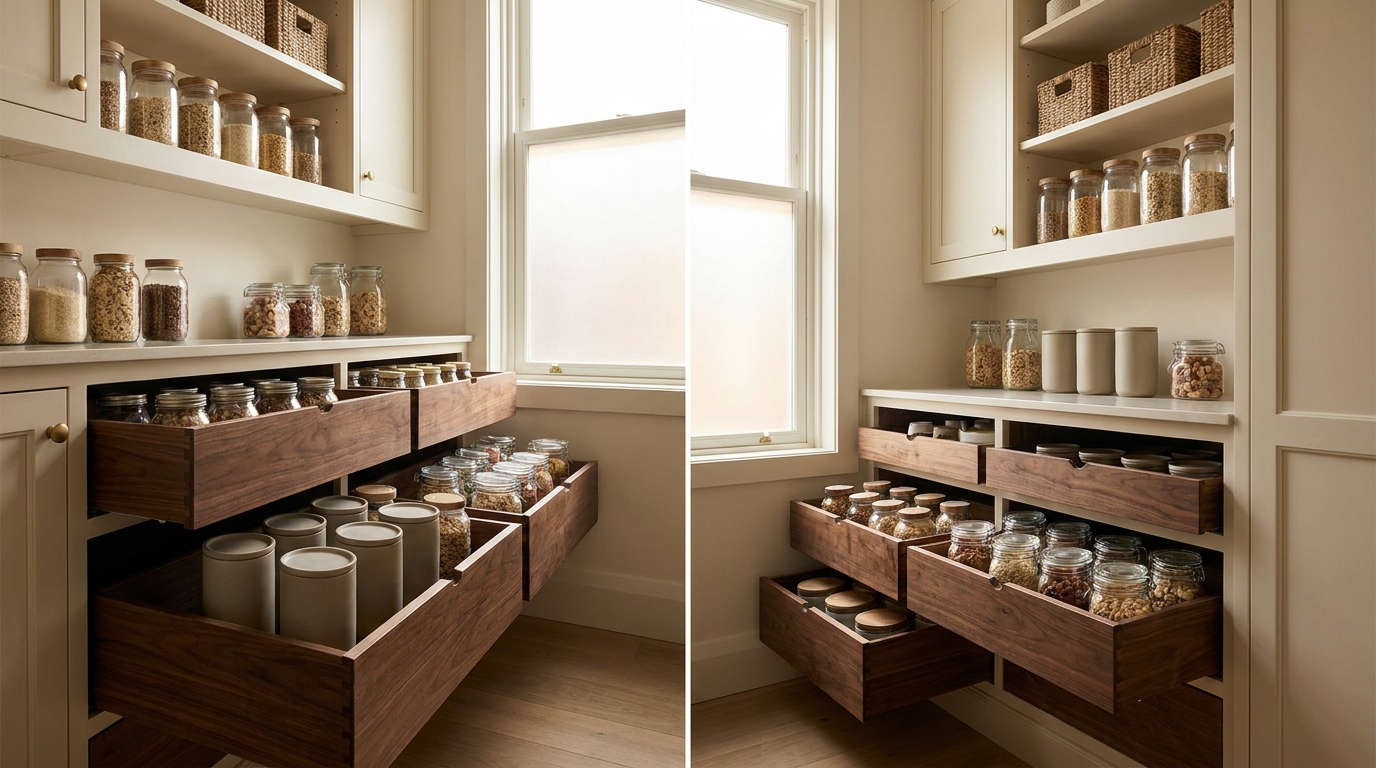
Full-extension drawers beat a dark deep shelf. Our custom pantry work uses deep pull-out drawers so you can see and reach what used to live at the back. You cannot use the oldest can first if you cannot see it. [1][6][8] A drawer that comes all the way out turns a warehouse flat into a dated row instead of a stack you have to unstack.
Can risers and tiered rows keep labels in the light. Tiered canned-goods storage, sized for cans, jars, and boxed goods, stops the front row from hiding the second row. Dates and condition only help if you can read them. A riser is the difference between rotating tomatoes and buying another case because you could not see the first one.
Build a weekday-front zone. This is the shallow face of the pantry: opened boxes, the current bag of rice, the cans you will use this week, and the snacks the household actually reaches for. Behind it, or below it, sit unopened club packs with the purchase month marked on the lid. USU recommends writing the purchase date (month and year) on the can lid with a marker. [6] That mark makes FIFO possible when a closed can code is not meant for you to decode. [1]
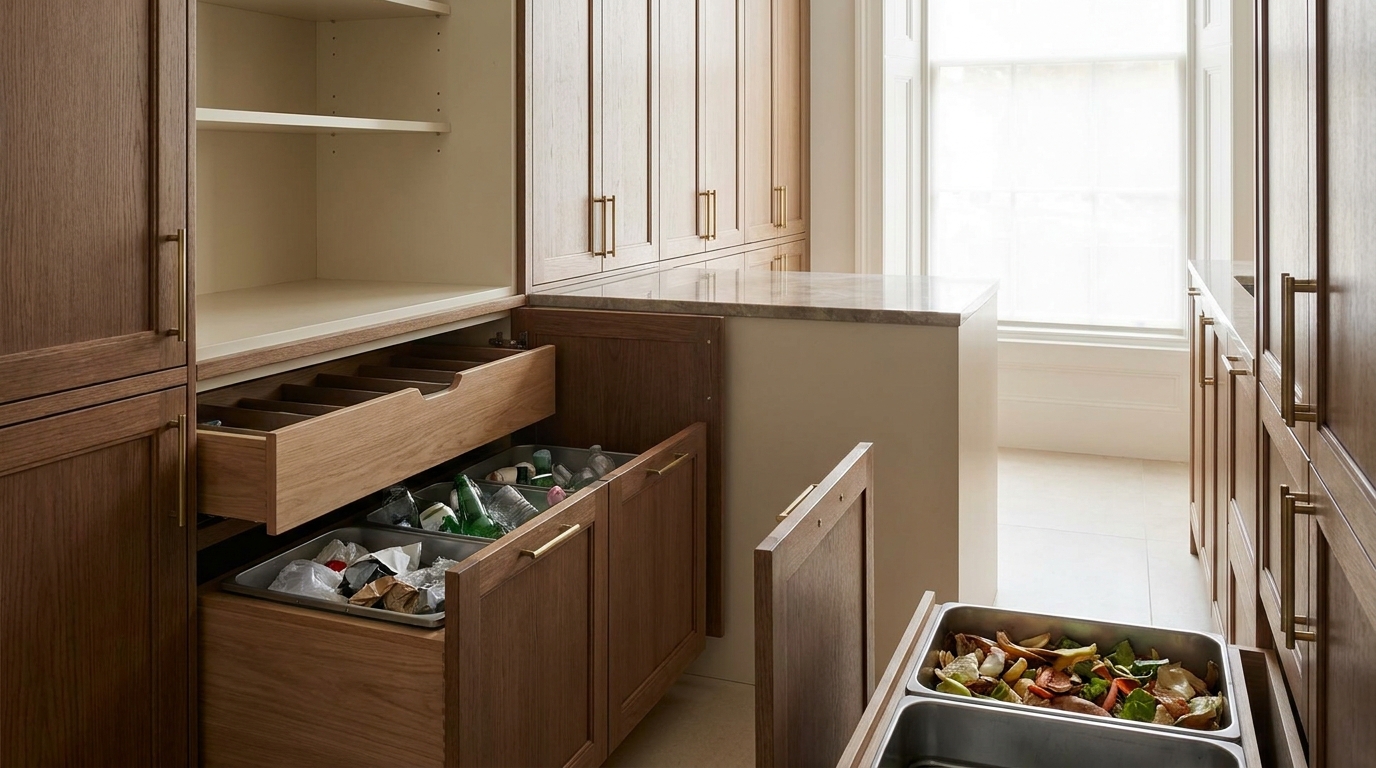
Break the flat down on a landing surface, then file it. A built-in pantry counter is where the club run becomes inventory: cut the plastic, inspect the cans, date the lids, and load the drawer from the back. Kansas State tells you to check packages for damage during storage. [8] That check is easier on a counter than on the floor of a crowded aisle.
Keep cooking-zone items and bulk items apart. Oils, spices, and a working bag of pasta can live in a shallower, closer zone. The 12-can sleeve and the backup cereal belong in the deep bay. Mixing those jobs is how a bulk drawer becomes a junk drawer.
5. Club-size dry goods: seal, decant, and use the oldest first
Cans are the easy part. Flour, rice, oats, cereal, nuts, chocolate, spices, dried fruit, and pet food are where warehouse volume meets pantry pests.
Opened paper and thin plastic are not a seal. University of Minnesota Extension, in guidance reviewed in 2024, notes that pantry pests can get into unopened paper, thin cardboard, and plastic, foil, or cellophane-wrapped packages. They may chew their way in or crawl through folds and seams. [7] NC State Extension's 2022 fact sheet says the same in storage language: put foods in airtight, sealed containers, because stored-product pests can penetrate thin or broken packaging. [5] Club bags of rice and oats are built for the warehouse, not for six quiet months on an open shelf.
Decant the bulk bag. Keep the date. Heavy glass, metal, or rigid plastic with a tight lid is the household standard UMN and NC State both point to. [5][7] Leave the original quality date or purchase date on a tag or on the bin. Kansas State lists white rice at 1 to 2 years and pasta at 1 to 2 years at 70°F, tightly covered once opened. [8] FSIS lists rice and dried pasta at two years on the shelf. [2] Those windows only hold if the food stays dry, dark, and closed.
Treat two to four months as a pest-pressure window for opened dried foods, not as a canned-goods rule. NC State tells households to try to use dried foods within two to four months of purchase and to adopt a first-in, first-out policy. [5] UMN says to buy dried foods in quantities small enough to use in that same window, and to use oldest and opened packages first. [7] That is how you handle flour, cereal, and nuts. It is not the two-to-five-year quality window for low-acid canned vegetables. [1][2]
Assume the pest can arrive in the bag. NC State notes that many pantry-pest problems start because a product was already infested before purchase, and that Indianmeal moths are probably the most frequently encountered stored-product pest in homes and grocery stores. [5] UMN calls them the most common moths infesting food in homes. [7] Sawtoothed grain beetles are flat enough to enter imperfectly sealed products. [5] If the pantry also holds pet food, give that bag its own sealed bin. NC State flags dry dog food and paprika as two of the items cigarette beetles most often attack at home. [5]
6. Inspect the flat before it becomes the back row
Warehouse-club packaging is tough. It is not a promise that every can in the sleeve is sound.
Reject the obvious failures at the car, not at dinner. FSIS says to discard cans that are dented, rusted, or swollen. [1] USU says to discard badly dented, bulging, rusty, or leaky cans, to discard any can that spurts, and not to taste contents that have a strange odor or appearance. [6] Kansas State adds a household rule for that counter: when in doubt, throw it out. [8] Sort any "Keep Refrigerated" cans into the refrigerator on the same trip you file the tomatoes. [2]
Date as you file, rotate as you cook. Marker on the lid, oldest in front, new stock behind. [6][8] NC State's stock-rotation step is the same policy in pest language: use oldest foods before newer products, and adopt first-in, first-out. [5] A weekday-front zone makes that automatic. You cook from the front. You restock the back.
7. How we plan a bulk pantry on a design visit
Our team starts with how you shop, not with a catalog wall of bins. If the household does a warehouse-club run twice a month, the pantry has to take that volume and still show you what to cook this week. Club-size dry goods and a working spice row are two zones, not one deep shelf.
We measure for the open condition. Drawers at full extension, risers loaded, a place to stand while you date lids. A bulk pantry that only works when everything is packed tight will fail the first Saturday you cook from it. A pull-out spice tower and a family cooking zone still belong next to the range. The bulk bay is the tool for the rest of the case.
Homeowners in Charlotte, Fort Mill, Rock Hill, Ballantyne, Waxhaw, Wesley Chapel, and Indian Land bring us the same pattern: a cart full of value, and a pantry that cannot rotate it.
Practical takeaways
- Give warehouse-club food its own deep bay. Do not ask a cooking-zone shelf or a slim spice tower to hold 30-packs and 25-pound bags.
- Use first-in, first-out on purpose. Oldest in front, new stock behind, purchase month on the lid. [5][6][8]
- Treat most date labels as quality, not safety. Except for infant formula, federal law does not require dating, and "Best if Used By" is not a dumpster date. [1][4]
- Rotate canned goods on their quality clocks. High-acid cans (tomatoes, fruit) about 12 to 18 months; low-acid cans (vegetables, meats) about two to five years. [1][2]
- Keep the bay cool, dry, dark, and off the floor. Aim around a 70°F cupboard, away from appliances and sun, with metal cans off concrete. [6][8]
- Use full-extension drawers, can risers, and a weekday-front zone so the back row is visible and this week's food is the food you actually grab.
- Decant club-size dry goods into glass, metal, or heavy plastic. Thin paper and film are not pest-proof. [5][7]
- Inspect for dents, rust, swelling, and "Keep Refrigerated" labels before a can reaches the back of a drawer. [1][2][6]
How we can help
A bulk pantry should make the club run easier to cook from, not easier to lose. We design deep drawers, tiered can rows, sealed dry-goods bays, and a weekday-front zone so first-in, first-out is the layout.
Have more questions or want to get in touch?
Contact us · (704) 604-3870 · design@theclosetrehab.com
Citations
- USDA Food Safety and Inspection Service, "Food Product Dating" (2025)
- USDA Food Safety and Inspection Service, "Shelf-Stable Food Safety" (2024-10-24)
- U.S. Environmental Protection Agency, "Estimating the Cost of Food Waste to American Consumers" (2025-04-04; page updated 2026-03-18)
- U.S. Food and Drug Administration, "How to Cut Food Waste and Maintain Food Safety" (2024-03-05)
- NC State Extension, "Common Pantry Pests and their Management" (2022-07-15)
- Utah State University Extension, "Storing Canned Goods" (n.d.)
- University of Minnesota Extension, "Pantry pests: Insects found in stored food" (reviewed 2024)
- Kansas State University Research and Extension, "Safe Food Storage: The Cupboard" (MF3131, June 2026)