Butler Pantry Storage: Serving, Glassware, Work Bay
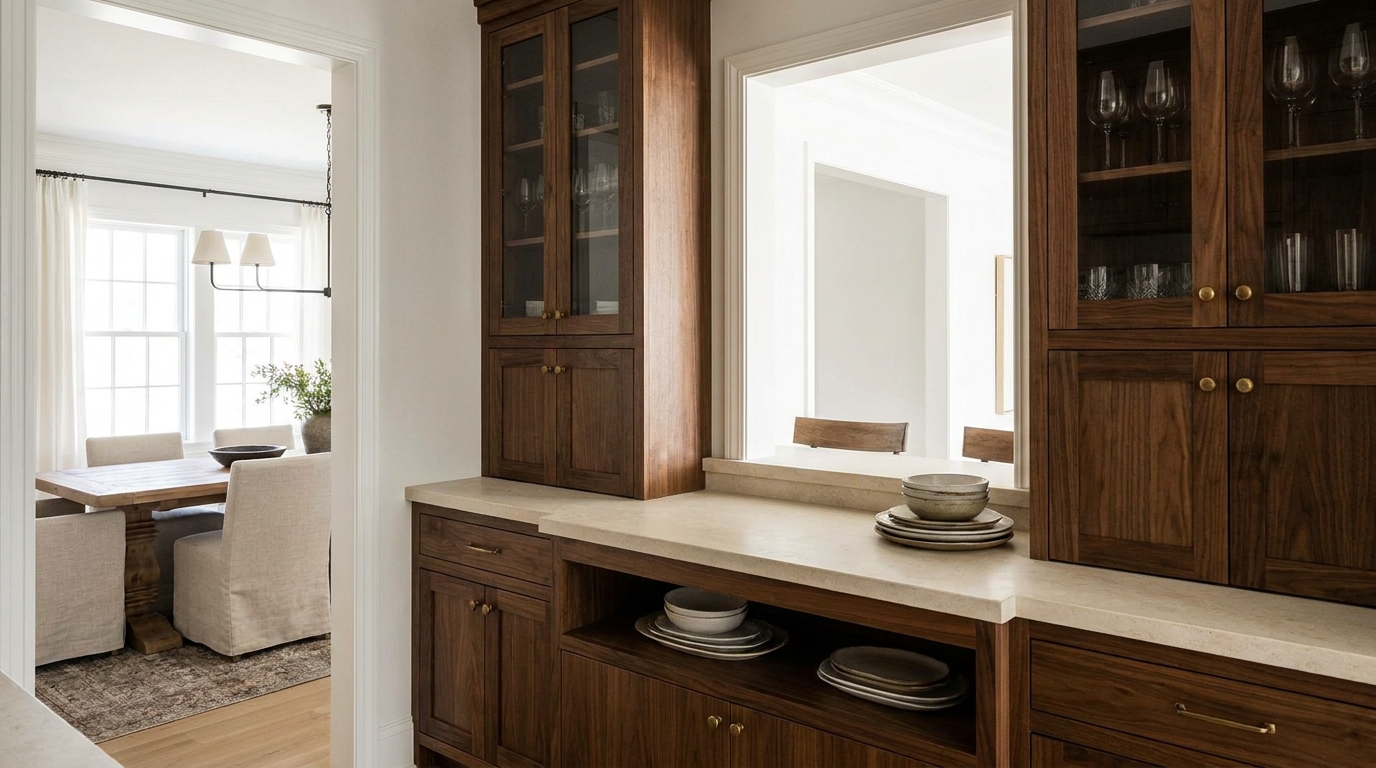
A butler's pantry is a serving and staging room between the kitchen and the dining room. Butler pantry storage holds glassware, serving pieces, and table linens behind closed doors, and it gives you a counter-height work bay so platters can leave the kitchen already set. It is not a second food pantry, and it is not where weekday cooking, bulk warehouse-club goods, or spice pull-outs belong.
1. What this room is for (and what it is not)
Homeowners in Charlotte, Fort Mill, and Ballantyne often ask us to "add pantry space" when what they actually need is a quiet serving bay. The kitchen already handles food. The dining room should stay a dining room. The butler's pantry sits in the middle and takes the staging work.
This room is for:
- Stemware, tumblers, and everyday water glasses
- Platters, trays, and serving pieces used for guests
- Table linens, napkins, and placemats ready for the table
- A clear pass-through work bay for plating, pouring, and last-minute setup
This room is not for:
- Family cooking zones or a second range wall
- Spice and oil pull-outs that belong at the cooktop
- Bulk warehouse-club bays of paper goods and extras
- Appliance garages for mixers and daily small appliances
- Slim pantry towers packed with canned goods
- A lighting plan that tries to do the pantry's job
When we design custom pantry storage for a Waxhaw or Wesley Chapel kitchen, food stays in the pantry. Serving stays here. That split keeps both rooms honest.
2. Plan a pass-through work bay, not a leftover hallway
The work is the point. If the bay is too tight, two people with a tray cannot pass. If it is only a corridor of upper cabinets, you still plate on the kitchen island and the dining room fills with stacks.
The U.S. Access Board's ADA Standards for a pass-through kitchen with counters, appliances, or cabinets on two opposing sides set a 40-inch minimum clearance between those faces and require two entries. [2] Spaces with no cooktop or conventional range are not required to meet that clearance rule, which describes many butler's pantries. [2] We still use 40 inches as a planning target when the bay has base cabinets on both sides, because a serving room that cannot pass a platter is just a closet with a counter.
A U-shaped work area enclosed on three sides is a different animal. The same standards call for 60 inches between opposing faces in that layout. [2] Most butler's pantries we see in Rock Hill and Indian Land homes are galley pass-throughs, not U-shapes. Keep the path open at both ends so kitchen staff (that is you, on a Saturday) can enter from the cook side and leave toward the table.
Work-bay rules we hold to:
- Leave a continuous counter long enough to set a platter, a stack of plates, and a water pitcher without shuffling.
- Keep the floor stable, firm, and slip resistant, the same surface standard the Access Board uses for walking and work areas. [1]
- Do not let open doors, trash pull-outs, or a wine cooler door eat the aisle while someone is carrying glass.
- Give the bay two clear ends. A dead-end staging niche forces a turn with a loaded tray.
Accessible dining and work surfaces in the ADA Standards sit 28 to 34 inches above the finish floor. [3] A typical standing kitchen counter is higher. For most households we keep a standing plating height and, when a family member sits to plate or uses a mobility aid, we can drop a stretch of the bay into that 28-to-34-inch band. [3] In residential kitchens that must meet the dwelling-unit work-surface rule, the Access Board caps that accessible section at 34 inches and asks for at least 30 inches of width. [2]
Hardware on the bay should be easy to use with one hand. The Access Board's operable-parts guide accepts U-shaped pulls and lever handles and flags round knobs that require a full-hand grip and wrist twist. [8] That matters when your hands are wet from rinsing glasses.
3. Store glassware so it stays clean, reachable, and out of little hands
Glass is the reason this room exists. Open shelves over the dining table look pretty in a photo and collect dust, lipstick, and fingerprints. Closed storage is the working answer.
The 2022 FDA Food Code (January 2023 version) tells food establishments to store cleaned equipment and utensils in a clean, dry location, away from splash and dust, and at least 6 inches above the floor. [4] Clean pieces should sit in a self-draining position that allows air drying, and they should be covered or inverted. [4] Your house is not a restaurant. The hygiene logic still holds: invert stemware, close the doors, and keep rims off open shelves that catch kitchen grease.
Daily glasses versus guest crystal:
- Put everyday water glasses and tumblers on shelves or in drawers inside the 15-to-48-inch unobstructed reach range the Access Board sets for a forward or side approach. [1]
- If you reach over a counter deeper than 20 inches, that high forward reach drops from 48 inches to 44 inches. [1]
- Keep guest stemware in the same closed run, on a higher shelf if you use it less, still behind a door.
- A 2019 Nemours KidsHealth review tells parents to keep glass objects such as drinking glasses and bowls in a high cabinet far from reach, and to latch drawers that hold sharp utensils. [7]
- That is not a contradiction. Closed doors, latches where toddlers visit, and adult-height everyday glass behind those doors can live in the same elevation.
Materials that touch food or lips need a surface that is smooth, easily cleanable, durable, and corrosion-resistant, and that does not impart odors or tastes. [4] University of Minnesota Extension notes that hot water at 171°F for at least 15 seconds can sanitize heat-resistant items such as metal utensils, cookware, and tempered glass. [6] If your butler's pantry has a small rinse sink, that is for rinsing and staging, not for skipping a real wash. Air-dry. Do not towel-dry clean glasses with a used linen.
The Food Code also limits lead in ceramic, china, and crystal utensils that contact food, with category caps such as 0.5 mg/L for beverage mugs, cups, and pitchers. [4] If you keep older crystal in this room, treat pieces of unknown origin as display or occasional use, not as overnight storage for wine or citrus.
Pegged stemware racks under an upper cabinet can work if the glasses hang inverted and the rack is inside a closed case. Pegs that stick into the walkway become a shatter hazard the first time someone turns with a tray.
4. Give serving pieces and table linens their own closed homes
Platters do not belong in the oven drawer "for now." Linens do not belong in a dining-room sideboard that guests open looking for coasters.
Serving pieces
- Store trays and platters on edge in a vertical divider so you can pull one without lifting a stack.
- Keep lidded serving pieces with the lids nested or stored with the base, not in a separate room.
- Place heavy serving ware low. The National Council on Aging, writing in June 2024 about furniture tip-overs, notes that heavier objects on higher drawers or higher shelves help shift a piece of furniture past its center of gravity. [5]
- Put the pieces you use for every dinner party inside that 15-to-48-inch band. [1] Holiday-only punch bowls can sit higher, still behind a door.
Table linens
The 2022 FDA Food Code requires cloth napkins to be laundered between each use and requires soiled linens to sit in clean, nonabsorbent receptacles (or clean, washable laundry bags) so they do not contaminate food, clean equipment, or clean utensils. [4] In a house, that reads as: clean napkins in a closed, dry cabinet; soiled ones in a lined hamper in this room, not on the counter; nothing damp left in a wood drawer.
Folded tablecloths want a wide, shallow shelf or a linen drawer so they do not slump into deep creases. Place mats can live in a shallow tray divider. Keep this cabinet away from the rinse sink's splash zone. The Food Code's storage rule is the same as for utensils: clean, dry, and protected from splash and dust. [4]
When we walk a Fort Mill dining room that still holds the china, we move that inventory into the butler's pantry so the dining room can stay a table, chairs, and a clear buffet top.
5. Closed storage keeps the dining room clear
A butler's pantry earns its keep on the night you host. Dirty glasses come back here, not onto the piano. Extra plates wait here, not in a pile on the sideboard. The dining room stays a room people sit in.
The Food Code's handling rules for kitchenware and tableware are built around lip-contact surfaces. Cleaned utensils must be handled, displayed, and dispensed so those surfaces stay protected. Knives, forks, and spoons that are not prewrapped should be presented so only the handles are touched. Preset tableware should be wrapped, covered, or inverted unless unused settings are pulled when a guest sits. [4] Closed cabinets and inverted glass do that job without turning your dining table into a warewashing rack.
In food-service lines, the Access Board requires self-service shelves for tableware, dishware, condiments, food, and beverages to sit within the same reach ranges in section 308. [3] Your butler's pantry is not a cafeteria rail. The idea still helps: the pieces you grab during service should not live on a 72-inch shelf.
For kitchens and kitchenettes, the Standards also ask that at least 50 percent of shelf space in storage facilities fall within accessible storage rules. [2] We treat that as a useful split: half the elevation for the glasses and trays you actually use, half for overflow and once-a-year pieces, all of it closed.
Closed-storage checklist:
- Solid or glazed doors, not open decorative shelves over the work bay
- Soft-close hinges so a slammed door does not ring through crystal
- Adjustable shelves so a new pitcher set does not sit on its side
- A labeled zone for soiled return (a tray or a lidded bin) so dirty glass never shares a shelf with clean glass
- No "temporary" stacks on the dining table after the party
6. Build the bay so it is safe to use during a real party
Serving is a food-handling job. University of Minnesota Extension, in guidance reviewed in 2026, tells anyone cooking for a crowd to run a full sanitation routine on equipment, utensils, counters, and surfaces in the kitchen and the service area. [9] That service area is this room.
The same page puts time/temperature control for safety foods outside the 41°F to 135°F danger zone, holds hot food at 135°F or above and cold food at 41°F or below, and says to discard TCS food held without temperature control for two hours or more. [9] If you stage a warm casserole or a chilled tray in the butler's pantry, the work bay is a pass-through, not a holding cabinet. Use a warming drawer or ice only if you can actually hold those temperatures. Otherwise, plate small and refill from the kitchen.
Sanitation here is a five-step loop: dry clean, wet clean, rinse, sanitize, dry. [9] Do not park a sponge on the work bay. Minnesota Extension warns that debris and pathogens hide in sponges and that cleaning cloths should not sit in detergent water. [6]
Tall cases need a wall. Freestanding cabinets and curio cabinets show up on the National Council on Aging's 2024 tip-over list, along with other furniture with drawers, doors, and shelves. [5] NCOA, citing CPSC figures for 2020 through 2022, reported about 17,800 emergency-room visits a year from furniture, TV, or appliance tip-overs, and it notes that heavier loads up high make a case easier to pull past its tipping point. [5] The federal STURDY standard that took effect on September 1, 2023 covers certain clothing storage units, not every glass case in a butler's pantry, so anchoring still matters. [5] Our built-in millwork fastens to the structure. We still keep heavy platters low and skip top-heavy open hutches that a child or a guest can pull.
If grandchildren visit a Wesley Chapel house, latch the glass doors. Keep knives and serving forks in a latched drawer. [7] Do not store appealing climb-to items on the top shelf of a tall case.
Practical takeaways
- Treat the butler's pantry as serving storage plus a work bay, not as extra food pantry.
- Aim for a 40-inch pass-through when cabinets face each other, with an opening at both ends. [2]
- Put daily glassware in closed, inverted storage inside a 15-to-48-inch reach, and latch it when small children are around. [1] [4] [7]
- Give platters vertical dividers and put the heavy pieces on low shelves. [5]
- Keep clean linens dry and closed; park soiled napkins in a lined hamper, not on the counter. [4]
- Sanitize the work bay like a service counter, and do not use it as a two-hour parking spot for hot or cold food. [9]
- Fasten tall cases to the wall and skip freestanding curio towers loaded at the top. [5]
How we can help
Our team designs butler's pantries the same way we design the rest of a kitchen storage plan: by what you actually carry from stove to table. We measure the pass-through, map glassware and linens, and build a work bay that stays clear. If you are in Charlotte, Waxhaw, Ballantyne, Fort Mill, Rock Hill, Wesley Chapel, or Indian Land, we can look at the room between your kitchen and dining room and tell you whether it wants serving storage or a true food pantry (sometimes both, in two different cabinets).
Have more questions or want to get in touch?
https://theclosetrehab.com/contact-us/ · (704) 604-3870 · design@theclosetrehab.com
Citations
- U.S. Access Board, "Chapter 3: Building Blocks" (2010 ADA Standards)
- U.S. Access Board, "Chapter 8: Special Rooms, Spaces, and Elements" (2010 ADA Standards)
- U.S. Access Board, "Chapter 9: Built-In Elements" (2010 ADA Standards)
- U.S. Food and Drug Administration, "Food Code 2022" (2023-01-18)
- National Council on Aging, "How to Prevent Deadly Furniture Tip-Overs" (2024-06-27)
- University of Minnesota Extension, "Sanitizing equipment and food contact surfaces" (2025)
- Nemours KidsHealth, "Preventing Cuts" (2019-02)
- U.S. Access Board, "Guide to the ADA Accessibility Standards: Chapter 3: Operable Parts" (2010 ADA Standards)
- University of Minnesota Extension, "Cooking safely for a crowd" (2026)