Closet Hamper Storage: Sort, Vent, and a Laundry Path
A pile of jeans by the dresser is not a laundry habit. It is a missing station. Dedicated closet hamper storage that splits sorts, lets air move, and sits on a short path to the washer gives dirty clothes a place to land the moment they come off.
The U.S. Environmental Protection Agency (EPA) advises keeping indoor humidity below 60 percent (ideally 30 to 50 percent) and drying wet or damp items within 24 to 48 hours so mold does not get a foothold [1]. A closed, overstuffed hamper full of still-damp workout gear works against that guidance.
1. Treat the closet as the start of the dirty-clothes path
Laundry rooms get the folding counters and detergent drawers. Closets get the moment clothes leave the body. That first step is where most floor piles start. If the only hamper is a lidded bin in a dark corner, or a basket already heaped past the rim, the next T-shirt goes on the rug.
This is the closet side of the path, not the wash-day layout. A laundry room still needs its own sorting, washing, drying, and folding stations. The closet's job is narrower: catch dirty clothes at undress, keep them off clean hanging rods, and make the carry to the washer obvious.
Why the floor wins without a zone. People undress where they change. The hamper has to live there, at a height a tired hand will actually use. A basket across the room, behind a chair, or buried under hanging shirts is furniture, not a station.
Keep dirty and clean on different planes. Sweaty socks should not share a shelf with folded knits. University of Missouri Extension guidance (reviewed in 2017) notes that soil on dirty articles can feed mildew when moisture and temperature are right, and that poorly ventilated closets get damp and musty in wet weather [3]. Separate the dirty bay from hanging and folded storage, even in a small reach-in.
2. Split sorts at the point of undress
One mixed hamper feels simple until wash day. Then someone has to dump, pick, and re-sort on the laundry floor. That extra handling is why clothes wait. Sorting at the closet, while the garment is already in your hand, cuts that second pile.
A 2015 University of Kentucky Cooperative Extension publication asks households to sort by more than color: fabric type, lint givers versus lint takers, sturdy versus delicate construction, and heavy soil versus light soil, then to put those groups in labeled baskets before they reach the laundry room [5]. New Mexico State University Extension's 2016 clothes-care guide makes the same split for the washer: keep whites off colored loads, lightly soiled items off heavily soiled ones, lint shedders off lint collectors, and delicates off sturdy pieces [6].
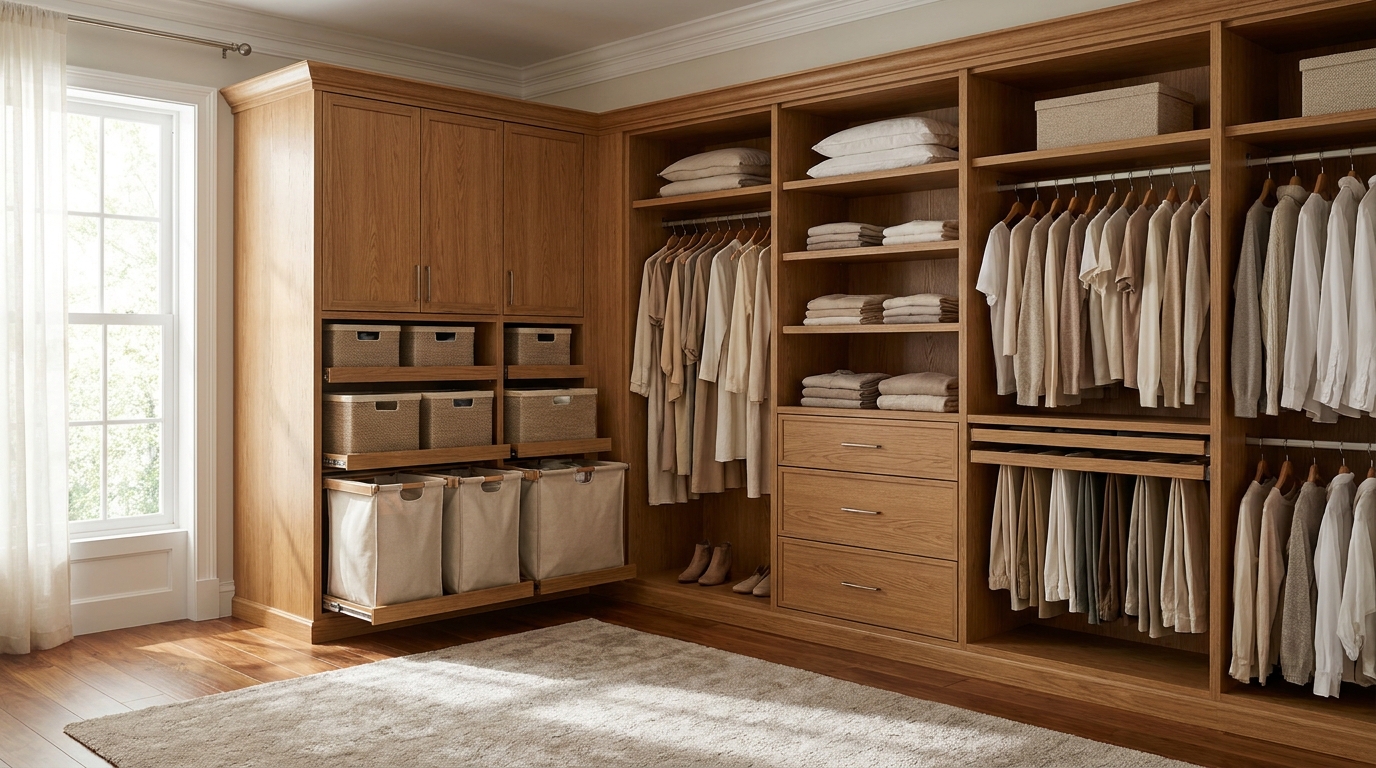
A closet does not need six bins. Two or three pull-outs cover most households:
- Lights and whites. Undershirts, sheets if they are stored nearby, pale knits.
- Darks and brights. Jeans, navy tees, most everyday color.
- Delicates or towels. Bras, mesh bags, gym knits, or bath towels if the closet sits beside a bath.
Label the faces of the bins. Kentucky's family-laundry tips specifically recommend marked baskets so each person can sort before the load travels [5]. Kids and partners will use a labeled pull-out. They will not use an unlabeled cube that already looks full.
Heavy soil does not belong in the overnight mix. Grass-stained baseball pants and a silk blouse should not sit in the same bag. If a household does yard work or sports, give that dirt its own bin or a bag that goes straight to the washer. NMSU's 2016 guidance is blunt: do not wash lightly soiled clothes with heavily soiled ones [6].
3. Ventilate the dirty-clothes bay
Hampers fail when they become damp boxes. Natural-fiber clothes take on moisture quickly and give it up slowly. The Smithsonian's Museum Conservation Institute (guidance updated in 2023) describes cellulosic textiles as hygroscopic, notes that high humidity, warmth, and poor ventilation encourage mold, and adds that soiling and organic residues help mildew grow even at lower relative humidities [4]. A hamper full of worn cotton is a small climate of its own: body soil, trapped air, and closet humidity.
EPA's mold house tour, updated in 2025, flags bedroom closets directly. High room humidity can cause mold on furnishings or clothing, which is why the agency repeats the indoor target of below 60 percent relative humidity, ideally 30 to 50 percent [2]. Missouri Extension's 2017 review is specific about closets: improve air movement by opening doors or adding a fan, hang clothes loosely, and dry wet clothing (including rain-damp and perspiration-damp pieces) before it goes back into the closet [3].
Build the bay so air can move. A solid-sided cabinet with a tight door and a plastic liner is a moisture trap. We specify hamper bays that breathe:
- Mesh or perforated bags, not sealed plastic sacks.
- Slatted, louvered, or open-front cabinet faces, or a pull-out that sits in an open knee space.
- A gap at the toe-kick and above the bag so the bay is not a dead air pocket.
- Room to stop short of packing the bag to the rim.
Dry first, then drop. Missouri Extension's 2017 fabric notes say it plainly: never let clothing lie around damp or wet, and dry soiled clothes before they go in the hamper [3]. Kentucky's 2015 laundry handout tells every family member the same thing: do not place wet articles in laundry baskets [5]. Workout shirts, swimsuits, and bath towels need a short hang before they join the sort.
Watch closets on exterior walls. Smithsonian conservation notes that attics, basements, and closets against exterior walls swing with outdoor temperature and humidity, and it does not recommend those spots for textile storage [4]. A hamper bay on a cold outside wall needs even more air movement.
4. Specify pull-out hampers people will actually use
The hardware matters because unused hardware becomes a floor pile again. A tilt-out near the floor is awkward with a full bag. A hamper hidden behind hanging clothes is invisible at night. Pull-outs at a comfortable reach, with bags that lift out, get used.
Put the bay where clothes come off. In a walk-in, that is often beside the dressing bench or the double-hang for everyday shirts. In a reach-in, it is usually a lower cabinet beside the hanging, not a bin shoved to the far end of the rod. Our custom closet systems treat built-in hampers as part of the plan for both walk-ins and reach-ins, next to hang space, folded storage, and shoes.
One bag per sort, removable in one motion. The bag should come out without unloading the closet. Mesh bags with sturdy handles let you walk a sort to the washer without dumping on the bedroom floor first. If two people share the closet, two or three bags beat one giant canvas that nobody wants to carry.
Skip the lid that seals the smell in. A lid can hide the pile. If it also seals damp air around soiled cotton, it fights the ventilation rules above. A pull-out with an open top, or a door that closes on a ventilated cabinet, hides the mess without bottling the moisture.
We also measure basket travel, filled-bag height, and the path out of the closet. A hamper that cannot come out fully is a drawer people stop using.
5. Give dirty clothes a path to the washer, not a second floor pile
ENERGY STAR notes that the average American family washes about 300 loads of laundry each year, and it recommends running full washer loads when you can because washers use about the same energy regardless of load size [7]. That is a lot of trips from bedroom to machine. If each trip starts with hunting for socks on the floor, the closet never empties.
Design the carry, not just the bin. The closet hamper is only half a station if the bag cannot leave the room. We ask where the washer lives, how far the walk is, and whether stairs are involved. Then we size bags a person can carry without spilling, and we keep a clear path from the closet door to the hall.
Meet the laundry room halfway. Once the bag arrives, it should land in a labeled sort, not on the floor. Our laundry room storage work uses built-in hamper stations and labeled bins for darks, lights, and delicates so the closet sort and the wash-day sort match. The closet does the first split. The laundry room does the wash, dry, and fold.
Keep moisture from traveling back toward bedrooms. EPA's house tour is clear on the laundry end of the same moisture story: an improperly vented clothes dryer raises room humidity and may lead to mold, and clothes dryers must vent outdoors [2]. The EPA brief guide repeats the same list, including venting dryers outside and increasing air movement when humidity is high [1]. ENERGY STAR also advises leaving a front-load washer door ajar after use so the airtight seal does not trap moisture and grow mold in the drum [7]. Empty closet bags, then return them to the ventilated bay.
6. Keep the bay clean so it stays a station
A hamper zone is a soil bin, even when the clothes look "just worn." Missouri Extension's 2017 review reminds readers that clean clothing is less likely to mildew than soiled clothing, and that even mildew-resistant synthetics can support growth when soil is sitting on them [3]. Washable liners are how you reset the bay.
Empty on a schedule, not when the bag spills. Full bags press damp fabric against cabinet sides, so leave a little volume. ENERGY STAR wants full loads at the machine [7]. The closet can wait a day, but it should not wait until clothes spill onto hanging shirts.
Wash the bag, wipe the box. Mesh liners go through a hot wash and a full dry. Cabinet interiors get a wipe when they look dusty or smell musty. Missouri Extension treats musty smell as a sign of mold growth and tells households to heat and dry the space promptly, rather than covering it with perfume [3].
Give gym clothes a pause hook. A short rod or a couple of hooks beside the hamper lets damp pieces hang until they are only soiled, not wet. That matches the dry-before-hamper rule from both Missouri (2017) and Kentucky (2015) [3][5].
If the closet already smells closed-in, fix air first. EPA's control list is practical: keep humidity in the 30 to 50 percent band when you can, run dehumidifiers or air conditioning as needed, and increase ventilation or air movement [1]. In a tight reach-in, that can mean louvered doors, a grill in the door panel, or leaving the doors open after a humid Carolina summer day.
Practical takeaways
- Catch clothes where they come off. Put ventilated, labeled hamper pull-outs in the closet, not across the bedroom.
- Sort into two or three bags. Lights, darks, and delicates (or towels) beat one mixed pile that has to be re-sorted on the laundry floor [5][6].
- Dry damp pieces before they drop. Gym shirts, towels, and rain-wet clothes hang first. Kentucky's 2015 handout and Missouri's 2017 review both warn against wet items in the hamper [3][5].
- Let the bay breathe. Mesh bags, air gaps, and unsealed cabinets keep humidity from sitting on soiled cotton [1][4].
- Plan the walk to the washer. Removable bags, a clear path, and matching laundry-room sorts keep the floor empty at both ends.
- Clean the liners. A hamper is a soil bin. Wash it. If it smells musty, treat moisture, not the odor [3].
- Watch whole-house humidity. EPA's target remains below 60 percent relative humidity, ideally 30 to 50 percent, with wet items dried inside 24 to 48 hours [1][2].
How we can help
We design closet hamper bays as part of the closet, not as an afterthought basket: split sorts, ventilated pull-outs, and a clear path that hands off to the laundry room. If your Charlotte-area closet is growing a floor pile, we will measure the undress zone, the carry to the washer, and the air around the bay before we draw a stick of cabinetry.
Have more questions or want to get in touch? https://theclosetrehab.com/contact-us/ · (704) 604-3870 · design@theclosetrehab.com
Citations
- U.S. Environmental Protection Agency, "A Brief Guide to Mold, Moisture and Your Home" (2026-02-18)
- U.S. Environmental Protection Agency, "Text Version of the Mold House Tour" (2025-09-25)
- University of Missouri Extension, "How to Prevent and Remove Mildew (Home Methods)" (reviewed 2017-09)
- Smithsonian Museum Conservation Institute, "Mold and Mildew on Textiles" (updated 2023-09)
- University of Kentucky Cooperative Extension, "Tackling Your Laundry: Let's talk safety and tips for success!" (2015-03)
- New Mexico State University Cooperative Extension Service, "Getting Clothes Clean (Guide C-503)" (revised 2016-03)
- ENERGY STAR, "Clothes Washers" (2026)