Closet Handbag Storage: Cubbies, Pegs, and Covers
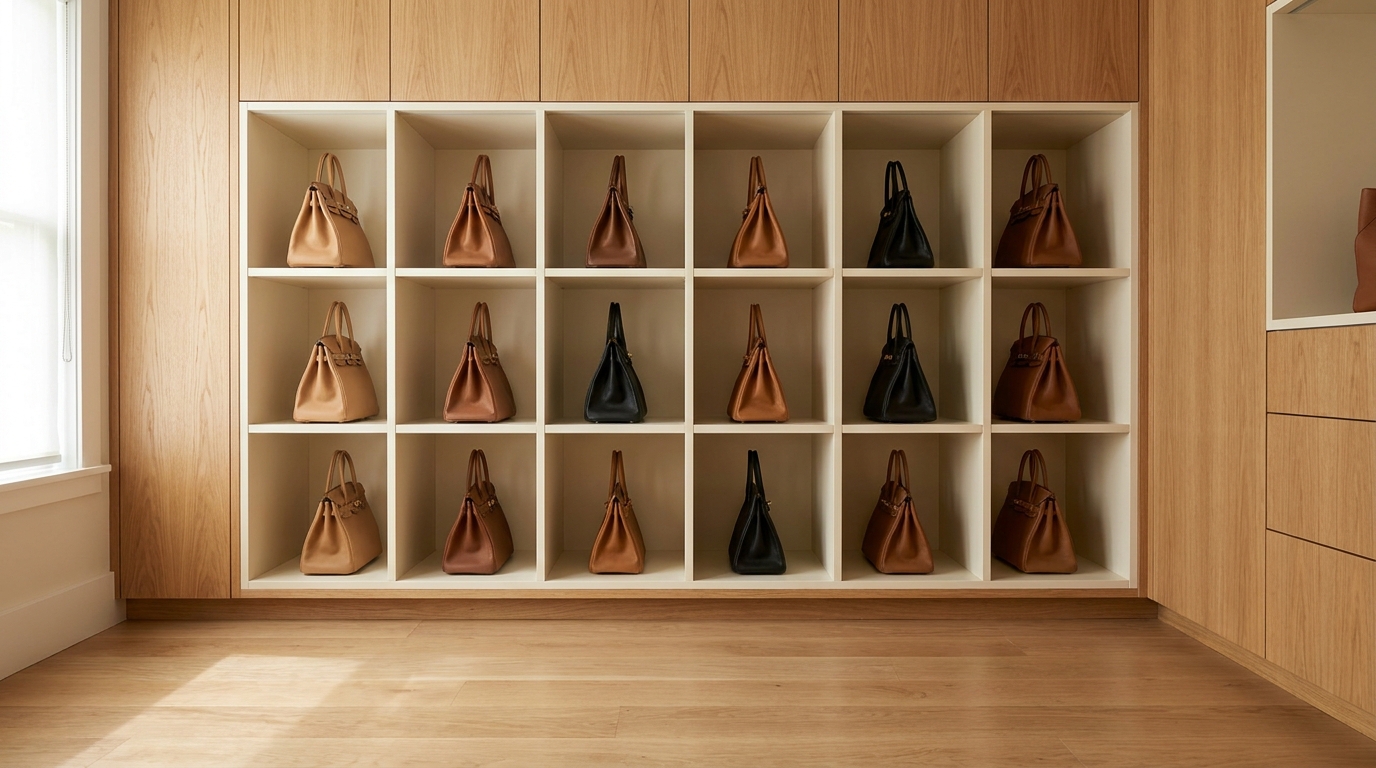
A dedicated bag wall keeps handbags in shape and within reach
A master-closet wall built for handbags, totes, and everyday bags is not a jewelry drawer, a valet rod, or a shoe wall. It is a vertical zone of cubbies sized to the largest bag in that group, pegs for the totes you grab every day, and breathable dust covers for leather that should not sit crushed on a shelf. Conservation guidance for leather bags and pouches is straightforward: support the object in its intended shape, keep dust off, and hold relative humidity out of the mold range.[8][9]
That is the job of custom closet handbag storage. In Charlotte, NC, Fort Mill, SC, Rock Hill, SC, and nearby towns, summer humidity makes the climate piece as important as the cubby size. A pile of bags on a high shelf, or a free-standing tower parked in the aisle, solves none of it.
1. What a handbag wall is (and is not)
A bag wall is a single, planned elevation. Structured satchels sit in open cubbies. Soft daily totes hang from pegs or short hooks. Evening bags and seasonal leather rest in slightly deeper cubbies, often with a fabric cover. Hardware faces forward so you can see what you own without stacking one bag on another.
It is not a catch-all accessory wall. Jewelry belongs in lined drawers. Ties and belts belong on racks. Shoes belong on their own shelves or cubbies. Mixing those jobs with handbags is how straps get crushed, dust covers get skipped, and the bag you need ends up on the floor.
Our team designs this zone as part of a custom closet, not as a last-minute add-on. The wall has to work with hang space, drawers, and a walking path.
What this wall should do:
- Give each regularly used bag its own footprint.
- Keep daily bags at a height you can reach without a stool.
- Protect structured leather from being flattened by a stack.
- Leave air around each piece so a Carolina closet does not become a stagnant box.
2. Size cubbies to the largest bag in the zone
Start with the bag that will actually live in that column, not a catalog average. Measure height, width, and depth of the largest tote or satchel in that group, then add clearance so the bag can slide in and out without scraping hardware on the shelf above. A cubby that fits a slim crossbody will pinch a structured work tote. A cubby sized only for the work tote will swallow a clutch and hide it.
We usually group bags by size, not by color. One column for large totes, one for medium structured bags, and a shallower row for small bags. The largest bag in each column sets the cubby. Everything else in that column has to fit that envelope, or it belongs in a different column.
Practical sizing rules we use on site:
- One bag per cubby for structured leather. Stacking is how bases collapse and straps crease.
- Clearance above the bag, not a tight lid. You need room to lift, not drag.
- Depth that matches the bag, not the full closet depth. A 14-inch bag in a 24-inch-deep hole becomes a reach-and-hunt problem.
- A little air around the sides. NC State Extension notes that a packed closet can trap moisture, and if a closet is already showing mold from poor ventilation, removing about one-third of the contents can help circulation.[5]
Do not size the whole wall to a weekend travel tote you use twice a year. That bag can live on a higher shelf or in a deeper cubby at the end of the run. Daily bags get the best real estate.
3. Closet handbag storage: pegs for daily drivers, cubbies for structured leather
Pegs are for bags you use. A canvas tote, a nylon everyday bag, or a soft leather hobo that you take to work can hang from a peg or a short hook at standing height. You see it, you grab it, you put it back. That is a use cycle, not long-term archival storage.
Cubbies are for bags that should not hang by a strap for months. Structured leather, boxes with stiff frames, and anything with a shaped base need a floor under them. Conservators treat leather objects as pieces that should be fully supported in storage, with sharp folds padded so the hide does not crease and later split.[8] A heavy satchel hanging by one strap overnight is different from leaving that same satchel on a peg from May to October.
We like a mixed elevation:
- Eye-level peg rail for two to four daily bags.
- Open cubbies beside or below the rail for structured pieces.
- A covered row for leather you wear less often.
Do not put the daily tote on the floor “just for tonight.” Floors collect dust and get kicked. Do not park it on the top shelf because that is where an empty box happened to be. If you need a stool to put a bag away, you will not put it away.
Hooks should be stout and spaced so bags do not nest into each other. Crowded pegs recreate the pile you were trying to leave behind.
4. Dust covers and optional stuffing that keep bags in shape
Dust is not only unsightly on leather. Conservation notes on tanned leather point out that dust particles attract water vapor and may carry pollutants, and they recommend protecting stored leather with cotton or polyethylene dust sheets, or with closed cabinets and unbuffered acid-free boxes.[8] In a home closet, the everyday version is a breathable fabric dust cover (cotton or the bag’s original cloth bag), not a sealed plastic sack.
Stuffing is optional. It is not a rule we invent for every bag. The Smithsonian’s Museum Conservation Institute notes that some stuffing or interleaving may be necessary to keep a three-dimensional shape or to keep surfaces from rubbing, and it recommends unbuffered, neutral-pH tissue for mixed textile and costume storage, with extra caution about paper-heavy packing in humid, subtropical climates.[10] CCI’s leather-care notes go further for pouches and rounded objects: pad folds, and fill pouches with polyester batting or rolls of acid-free paper so the piece does not sag into a crease while it stiffens.[8]
Newer CCI collection guidelines for bags, purses, and similar rounded objects say to use inner padded supports to preserve shape, and they warn against overstuffing, which stretches skin and can stress stitching.[9] That is the home version we recommend:
- If a structured bag slumps when empty, lightly fill the body with unbuffered tissue or a soft insert so the sides stay up.
- If the bag holds its shape on its own, skip the stuffing.
- Never pack it so tightly that zippers strain or the leather looks drum-tight.
Covers go on clean, dry bags. Wipe surface dust first. Do not bag a wet or damp tote and park it in a cubby. Florida Extension work on indoor humidity notes that stagnant closet air is a mold risk, and leather items at the back of a closet are often the first to show it.[7]
5. Humidity, airflow, and leather care in a Carolina closet
Leather is a protein material. It takes up and gives off moisture as the room changes. A 1992 Canadian Conservation Institute note that is still published for tanned leather (including bags) recommends a stable relative humidity around 45 to 55 percent, and it is blunt about the edges: below about 30 percent RH, leather can lose moisture and become brittle; above about 65 percent RH, mold and hydrolytic damage become the concern.[8] CCI’s later leather-care guidance repeats the mold threshold: relative humidity over 65 percent favors mold on leather, skins, and related materials, and limited air circulation raises the risk.[9]
That museum band sits inside what U.S. health agencies already ask of a house. EPA’s residential mold guide says to keep indoor humidity below 60 percent if possible, ideally between 30 and 50 percent.[4] NC State Extension, writing for North Carolina homes, cites that EPA range and names leather among the household materials that can feed mold when moisture is present.[6]
The Carolinas add a local wrinkle. University of Florida IFAS notes that relative humidity above 70 percent for long periods can lead to mold in stagnant air spaces such as closets, and it flags leather shoes in the back of a closet as an early warning.[7] Master closets in Charlotte, Ballantyne, Waxhaw, and Rock Hill still go stale when they are packed to the ceiling and the door stays shut.
What we design for, and what you can do between visits:
- Do not seal leather in plastic. A fabric cover plus air around the cubby is the better pair.
- Leave breathing room. NC State’s mold checklist says closet mold is often a ventilation problem, and that leaving the door open and reducing an overfilled closet (about one-third of the contents) can improve airflow.[5]
- Keep the bag wall off an exterior wall if you can, especially one that runs cool and collects condensation.
- Store bags clean and dry. Conservation practice for leather starts with support and a stable room, not with oils and conditioners as a substitute for climate.[8]
We are a storage shop, not a leather conservator. If a bag already has active mold, fix the humidity first, then talk about the cubby.
6. Put daily bags in a comfortable reach band
The 2010 ADA Standards are a public-access rule, not a mandate for a private bedroom closet. Still, the numbers are a useful analog for a wall you use every morning. For an unobstructed forward or side reach, operable parts fall between 15 inches and 48 inches above the floor.[3]
We use that band as a planning guide, not a code inspection:
- Daily bags: pegs and cubbies inside that 15-to-48-inch zone.
- Seasonal or occasional bags: above 48 inches is acceptable if you do not need them on a weekday.
- Nothing you use weekly on the floor, and nothing you use weekly on a shelf you have to climb.
If you share the closet, set the daily row to the shorter user’s comfortable reach. A bag wall that only works for one person will not stay tidy.
Corner cubbies are awkward. The Access Board’s guide notes that elements in corners are hard to reach from a side approach.[3] We keep the bag you grab most out of the corner and on a straight run of wall.
7. Free-standing towers can tip; built-in walls are a different case
A tall, empty cubby tower loaded with bags on the top row is still furniture. In 2023, CPSC adopted ASTM F2057-23 as the mandatory federal stability standard for clothing storage units under the STURDY law. CPSC staff reported 234 fatalities from clothing-storage-unit tip-overs from January 2000 through April 2022, including 199 child fatalities, and estimated 84,100 emergency-department injuries tied to those units from 2006 through 2021 (about 5,300 per year).[1]
The rule, now at 16 CFR part 1261, applies to free-standing clothing storage units manufactured after September 1, 2023. CPSC’s business guidance defines a covered unit as free-standing furniture with drawers and/or hinged doors, at least 27 inches high, at least 30 pounds, and at least 3.2 cubic feet of enclosed storage. It also lists what is not in scope, including shelving units such as bookcases and built-in units intended to be permanently attached to the building.[2]
That distinction matters in a closet:
- A free-standing dresser or armoire used as a bag cabinet can fall under STURDY if it meets those size tests. Anchor it. Do not treat a tip strap as optional.
- An open cubby tower may look more like a bookcase (shelving is outside the CSU definition), but it can still tip if it is tall, narrow, and top-heavy. CPSC still tells households to anchor furniture to the wall.[1]
- A built-in bag wall fastened to the structure is the case we prefer in a master closet. It is not a free-standing CSU under that rule, because it is meant to stay attached to the building.[2]
STURDY is a child-injury standard for free-standing bedroom storage, not a custom-closet installation code. Built-ins are out of that federal scope for a reason. They still need sound fastening into studs, a sensible load, and an aisle that does not invite climbing. If a household includes young children, keep heavy bags off the top of any free-standing unit.
8. Leave a clear aisle so the wall actually works
A bag wall you cannot stand in front of is a display, not storage. You need room to step in, lift a structured bag with two hands, and turn without hitting a hamper or a hanging rod.
We plan the aisle as part of the closet, not as leftover floor. That means:
- No laundry basket permanently parked at the cubbies.
- No bench that forces you to reach over a seat to grab a tote.
- Enough space to open a nearby drawer without blocking the pegs.
Airflow is part of the same idea. A packed aisle and a packed wall are the stagnant closet UF IFAS and NC State both warn about.[5][7] Leave a path. Leave a little space above and beside the bags. Then the dust covers, the cubby sizes, and the pegs can do their jobs.
Practical takeaways
- Build a bag wall, not a bag pile. Cubbies, pegs, and covers are different tools for different bags.
- Size each column to the largest bag that will live there, then give structured leather its own cubby.
- Hang daily totes on pegs inside a comfortable reach band. Park structured leather on a supported cubby floor, not on a strap for the season.
- Use a breathable dust cover on leather you are not carrying this week. Light stuffing is optional when a bag slumps. Do not overstuff.[8][9][10]
- Watch humidity. EPA’s home guidance is below 60 percent RH, ideally 30 to 50 percent. Leather care notes flag mold above about 65 percent and brittleness in very dry air.[4][8]
- Give the closet air. An overfilled closet is a ventilation problem as much as a storage problem.[5]
- Anchor free-standing towers. STURDY and 16 CFR 1261 cover free-standing clothing storage units. Built-in walls attached to the building are a different category.[1][2]
- Keep a clear aisle so you can actually put the bag back.
How we can help
Have more questions or want to get in touch? We design custom closet handbag storage as part of a full master-closet plan for homes in Charlotte, NC, Fort Mill, SC, Rock Hill, SC, Ballantyne, NC, Waxhaw, NC, Wesley Chapel, NC, and Indian Land, SC. Contact us to schedule a design visit. Call (704) 604-3870 or email design@theclosetrehab.com.
Citations
- U.S. Consumer Product Safety Commission, "CPSC Adopts Final Consumer Product Safety Standard to Prevent Tip-overs of Dressers and Other Clothing Storage Units" (2023-04-19)
- U.S. Consumer Product Safety Commission, "Clothing Storage Units" (16 CFR part 1261 / ASTM F2057-23)
- U.S. Access Board, "Guide to the ADA Accessibility Standards, Chapter 3: Operable Parts" (§308.2 and §308.3, 15–48 in. unobstructed reach)
- U.S. Environmental Protection Agency, "A Brief Guide to Mold, Moisture and Your Home" (indoor humidity below 60%, ideally 30–50%)
- NC State Extension, "Mold and Moisture Checklist" (2022-04-04)
- NC State Extension, "Preventing Mold in Your Home" (2022-04-22)
- University of Florida IFAS Extension, "Energy Efficient Homes: Indoor Air Quality and Energy" (FCS3275/FY1044)
- Canadian Conservation Institute, "Care of Alum, Vegetable and Mineral-tanned Leather, CCI Notes 8/2" (1992)
- Canadian Conservation Institute, "Caring for leather, skin and fur" (preventive conservation guidelines)
- Smithsonian Museum Conservation Institute, "Acid Free Tissue Paper for Textiles & Costume Storage & Handling" (2022)