Closet Hanging Zones That Match the Wardrobe
Closet hanging zones work when they match the clothes you actually hang, not a generic half-the-rod-for-dresses sketch. Count shirts, jackets, trousers, and long garments first, then split double-hang from long-hang so hems clear the floor and the rod above. A 2020 University of Tennessee Extension clothing guide starts wardrobe planning with an inventory of what you own, grouped by type, so you stop guessing and stop buying more of the same. [1] Conservation practice is just as direct: structured, sturdy garments can hang on supportive hangers, while knits, bias-cut pieces, and heavily embellished clothes should stay off the rod. [2]
1. Inventory first, then assign hanging zones
Start with piles, not a catalog layout. Before we talk rod height, we sort the wardrobe the same way a clothing program would: tops, pants, skirts, dresses, and jackets in their own groups. [1] That count tells us how much double-hang you need versus how much continuous long-hang. A closet that looks full often has the wrong mix of zones, not too little wood.
A hanging inventory answers four questions. How many items truly belong on a hanger? How long is the longest shirt, jacket, dress, and coat on the hanger you will use? How many of those pieces do you reach for every week? How many should leave the rod? University Extension guidance from 2020 is blunt: you need to know what you have, so you can coordinate pieces and avoid buying something you already own. [1]
Count linear hanging, then drop the fold pile. Two silk blouses share a slim hanger profile. A winter overcoat does not. We measure the hanger you will keep, then add space so garments are not crushed. Canadian Conservation Institute notes treat hanging as an excellent space-saving method when the garment can take the load, and they still insist on air between pieces. [3] The 2020 Extension guide says to fold sweaters and other knitted garments so they will not stretch out of shape. [1] Those pieces belong on shelves or in drawers, not in the rod count.
2. What belongs on a rod (and what does not)
Hang the structured pieces. The National Park Service’s textile guidance is written for museum garments, but the construction test is the same one we use at home: sturdy, structured, or tailored clothes in good condition can hang on a padded hanger that matches the shoulder. [2] Jackets with set-in sleeves, woven dress shirts, tailored trousers, and many dresses meet that test. Choose a hanger slightly smaller than the shoulder width, because padding adds bulk. [2]
Keep knits, bias cuts, and heavy decoration off the hook. NPS tells collections staff not to hang garments that lack dimensional stability (knits), that are sewn on the bias, that are simply constructed like kimonos, or that are heavy or heavily embellished. [2] The American Institute for Conservation’s textile storage chapter makes the same call: knitted, bias-cut, or heavily embellished or beaded objects should not be hung, because the hanger supports only a small part of the garment’s mass. [4] Sweaters, jersey dresses, beaded evening wear, and bias-cut slips go flat.
Wire hangers fail the support test. Lightweight wire hangers do not adequately support a garment, according to Canadian Conservation Institute notes. [3] The 2020 Tennessee Extension guide adds that wire hangers can bend, snag, rust, and leave dents in shoulders. [1] Use a plastic or padded hanger. For pants and skirts, a 2015 Oregon Heritage bulletin says to use trouser hangers instead of draping the garment over a regular hanger’s crossbar. [5]
Hanging concentrates weight at the top. When a garment hangs, stress gathers at the shoulders, neck, and bodice. [2] That is why a padded, correctly sized hanger matters, and why a heavy skirted dress may need extra support from the waist back up to the hanger hook. [2][3] A closet hanging zone is a decision about whether the garment can carry its own weight, not only a rod height.
3. How much double-hang versus long-hang you actually need
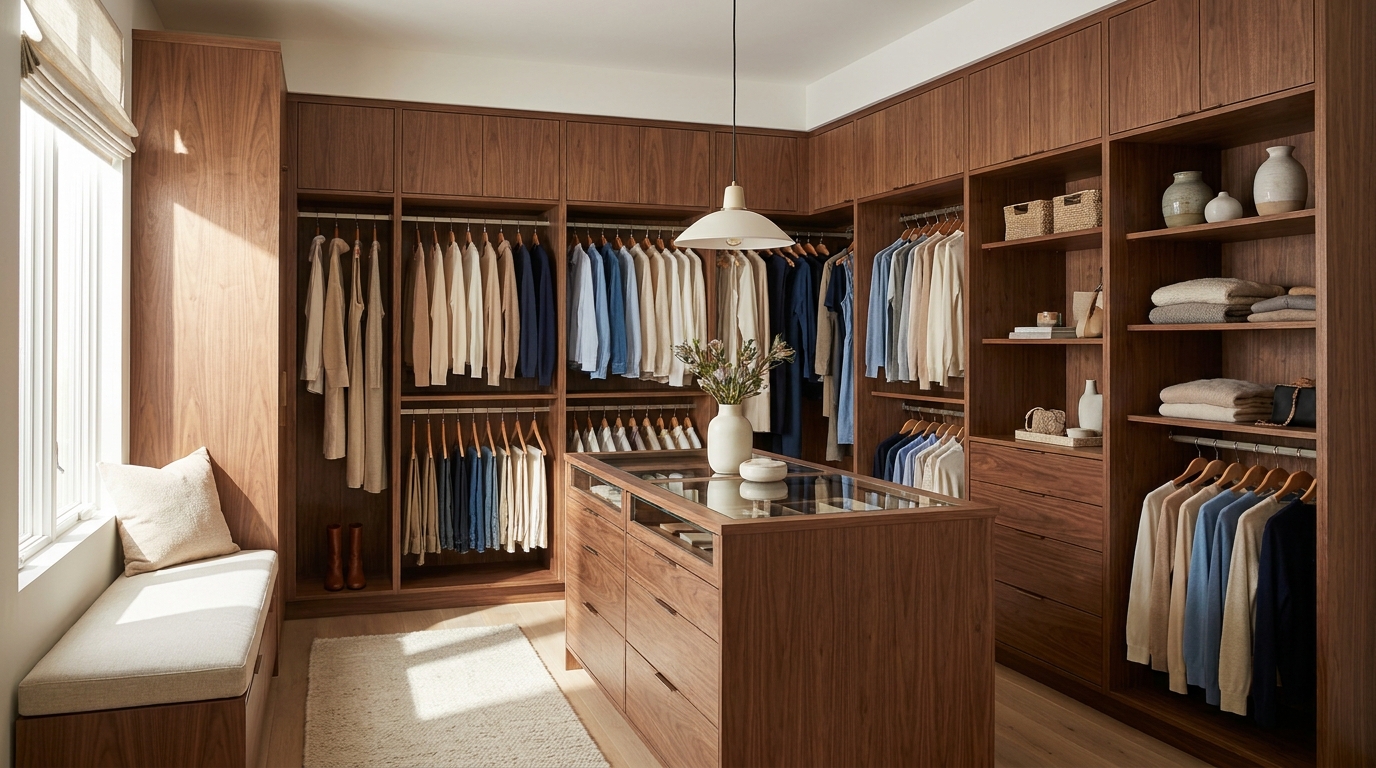
Double-hang is two short drops stacked. Shirts, blouses, folded trousers, many jackets, and knee-length skirts live here. Each rod only has to clear a short garment, so one wall can hold two working rows. Long-hang is one continuous drop for dresses, gowns, robes, and coats that would hit a lower rod.
There is no universal 50/50 split. A wardrobe of dress shirts and slacks wants mostly double-hang. A wardrobe of midi and maxi dresses wants a real long-hang bay, not a leftover corner. We convert the inventory into lineal inches: hanging pieces in each length class, times hanger width, plus breathing room. If shirts and dresses share one single rod, the shirts steal the drop the dresses need, and the dresses steal the density the shirts need.
Institutional closets already split short hang from long hang. Lehigh University’s published M&M residence closet lists a long hanging space 60 inches tall and a short hanging space 39 inches tall. [6] That is a dorm spec, not a Charlotte master suite, but it records the same two-zone idea: short hang gets a compact vertical bay, long hang gets a taller bay. We still measure your longest shirt and your longest dress.
Leave slack, and keep long-hang honest. Conservation storage asks for enough space that objects hang without touching neighbors, and at a minimum are not crushed. [4] We leave a vacant stretch on each rod, or a panel that can switch from double-hang to long-hang if the wardrobe shifts. A drawing that shows double-hang on every wall looks efficient and then fails the first gown. Our custom closet designs start with that hang-space split (standard hang versus double-hang for dresses, suits, blouses, and everyday wear) before we talk finishes.
4. Rod heights and the clearances that stop dragging
Measure drop, then set the rod. Hold the garment on its real hanger. Measure from the top of the hook to the hem, then add clearance so the hem does not wipe the floor or the rod below. That number, not a memorized standard height, sets the rod. Too low, and dresses puddle. Too high, and you waste air above the hanger.
Short hang needs a full shirt drop. Lehigh’s 39-inch short hanging bay shows how compact a shirt zone can be when the drop is planned. [6] If your longest hanging shirt or jacket is longer than that bay, we drop the lower rod or raise the upper one. The hem should hang free, and nothing should rest on the clothes below.
Long hang needs a continuous column. Lehigh’s long hanging bay is 60 inches tall. [6] Many gowns and coats need more than that once you add hanger hook and floor clearance, which is why we measure the actual piece. NPS also flags hook shape: choose hangers with smooth, long-necked hooks so the garment does not sit high on the hanger and rub the hanging bar or the shelf above. [2] That small clearance at the top of the zone is as important as the hem clearance at the bottom.
Leave air between stacked rods. Double-hang fails when the upper hem lands on the lower hangers. We set the lower rod high enough that trousers or shirts clear the floor, then set the upper rod so the shortest upper garment still clears the hangers below. If a jacket on the top rod sits on the shirts below, the zone is too tight.
Heavy skirts need more than a higher rod. Dresses with heavy skirts can pull at the bodice. NPS notes that those garments may need supplementary support from the waistline back to the hanger. [2] CCI describes the same fix: cotton tapes from the waistband to the hanger hook so the skirt does not hang from the shoulder seams alone. [3] The zone still has to be tall enough that the hem never drags.
5. Side-to-side spacing so garments can breathe
Crowding is a storage failure, not a sign you need more rod. The 2020 Extension clothing guide tells people to hang pressed clothes so they are not crowded by other clothes. [1] CCI is more specific for hanging storage: hang garments at least 10 cm (about 4 inches) apart. [3] That gap is museum spacing, and a working closet will run tighter than a costume vault, but the principle holds. If you cannot slide a hanger without shoving three others, the zone is too full for the rod length you built.
Crushing is structural damage, not just wrinkles. AIC notes that hanging already supports only a small part of the object, and that crushing and compression are hard to control when space is short. [4] Suits lose shoulder shape. We would rather give you honest double-hang with space between hangers than extra rod you have to jam. Group like hangers together so a padded jacket hanger does not steal space planned for slim shirt hangers. [3]
Give hanging a closed, dry home. CCI prefers enclosed units so hanging clothes are not draped in dust. [3] George Washington University’s Textile Museum tells home collectors to store textiles in a cool, dry room and to avoid attics and basements, which swing the most in temperature and humidity. [7] Do not park an overflow rod in a damp bonus space just to gain lineal inches.
6. Daily-use rods should sit in a real reach band
Reach is part of hanging design. A long-hang rod at the ceiling may clear a gown and still fail you every morning. The U.S. Access Board’s guide to the ADA Standards states the unobstructed forward reach range as 15 inches to 48 inches, and the unobstructed side reach as the same 15 to 48 inches. [8] Those numbers apply to operable parts in covered facilities, not to every private-home closet rod. They are still the clearest public reach band we have for the hangers you grab daily.
Accessible storage uses that same range. In the ADA Standards, storage elements must comply with at least one of the reach ranges in section 308. [9] We do not treat a private residence as a public building. We do put everyday shirts, work trousers, and the jacket you wear most weeks on rods you can take off without a stool. If mobility is a design driver, we keep a daily-use run inside that 15-to-48-inch reference band and treat the upper rod as secondary storage. [8][9]
7. Humidity and air around hanging clothes
Keep the closet in the same moisture range as the house. EPA’s indoor air guidance says to keep indoor humidity between 30 and 50 percent, because high humidity raises the chance of mold. [10] Hanging wool and lined jackets in a damp box is how mildew starts at the shoulder. A closet that shares the bedroom’s conditioned air is already ahead.
Attics and basements are the wrong overflow. The Textile Museum is explicit: those rooms usually lack climate control and see the largest swings of temperature and relative humidity. [7] If humidity runs high for part of the year, circulate the air (even a fan helps) and consider a dehumidifier. [7] We would rather refine closet hanging zones in the bedroom than add a bonus rod in a space that sweats.
Air between hangers is climate control, not just neatness. Crowded clothes trap moisture. CCI’s 10 cm spacing and the Extension warning against crowding both serve the same end: air can move and fabric can dry. [1][3] Combine that spacing with EPA’s 30-to-50-percent indoor humidity target. [10] CCI also tells collections staff to store textiles clean, because soil invites infestation. [3] Do not hang a wet coat back on a working rod.
Practical takeaways
- Count the wardrobe by type and hanging length before you pick rod heights. A 2020 Extension inventory is still the right first step. [1]
- Hang structured shirts, jackets, and dresses on padded or plastic hangers. Fold knits, bias-cut pieces, and heavily embellished garments. [1][2][4]
- Size double-hang to the short-drop count and long-hang to the dresses and coats. Lehigh’s 39-inch short bay and 60-inch long bay show the two-zone idea; your measurements set the final drop. [6]
- Measure hook-to-hem, then add clearance so hems do not drag and upper garments do not sit on the hangers below. Use long-necked hooks so fabric does not rub the bar or shelf. [2]
- Leave space between hangers. CCI’s museum minimum is 10 cm (about 4 inches) apart. If hangers cannot move, the zone is too full. [3]
- Put everyday hanging in a comfortable reach band. The Access Board’s 15-to-48-inch unobstructed reach range is a useful check, not a claim that every home rod must sit at 48 inches. [8][9]
- Keep hanging zones in a conditioned room and indoor humidity between 30 and 50 percent. Skip attic and basement overflow rods. [7][10]
How we can help
Have more questions or want to get in touch? Contact us · (704) 604-3870 · design@theclosetrehab.com. Our team will inventory the hanging clothes you actually wear, set double-hang and long-hang to those counts, and lock rod heights so dresses, suits, and shirts clear the floor. You can also review how the design process works before we visit.
Citations
- University of Tennessee Extension, "Clothing and Textiles Project Area Guide Beginner (W 885)" (2020-04)
- U.S. National Park Service, "Conserve O Gram 4/5: Storage Techniques for Hanging Garments: Padded Hangers" (2020-12; page last updated 2026-01-21)
- Canadian Conservation Institute, "Hanging Storage for Costumes - CCI Notes 13/5" (2009 revision; page dated 2019-02-22)
- American Institute for Conservation, Textile Specialty Group, "TSG Chapter VIII. Storage of Textiles, Section D. Storage Methods" (final revision 1998-04-02; wiki page current)
- Oregon Heritage / Oregon Parks and Recreation Department, "Caring for Textiles: Cleaning and Garment Hanging (Oregon Heritage Bulletin 20)" (2015-07)
- Lehigh University Finance and Administration, "Closet (M&M)" (undated page; accessed 2026-08-17)
- The George Washington University Museum and The Textile Museum, "Storing Textiles" (undated page; accessed 2026-08-17)
- U.S. Access Board, "Guide to the ADA Accessibility Standards, Chapter 3: Operable Parts" (accessed 2026-08-17)
- U.S. Access Board, "ADA Accessibility Standards, Chapter 8: Special Rooms, Spaces, and Elements (811 Storage)" (2010 Standards)
- U.S. Environmental Protection Agency, "Care for Your Air: A Guide to Indoor Air Quality" (page last updated 2026-08-17)