Closet Ironing Station: Fold-Away Press Bay
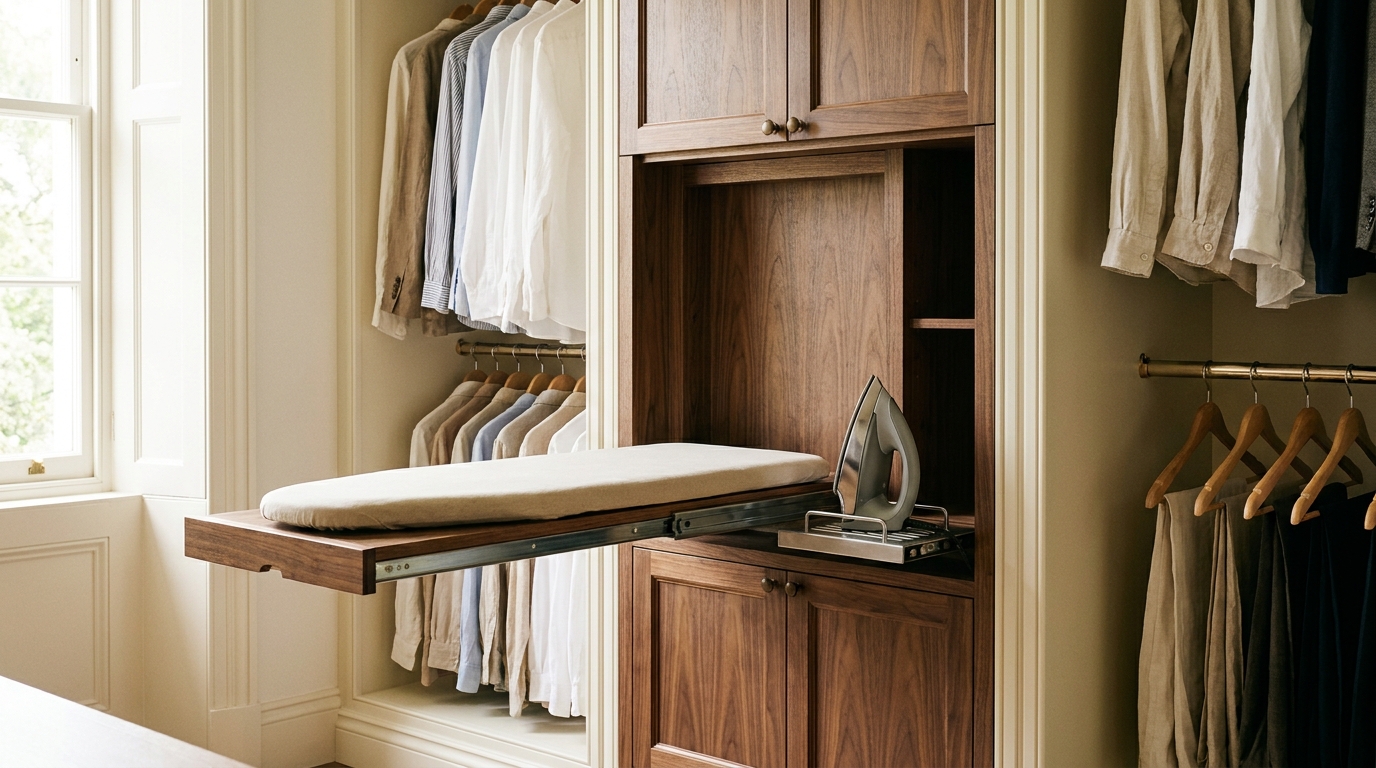
A closet ironing station is a fold-away press bay inside the wardrobe: a pull-out or fold-down board, a heat-safe rest for the iron, a steamer hook, and a hang-to-cool rod so a pressed shirt never lands on the bed. The bay parks vertically when you are done, so it does not steal the hanging inches you already need for jackets, dresses, and shirts. Heat and steam still deserve respect. Burns often start when dry heat (a hot iron) or steam meets skin, and a government encyclopedia still lists a child grabbing a hot iron as a typical household accident [3][4].
1. Why the bed is a poor press surface
Beds are for sleep, not for a hot soleplate. An iron on a comforter has no stable rest, no hang-off rod, and a cord that crosses the floor. The person pressing is also the person who walks away to answer the door, and an unattended iron is easy for a child to pull down [3].
Steam is a scald, not a “softer” heat. Scalds come from hot liquids or steam. A garment steamer that spits water can injure in a second, which is why a 2024 U.S. recall of about two million handheld steamers cited 122 reports of hot water spraying or spitting from the nozzle and 23 burn injuries [1][4]. A closet bay does not remove that physics. It does put the tool on a dedicated, heat-aware surface instead of on bedding.
The closet is already where the shirt lives. Walking a pressed blouse across the house to a laundry counter, or draping it over a chair, puts a crease back in before the fiber cools. A press bay next to the hanging zone closes that loop: press, hang, close the doors.
2. What belongs in a fold-away closet press bay
Four parts, one parking position. We design the bay as a small, purpose-built station, not as a spare hotel board jammed between coats. The kit is simple:
- A pull-out or fold-down board with a heat-tolerant cover, sized for a shirt front and a pant leg, that parks flush when closed.
- A heat-safe rest so the iron sits soleplate-down on a rated surface, never on wood, not on a folded towel, and not on a shelf of sweaters.
- A steamer hook at standing height, with clearance in front of hanging clothes so steam does not soak the next garment.
- A hang-to-cool rod (a valet rod or a short dedicated hang bar) so the shirt leaves the board immediately.
Power belongs in the bay, not in a daisy-chained cord. A listed receptacle in the press niche, on an arc-fault-protected closet circuit, beats an extension cord snaked under hanging clothes. Minnesota’s 2023 National Electrical Code inspection checklist, used here as a plain-language NEC summary, requires combination-type AFCI protection on dwelling-unit closet branch circuits, and it keeps open or partially enclosed incandescent lamps out of clothes closets [5].
This is a closet project, not a laundry-room restamp. Some homes already press in a laundry room. This bay lives beside the wardrobe it serves, which is why we plan it on the same visit as custom closet hanging, shelves, and accessories. Hamper routing is different work.
3. Pull-out boards that park without stealing hang space
Hanging depth is the budget you cannot overspend. A typical hanging rod wants clear depth in front of the back wall. A press board that stays in that plane, even when “folded,” costs you shirts. The solution is a dead zone: an end panel, the cavity under a double-hang section, a shallow tower beside the door, or a knee-height drawer stack that never held long hang in the first place.
Pull-out versus fold-down is a reach question, not a style question. A pull-out board on full-extension slides comes toward you at a set height, which is kind to wrists and keeps the iron cord off the floor. A fold-down board hinged to a side panel can be cheaper in a tight reach-in, as long as it does not swing into the door or the opposite hang. In either case, the closed board should sit inside a cabinet box or a recessed pocket, not in the hanging plane.
The board cover is a consumable, the box is not. A scorched pad is replaceable. A scorched wood top is a remodel. Specify a heat-rated cover, a metal or composite rest for the iron, and a drip edge if you use a steam iron, so condensate does not sit on finished panels.
Reach-in closets can still host a bay. A standard reach-in can take a fold-down on the return wall or a slim pull-out under a single hang section, if the door swing is mapped first. We do this in Charlotte and Fort Mill bedrooms where the closet is the only indoor place left for a board.
4. Steamer hooks, heat-safe rests, and hang-to-cool
Steamers need a hook, a drip plan, and a keep-out zone. A handheld steamer is useful for hanging knits and lined jackets that hate a sliding iron. It is also a scald tool. Keep the nozzle pointed into open air or onto the garment, never toward a face or a child’s height, and park it on a hook so the tank is upright after use [1]. A small heat-safe tray under the hook catches drips. Do not hang the steamer over a wood shelf of folded cashmere.
The iron needs a rest that can take residual heat. Auto-shutoff helps. It does not make a hot soleplate safe on particleboard. The rest should be listed for appliance heat, large enough for the iron to sit stable, and high enough that a toddler cannot grab the handle. MedlinePlus still names a child grabbing a hot iron as a classic burn scenario, and it advises keeping children away from hot items and keeping cords off the floor [3].
Hang-to-cool is the missing piece most portable boards skip. Cotton and linen should be pressed until dry. Wool should not be pressed completely dry. Either way, the garment needs a rod, not a pile on the bed, so the set holds as it cools [7]. A 12- to 18-inch valet rod beside the board is enough for two shirts. That is the whole point of putting the station in the closet: the hang line is already there.
A 2023 recall is a reminder about cords, not a reason to skip the bay. In December 2023, a recall expansion covering about 1.75 million travel steam irons warned that a damaged cord near the bushing can overheat, posing fire and burn hazards, and can expose copper wires, posing a shock hazard. The firm had 74 incident reports, including smoking, sparking, catching fire, or overheating at the cord, plus two reports of minor shocks [2]. A closet bay with a nearby receptacle shortens the cord run and makes damage easier to see. It does not excuse a frayed iron.
5. Fabric heat, moisture, and a press cloth
The label wins, the dial is second. A University of Kentucky Cooperative Extension publication on pressing (revised in 2002) still matches what we tell clients at the bay: test a scrap first, set the iron for the fiber, and on a blend use the lower temperature. A polyester-wool blend is pressed as polyester, not as wool [7].
Heat and moisture are fiber-specific, which is why the bay needs a press cloth and a spray bottle, not only steam. The same extension guidance is blunt:
- Linen: high temperature, much moisture, wrong side or a cloth, press until dry.
- Cotton: fairly high temperature, some moisture; easy-care finishes need less of both.
- Wool: moderate temperature, some moisture, do not press completely dry, protect the face with a wool cloth.
- Silk: moderate temperature, little moisture, wrong side, watch water spots.
- Polyester: low to medium temperature, slight pressure, wrong side, press cloth to prevent shine.
- Acetate and modacrylic: low or very low heat; steam can drop some synthetics toward their melting point [7].
True pressing is lift-and-set, not a drag race. The extension describes pressing as a lowering and lifting motion so you do not stretch the grain. Dragging the iron is ironing, and it can shine a surface or pull a seam. A small sleeve board or a padded ham in a nearby drawer earns its keep for cuffs and collars that a full board mashes [7].
None of this requires a commercial laundry layout. It requires a stable board, the right heat, and a rod.
6. Electrical layout that belongs in a clothes closet
A press bay is an operating appliance next to fuel. Clothing, paper hang tags, and wood panels are combustibles. NFPA’s May 2026 analysis of 2020 through 2024 home electrical fires found an estimated annual average of 46,652 home electrical structure fires, with about 527 civilian deaths, 1,580 civilian injuries, and $2.4 billion in direct property damage each year. About 12 percent of those fires started in a bedroom. Operating equipment was the heat source in an estimated 90 percent of the fires, and electrical wire or cable insulation was the item first ignited in 36 percent [6].
AFCI protection is the closet-circuit baseline, not an upgrade sticker. The 2023 NEC summary used by Minnesota’s Department of Labor and Industry requires listed combination-type AFCI devices on branch circuits that supply 125-volt, 15- and 20-amp outlets or devices in closets (and in bedrooms, hallways, and laundry areas). That protection is also required when closet circuit wiring or a device is modified, replaced, or extended [5]. If we add a receptacle for the iron, the circuit conversation happens with a licensed electrician, not with a power strip.
Lighting in a clothes closet has its own clearances. The same NEC summary defines closet storage space from the floor to 6 feet or the highest hanging rod, 24 inches from the sides and back, then continuing up at 12 inches or the shelf width, whichever is greater. Totally enclosed surface-mounted incandescent or LED luminaires need 12 inches from that storage; totally enclosed recessed units and fluorescent fixtures need 6 inches. Open or partially enclosed incandescent lamps and pendant fixtures are not permitted in clothes closets [5]. A press bay does not get a bare bulb “for extra light.”
Keep the cord in sight and off the floor. Damaged appliance cords and pinched insulation show up in electrical-fire data as wire insulation ignited by arcing from operating equipment [6]. Do not run the iron cord under hanging clothes, through the door strike, or under a rug. Do not leave an extension cord as the permanent feed for a heat tool. If the receptacle is not in the bay, the millwork is not finished.
7. Safety habits once the bay is in
Unplug when you step away. Auto-shutoff is a backup, not a babysitter. Park the iron on its rest, switch it off, and pull the plug before you leave the closet. Keep the cord where a child cannot yank the appliance off the rest [3].
Give steam a keep-out radius. Point the steamer at the garment, not at your wrist or someone standing in the door. If hot water ever sprays from a nozzle, stop using that unit and check recalls. The 2024 steamer recall existed because units expelled hot water while heating or during use [1].
If skin meets heat, cool water first, ice never. For a minor burn with unbroken skin, MedlinePlus advises running cool water (not ice water) over the area for at least 5 to 30 minutes, then covering with a dry sterile dressing. Do not put oil, butter, or ice on a severe burn. The NHS advises 20 minutes of cool running water for burns and scalds, as soon as possible, and it names a hot iron as a typical dry-heat burn [3][4]. Larger burns, hands, and joints need medical advice.
Close the bay so the closet is a closet again. Board up, iron cold and stowed, steamer upright, rod clear. The hanging clothes should not rest against a warm soleplate or a damp steamer head.
Practical takeaways
- Put the board in a dead zone (end panel, under double hang, or a slim tower) so closed depth does not eat the hang line.
- Specify four pieces together: fold-away board, heat-safe rest, steamer hook with drip tray, hang-to-cool rod.
- Give the iron a listed receptacle on an AFCI-protected closet circuit. Do not feed a heat tool from a permanent extension cord [5][6].
- Match heat to fiber, test a scrap, use a press cloth on blends and shine-prone faces, and hang the garment to cool [7].
- Treat steam like a scald source. Unplug when you leave, keep children off the rest, and cool a burn with water, not ice [1][3][4].
How we can help
Have more questions or want to get in touch? Visit our contact page, call (704) 604-3870, or email design@theclosetrehab.com. We will measure your hanging depth, find a pocket that does not steal shirts, and design a press bay that parks cleanly when the last collar is done.
Citations
- New York State Division of Homeland Security and Emergency Services, "Vornado Recalls Two Million Handheld Garment Steamers Due to Serious Burn Hazard" (2024-02-08)
- New York State Division of Homeland Security and Emergency Services, "Vornado Expands Recall to Include Additional 1.75 Million Steamfast Travel Steam Irons Due to Fire, Burn and Shock Hazards" (2023-12-14)
- MedlinePlus (National Library of Medicine), "Burns" (reviewed 2026-04-09)
- NHS, "Burns and scalds" (reviewed 2026-03-31)
- Minnesota Department of Labor and Industry, "Electrical Inspection Checklist for One-Family Dwellings, Based on the 2023 National Electrical Code (NEC)" (2023)
- National Fire Protection Association, "Home Electrical Fires" (2026-05-01; data years 2020-2024)
- University of Kentucky Cooperative Extension Service, "Pressing Techniques for home sewing" (CT-LMH.019, revised 2002)