Closet Lighting Design: Ambient, Task, Controls
Good closet lighting design is a layered plan, not a single bulb in the middle of the ceiling. You need enough ambient light to walk in and orient yourself, focused task light on rods, shelves, and drawers so you can match colors and read labels, and smart controls (including motion or vacancy sensors) so light is there when you need it and off when you leave. Done well, that combination improves visibility, cuts trip risk in dark corners and door thresholds, and makes everyday dressing faster in both walk-ins and reach-ins. For Charlotte homeowners planning a custom system, we treat lighting as part of the storage design, not an afterthought.
Why closet light is a daily-use problem
Most of us open a closet dozens of times a week, often before coffee, after sunset, or in a rush. A single bare bulb (or no dedicated light at all) creates hard shadows under shelves, muddy color on navy versus black clothing, and dark floor edges where shoes, baskets, and step stools live. That is not only annoying. Dim paths and uneven light are exactly the conditions fall-prevention guidance warns about in other parts of the home, and the same logic applies when you step into a deep walk-in or dig into a dark reach-in.[1][2]
Closets also hide electrical and fire-risk details. Clothes, paper boxes, and soft goods can sit close to fixtures. National fire-safety messaging notes that heat building near things that burn (for example a lit bulb next to cloth or paper) can start a fire without an open flame, which is one reason fixture type, clearance from storage, and correct lamp choice matter in clothes closets.[3] Layered, cooler-running LED sources and code-aware placement help you see better without stacking those risks.
The three layers that make closet lighting design work
Professional residential guidance describes lighting in layers: ambient for general brightness and comfort, task light close to where work happens, and accent light for focus or finish details.[4][5] In a closet, accent is optional. Ambient and task are the workhorses.
Ambient: safe entry and even fill
Ambient light is the base layer. It should be bright enough to move around without eye strain or deep dark zones, yet controlled so it does not blast glare into your eyes when you open the door. Ceiling surface fixtures, recessed downlights, or a simple central luminaire can carry this role in a walk-in. In a small reach-in, a single well-placed fixture above the door or on the ceiling often has to serve as both ambient and task light, which is why placement and beam quality matter more than raw wattage.
U.S. Department of Energy guidance on high-performance residential lighting, drawing on Illuminating Engineering Society (IES) practice, treats many service areas (including closets) as places where one efficient system often does double duty as ambient and task light, so levels can be higher than pure circulation lighting alone.[5] IES-based residential tables in that same guide list general bedroom dressing ambient around 5 footcandles horizontal for typical adult eyes, with higher levels for fine visual work elsewhere in the home.[5] Closets used for color matching and small hardware (jewelry clasps, zipper pulls, small labels) benefit from more light at the clothes and shelf plane than bare "hallway" levels.
Task: light on the clothes, not only on your head
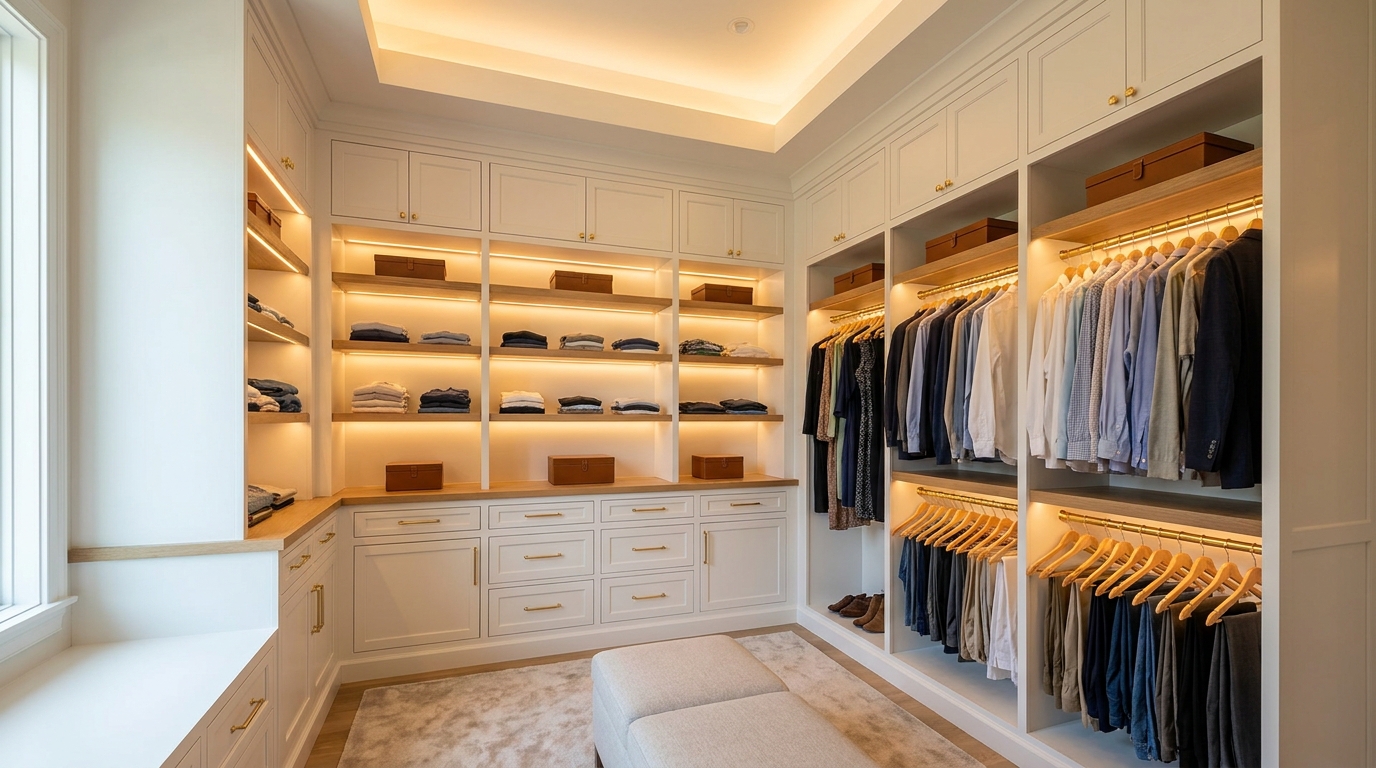
Task lighting puts lumens on the surfaces you actually use: hanging rods, shelf fronts, drawer interiors, and island tops in larger walk-ins. Vertical light on hanging garments is often more useful than a bright spot on the floor. That is why many custom systems combine:
- Recessed or surface ceiling fixtures for overall fill
- Continuous LED strip or puck lighting under shelves to wash hanging clothes
- Drawer and cabinet lighting so you are not guessing in deep boxes
- Island or bench task light if the walk-in includes a dressing surface
University extension-style residential lighting guides stress that task lighting supplements ambient light by placing light closer to the work, so you can use lower ambient levels overall and still see clearly, which also reduces energy waste.[4] In a closet, that means you can keep general light comfortable and boost only the zones you touch most often.
Color quality is part of task performance. The color rendering index (CRI) describes how accurately a source shows object colors. Sources at about 90 CRI and above generally render colors very well; higher CRI usually means more natural clothing color under the light.[4] DOE service-area guidance specifically recommends higher-CRI warm-white lamps (for example 80 CRI at 3000K in that document's framing) in closets so clothing colors appear accurately, and notes recessed lighting can give crisp illumination of clothes when used carefully.[5] When we specify systems for clients, we treat color temperature and CRI as design choices tied to finishes and daily dressing, not as afterthoughts on a product sheet.
Controls and motion: light when you arrive, off when you leave
Closets are classic "left on" spaces. DOE high-performance lighting guidance calls out lights that may sit on unattended for long periods (including closets) as strong candidates for use-limiting controls, and lists automatic on/automatic off applications for interior rooms with no daylight and for closets.[5] California Lighting Technology Center residential guidance similarly treats layered design plus sensors or dimmers as a way to cut ambient load without sacrificing comfort, and notes that walk-in closets are among the spaces where vacancy or occupancy sensor strategies are expected alongside high-efficacy sources in energy-code contexts.[4]
From a safety angle, federal fall-prevention resources encourage good lighting in rooms and hallways, with easily accessible switches or motion sensor lights.[1] CDC's STEADI "Check for Safety" checklist (2017) likewise pushes brighter, reachable lighting, lights and switches at both ends of stairs, and night lights that can come on after dark so you can see where you walk.[2] Closets that open off bedrooms and halls are part of those night routes. A motion or door-activated closet light reduces the "shuffle into a black rectangle" moment that trips people who are half awake or carrying laundry.
Practical control patterns we see work well:
- Occupancy sensors for automatic on when you open or enter (helpful in windowless walk-ins)
- Vacancy sensors (manual on, auto off) when you want deliberate control but guaranteed shutoff
- Door-jamb or magnetic contacts on reach-ins so light follows the door
- Separate switches or scenes for ambient versus shelf strips in large custom rooms
- Timeouts short enough to save energy but long enough for a full outfit choice
Sensors need a clear view of movement. Passive-infrared types need line of sight; cluttered high shelves can block them, so we plan sensor location with the storage layout, not after the rods are full.
Safety: trip hazards, heat, and fixture choice
Lighting is a safety system as much as a design finish.
Visibility and falls. Improving light in dark routes and using easily reached switches or motion lights are standard home fall-prevention recommendations in CDC materials for older adults.[1][2] A walk-in with a dark center aisle, low steps into a platform, or a step stool for high shelves is not safer than a dim hallway. Uniform floor light at thresholds, plus vertical light so you can judge height on shelves, reduces guessing. Keep the floor clear; light cannot fix clutter you still trip on.[1][2]
Aging eyes need more light. Vision changes with age. MedlinePlus notes that by about age 60, pupils may shrink to roughly one third the size they were at age 20, and they may react more slowly to dark or bright light, which makes low light harder and glare more bothersome.[6] CLTC guidance, citing IES practice, explains that recommended illumination levels scale with age group (roughly doubling and quadrupling needs for older adult ranges relative to the youngest reference group in that framing), which is why adjustable or layered systems serve multi-age households better than one fixed dim level.[4] If grandparents, parents, and teens share a home in Charlotte, plan for the eyes that need the most help, with dimming for everyone else.
Heat and combustibles. Soft goods next to hot sources are a known household fire risk theme. NFPA electrical home fire safety material notes that fires can start when heat builds near things that burn, such as a light bulb on near cloth or paper.[3] Clothes closets concentrate those materials. Modern practice favors completely enclosed LED luminaires rated for the application, recessed or surface fixtures with adequate clearance from storage, and cooler-running LED sources that waste less energy as heat. ENERGY STAR explains that LED products produce light up to about 90% more efficiently than traditional incandescent bulbs, and that incandescent sources release a large share of their energy as heat rather than light.[7] Less heat near hangers is both an energy story and a safety story.
Electrical work quality. NFPA urges qualified electricians for electrical work and home inspection practices that catch hazards early.[3] Custom closet lighting often means new circuits, low-profile drivers, dimmers matched to LED loads, and AFCI/GFCI considerations depending on location. We coordinate storage design with licensed electrical work so the pretty strip light is also a safe installation.
Efficiency without dim daily life
ENERGY STAR certified LED bulbs use up to 90% less energy than incandescent bulbs, last about 15 times longer, and (per ENERGY STAR's 2022 product-savings summary) can save more than $50 in electricity over a bulb's lifetime under their stated assumptions.[8] ENERGY STAR also notes that replacing the five most frequently used fixtures or their bulbs with ENERGY STAR models can save about $40 a year in energy costs in that same summary framing.[8] Closets may not be the highest-hour rooms in the house, but they still benefit: long life means fewer ladder trips into a packed walk-in, and low wattage makes multi-zone strip lighting practical.
DOE high-performance lighting strategies emphasize efficient ambient coverage, good color, glare control, and controls, and describe substantial lighting energy reductions when high-performance approaches replace older incandescent-based designs (the 2012 guide discusses reductions on the order of up to about 65% in its comparison framing for full high-performance application).[5] For closets specifically, the same guide pairs efficient fixtures with use-limiting controls as a modest-cost way to stop unattended burn time.[5]
When we plan closet lighting design for a renovation, we usually default to LED sources with high CRI, warm-to-neutral white (often in the 2700K to 3500K range depending on finishes and adjoining rooms), and drivers that dim smoothly if the client wants scene control. Cool blue-white light can make whites look harsh and mornings feel clinical; very warm light can flatten blues and blacks. Matching the closet to the bedroom's color temperature keeps the transition natural when the door opens.
Walk-ins versus reach-ins: layout that fits Charlotte homes
Charlotte housing stock ranges from classic bungalows with shallow reach-ins to new builds with large primary suites. The lighting recipe shifts with geometry.
Reach-in closets. Depth is short, so a single poorly placed ceiling light behind your head when you stand at the rod will put your body in shadow. Better patterns include a fixture near the front (above the door header or just inside on the ceiling) that lights the clothing plane, plus under-shelf LED if double hang or long shelves create caves of darkness. Door-activated or motion light removes the search for a switch behind coats. Keep clearances between luminaires and stored goods as required by electrical code for clothes closets; when in doubt, use closet-rated enclosed LED fixtures and leave space so boxes are not jammed against the lamp.
Walk-in closets. Think in zones: entry and aisle (ambient), long hang runs (vertical task), shelves and cubbies (under-shelf strips), island or dresser (downlight or pendant plus local task), and optional vanity mirror light if the room doubles as a dressing room. Continuous runs of LED along the length of hang space usually beat a few bright spots that leave dark intervals between suits. Islands create shadows; light both the perimeter and the island work surface. If the walk-in has no window, automatic controls matter even more because there is no daylight "backup" when someone forgets the switch.[5]
Shared and aging-in-place suites. Put switches where hands already go (latch side of the door, bedroom path), consider glowing or easy-to-find controls, and avoid relying only on a pull chain in the dark center of the room. Pair lighting upgrades with storage that keeps daily items between shoulder and knee height so people reach less and step-stool less, which is the same "keep frequent items easy to reach" idea fall checklists promote in kitchens and bedrooms.[2]
Finish and reflectance. Light-colored interiors bounce light; dark espresso interiors swallow it. If you love deep finishes, budget more carefully aimed task light and higher output strips so the space still reads clearly. Our cabinet and shelf finishes choices and lighting plan should be decided together so paint, laminate, or wood tone and the LED spectrum support each other.
A practical planning checklist for homeowners
Before you order fixtures, walk your current closet at night with the room lights off and note where your eyes fail. Then map:
- Paths. Door threshold, center aisle, step to a laundry hamper, route to a safe.
- Tasks. Color matching on hang, reading labels on bins, finding dark shoes on the floor, packing a bag on an island.
- Users. Kids, guests, older adults, anyone with low vision.
- Layers. At least one ambient source plus task light on primary hang and shelves for anything larger than a tiny reach-in.
- Controls. Sensor or door switch plus a manual override you can find in the dark.
- Efficiency and heat. LED, preferably ENERGY STAR where a bulb or fixture category applies, with enclosed fixtures appropriate to clothes storage.[7][8]
- Integration. Power for future LED runs inside cabinets, not only a single junction box in the ceiling center.
- Code and install. Licensed electrical work, clearances from storage, and dimmers compatible with the LED load.[3]
If you are already planning a custom remodel, lighting decisions land early: rod heights, shelf thickness, and island location all change where light should sit. Our process is built to sequence design, measure, and install so those details are not left for a last-minute store run. You can see how we structure projects on our how it works page, and browse the kinds of spaces we build for closets, pantries, and more.
How our team approaches closet lighting design
At The Closet Rehab, we design custom closets, pantries, and garage systems for Charlotte-area homes. When clients ask for closet lighting design, we do not treat it as a decorative add-on. We start with how you dress and store, then place ambient and task layers so every zone you touch is readable. We coordinate LED type, color quality, and controls with the millwork so strips are protected, drivers are accessible, and sensors actually see you walk in.
Typical recommendations we discuss in consults:
- High-CRI LED for honest color on clothing and finishes[4][5]
- Under-shelf and rod-oriented light so garments are lit from the front, not only from above
- Motion or vacancy controls for windowless rooms and busy family reach-ins[4][5]
- Separate zones in large walk-ins so you are not forced to full brightness for a two-minute grab
- Clear paths and light at the floor plane where shoes and lower drawers live, aligned with broader home lighting safety habits[1][2]
Every home is different. A south Charlotte primary suite walk-in is not the same project as a condo reach-in near Uptown. The principles stay stable: layer the light, favor efficient cool-running LEDs, control runtime, and design for real eyes and real mornings.
Bottom line
Closet lighting design that works combines ambient fill, task light on clothing and shelves, and controls that greet you when you enter. That mix supports safer footing, truer color, less wasted energy, and a calmer daily routine. If you are planning a custom closet in the Charlotte area and want lighting built into the system from the start, contact our team and we will walk the space with you, including the dark corners a single bulb never fixed.
Citations
- Centers for Disease Control and Prevention (Vision and Eye Health), "About Vision Impairment and Falls Among Older Adults" (page content current as of 2024)
- Centers for Disease Control and Prevention (STEADI), "Check for Safety: A Home Fall Prevention Checklist for Older Adults" (2017)
- National Fire Protection Association, "Electrical Home Fire Safety" (page includes 2020-2024 fire statistics and heat-near-combustibles guidance)
- California Lighting Technology Center, UC Davis, "2022 Residential Lighting Guide" (2022)
- U.S. Department of Energy, Building America, "Strategy Guideline: High Performance Residential Lighting" (2012)
- MedlinePlus (National Library of Medicine), "Aging changes in the senses" (page updated 2024)
- ENERGY STAR, "Learn About LED Lighting"
- ENERGY STAR, "ENERGY STAR Product-specific Savings" (2022)