Closet Luggage Storage That Keeps Bags Off the Floor
Why a travel bay belongs in the master closet
Suitcases on the bedroom floor are not storage. They are trip hazards, they collect dust, and they force a heavy lift from a squat every time you leave town. Closet luggage storage in a dedicated master-closet travel bay puts bags on packing shelves, keeps packing cubes and toiletry kits in assigned cubbies, and leaves the floor clear so you can walk in, pack, and walk out. Pennsylvania State University Extension’s fall-prevention guidance is blunt: keep walkways clear of clutter, cords, and furniture, and store frequently used items within easy reach so you are not climbing or stretching.[9] OSHA’s materials-handling rule, written for workplaces but useful as a layout analog, says storage of material shall not create a hazard and that storage areas shall be kept free from accumulation of materials that constitute tripping hazards.[6][8]
This bay is not a guest-bedroom overflow closet, not a seasonal-clothing attic, not a shoe wall, and not a jewelry drawer run. It is the one stretch of the master closet that exists for travel: hard-sided and soft-sided bags, packing cubes, toiletry kits, and a reachable packing shelf. Our team designs that bay so Charlotte, Fort Mill, and Ballantyne households can pack for a CLT flight without kneeling on the floor or kicking a carry-on in the dark.
1. What a travel bay is (and what it is not)
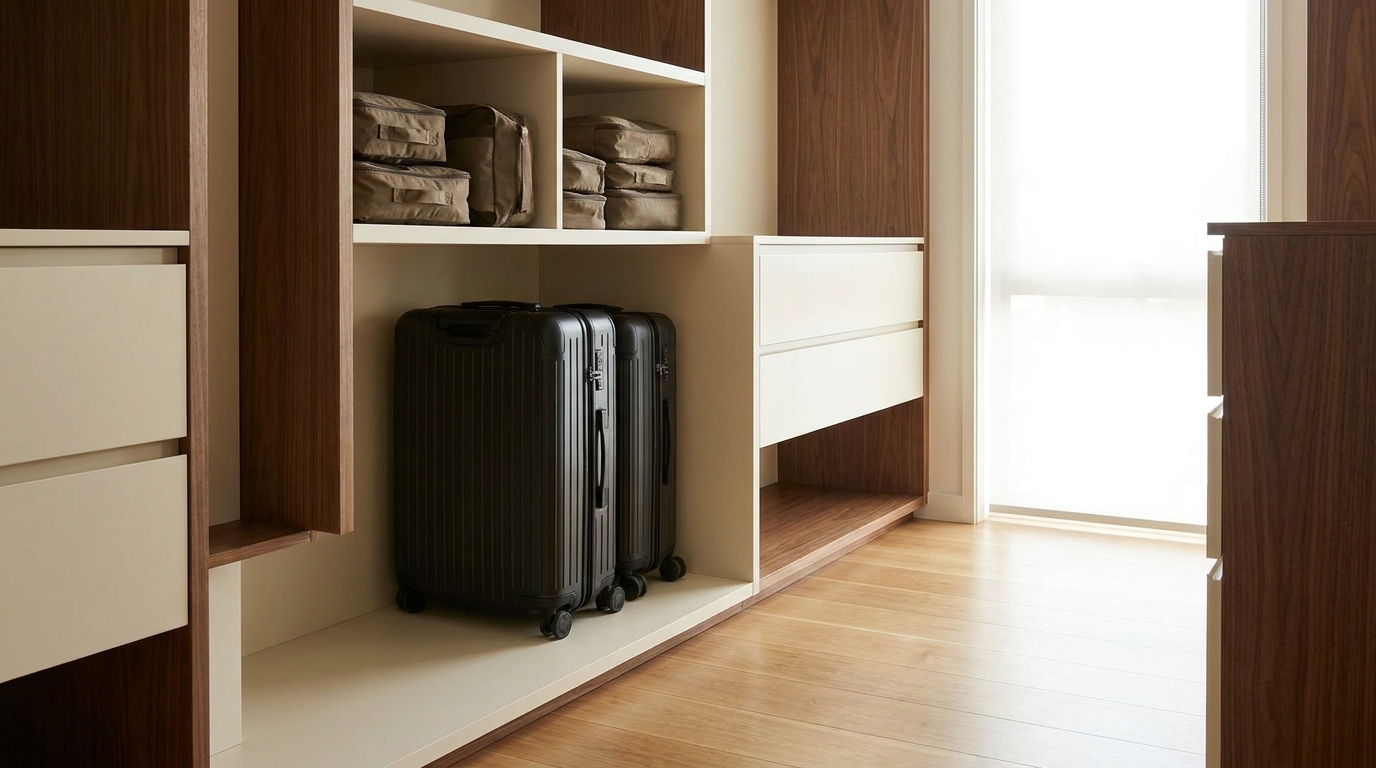
A travel bay is a wall-attached run of suitcase shelves, cube cubbies, and a packing shelf, sized for the bags you actually own. It sits in the master closet because that is where you dress, and that is where packing should happen. The floor in front of it stays empty on purpose.
What belongs in the bay:
- Suitcase shelves: one slot per bag, on edge or flat, labeled by size (carry-on, checked, garment bag).
- Packing-cube cubbies: cubes stay packed by traveler or by trip type so clothing does not migrate into everyday drawers.
- Toiletry-kit cubbies: a carry-on quart bag and a checked-bag kit, stored upright so bottles do not leak onto shirts.
- A reachable packing shelf: a waist-height work surface where an open bag sits while you load it.
- A clear floor: no bags, no stray shoes, no “I’ll put it away when we get back” pile.
What does not belong here: guest linens, off-season coats, everyday shoes, or jewelry trays. Those are different closet jobs. A shoe wall next to luggage turns the bay into a dump. Rock Hill and Indian Land households that fly often already own the bags. The design problem is that those bags live on the floor, under the bed, or stacked in a guest room. A travel bay brings them into the master closet as a planned zone, then keeps every other closet function out of that zone.
2. Keep the bags off the floor
A suitcase on the closet floor is a low, dark, hard object in a walking path. You hit it with a shin at 5 a.m. on a departure morning. You trip on the telescoping handle. Penn State Extension lists “keep walkways clear of clutter, cords, and furniture” among the home changes that reduce fall risk, and it tells households to store frequently used items within easy reach so they are not climbing or stretching.[9] OSHA’s 29 CFR 1910.176 is workplace guidance, not a residential code, and we label it that way. Even so, the housekeeping line is the same idea we design around: storage areas shall be kept free from accumulation of materials that constitute hazards from tripping, fire, explosion, or pest harborage.[6] OSHA’s 2002 Materials Handling and Storage booklet (Publication 2236) repeats it: keep storage areas free from accumulated materials that cause tripping, and keep aisles and passageways clear of obstructions and tripping hazards.[8]
Floor rules we hold to in a travel bay:
- No bag sits on the slab once the install is done. If a bag is in the closet, it has a shelf.
- The floor strip in front of the packing shelf stays empty so you can stand a suitcase upright, open it, and pack without shuffling.
- Handles, straps, and wheels stay on the shelf, not in the walking path.
- After a trip, bags go back on the shelf before clothes go back in the drawers.
Wesley Chapel and Waxhaw master closets are often the darkest rooms in the house before the lights come on. A clear floor is not a style preference. It is how you avoid a fall on the way to the shower with a rolling bag behind you.
3. Put packing work in the reach zone
The packing shelf is the working surface of the travel bay. It should sit where your hands already are, not where you have to climb or drop to your knees.
The U.S. Access Board’s ADA Standards, section 308, set an unobstructed adult reach range of 15 inches minimum to 48 inches maximum above the finish floor for both forward and side reach. That range applies to operable parts in accessible facilities. A private home is not required to follow it, but it is the most widely published dimensional description of a reachable zone, and it is a sound brief for a packing shelf and for the suitcase slots you use every trip.[5][11]
OSHA’s heavy-lifting eTool, again workplace guidance, describes a “power zone” of about mid-thigh to mid-chest for materials that must be lifted by hand. It tells workers to limit a single-person lift to no more than 50 pounds, to use two people above that, to keep the vertical distance of lifts between mid-thigh and shoulder height, and not to start a lift below mid-thigh or finish it above the shoulder. Lifting from below waist height stresses the legs, knees, and back. Lifting above shoulder height stresses the upper back, shoulders, and arms.[7] University of Minnesota Extension’s back-health page (reviewed in 2019) matches the motion, not the workplace: lift with the knees while tightening the core, hold the object close to the body, and ask for help if the object is too heavy or too large to lift safely.[10] OSHA’s grocery-warehousing storage eTool adds the shelf-height version of the same rule: raise the bottom level so torso bending is not required, and do not raise the top of a heavy product higher than mid-chest.[12]
How we apply that to luggage:
- Carry-ons and the bags you pack most often sit in the 15-to-48-inch band, inside the power zone.
- Heavier checked bags sit on the lower shelves of that band, not on the floor and not on a top shelf you have to press overhead.
- The packing shelf sits near waist to mid-chest so an open bag is loaded at standing height.
- Light, infrequent items (an empty duffel, a rarely used garment bag) can go higher. Heavy, frequent items cannot.
A Fort Mill household packing two checked bags and a carry-on should not start the morning with a floor lift. The travel bay makes the first move a short, close, standing transfer from shelf to packing surface.
4. Weight, wall attachment, and why kids should not climb the shelves
Luggage is dense. A loaded checked bag is a concentrated load on a shelf, and a stack of empty hard-sided cases is a climbable tower if you leave it free-standing. CPSC’s February 2024 tip-over report (injuries for 2020 through 2022, fatalities from January 1, 2013 through July 31, 2023) estimated an annual average of 17,800 emergency department-treated instability or tip-over injuries. Children under 18 accounted for 7,800 (44%) of those injuries. Furniture was involved in 14,500 (82%). Among child furniture injuries, an estimated 1,800 involved a chest, bureau, or dresser, and 1,000 involved shelving, a shelving unit, or a bookcase. Of 217 reported fatalities in that window, 155 (71%) involved children, and among fatalities with a known room, 44% occurred in bedrooms.[1] CPSC notes that instability can come from a small footprint or top-heavy design, carpet, a missing or failed tip-over restraint, heavy objects on top of furniture, or multiple open drawers.[1]
The STURDY Act produced a mandatory federal standard. On May 4, 2023, CPSC published a direct final rule adopting ASTM F2057-23 as the consumer product safety standard for clothing storage units. The rule is codified at 16 CFR part 1261 and took effect on September 1, 2023.[1][2][3] Part 1261’s purpose is to protect children up to 72 months of age from tip-over-related death or injury. A clothing storage unit, for this part, is a free-standing furniture item intended for the storage of clothing, typical of bedroom furniture, manufactured after September 1, 2023.[3] ASTM F2057-23, as described in the Federal Register notice, covers free-standing units 27 inches or taller, 30 pounds or heavier, and 3.2 cubic feet or greater in enclosed storage. It does not cover built-in units intended to be permanently attached to the building.[2] CPSC’s November 2023 enforcement policy on the STURDY warnings is direct: “ALWAYS install anti-tip device provided,” and “NEVER allow children to stand, climb, or hang on any drawers, doors, or shelves.”[4]
That last sentence is the design brief for a travel bay even when the bay is built-in. A wall-attached closet system is not a free-standing dresser, and that is the point. We fasten suitcase shelves to the structure so a loaded bag cannot walk the unit off its feet. We still keep heavy bags on the lower, reachable shelves, and we do not treat open luggage shelves as a climbing wall for a grandchild visiting Ballantyne.
Stability habits we design into the bay:
- Fasten the run to wall studs. Do not leave a tall luggage cabinet free-standing in the closet.
- Put the heaviest bags on the lower reachable shelves, not on a top deck that makes the stack top-heavy.[1][7][12]
- Keep tempting items (chargers, toys, tablets) off the top of the luggage stack so a child is not invited to climb.[4]
- Use shelf lips or stops so a hard-sided case cannot slide off when someone pulls the bag next to it.
- If any free-standing clothing storage unit remains in the room (a leftover dresser, an armoire), treat it as a CSU: it must meet 16 CFR 1261 if it was made after September 1, 2023, and it still needs its anti-tip device installed.[2][3][4]
5. Packing cubes and toiletry kits, staged for the actual trip
The travel bay only works if the small goods have a home as well as the bags. Packing cubes and toiletry kits are the contents that otherwise explode across the bathroom counter and the bed the night before a flight.
FAA PackSafe’s medicinal and toiletry-articles entry covers hairspray, hand sanitizer, aerosols, rubbing alcohol, inhalers, nail polish and remover, sunscreen, perfume, cologne, shaving cream, and similar personal-use products. The total aggregate quantity per person cannot exceed 2 kg (70 oz) or 2 L (68 fl oz). Each container must not exceed 0.5 kg (18 oz) or 500 ml (17 fl oz). Aerosol nozzles must be capped or otherwise protected against accidental release. Liquids, gels, and aerosols in carry-on baggage are further limited to 100 ml (3.4 oz) containers at the TSA checkpoint.[13] FAA’s PackSafe passenger chart makes the same split: some personal items such as toiletries and medicines are excepted from the general ban on dangerous goods in baggage, and the rest should stay out.[14]
How we stage those kits in the closet:
- Carry-on kit: travel-size bottles already inside a quart-size bag, on a cubby at packing-shelf height, so it drops into the carry-on without a bathroom scavenger hunt.
- Checked-bag kit: larger bottles that stay inside the FAA per-container and per-person caps, stored upright in a leak-resistant tray, not loose on a high shelf.
- Packing cubes: one set per traveler, or one set per trip type (weekend, week-long, beach), on a shelf in the 15-to-48-inch band so you are not climbing for them.[5][9]
- A small document tray: passports, TSA-recognized locks, and a packing list, not mixed into jewelry storage.
Indian Land and Fort Mill families who split time between a carry-on and a checked bag should not rebuild the toiletry kit from the master bath every Thursday night. The kits live in the travel bay. The bathroom keeps the everyday bottles.
6. Give the packing shelf a real clear floor
A packing shelf with a suitcase in front of it is a workstation. It needs standing room, not a maze of hanging clothes.
The Access Board’s ADA Standards, section 305, set a clear floor space of 30 inches by 48 inches minimum, positioned for a forward or parallel approach.[5] Section 307 limits objects with leading edges more than 27 inches and not more than 80 inches above the floor to a 4-inch maximum horizontal protrusion into a circulation path.[5] Those figures are written for accessible public and commercial facilities. In a master closet they are still useful: 30 by 48 inches in front of the packing shelf is enough to stand a bag upright and pack it, and a shelf that does not project into the aisle keeps you from catching a hip on a corner in the dark.
Hold that packing stance. Keep hanging clothes off the packing shelf. After packing, the open bag goes back on its shelf or out the door. It does not stay in the stance space “for the morning.” Charlotte-area master closets in Ballantyne and Waxhaw often share a bath door swing. The travel bay should sit on a wall that does not fight that swing, so the packing stance and the bathroom path are two different floors.
7. A master-closet layout that matches how people actually fly
Our custom closet work already plans hanging, drawers, and accessory storage as separate jobs. The travel bay is one more job, drawn on the same wall, with its own shelves and its own floor.
A typical two-traveler bay we sketch for a Charlotte or Rock Hill master closet:
- Two checked-bag shelves (lower reachable band) and two carry-on shelves (mid band).
- One garment-bag slot used only for travel clothing, not everyday wear.
- Cube cubbies for packing cubes, two toiletry cubbies, and a leak tray.
- One packing shelf in the power zone, with 30 by 48 inches of clear floor in front.
- Labels on shelf edges so the empty bag goes back to the same slot after the trip.
A one-traveler bay is the same idea at a smaller count: one carry-on in the 15-to-48-inch band, one checked bag on a lower reachable shelf, cubes and a single toiletry kit at packing-shelf height, and the same clear floor. Wesley Chapel households who drive more than they fly still benefit. A rolling bag for a week at the beach is the same trip hazard as a bag for a Tuesday client meeting. The travel bay does not care whether the destination is a gate at CLT or a driveway in Fort Mill. It cares that the bag has a shelf.
Practical takeaways
- Give travel its own bay in the master closet. Do not mix suitcases with guest overflow, seasonal clothing, shoes, or jewelry.
- Get every bag off the floor. A suitcase on the slab is a trip hazard.[6][8][9]
- Park packing work between 15 and 48 inches, inside a mid-thigh to mid-chest power zone, so you are not lifting from a squat or pressing a loaded bag overhead.[5][7][11]
- Fasten the run to the wall. Free-standing, top-heavy storage in bedrooms injures people, especially children. Built-in, stud-attached shelves are the right closet answer. Keep kids off drawers, doors, and shelves.[1][2][3][4]
- Stage packing cubes and toiletry kits in labeled cubbies. Keep carry-on liquids inside TSA’s 100 ml / 3.4 oz checkpoint limit, and keep checked toiletries inside FAA’s 2 kg / 2 L per-person and 0.5 kg / 500 ml per-container caps.[13][14]
- Hold 30 by 48 inches of clear floor in front of the packing shelf so an open bag has a stance, not a pile.[5]
- Return bags to the same slots after the trip. The travel bay fails if the floor becomes the unloading zone.
How we can help
Our team designs master-closet travel bays as part of a full custom closet: suitcase shelves, cube cubbies, toiletry staging, a reachable packing shelf, and a floor that stays clear. We measure the bags you own, place the heavy ones in the reachable band, and fasten the run to the structure so the bay is storage, not a pile. Have more questions or want to get in touch? https://theclosetrehab.com/contact-us/ · (704) 604-3870 · design@theclosetrehab.com
Citations
- U.S. Consumer Product Safety Commission, "Product Instability or Tip-Over Injuries and Fatalities Associated with Televisions, Furniture, and Appliances: 2023 Report" (2024-02)
- Federal Register / U.S. Government Publishing Office, "Safety Standard for Clothing Storage Units" (88 FR 28403) (2023-05-04)
- Electronic Code of Federal Regulations, "16 CFR Part 1261, Safety Standard for Clothing Storage Units" (2023-05-04; current)
- U.S. Consumer Product Safety Commission, "Enforcement Policy for Warnings on Clothing Storage Units" (2023-11-15)
- U.S. Access Board, "ADA Accessibility Standards, Chapter 3: Building Blocks" (§305, §307, §308) (current)
- Occupational Safety and Health Administration, "29 CFR 1910.176, Handling materials - general" (workplace standard)
- Occupational Safety and Health Administration, "eTools: Materials Handling, Heavy Lifting" (workplace guidance)
- Occupational Safety and Health Administration, "Materials Handling and Storage, OSHA 2236" (2002, revised)
- Penn State Extension, "Maintaining Balance and Preventing Falls" (accessed 2026-09-14)
- University of Minnesota Extension, "Healthy and fit on the go: ergonomics and back health" (accessed 2026-09-14)
- U.S. Access Board, "Guide to the ADA Standards, Chapter 3: Operable Parts" (current)
- Occupational Safety and Health Administration, "eTools: Grocery Warehousing, Storage" (workplace guidance)
- Federal Aviation Administration, "PackSafe, Medicinal and Toiletry Articles" (2024-06-07)
- Federal Aviation Administration, "PackSafe for Passengers" (accessed 2026-09-14)