Cool, dark cooking oil storage off the range wall
Cooking oil belongs in a closed bottle on a cool, dark pantry shelf, not on the warm wall beside the range. A UC Davis research page tells cooks to keep olive oil and avocado oil in a cool, dark cabinet away from the stove, because light, heat, and air can cause the oil to lose freshness, and to close the lid after each use [1]. Vinegar can sit on that same kind of shelf in its own tightly covered bottle. A June 2026 Kansas State cupboard guide lists vinegar at 2 years when kept tightly covered, while vegetable oil on that chart is 6 months unopened and 3 to 5 months opened, in a cool, dark, tightly closed container [2].
1. Move the bottles off the warm wall
A rail beside the range feels handy, because the oil is there when the pan heats. That wall is also the warmest, brightest stretch of a working kitchen. Heat from the burners, light from the room, and air from a loose cap all sit on the oil at once.
A Clemson University fact sheet revised in 2020 says storage areas near oven ranges, hot water pipes, or heating ducts should not be used, because heat and moisture can cause food to lose its quality more rapidly [3]. High temperature or humidity may reduce storage time considerably, that fact sheet says [3]. Clemson states that its recommendations are for South Carolina conditions and may not apply to other areas [3].
The Pacific Northwest bulletin PNW 612, revised in March 2023, tells readers to keep cupboard storage below 85°F, with 50°F to 70°F as the optimum [4]. Avoid cabinets near an oven, a stove, hot pipes, or a refrigerator exhaust, because cooler temperatures help preserve food quality [4]. A North Dakota State guide reviewed in January 2023 says to store foods in cool cabinets, away from appliances that produce heat [5]. Kansas State's June 2026 publication says to use a cool, dry, dark place, away from heat sources such as appliances and the sun [2].
Leave that wall for the pantry, or for a cabinet that does not share a side with the range.
2. What goes wrong when oil stays warm, bright, and open
Penn State Extension's guide, updated in August 2024, says oils stored too long will go rancid and develop an undesirable taste and odor [6].
UC Davis describes rancidity as the oil breaking down over time, which can give it a stale smell or taste [1]. Oil that smells stale, or that reminds you of play dough, may have gone rancid [1]. Smell and taste can flag a freshness problem, but they cannot prove a bottle is pure [1]. Fresh extra virgin olive oil can taste fruity, bitter, or peppery, and that peppery catch in the throat can be part of the oil, not a defect [1].
In a 2016 UC Davis magazine piece, Dan Flynn, then executive director of the UC Davis Olive Center, said standards require extra virgin olive oil to have no rancidity or other off-flavors from poor-quality fruit, processing, or storage [8].
Clemson's 2020 fact sheet separates quality from safety. A poor-quality food may still be safe, and pantry food may stay safe past a recommended time while flavor, texture, and nutritive value drop [3]. Kansas State and North Dakota State both say: when in doubt, throw it out [2][5]. A sharp, stale, or play dough smell is a reason to stop, even if a printed date is still ahead [1].
3. Shelf-life numbers, and why the charts do not match
No single month count covers every bottle. Read the figures below as quality windows for oil kept cool, dark, and closed, not as a day the oil becomes unsafe.
Penn State's 2024 guide gives vegetable oil 1 to 6 months opened and 6 to 12 months unopened in a cool, dark place [6]. Almond, walnut, sesame, and hazelnut oils have a shorter storage life on that page [6].
At 70°F, Kansas State's June 2026 chart lists vegetable oil at 6 months unopened and 3 to 5 months opened [2]. The note says refrigeration is not needed, and to store the oil cool, dark, and tightly closed [2]. The chart was adapted from USDA FoodKeeper materials and from University of Missouri and North Dakota State publications [2].
North Dakota State's January 2023 guide lists 6 months unopened, 3 to 5 months opened in the pantry, and 4 months opened in the refrigerator [5]. It says refrigeration is not needed, and to store the oil in a cool, dark, tightly closed container [5].
The March 2023 Pacific Northwest bulletin lists times at 70°F and calls them guidelines, not rules [4]. Unopened vegetable oil is 6 months and opened oil is 1 to 3 months [4]. Refrigeration extends shelf life, and the oil should be stored cool, dark, and tightly closed [4].
Virginia Tech's October 2025 chart uses an asterisk to mean opened [7]. Vegetable oils show 6 months in the pantry, a 3 to 5 month opened line, and 4 months in the refrigerator with the opened mark [7]. Salad oil is a separate row, at 6 to 12 months in the pantry, with opened marks at 3 to 5 months and at 4 months refrigerated [7].
Clemson's 2020 airtight-pantry chart does not split opened from unopened [3]. It lists olive oil at 6 months and vegetable oil at 1 year, and it warns that high temperature or humidity may shorten storage time [3]. That 1-year line is longer than the 6-month unopened lines on the Kansas State, North Dakota State, and Pacific Northwest charts [2][5][4].
For open olive oil, UC Davis says to finish it within weeks or a few months, in a bottle sized to how often you cook, because a large bottle is a bargain only while the oil is fresh [1]. Look for a harvest date. A "best by" date does not say when the fruit was picked [1]. In 2016, Flynn said to use extra virgin olive oil within 15 to 18 months of harvest, and that oil bought within a year of harvest may last two years unopened but is better within a couple of months of opening [8].
4. Closed bottles, and a shelf the light does not reach
Close the lid after each pour. UC Davis names air, with light and heat, as a cause of lost freshness [1]. Kansas State, North Dakota State, and the Pacific Northwest bulletin all want vegetable oil tightly closed, in a cool, dark place [2][5][4].
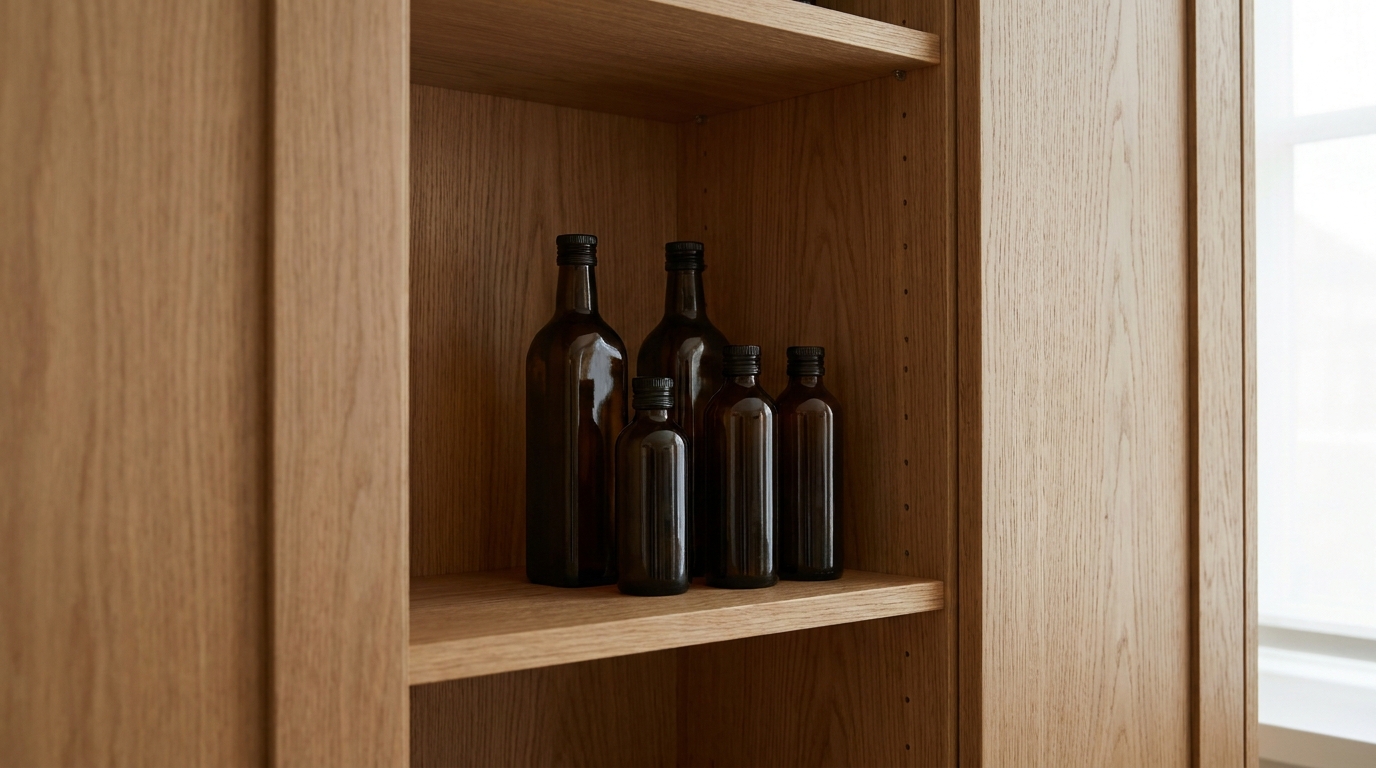
Dark glass or metal helps block light, and packaging alone cannot prove quality [1]. The Pacific Northwest bulletin says air and light change the flavor and color of food, and that light through clear packaging makes flavors deteriorate faster [4]. Keep a clear bottle in the closed pantry with the cap on after each pour [1][2]. Penn State gives almond, walnut, sesame, and hazelnut oils a shorter life than ordinary vegetable oil [6].
Write an open date on the cap and finish the older bottle first. North Dakota State suggests dating packages and using older food first, and Clemson calls that first in, first out [5][3].
Refrigeration is optional, and the pages do not agree. Penn State's 2024 guide says the fridge can extend oil life, though some oils cloud and then clear as they warm [6]. UC Davis says chilled olive oil may cloud or partly solidify, which does not prove purity, and still points cooks to a cool, dark cabinet [1]. Kansas State and North Dakota State print "refrigeration not needed" beside vegetable oil, while the Pacific Northwest bulletin says refrigeration extends shelf life [2][5][4].
5. Vinegar on that shelf, with its own rules
Vinegar can leave the warm wall with the oil, but the charts do not give it the oil's short opened window.
Kansas State's June 2026 chart lists vinegar at 2 years, tightly covered, and says a slight cloud does not affect quality [2]. It does not split opened from unopened. The March 2023 Pacific Northwest bulletin does: 2 years unopened, 12 months opened, tightly covered, and a slight cloud is not a quality failure [4]. North Dakota State's January 2023 guide matches those times and says distilled vinegar keeps longer than cider vinegar [5].
Virginia Tech's October 2025 chart lists vinegar at 2 years in the pantry, with no opened mark on that row [7]. Clemson's 2020 chart groups Tabasco, vinegar, and Worcestershire sauce at 30 months instead of giving vinegar its own line [3]. That 30-month figure is for the group, on a 2020 South Carolina chart [3].
Keep every vinegar cap tight [2][4][5]. Oil and vinegar can share the cool shelf in separate closed bottles. Do not bury them in the flour drawer or the spice pull-out.
6. A shelf you will actually use
Put the shelf inside the pantry, or in a cabinet that does not share a wall with the range, and shut the door. Cupboard guidance in the March 2023 Pacific Northwest bulletin is a temperature below 85°F, with 50°F to 70°F as the optimum, and cabinets away from the oven, stove, hot pipes, and refrigerator exhaust [4].
Keep the bottles in one row so you can see which one to use first. Kansas State's June 2026 guide says to buy only what you will use, and to use the oldest food first [2]. Keep cleaners off that shelf. The same guide says to store food away from chemicals so the food is not contaminated [2].
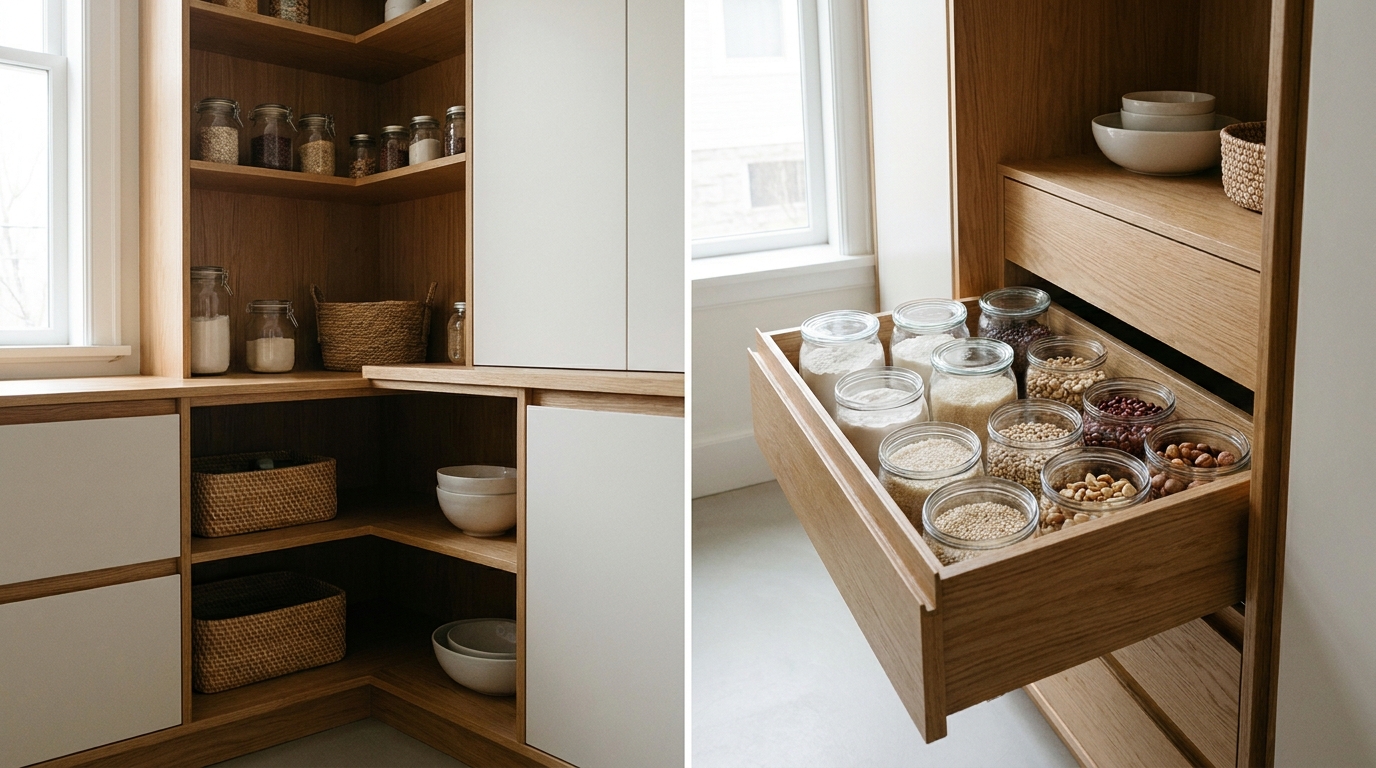
A shallow shelf is enough in many pantries, and a pull-out tray helps when bottles disappear at the back. Adjustable shelves and pull-outs are how we keep jars reachable, with oil and vinegar in their own zone.
The same idea fits a reach-in. Use a closed cabinet on a cool wall, sized to the bottles you buy, and leave the range wall for tools that are not food. That is as true for a walk-in in Charlotte as for a smaller pantry in Fort Mill or Rock Hill.
Practical takeaways
- Leave the range wall. Store oil in a cool, dark cabinet away from the stove [1][3][4].
- Close and shade the bottle. Cap it after each pour. Dark glass or metal helps, and a clear bottle belongs behind a closed door [1][2][4].
- Do not force one shelf life. Opened vegetable oil runs from 1 to 3 months to 1 to 6 months across these guides, with several charts at 3 to 5 months opened [6][2][4][5][7]. Open olive oil is weeks or a few months [1].
- Date the cap and use the older bottle. That is first in, first out [3][5].
- Time vinegar apart from oil. Kansas State in 2026 and Virginia Tech in 2025 list 2 years [2][7]. The March 2023 Pacific Northwest bulletin and North Dakota State's January 2023 guide list 12 months once opened [4][5].
- If it smells wrong, stop. A stale smell, or a smell like play dough, means the oil is past cooking use [1][6].
How we can help
A custom pantry can give those bottles a cool, closed shelf away from the range, separate from the flour drawer and the spice pull-out. See how we plan custom pantries for kitchens in the Charlotte area. Have more questions or want to get in touch? Call (704) 604-3870, email design@theclosetrehab.com, or use our contact page.
Citations
- UC Davis, "Olive and Avocado Oil" (2026)
- Kansas State University Research and Extension, "Safe Food Storage: The Cupboard" (June 2026)
- Clemson University Cooperative Extension, "Food Storage: Pantry" (2020-03-27)
- Pacific Northwest Extension (University of Idaho, Oregon State University, and Washington State University), "Storing Food for Safety and Quality" (revised March 2023)
- North Dakota State University Extension, "Food Storage Guide Answers the Question . . ." (reviewed January 2023)
- Penn State Extension, "Storing Staple Ingredients in the Kitchen" (2024-08-09)
- Virginia Cooperative Extension, Virginia Tech, "Food Storage Guidelines For Consumers" (revised October 2025)
- UC Davis Magazine, "How to Choose the Best Olive Oil" (2016-11-30)