Custom Cabinetry for Wine: Bottles Sideways, Off Heat
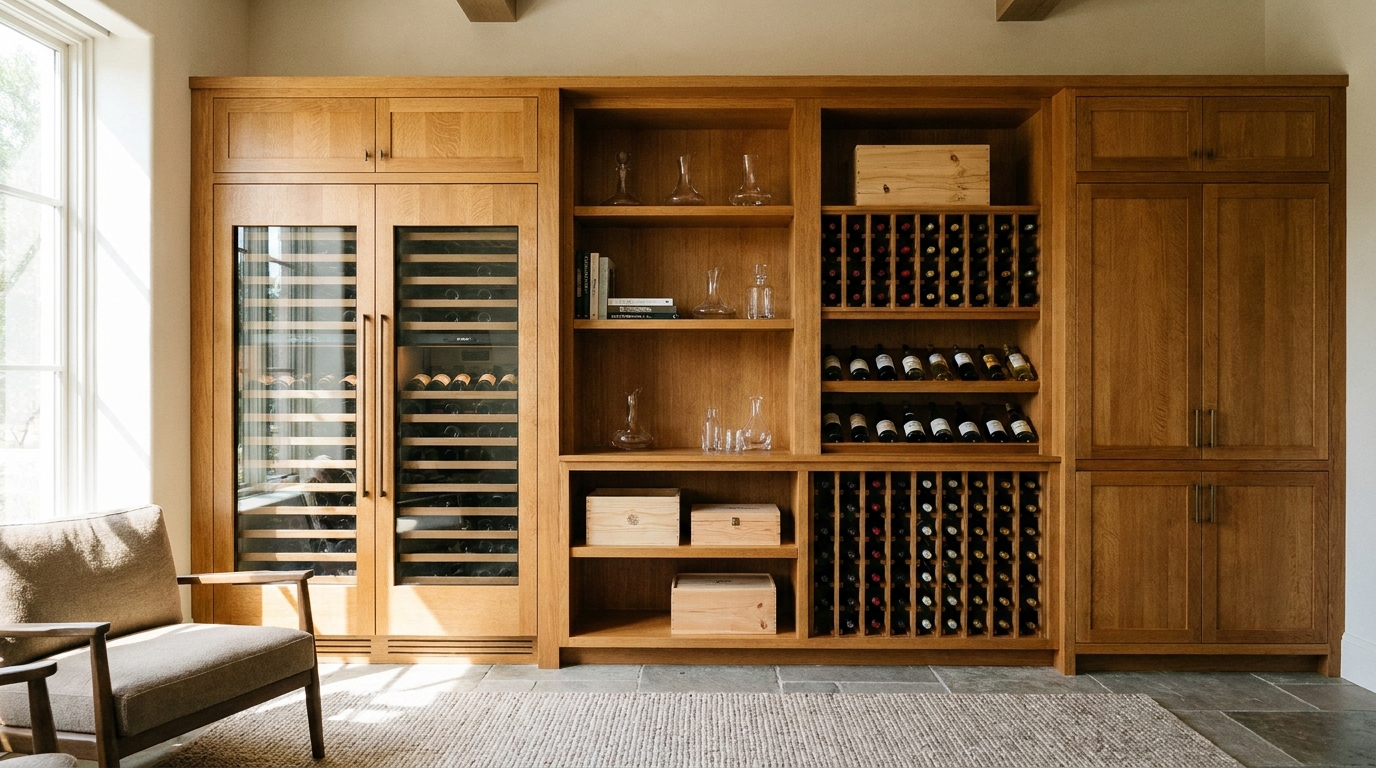
Wine that lives in a dining room or a living room needs a quiet cabinet, not a rack beside the range. Custom cabinetry can hold bottles on their side, with stemware on a shelf you can reach, as long as the rack stays off the oven, off the dishwasher, and out of direct sun. The Australian Wine Research Institute still quotes a 1986 recommendation to store bottled wine with the cork in contact with the wine. [1] A butler's pantry, built for serving pieces and a pass-through work bay, is a different project.
1. Keep the rack off the heat
Heat changes wine faster than a pretty shelf can fix. Purdue Extension's 2010 wine storage guide says wines have traditionally been held at cellar temperatures of 10 to 16°C (50 to 60°F), and that any temperature above 16°C (60°F) speeds maturation and can shorten life, especially for whites. [2] That same 2010 guide says temperatures above 24°C (75°F) age most wines in a way it calls untypical, and that wine should never see even a short exposure at 30°C (86°F) or above. [2]
The Australian Wine Research Institute's transport and storage page draws the limit from older studies, and the years belong in the sentence. Marais, in 1986, saw faulty flavours and a drop in overall quality after 12 months at 30°C. [1] Ough's 1992 guidance, as that page quotes it, is that a place above 25°C for long periods, or above 40°C for short periods, can affect quality, and that temperatures above 40°C can change how a wine looks and tastes in a matter of days. [1]
Swings are their own problem. Purdue's 2010 guide says temperature fluctuations test the closure, especially a cork, and can let air into the bottle, with rapid spoilage after that. [2] The AWRI page says day-to-night thermal cycling should be avoided. [1] It also says heat well above the surrounding air can move a cork or cause a leak, and that this physical damage does not always mean the wine itself is ruined, though the bottle no longer looks right to serve. [1]
That is why we will not hang a bottle rack on the wall beside the oven, above the dishwasher, or in a window that takes the afternoon sun. Those are the spots that spike when an appliance runs or when the light hits the glass. We are not quoting a measured temperature for your kitchen. We are keeping bottles out of the places most likely to leave the ranges those pages name.
Custom cabinetry does not cool a hot wall. If the room runs hot, the honest answer may be a different wall, fewer bottles, or a cooled unit you already trust, housed where the sun does not land on the glass.
A 2021 study in the journal Molecules followed one German Riesling for two years at about 15°C and about 25°C, set up as a cellar versus a residential room. [5] The evolution of primary and secondary aromas, color, and low-molecular-weight sulfur compounds depended mainly on storage temperature. [5] The authors note that people often keep wine in rooms above 20°C, and that higher temperatures speed chemical reactions and development in the bottle. [5] After six months, the warm bottles with a low sulfur dioxide level were more oxidized than the medium and high sulfur dioxide bottles held at the same warm temperature, and a similar pattern showed up in the cool storage as well. [5]
That is one wine and one set of stoppers, not a verdict on every bottle in a Charlotte sideboard. It is still a plain reason to keep a long-term rack off a hot wall.
In Charlotte, Ballantyne, Waxhaw, and Wesley Chapel, and across the line in Fort Mill, Indian Land, and Rock Hill, a west window and a nearby range are the two spots we refuse for bottles you hope to keep. An interior wall in the shade is the one we look for first. An unconditioned garage that heats with the afternoon gets the same refusal.
2. Lay cork-finished bottles on their side
Sideways is the position the guides name for corks. Purdue's 2010 guide says bottles closed with corks, whether bark or synthetic, should be stored upside down or sideways. [2] The reason it gives is to limit gas exchange with the outside air and to avoid faster oxidation. [2] The AWRI page repeats the 1986 recommendation that the cork stay in contact with the wine, in a cool range of 15 to 20°C, in a location those authors called dry. [1]
Angle is not the whole story, and the same AWRI page says so. Mas and colleagues, in a 2002 study the page summarizes, found that after 24 months upright bottles had more yellow-brown color than horizontal ones, but the difference was not significant. [1] Oxidation was higher for upright bottles sealed with agglomerated cork, with higher acetaldehyde in the white wine from the three-month point onward. [1] Skouroumounis and colleagues, in a 2005 study the page summarizes, found that horizontal versus upright storage had little effect on the chemistry or the sensory character of a Riesling and a wooded Chardonnay across 60 months. [1]
We still build the rack so a cork-finished bottle lies on its side. That matches the contact recommendation and the Purdue position rule. We do not tell you that a week standing on the counter will spoil a bottle. The later work AWRI summarizes did not show a large difference from angle alone.
Screw caps sit outside that Purdue sentence. Heat, light, and big temperature swings do more of the damage than bottle angle, which is why the wall comes before the slot. The 2010 guide does not give them a separate position rule, so we will not invent one. A mixed collection usually includes corks, and the sideways slot is the one we build.
Glasses do not belong in the bottle row. Everyday stems and tumblers go on a lower shelf or a side shelf, where you can take one without sliding a bottle. The bottles stay still. That is our layout, not a study. We size each opening to the bottles you actually keep, rather than forcing one depth on every shape.
3. Block direct sun, and do not fear every lamp the same way
Close, strong light can mark a white wine, and clear glass is the weak case. A 2005 technical note from the Australian Wine Research Institute reports a 1989 trial by Dozon and Noble. Still and sparkling white wines in clear glass developed a statistically significant lightstruck flavor after 3.3 hours and 3.4 hours under fluorescent lamps. [3] The same wines in green glass took 31.1 hours for the still wine and 18 hours for the sparkling wine. [3]
Those bottles sat 35 cm from two 40-watt fluorescent lamps. [3] The note says wine stored farther from the lamps, as in most winery and retail settings, gets significantly less light than that trial, and that sunlight in a window display is likely to do more harm than electric lighting. [3]
A July 2018 AWRI column puts a number on the window. Sunlight through glass is about 200 times brighter than the lighting in a well-lit room, citing a 2007 indoor-light study, and sunlight on bottled wine is more damaging than ordinary electric light. [4] The column describes lightstruck aroma, often cooked cabbage, wet wool, or a soy-like note, as a fault in white wines and especially in sparkling wines that have seen light. [4] It also says red wines carry high levels of procyanidins that absorb ultraviolet light, which helps keep that particular fault from forming. [4]
Do not read that as a free pass for a red wine in a sunny window. Purdue's 2010 guide still treats excessive ultraviolet light as something to avoid for storage in general. [2]
Steady and shaded is the ageability condition Purdue actually states. If storage avoids excessive ultraviolet light and holds a constant temperature, within about 1 to 1.5°C or about 2 to 3°F, and stays in the ranges in that guide, typical white table wines should hold their quality for about three years after bottling. [2] Red table wines, depending on style, may hold or improve for about three to 10 years. [2]
The guide calls these very general figures. Some wines are made to be drunk in their first year, and others can age for decades. A cabinet does not change which bottle you bought.
A door, or a wall that never sees the sun, is the practical answer. We use a solid door, a tinted door, or a shelf set back from the glass. We do not line clear bottles up in a west-facing glass front and call it storage.
A light you switch on while you choose a bottle, then leave off, is a design choice. The pages we cite are about sunlight and about close, long fluorescent exposure, not about a lamp used for a minute at dinner. [3]
4. Humidity and the refrigerator, without a fake percentage
Dry air can trouble a natural cork, and these pages do not hand us one target number. The AWRI transport page says wines under natural closures can dry out and leak if the air is too dry, and that most storage facilities do not adjust humidity. [1] The 1986 line on that same page also calls the spot "dry," which sits beside the warning about air that is too dry. [1] We treat that as a caution, not as a dining-room setpoint.
The 2005 note recommends storage that limits swings in both temperature and humidity. [3] We will not print a humidity percent these sources do not give us.
The kitchen refrigerator is for chilling a bottle you will open, not for a collection you hope to keep. Purdue's 2010 guide says storage below 10°C (50°F) may keep a wine from developing its full aroma and flavor. [2] It says an hour at 0°C (32°F) or below can throw tartrate crystals, which the guide calls only a visual defect, though people may confuse them with broken glass. [2] It also says wines at or below 14 percent alcohol can start to freeze below -5°C (23°F), pushing corks out and eventually breaking bottles. [2]
Pull one bottle to chill before dinner. Leave the rest in the cabinet, if the cabinet's wall is the steady one.
You may hear that a refrigerator compressor shakes wine until it is ruined. The 2005 AWRI note says prolonged refrigerator storage is believed by some to be harmful because of compressor vibration, and that the institute could not find literature on the subject. [3] We will not repeat that vibration claim as a fact. The reason we keep a collection out of the fridge is the cold Purdue describes, not a shaking story.
5. Give the bottles a still shelf and the glasses their own
A wine wall is a short list of parts, sized to what you own. The list is our layout, not a set of lab dimensions.
- Sideways slots for cork-finished bottles, deep enough for the bottles you keep, with a stop so one cannot roll forward when you pull its neighbor.
- A separate shelf for stems and everyday tumblers, lower or to the side, so dinner does not start by shifting the wine.
- A shaded or solid front on any run that faces a window.
- Clearance from the range, the dishwasher, and any vent that blows heat across the cabinet.
- A way to take one bottle without restacking the row. If the collection is large, we name the bays on the drawing so you are not hunting in the dark.
This kind of custom cabinetry follows the object, the way a pantry follows the boxes and a closet follows the clothes. The opening is cut for the bottle you use. We do not publish a universal slot depth and call it research.
If you already own a cooled wine unit, a housing around it is a different brief, and we will say so before we draw it. We will not pretend a wood cabinet on a dining-room wall holds the traditional cellar temperature of about 13°C (55°F) that Purdue's 2010 guide names, unless the room itself is already in that band. [2]
6. Decide the wall before you draw the cabinet
The first question on a design visit is whether the wall is a storage wall or a hot wall. We look at the window, the range, and the vent, and we ask which bottles are for this month and which ones you hope to keep. The in-home visit is free, with no obligation. From those measurements we draw the cabinet before anything is built, and installation is typically finished in a single day.
If what you actually need is a pass-through for platters, a landing for glassware, and a work surface between kitchen and dining room, say that. That is the butler's pantry, and we will design it as its own project rather than squeezing a wine rack into a work bay that runs warm. Custom cabinetry for wine is the quieter piece: bottles on their side, glasses within reach, heat and sun kept off the rack.
Practical takeaways
- Choose the wall before the rack. Purdue's 2010 long-term range is 10 to 16°C (50 to 60°F), and even a short exposure at 30°C (86°F) or above is outside what that guide allows. [2]
- Keep cork-finished bottles on their side. Purdue's 2010 guide says bark and synthetic corks should be upside down or sideways to limit gas exchange. [2] The AWRI page still quotes the 1986 advice to keep the cork in contact with the wine. [1]
- Do not expect angle to save a hot bottle. A 2005 study summarized by AWRI found little chemical or sensory difference between upright and horizontal storage across 60 months. [1]
- Shade the glass. A 2018 AWRI column says sunlight through a window is about 200 times brighter than a well-lit room and is harder on wine than ordinary electric light. [4]
- Chill one bottle in the refrigerator for dinner, and do not park a collection there. Storage below 10°C (50°F) is cooler than Purdue's 2010 recommended range. [2]
- Give glasses their own shelf so the bottles stay still.
- Call a butler's pantry a different project when you need a pass-through and serving pieces, not a quiet rack.
How we can help
Have more questions or want to get in touch? Tell us about the wall on our contact page, call (704) 604-3870, or email design@theclosetrehab.com. We can look at the spot during a free in-home design visit and tell you honestly whether that wall should hold wine.
Citations
- Australian Wine Research Institute, "Transport and storage" (page reviews sources through 2021; no visible updated-on line)
- Purdue Extension, "Wine Storage Guidelines, FS-58-W" (2010-03-24)
- Australian Wine Research Institute, "TN09, The effects of heat and light on wine during storage" (2005-08-01)
- Australian Wine Research Institute, "Ask the AWRI: Lightstruck character" (2018-07)
- Tarasov and colleagues, via the National Library of Medicine, "Wine Storage at Cellar vs. Room Conditions: Changes in the Aroma Composition of Riesling Wine" (2021-10-16)