Laundry Room Organization for a Dog Wash
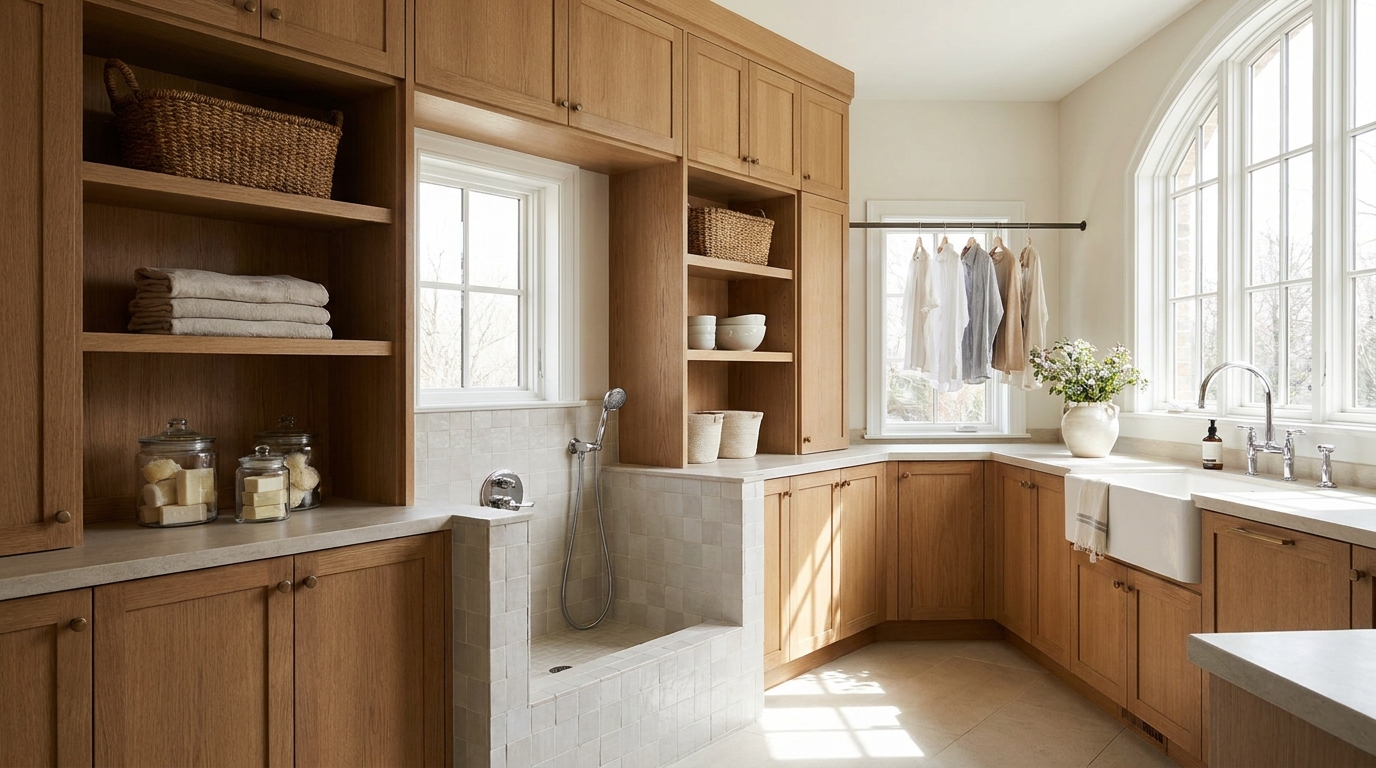
A dog wash stays under control when wet gear and dry food do not share a shelf. Laundry room organization for this bay is a short list: a hook or a ventilated shelf for wet towels, a closed cabinet for shampoo and cleaner, a hose that hangs so it can drain, and the dog's food in a dry kitchen cabinet rather than under the wash. If that laundry room cannot take repeated water, the same rules move to a garage bay. The dog wash is also a different job from a stain-soak sink, so it should not borrow that counter.
1. Set the wet zone apart from the dry work
A laundry room already has a reason to handle water. The washer, a utility sink, and the floor around them are the wet side of the house. A dog wash belongs on that side, in a bay with a way for water to leave, not on the folding counter where clean clothes land.
Give the dog a defined bay. We size that bay to the dog you actually wash and to the hose you will use. Splash stays inside the bay. Dry folding, the ironing board, and the rod for clean clothes stay outside it.
We plan the everyday sorting, folding, and hanging as its own system on our laundry room page. The dog bay is an extra wet job inside that room, or it leaves the room entirely.
The bay can stay in the laundry only when the floor, the wall finish, and the drain can take a wet dog over and over. If the room cannot take the water, we do not force the wash into it.
2. Keep the dog's food in a dry kitchen cabinet
The FDA pet-food storage page, current as of May 23, 2024, says to store dry pet food and unopened canned food in a cool and dry place, at less than 80 F, because excess heat or moisture may cause the nutrients to break down [1]. That limit is why the bag does not live under the hose.
Give the food a kitchen cabinet the dog cannot raid. If the dog is persistent or clever, that same page says to use a secure location the pet cannot access [1]. A latched kitchen cabinet does that job. An open cubby under the hose does not.
CDC's dogs page, updated June 15, 2026, says to store dog food separately from human food, and not to feed dogs where human food is prepared or eaten [2]. The pet shelf can be its own cabinet in the kitchen, not mixed into the dinner plates.
If the kibble moves into a bin, the FDA says to put the entire bag into a clean, dry container with a lid, instead of pouring the food loose, and to wash and dry the container between bags [1]. Keep the original bag so the lot number and the best-by date stay with the food. That bin belongs in the kitchen, not under the hose.
Bowls are a wet task, and the bag is not. The FDA says to wash and dry pet food bowls after each use, and to wash scoops after each use and use them only for pet food [1]. CDC's page on staying healthy around animals, updated May 4, 2026, says to keep pets and their supplies out of the kitchen, to disinfect pet supplies outside when possible, and never to clean those supplies in the kitchen sink, a food-prep area, or the bathroom sink [3].
If the laundry has a utility sink that is not a food sink, we can plan a small open shelf there for a clean bowl and a scoop. That location is our planning choice, not a spot those pages name. The food goes back to the dry cabinet when the scoop is washed.
3. Give wet towels air in the wash zone
Wet towels are the mess people try to hide, and hiding them is how they stay wet. A closed bin under the bay holds moisture against the towel and the cabinet box.
EPA's mold page, updated September 8, 2026, says the way to control indoor mold is to control moisture, and that molds can grow on virtually any substance when moisture is present, including wood, paper, carpet, and foods [4]. The same page says to clean and dry damp or wet building materials and furnishings within 24 to 48 hours to prevent mold growth [4].
Hang the towel you just used. A hook in the wash zone lets that towel drip and dry in open air. A ventilated shelf or an open rack does the same job for the extras. We leave space between towels so air can move, and we do not put a solid door on the only place a wet towel can land.
EPA also says to reduce indoor humidity to 30 to 60 percent, in part by venting dryers and other moisture sources to the outside [4]. EPA says not to install carpet where moisture is a perpetual problem, and its examples include spots by sinks and concrete floors with leaks or frequent condensation [4]. The bay floor should be a hard surface that can drain and dry. We do not run the room's carpet into the wash.
After the bath, wash your hands before you touch clean clothes or walk into the kitchen. CDC says to wash with soap and running water after handling your dog, its food, its waste, or its supplies [2]. The FDA safe-handling page, current as of May 23, 2024, says to wash hands for at least 20 seconds with soap and hot water both before and after handling pet food and treats [5]. A soap spot at the utility sink keeps that step in the wet zone.
4. Latch shampoo and cleaner up, out of reach
Shampoo, coat conditioner, and the cleaner you use on the bay are not an open display. A low ledge at the rim of the wash is an easy reach for a child and an easy nose for a dog.
The CPSC, on a page dated March 10, 2026, says medications and household cleaners should always be locked up and kept out of reach of children, because even small amounts can be dangerous [6]. That page points to locked cabinets or high shelves as the practical fix.
Put a door on the bottles. We place that cabinet up, with a latch or a lock, not as an open niche at knee height. The bottles stay upright, caps on, in the containers they came in.
The CPSC page does not name dog shampoo. We still store the shampoo with the cleaners, behind the same door, because a bright bottle on a low ledge is just as easy to grab. The food cabinet is in the kitchen, so these bottles do not share a cubby with kibble.
Detergent and stain spray can use the room's other closed cleaning storage, away from the wet-towel shelf. The dog bay needs only the bottles you use on the dog and on the bay.
5. Hang the hose so it can drain, and keep the end out of a filled basin
The hose can connect dirty wash water to the drinking water in the wall. The habit to design out is a hose left sitting in the basin.
Penn State Extension updated its foodservice water article on October 13, 2025 [7]. It describes a cross-connection as a direct link between safe and unsafe water [7]. The examples are a hose tip dropped below the water in a mop bucket, and a sprayer nozzle submerged while a sink fills [7]. A home laundry is not a restaurant, so that Food Code is not your house code.
Do not leave the hose in the filled bay. That is the same physical mistake as those examples. The page says backflow is dirty water flowing back into safe water, and that backsiphonage is a vacuum sucking those contaminants into the safe supply [7].
We hang the hose end in open air, above the basin, so it can drain. We do not coil it in the tub. We also do not build a cabinet that makes the hose lie in the bottom.
That page calls an air gap a 100 percent sure way to prevent backflow [7]. It describes an air gap as a physical space between a safe water outlet and unsafe water, such as a faucet above a sink's flood rim [7]. For those kitchens, it says Food Code rules require vacuum breakers installed by licensed or certified plumbers [7].
Colorado State University Extension, in a fact sheet first published in April 2003 and reviewed in August 2025, says a drop in city pressure, from a line break or from heavy use such as firefighting, can pull contaminants back through a hose-attached sprinkler, spray nozzle, or pesticide sprayer [8]. Atmospheric and pressure vacuum breakers on that sheet work only against back-siphonage, not against back-pressure [8].
The sheet says sprinkler attachments, spray nozzles, and other items on a hose connected to drinking water need an approved hose connection vacuum breaker, the type made for sill cocks and hose bibbs [8]. A hose-end sprayer for fertilizer or pesticide needs at least that breaker, and injecting those chemicals through the irrigation system is a higher hazard that calls for a reduced-pressure device [8].
Do not inject shampoo into the hose. Rinse water and a bottle are a simpler case than a chemical injector, but the hose still should not sit in dirty water. The sheet says backflow prevention devices are designed to keep pesticides, feces, and other hazardous materials from contaminating drinking water [8].
6. Move the bay to the garage when the laundry cannot take water
Some laundries are a closet with a stacked washer and dryer and no drain you would trust with a wet dog. Forcing a wash into that closet wets the clean clothes and the floor outside the door. The garage is the better bay when the slab or a floor drain can take the water.
Carry the same four rules outside. Wet towels get a hook or a ventilated shelf in the garage bay, not a closed cabinet. Shampoo and cleaner go in a latched cabinet, up and out of a child's reach. The hose hangs so it can drain, with the end out of any filled basin. The food stays in the kitchen.
A garage that heats up in summer is a poor food room. The FDA says dry pet food should stay in a cool and dry place at less than 80 F, because excess heat or moisture may cause the nutrients to break down [1].
The Colorado State fact sheet says backflow devices will be damaged by freezing unless they are drained of all water, and that hose connection vacuum breakers are best removed, drained, and stored for the winter [8]. Ask the plumber how the garage bibb should be winterized. We can place the hose hook where that routine is easy. We do not promise a fitting that stays full of water through a freeze.
In Charlotte and Fort Mill, the laundry sometimes already has the sink and a floor that can take splash, so the bay stays indoors. In Ballantyne, Waxhaw, Wesley Chapel, and across the line in Rock Hill and Indian Land, the garage is often the floor that can take the water. We also plan this split in Marvin, Pineville, and Weddington when the laundry is upstairs or too finely finished for a wet dog.
The drain, the bibb, and the backflow device are the plumber's work. The cabinet, the hook, and the latched door are ours.
7. Do not treat the dog wash as a stain-soak sink
A stain-soak sink is for clothes. You fill it, leave a shirt, and come back later. A dog wash is a short rinse with a hose, a towel, and a bottle of shampoo. One basin can do only one of those jobs at a time.
Split the two jobs if the room has both. Using one basin for both puts wet dog towels on the pretreat counter and leaves soak bottles where a child or a dog can reach them. Soak supplies can live in the latched cleaning cabinet, away from the hose hook. The folding counter stays a dry surface for clean clothes.
If there is only one sink, decide which job it does today, and put the other job's tools away before you start. Do not store the food, the shampoo, and the wet towel in the same under-sink opening. That opening should get wet, drain, and dry. It is not a pantry, and it is not a hamper.
Practical takeaways
- Keep food out of the wash. The FDA says dry pet food belongs in a cool, dry place at less than 80 F, so the bag stays in a kitchen cabinet, not under the hose [1].
- Store food apart from people-food. CDC says to keep dog food separate from human food and not to feed dogs where human food is prepared or eaten [2].
- Dry towels in open air. Use a hook or a ventilated shelf, and do not shut wet towels in a closed bin. EPA ties mold control to moisture control and to drying wet materials within 24 to 48 hours [4].
- Latch the bottles. The CPSC says household cleaners should be locked up, out of a child's reach, in a locked cabinet or on a high shelf [6].
- Hang the hose so the end drains. A hose tip left below the water in a bucket or a sink is one of Penn State Extension's examples of a cross-connection [7].
- Leave the backflow device to a plumber. Colorado State University Extension says items on a hose connected to drinking water need an approved hose connection vacuum breaker, the type made for hose bibbs [8].
- Skip carpet in the bay. EPA says not to install carpet where moisture is a perpetual problem [4]. Use a hard surface that can drain.
- Move the bay to the garage when the laundry cannot take water, and still keep the food in the cool, dry kitchen cabinet.
How we can help
Our team builds the latched cabinet, the towel hook or ventilated shelf, and the hose hook as part of a custom laundry or a garage storage wall, and we keep the food cabinet in the kitchen. A free in-home design consultation is how we measure the bay and the dry storage around it. Have more questions or want to get in touch? Visit our contact page, call (704) 604-3870, or email design@theclosetrehab.com.
Citations
- U.S. Food and Drug Administration, "Proper Storage of Pet Food & Treats" (2024-05-23)
- Centers for Disease Control and Prevention, "Dogs" (2026-06-15)
- Centers for Disease Control and Prevention, "Ways to Stay Healthy Around Animals" (2026-05-04)
- U.S. Environmental Protection Agency, "What are ten things I need to know about mold?" (2026-09-08)
- U.S. Food and Drug Administration, "Tips for Safe Handling of Pet Food and Treats" (2024-05-23)
- U.S. Consumer Product Safety Commission, "Medication & Cleaner Storage Safety | Protect Children at Home" (2026-03-10)
- Penn State Extension, "Safe Water and Your Foodservice Operation" (2025-10-13)
- Colorado State University Extension, "Home Sprinkler Systems: Backflow Prevention Devices" (reviewed 2025-08; first published 2003-04)