Serving Platter Storage: On Edge in Its Own Cabinet
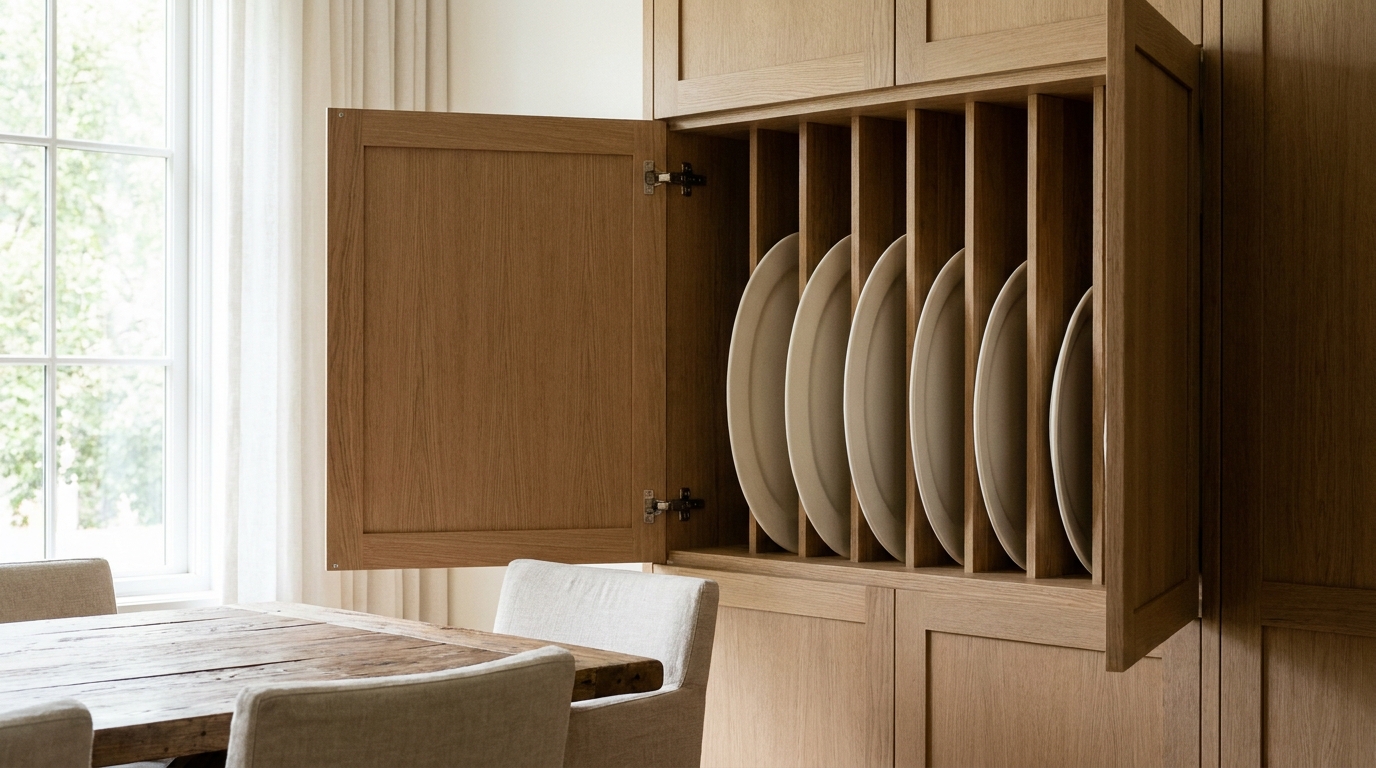
The platter that carries the turkey does not belong in the everyday hutch, and the chafing dish does not stay on the table after the meal. Oversized platters stand on edge in their own cabinet, the chafing dish and the roaster get a shelf sized to those pieces, and bulky table runners go in a separate bin. That split leaves the daily dish cabinet and the flat napkin drawer for ordinary weeknights. When guests leave, each large piece has a place you can reach without unstacking the dishes you use every week.
1. Keep hosting pieces out of the everyday hutch
The hutch is already doing another job. A Charlotte dining room often has one glass cabinet and one shallow drawer, meant for everyday plates and flat napkins. Hosting adds a different set: an oval turkey platter, a long fish platter, a chafing dish frame, a covered roaster, and a runner that spans the table. Those pieces are larger, heavier, and used on fewer days. If they live in the hutch, the daily plates stack higher, and the platter you need first is the one at the bottom.
This cabinet starts when the meal ends. During dinner the platter is on the table and the chafing dish is holding food. Afterward the food leaves those pieces, they get washed, and they go into a cabinet planned for their shape. We are not reworking the everyday dish hutch in this article, and we are not reorganizing the napkin drawer. The job is a home for the oversized serving pieces so they stop borrowing space from what you use on a weeknight.
In Fort Mill and Rock Hill, the same clash shows up the week of Thanksgiving, when the extra pieces come down from a closet or the back of the hutch.
2. Stand oversized platters on edge
A stack is how platters chip. The National Park Service Museum Handbook's 2000 appendix on ceramic, glass, and stone objects tells curators not to stack plates, cups, and bowls. If space forces a stack, it says to put soft fabric, such as washed cotton flannel, or polyethylene foam between each object, and not to put pressure on the pieces [5]. A 2019 care sheet for the Centre of Ceramic Art at York Art Gallery says over-stacking can leave the bottom two or three pieces in a very vulnerable position, and that it is better to add another shelf than to over-stack [6].
Vertical slots are that extra shelf, turned on end. Each oversized platter gets its own opening and a fixed divider, so one platter is not carrying the next. You slide one piece out without lifting the others. The Park Service says to choose shelves only deep enough for a single object when you can, so you do not move one thing to reach another, and to put the heaviest objects on the bottom shelves [5]. The 2019 sheet says each object should be safe in its own space, and that you should not have to reach over one object to get to another [6].
Size the opening to the platter you own. A handled turkey platter and a flat oval are not the same thickness. Measure the thickest point, handle or foot included, and make the slot wider than that so the glaze does not scrape the divider. Leave room to pinch the rim.
The 2019 sheet says not to pick an object up by the handle, the knob, or any weak area, and to support it from underneath [6]. A slot that makes you yank a handle has failed.
Stop the slide, and skip the spotlight. The Park Service says to store ceramics and glass on stationary shelves, to avoid damage from vibration, and to line the shelves with closed-cell polyethylene foam fixed so it will not bulge or slide [5]. We use a thin non-slip liner for the same reason. If two thin pieces must share a slot, put cloth or foam between them. That is the padding the appendix allows only when space is truly tight [5].
The same appendix says visible or ultraviolet light will not damage most ceramics, glass, and stone, but infrared can heat an object, and it says not to aim spotlights directly at the pieces [5]. A glass door that lets you see the platter is fine. A lamp aimed at the shelf is not.
Fasten the box, and store only a clean, dry platter. The 2019 sheet lists shelf collapse as a cause of breakage and says to check shelves and, if possible, attach a rack to the wall so it cannot shift [6]. We fasten the cabinet to the wall so a loaded shelf is not free to rack. The sheet also says a clean, dry place is essential for ceramics [6]. Wash the platter, dry the foot, then stand it up.
3. Give the chafing dish and the roaster their own shelf
The dish works at dinner, then comes off the table. On November 13, 2026, USDA said to keep hot food in the oven, in heated chafing dishes, on warming trays, or in slow cookers at or above 140 degrees F, because bacteria grow quickly between 40 and 140 degrees F [1]. That is the chafing dish's job while people are eating. It is not a reason to leave the frame out overnight, or to drop it onto the everyday plates.
Measure the parts you own. A chafing dish is a frame, a water pan, a food pan, and a lid. A roaster is a pan and a lid that may not nest in those pans. We measure each part with the lid on and with the lid beside the pan, then set one shelf to the tallest and deepest piece you will store.
An awkward lid stands at the back of that shelf or in a shallow upright pocket. It does not lie across the platter slots.
Keep the shelf low, and keep it dry. Empty, these pieces are still heavy, so they follow the same bottom-shelf rule as the heaviest platters [5]. You should be able to lift the frame with two hands. The shelf holds the washed dish only.
Leftovers do not go on that shelf, and neither does canned fuel. Fuel goes back to the storage its own label requires, outside this cabinet and away from the runners. Wipe the water pan and let the metal dry before the door closes. A damp roaster is how a lid sticks and a liner stains.
4. Put bulky runners in a separate bin
The napkin drawer is the wrong shape. Flat napkins and a thin cloth fold into a shallow drawer. A quilted runner and a long linen do not. Forcing them in bends the napkins and creases the runner on a hard fold. The bulky pieces get their own bin or deep bay, and the napkin drawer stays what it is.
They go in clean, dry, and able to breathe. A 2008 University of Kentucky Cooperative Extension publication on textile heirlooms, including household linens, says to clean items before storing, because a soiled textile may attract insects and set permanent stains [7]. It says humidity over 55 percent promotes mildew [7]. It also says not to wrap textiles in plastic bags, because air is cut off and moisture may condense, and that textiles sealed too tightly can pick up condensation [7].
Wash the runner after the meal, hem included, and do not bin it while a seam still feels damp. A fabric bin, a muslin cover, or an open box fits better than an airtight bag.
Keep the bin out of the glass bay. The Kentucky publication says ultraviolet light weakens fibers and fades dyes, and that a dark spot is best for storage [7]. Platters may sit behind glass. The Park Service says visible or ultraviolet light will not damage most ceramics, and it says not to keep light-sensitive objects in those glass cabinets [5]. The runner bin belongs behind a solid door or under a lid.
Follow the cloth's own label. The 2008 publication is written for heirlooms, including monogrammed linens, so its washing steps are stricter than a normal cycle on a runner you use every Thanksgiving [7]. Follow the label on your cloth. The storage rule we use is the one that publication actually states: clean, fully dry, dark enough, and not sealed up.
5. Use the two-hour window as a design test
Holding hot food and putting the dish away are two steps. USDA's November 13, 2026 guidance says to keep hot food in a heated chafing dish at or above 140 degrees F, to refrigerate perishables within 2 hours, and to discard perishable food left at room temperature for more than two hours [1]. The FSIS leftovers page, last updated July 31, 2020, says leftovers must be refrigerated within 2 hours of cooking, or after the food comes off an appliance that is keeping it warm [2]. When the pan leaves the heat, the empty frame should have a shelf you already know. You should not be searching the hutch while the food sits on the counter.
Move the food off the platter. That 2020 page says hot food can go directly into the refrigerator, or into an ice or cold water bath first [2]. You do not have to wait until the turkey feels cool. A November 20, 2025 University of Maine Cooperative Extension note says that if turkey, stuffing, casseroles, vegetables, or gravy sit at room temperature for more than two hours, bacteria can grow quickly and the food should no longer be eaten [3]. Slice the turkey into smaller pieces, use shallow containers so it cools evenly, set the refrigerator at 40 degrees or below, and leave space so air can move between containers [3].
A hot room shortens the time food may sit out. A November 6, 2024 N.C. Cooperative Extension note, from NC State University's Safe Plates program, says to refrigerate perishables within two hours, with the clock starting when the food is set out [4]. Above 90 degrees F, in a warm kitchen or outdoors, that note says to aim for one hour [4]. That one-hour aim is for food sitting in the heat. It does not replace the USDA instruction to hold hot food in a heated chafing dish at or above 140 degrees F while you are serving [1].
The meal goes in the refrigerator. The dishes go in the cabinet. Divide large portions into smaller containers for quicker cooling, which USDA listed on November 13, 2026 [1]. The North Carolina note says to use shallow, airtight containers [4]. Most Thanksgiving leftovers can stay refrigerated for three to four days, while gravy should be used within one to two days, according to the 2025 Maine note [3]. Reheat leftovers to 165 degrees F before serving [1].
The platter cabinet holds the clean dishes, not that food. If the chafing dish or the platter is hard to reach, the food waits on the table while the time limit keeps running.
6. Measure the pieces, then draw the cabinet
Start with the pieces, not a stock layout. We set the platters, chafing parts, roaster, and bulky runners on the table and measure them as they will be stored. Handles, lids, and feet change the slot and the shelf. A once-a-year piece still counts if you are keeping it. The 2019 ceramic sheet says shelving and shelf depth should suit the objects [6].
Three zones, near the table, in a dry room. The lower run is vertical slots, with the heaviest platters on the bottom [5]. One shelf is only for the chafing dish and the roaster, empty and dry. One solid-door bay or bin is for runners, not in the glass bay with the platters [5][7]. A platter that stands past the shelf will hit the door, so the slots sit back or the door clears that edge.
In a Charlotte home the cabinet might be a pantry bay, a dining-room piece, or the closed side of a butler's pantry. The 2008 Kentucky publication says to avoid basements and other places with high humidity and poor air circulation [7].
What we install. Our team draws those zones around your pieces and installs the cabinet so the shelves are fixed and the box and the wall carry the weight. Bring the pieces, or a careful list of them. We will not guess sizes from a photo of a set table.
Practical takeaways
- One platter per slot, heaviest low. The 2000 Park Service appendix says not to stack plates, and to keep the heaviest objects on the bottom shelves [5].
- Lift the body, not the handle. The 2019 ceramic sheet says not to pick a piece up by the handle, knob, or a weak spot [6].
- Give the chafing dish and roaster their own dry shelf. USDA's November 13, 2026 guidance holds hot food in a heated chafing dish at or above 140 degrees F [1]. After dinner, store the empty dish, not the fuel and not the leftovers.
- Refrigerate when food leaves the heat. The July 31, 2020 FSIS page says hot food can go straight into the refrigerator, within 2 hours of cooking or of leaving a warming appliance [2]. Above 90 degrees F, the 2024 North Carolina note says to aim for one hour if the food is sitting out [4].
- Bin runners only when clean, dry, and unsealed. A 2008 Kentucky publication says soiled textiles can set stains, humidity over 55 percent promotes mildew, and plastic bags can trap moisture [7].
- Cool the meal in the refrigerator. Shallow containers, a fridge at 40 degrees or below, and air between containers are the 2025 Maine method [3]. Reheat leftovers to 165 degrees F [1].
How we can help
Have more questions or want to get in touch? We design and install cabinet storage for the oversized platters, chafing dishes, roasters, and bulky runners that come out when you host, for homes in Charlotte, Fort Mill, and Rock Hill. Tell us which pieces you need to put away when the meal is over. Reach us through our contact page. Phone (704) 604-3870. Email design@theclosetrehab.com.
Citations
- U.S. Department of Agriculture, "The Recipe for a Safe Thanksgiving" (2026-11-13)
- USDA Food Safety and Inspection Service, "Leftovers and Food Safety" (2020-07-31)
- University of Maine, "Tips for safely storing Thanksgiving leftovers" (2025-11-20)
- N.C. Cooperative Extension, "Enjoy Your Thanksgiving Leftovers Safely" (2024-11-06)
- National Park Service, "Appendix P: Curatorial Care of Ceramic, Glass, and Stone Objects" (2000)
- York Art Gallery, Centre of Ceramic Art, "CoCA Resource: Care of Ceramics" (2019)
- University of Kentucky Cooperative Extension, "Caring for Your Textile Heirlooms" (2008)