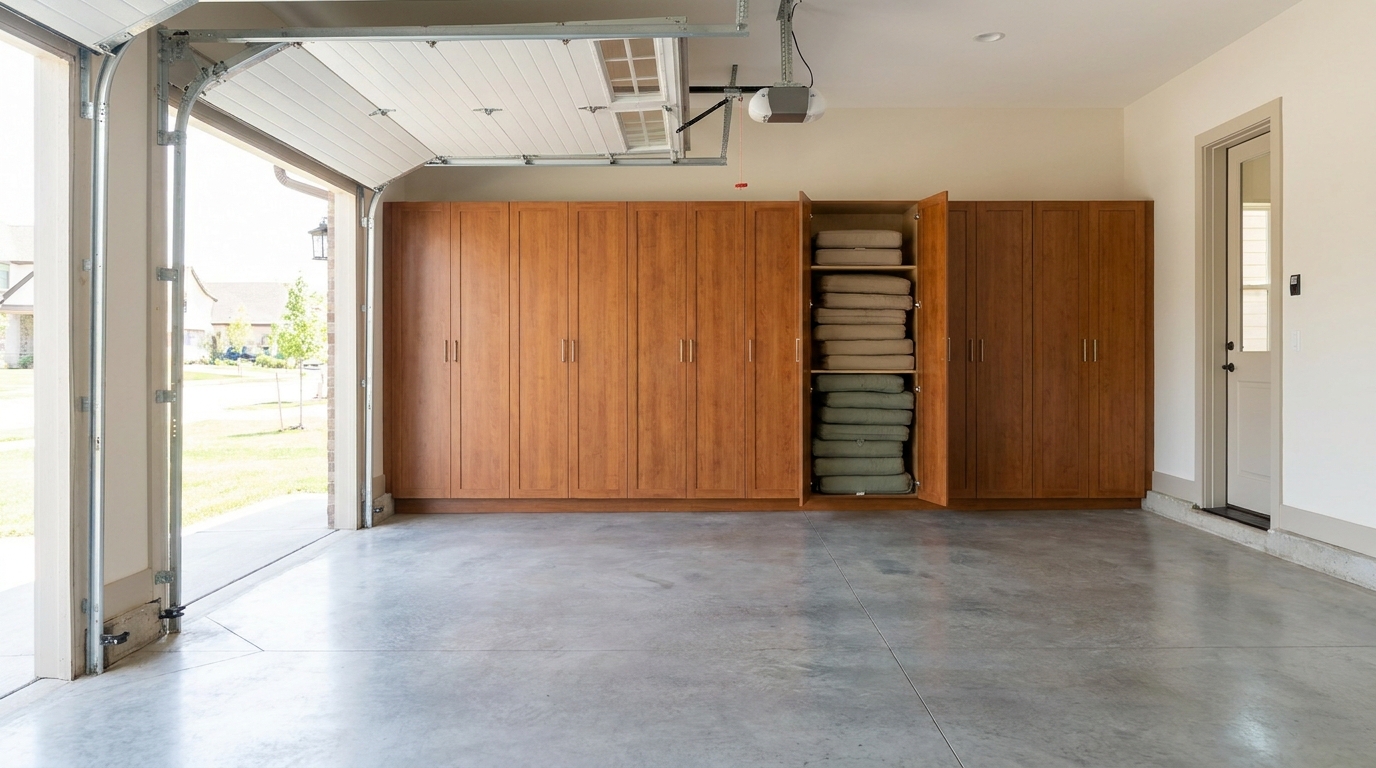
Garage Organization That Keeps the Extinguisher in Reach
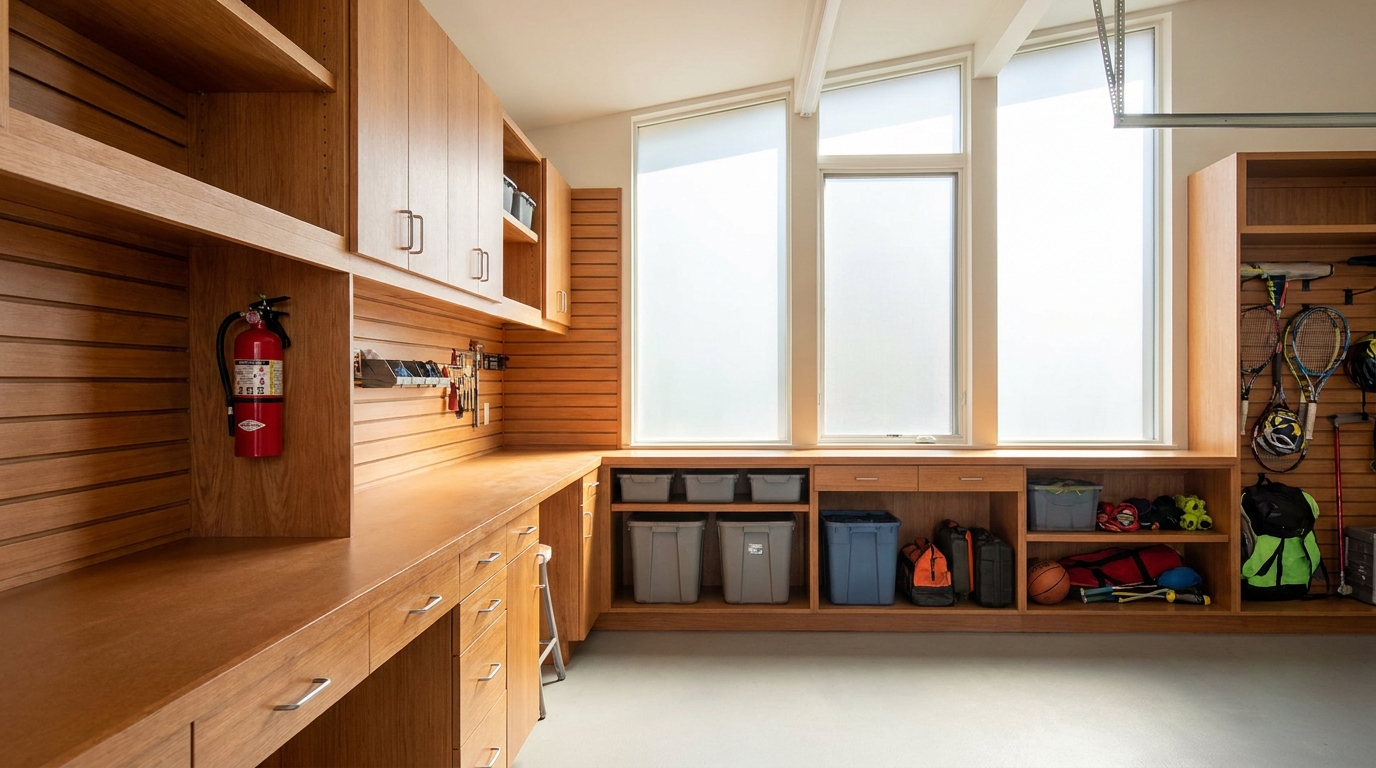
A finished cabinet wall can still leave the fire extinguisher behind a door, behind a bin, or behind the open door of a parked car. Garage organization has to reserve a mount, clear space in front of it, and a path a cabinet door does not cover. The National Fire Protection Association's home guidance says to install fire extinguishers close to an exit and to keep your back to a clear exit when you use one, so you can get out if the fire cannot be controlled [3]. We mark that spot before the cabinet layout is locked, and we follow the instructions that came with the extinguisher you already have.
1. Pick the spot before the cabinet line is drawn
The order of the drawing is the decision. If the cabinets are locked first, the extinguisher gets whatever gap is left, often a corner you cannot see from the doorway or a slice of wall a tall door crosses when it opens. We start at the way out.
On garage visits in Charlotte, Fort Mill, and Rock Hill, we stand at the door into the house and at the door to the driveway. We ask which one people would actually use if they needed to leave. The mount belongs on that path, where a person can take the extinguisher without walking deeper into the garage.
The NFPA home page says extinguishers are one element of a fire response plan, but the primary element is safe escape, and the first priority is to get out safely because fire grows and spreads so rapidly [3]. A December 2024 NFPA fact sheet for code officials says extinguishers should be readily accessible, which typically includes normal paths of travel, and that they are not a substitute for evacuating safely and quickly [7]. That sheet lists single-family homes and two-family homes among occupancies where extinguishers are not required [7]. We are placing the unit a household already keeps, not claiming that a house code forces you to hang one.
The U.S. Fire Administration page on choosing and using fire extinguishers, last reviewed April 1, 2023, says to be sure nothing is blocking or limiting the ability to reach the extinguisher [1]. A cabinet door counts. So does a bin parked in front of the bracket, or a bike that has to move before a hand can close on the handle.
University of Illinois Extension's kitchen fires page says to install fire extinguishers close to exits, and to keep them at least 30 feet from the stove if possible [4]. That distance is about a stove, not a garage stall, and we do not copy it onto a parking bay. The same page says not to store the extinguisher in a cabinet or a hard-to-reach place in the kitchen, because in an emergency it should be easy to grab [4]. We keep the garage cylinder on the open wall, not inside a cabinet and not in a fuel locker.
The U.S. Fire Administration garage page, also last reviewed April 1, 2023, says to store oil, gasoline, paints, propane, and varnishes in a shed away from the home [2]. The extinguisher does not belong locked in with those products. The mount stays on the path out.
A parked car is the other cover people forget. We open the door of the stall the family actually uses, and if that door swings across the bracket, the bracket moves. No page we used prints a measurement from a car door to an extinguisher, so we do not invent one.
2. Keep the way out behind the person holding it
You should be able to take the extinguisher while the exit stays behind you. The NFPA home page says to use a portable extinguisher when the fire is confined to a small area, such as a wastebasket, and is not growing, when everyone has exited, when the fire department has been called or is being called, and when the room is not filled with smoke [3]. If the room fills with smoke, that page says to leave immediately [3].
The U.S. Fire Administration page last reviewed April 1, 2023 says to use an extinguisher only when every answer is yes: others have been alerted, someone has called the fire department, the person is physically able, the fire is small and contained in one object or on one surface such as a pan or a wastebasket, the person is safe from toxic smoke, and there is a clear escape route [1]. That page says young children and older adults should not use fire extinguishers [1]. If you are unsure, alert others, leave, and call 911 from a mobile phone or a neighbor's phone [1].
The American Red Cross page, which carries a 2026 copyright, says to be sure everyone has left or is leaving, the fire department has been called, the fire is small and not spreading, your back is to an exit, and there is not much smoke [5]. If the fire does not immediately die down, drop the extinguisher and get out [5]. Most portable extinguishers empty in 8 seconds, which is a poor moment to be opening a cabinet [5]. The Texas Department of Insurance page, last updated August 13, 2025, says to limit use to a small fire, about the size of a small trash can, that is contained and not growing, and to call the fire department if there is any doubt [6].
Garages earn the extra care. The U.S. Fire Administration basement and garage page, last reviewed April 1, 2023, says these spaces carry added risk because flammable liquids, stored combustibles, gas appliances, and electrical tools can lead to fires [2]. The same page says garage fires tend to spread farther and cause more injuries and dollar loss than fires that start in all other areas of the home, citing the National Fire Incident Reporting System, and it does not print the year of that comparison [2].
That page also lists a 20-minute fire-rated door that is self-closing and self-latching from the garage into the house [2]. We do not build that door. We do test the wall beside the door you already use before we promise an unbroken cabinet run.
3. Match the label to this garage, then follow the maker
The U.S. Fire Administration describes five primary types [1]. Class A is cloth, wood, and paper, Class B is combustible and flammable liquids such as grease, gasoline, oil, and oil-based paints, and Class C is plugged-in electrical equipment, using an agent that does not conduct electricity [1]. Classes A, B, and C are the ones that page says are often found in homes and businesses, while Class D (flammable metals) is often found in factories and Class K (cooking oils and fats) is often found in commercial kitchens [1].
Multipurpose extinguishers labeled B-C or A-B-C can be used on most types of home fires, and most home improvement stores carry units that cover Class A through Class C [1]. Look for a UL Listed or ULC Listed label [1]. The NFPA home page asks for the label of an independent testing laboratory [3]. Illinois Extension adds that a Class A-only extinguisher will not work on a grease fire, and that the seal is often a UL label [4].
The pages do not all say the same thing about size, and we do not flatten them into one cabinet rule. The U.S. Fire Administration says to select the largest extinguisher a user can safely and comfortably operate [1]. The NFPA home page says it should be large enough for a small fire but not so heavy that it is hard to handle [3]. Illinois Extension says a 5-pound extinguisher is generally recommended for home use, and we do not turn that suggestion into a slot width [4].
Read the instructions before a fire [3]. The Red Cross says manufacturers do not all work the same way, there is no time to read directions in an emergency, and only adults should use extinguishers [5]. Get that training from the fire department or a manufacturer [5]. The NFPA home page says children should not be trained to operate them, and that only adults who know how should use them [3].
The Texas page says the extinguisher is not a toy [6]. Many models are one-time use and cannot be recharged [5]. You can recharge some units, and others need to be replaced if the pressure is too low [1]. Follow the manufacturer's instructions either way [5].
4. Leave a reach that a door cannot cover
The Red Cross says to install extinguishers high on the wall, near an exit, and away from heat sources, easy for trained adults to reach and kept away from children's hands [5]. Heat may make the contents less effective or cause the extinguisher to lose its charge more quickly [5]. "High on the wall" is that page's phrase, and we do not turn it into inches.
The December 2024 NFPA fact sheet prints mounting heights in the installation rules it summarizes, and it puts one- and two-family homes in the not-required column [7]. Those heights are not a home rule we copy onto a garage wall. If the adult who would use the unit cannot reach the bracket, the next conversation is with the local fire department.
We swing every cabinet door that can reach the mount. Fully open, that door must not cover the cylinder, the gauge, or the hand space in front of the handle. We size the gap to the box you use, because no page we read prints a universal slot width. A rack or a bin in that reach is a block, and nothing should block or limit the ability to reach the extinguisher [1].
If a visual obstruction cannot be avoided, the December 2024 sheet says arrows, lights, or signs are needed, though a sign is not a reason to leave the unit at the back of the garage [7]. Keep the bracket off a heater, because heat may make the contents less effective or cause the extinguisher to lose its charge more quickly [5]. Wipe dust, oil, or grease off the outside of the extinguisher [1]. Do not put the mount under a drip from a parked car.
5. Make the monthly look possible without unpacking the wall
A mount you cannot inspect is only half a mount. The U.S. Fire Administration says to check easy access, pressure, working parts, and cleanliness [1]. Many gauges show when pressure is too high or too low, and the can, hoses, and nozzles should not be damaged, dented, or rusted [1]. Some units need a monthly shake, and others need a pressure test every few years, so follow the guidelines on that unit [1].
Illinois Extension says to inspect once a month: gauge in a safe range, hoses and nozzles free of damage, rust, or dents, outside wiped clean, and the cylinder lifted because a light one may be leaking [4]. Shake chemical extinguishers monthly, read the label on the extinguisher, and check the label or tag for an expiration date [4]. That page says that, according to National Fire Protection Association standards, rechargeable fire extinguishers are good for 6 years, and disposable fire extinguishers are good for 12 years [4]. If your label disagrees with those spans, the label wins.
The Red Cross says to use the gauge or the test button, because an extinguisher will not work properly if it is not charged, and to replace it or have it serviced if it is low, damaged, or corroded [5]. The Texas Department of Insurance page, last updated August 13, 2025, adds a monthly check that the unit is fully charged, undamaged, and free of a blocked nozzle, plus yearly service by an SFMO-licensed company [6]. That license line is Texas wording, not a rule we import for Fort Mill or Indian Land. For training or questions, the U.S. Fire Administration points people to their fire department [1].
The gauge, the pin, and the nozzle have to be readable without moving a bin, a bike, or a door. Clear space in front of the mount is what makes that check a glance.
6. Stop the cabinet run where the mount begins
This is the part our team draws. On garage storage projects, the extinguisher bay is a reserved piece of wall, not a leftover. Tall cabinets, a workbench, and overhead racks can still fill the rest of the garage. They stop where the hand needs to go.
We measure the cylinder and the bracket you already own, and we size the opening to that box, including the nearest door swing. If you are still choosing an extinguisher, we wait until you and your fire department agree on it. We do not pick a pound size in a design meeting and call it a safety rule.
The same gap shows up in Waxhaw, Wesley Chapel, Indian Land, and Ballantyne, and on narrower walls in Pineville, Marvin, and Weddington. A free in-home design consultation is how we see the door, the car, and the cylinder together. Professional installation then builds that run, with the gap left open.
Practical takeaways
- Mark the mount before the cabinets. Put it on the path out, close to an exit, with the way out behind you [3][7].
- Keep it out of a closed cabinet and out of the fuel locker. A kitchen page says not to store an extinguisher in a cabinet or a hard-to-reach place in the kitchen, and the garage page says to keep oil, gasoline, paints, propane, and varnishes in a shed away from the home [2][4].
- Test both doors. If an open cabinet door or an open car door covers the bracket, move the mount. The car-door test is our practice, not a published distance.
- Match the label to the garage. Look for a multipurpose A-B-C unit with a UL Listed or ULC Listed label, in a size the adult who would use it can handle [1][3].
- Leave the gauge visible. Nothing should block the reach, and the monthly look at pressure, damage, and the nozzle should not mean unpacking the wall [1][6].
- Get people out first. Use an extinguisher only for a small fire that is not growing, with everyone leaving, the fire department called, little smoke, and a clear exit at your back [1][3][5].
How we can help
Have more questions or want to get in touch? Call (704) 604-3870. You can also email design@theclosetrehab.com or visit our contact page. We will look at the garage with you, reserve the extinguisher mount before the cabinet run is drawn, and build the storage around a reach you can actually use.
Citations
- U.S. Fire Administration, "Choosing and Using Fire Extinguishers" (2023-04-01)
- U.S. Fire Administration, "Basement and Garage Fire Safety" (2023-04-01)
- National Fire Protection Association, "Fire extinguishers" (undated)
- University of Illinois Extension, "Kitchen Fires" (2025-03)
- American Red Cross, "Fire Safety Equipment" (2026)
- Texas Department of Insurance, "How to choose and use a fire extinguisher" (2025-08-13)
- National Fire Protection Association, "Fire Extinguisher Location and Placement" (2024-12)