Kids Homework Storage: Niche, Drawers, and Cubby
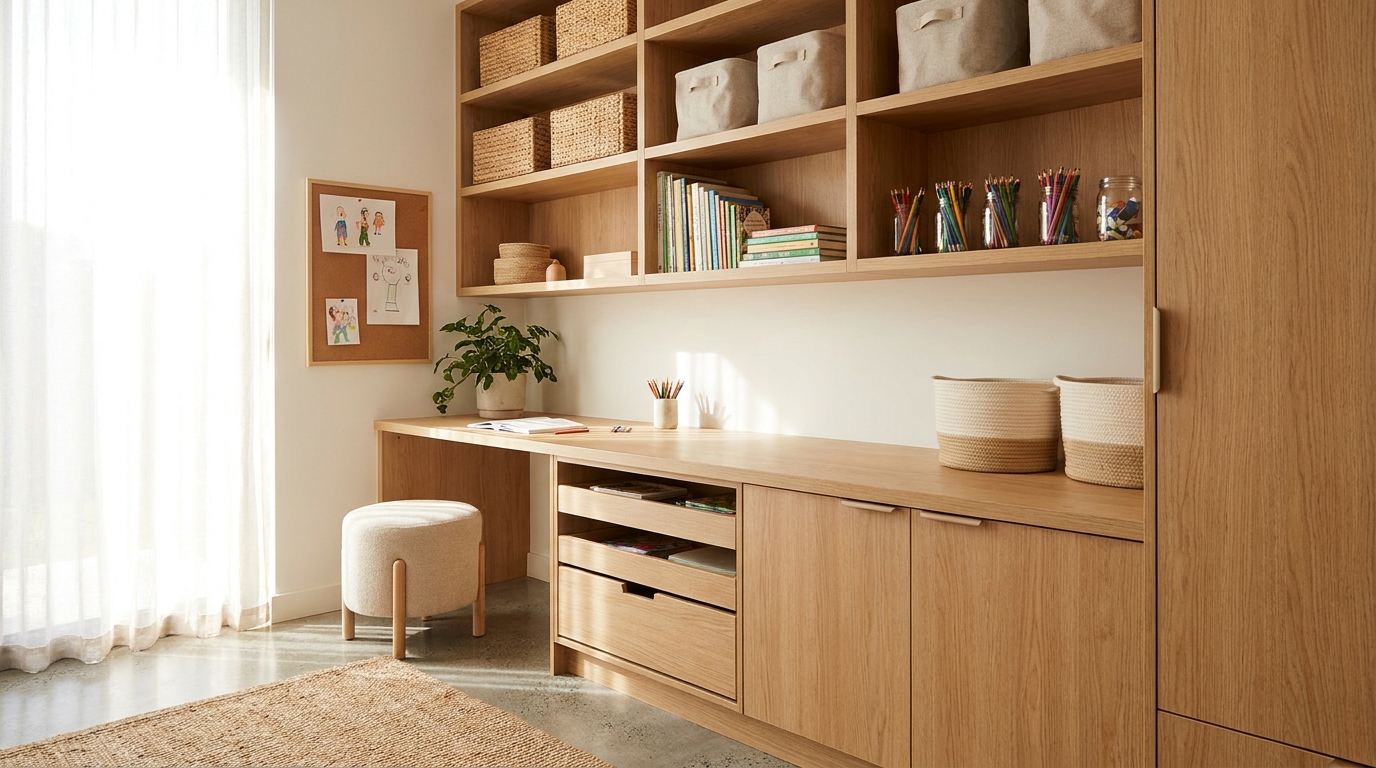
The backpack lands in the doorway, and the only clear surface in the room is gone by midweek. Kids homework storage works better as a small niche built for one child: a writing surface, closed drawers for supplies, and a cubby the backpack leaves so the floor stays walkable. We place that niche in a bedroom, a hall, or the end of a closet run, and we size it to the child who will sit there rather than to an adult desk. The chair has to pull in without blocking the door, and any tall bookcase in the same zone is anchored to the wall.
1. Give the backpack a cubby the child can reach
A pack on the floor is a trip in the dark and a block in the path out of the room. The U.S. Fire Administration says residents could have less than 2 minutes to escape a home fire once the smoke alarm sounds. It also tells households to make sure doors and windows are not blocked, and to find two ways out of every room. [5] A cubby puts the bag at the child's reach so the floor and the door swing stay open.
We size the opening to the backpack the family actually uses. We do not pull an adult shelf height off a chart and call it a child's reach. During the visit the child stands at the wall and sets the pack where their hands land without a climb. If two children share the niche, each pack gets its own opening.
The cubby is also where the pack gets unloaded. HealthyChildren.org, updated in August 2026, says a backpack should not weigh more than 15% of a child's body weight, which means a child who weighs 100 pounds should not carry a pack heavier than 15 pounds. [2] The same page says that if a child has to lean forward to support the pack, it is too heavy, and it tells families to clean the backpack weekly and take out unneeded items. [2] It also says to use both shoulder straps so the load stays close to the body. [2]
This is not a family drop zone for mail, keys, and every coat in the house. It is also not a teen closet, where the need is usually a longer hang and a higher bag shelf. One school-age child gets one opening they can use without standing on the chair.
2. Close the supplies so the desktop stays a writing surface
An open pile of pencils, clips, erasers, and spare paper looks tidy for about a day. Then it creeps across the writing surface, and the assignment has nowhere to sit. We put those supplies in drawers and leave the top for the work that is due.
A HealthyChildren home-safety page last updated in September 2022 tells families to check floors constantly for small objects a child could swallow, including coins, beads, buttons, pins, and pills, because those items can cause choking or poisoning. [4] That page is written for families with young children. Pencil caps and paper clips are the same kind of small object when a younger sibling shares the house. Closed drawers keep those pieces off the floor and off the page.
The drawer bank is part of the niche, not a separate dresser parked beside it. We set the drawer fronts where the seated child can open them without standing up, and we check that in the chair before we lock the layout. Top drawers hold what gets used every night. We do not publish a universal drawer height, because the right one changes with the child.
The desktop stays plain on purpose. One pencil and the current packet can live there. Chargers, mail, and a rotating stack of art projects belong somewhere else. If the family wants a tray for papers going back to school, we size that tray to the papers and keep it at the back edge.
This niche is not a playroom. Toy bins are a different project. Homework supplies stay in their own drawers, and toys, if they live in this room at all, live outside the writing zone.
3. Fit the chair and the writing height to this child
Adult desks are the wrong starting point. A HealthyChildren page last updated in November 2021 says chair height should be set so a child's feet rest flat on the floor, and that a step stool can support the feet. [3] For a smaller child, that page says parents may need blankets or pillows on the seat, and it recommends a designated workstation with an adjustable chair when one is available. [3] We use those fit checks for writing, which is what this niche is for.
OSHA's computer workstation eTool says there is no single correct posture or arrangement of components that will fit everyone, and its basic goals include feet flat on the floor. [6] The eTool states that it does not create new OSHA requirements, and it describes adult computer work. [6] We do not copy that layout, or the clearance inches published for adult users, onto a child.
OSHA's desk page for those same adult workstations says a surface that is too high or too low may lead to awkward postures, such as extended arms and raised shoulders. [7] It also says nothing stored under the work surface should limit the space needed for legs and feet. [7] If the surface cannot be lowered, that page says to raise the chair and, if needed, provide a footrest. [7] On a child's niche we do the measuring in person, and we still keep the knee space empty.
The child sits in the chair they will actually use. Feet are flat on the floor or on a firm footrest, not dangling. We set the writing surface near the seated elbow so the shoulders can stay down while the child writes. Then we slide the chair in and out, and it has to pull fully in and come back out without crossing the door swing.
We recheck when the child grows. A surface that was right in second grade can be low a few years later, and a footrest can become a trip. Adjustable chair height is worth it when one child will use the niche for several grades.
4. Anchor the bookcase and keep heavy books low
A tall bookcase next to a child's desk is a climb waiting for a reason. In a February 2026 release, the U.S. Consumer Product Safety Commission estimated that from 2020 through 2022, emergency departments treated an average of 17,800 tip-over injuries a year, that 44% of the victims were under 18, and that this share means a child is treated every 53 minutes. [1]
The same release reported 217 tip-over fatalities from 2013 to mid-2023, and 71% of those killed were children ages one to three years. [1] Most of the fatalities involved televisions and furniture. [1] The reported deaths were concentrated in children ages one to three. A bookcase beside a school-age desk is still anchored, because the same release counts people under 18 in the injury total and tells households to anchor bookcases. [1]
CPSC tells households to anchor furniture such as bookcases and dressers to the wall, to keep tempting items off higher shelves where a child might climb, and to store heavier items on lower shelves. [1] Textbooks go low. The top is not a shelf for a trophy or a toy. If the family wants display space, we put it where the child does not have to climb, or we leave the top empty.
The same 2026 release notes that a mandatory stability standard for clothing storage units such as dressers and armoires took effect in September 2023. [1] A bookcase is not that kind of unit, and neither is a bank of pencil drawers. We still anchor the tall case to the wall as part of the installation, and we follow the hardware instructions for the anchors we use.
The 2022 HealthyChildren home-safety page says children can be seriously hurt or even killed when they climb onto, fall against, or pull themselves up on bookshelves and dressers, and it says to anchor bookcases, dressers, and TV stands to the wall. [4] That page is aimed at families with young children, which lines up with the ages in the fatality count. A built-in case is not automatically safe because it looks permanent. If the wall will not take an anchor, we shorten the storage or move it.
5. Light the page and leave the door clear
A ceiling fixture alone often leaves the writing surface in the child's shadow. The Department of Energy's office energy checklist says to use task lighting and to focus the light where you need it, so the light directly illuminates the work area instead of brightly lighting the whole room. [8] That checklist is an energy list for offices, not a medical standard for children's eyes.
We still use the placement idea: a lamp the child can switch without a climb, aimed at the paper, with the shade keeping the bulb out of the eyes. We do not quote a lux number we were not given for this niche.
Light will not fix a niche that blocks the way out. If the spot is a hall, we draw the door swing and the chair's pull-out before we commit. The fire-safety instruction is plain: doors and windows should not be blocked, and each room should have two ways out. [5] A chair that sits in the swing when a child stands up fails that test.
In a bedroom, the same check applies to the bedroom door and to a closet door used every morning. The chair has a place to sit, and it is not the exit.
The better locations are usually simple. A bedroom wall beside the existing closet, a wide hall that is not the only exit, or the last bay of a closet run can each take a short writing surface, a drawer stack, and one backpack opening. When the niche finishes a run of custom closets, we keep hanging clothes and the writing surface in separate zones. In Charlotte, Fort Mill, Rock Hill, and nearby towns such as Waxhaw, that last bay is often the wall left.
Some jobs do not belong in this niche. A kitchen command center is for mail, a calendar, and charging. A nursery is a different safety problem.
A home office for two adults needs a different chair and a longer surface. A playroom wants bins for toys, not a clear page. We will say no to a homework niche that tries to be all four.
6. Decide the niche on a visit, not from a catalog height
Catalog desk heights are averages for someone else. On the visit we use five checks from our own practice, not a national size chart. The child sits so we can see the feet and the elbows, and the backpack goes to the wall so we can mark an opening that accepts that bag without a climb.
The chair moves in and out while the door opens through its full swing. We check any tall bookcase and whether the wall can take anchors. Last, we list what may stay on the desktop, which is usually the assignment and almost nothing else.
Children in the same grade are not the same height. A niche in a Ballantyne bedroom may serve a very different body than a niche in an Indian Land hall. Measuring the child in the room is the method.
A desk without a cubby sends the pack back to the floor. Drawers without a clear top become another stack. A bookcase without an anchor is the hazard CPSC describes. [1]
We design and install this storage for homeowners in Charlotte and surrounding communities, including Fort Mill and Rock Hill. The wall, the door, the bag, and the child are specific. A catalog desk cannot see the swing of your door.
Practical takeaways
- Build one niche, not a pile of separate furniture. Plan the writing surface, closed supply drawers, and backpack cubby together so the pack and the pencils are not living on the floor.
- Set the cubby with the child, and size the opening to the pack you own. Do not borrow an adult reach range and call it a child's height.
- Keep the desktop for the assignment. A 2022 home-safety page reminds families that small objects on the floor can choke a young child. [4] Daily supplies belong in drawers.
- Support the feet before you chase a standard desk height. A 2021 pediatrics page says the feet should rest flat on the floor, and that a step stool can do that job. [3] Fit the writing height to that seated child.
- Leave the knee space and the door swing empty. Stored goods should not limit room for legs and feet, and a chair must not block the door. [5] [7]
- Anchor a tall bookcase and load it low. CPSC's February 2026 guidance says to anchor bookcases, keep tempting items off high shelves, and put heavier items lower. [1]
- Aim a lamp at the page. Focus light on the work area rather than hoping one ceiling fixture will do it. [8]
- Recheck as the child grows. Feet, elbow height, and the cubby opening change. Plan a way to adjust the chair and still support the feet.
How we can help
Have more questions or want to get in touch? Our team plans this child-scale niche as one piece of custom storage, with the writing surface, supply drawers, and backpack cubby fitted on site, and we offer a free in-home design consultation and professional installation for homeowners in Charlotte and surrounding areas. Start with our contact page, call (704) 604-3870, or email design@theclosetrehab.com.
Citations
- U.S. Consumer Product Safety Commission, "CPSC Urges Fans: Anchor TVs and Furniture Before Super Bowl LX" (2026-02-05)
- HealthyChildren.org, American Academy of Pediatrics, "School Backpack Safety: Proper Fit, Smart Packing & Preventing Back Pain" (2026-08-27)
- HealthyChildren.org, American Academy of Pediatrics, "How can I help my child avoid eye and back strain from being on the computer?" (2021-11-30)
- HealthyChildren.org, American Academy of Pediatrics, "Home Safety: Tips for Families With Young Children" (2022-09-02)
- U.S. Fire Administration, "Home Fire Escape Plans" (2026-09-03)
- Occupational Safety and Health Administration, "eTools: Computer Workstations" (page undated; read 2026-11-09)
- Occupational Safety and Health Administration, "eTools: Computer Workstations, Desks" (page undated; read 2026-11-09)
- U.S. Department of Energy, Federal Energy Management Program, "Office Energy Checklist" (live page read 2026-11-09; no publication date printed on the page)