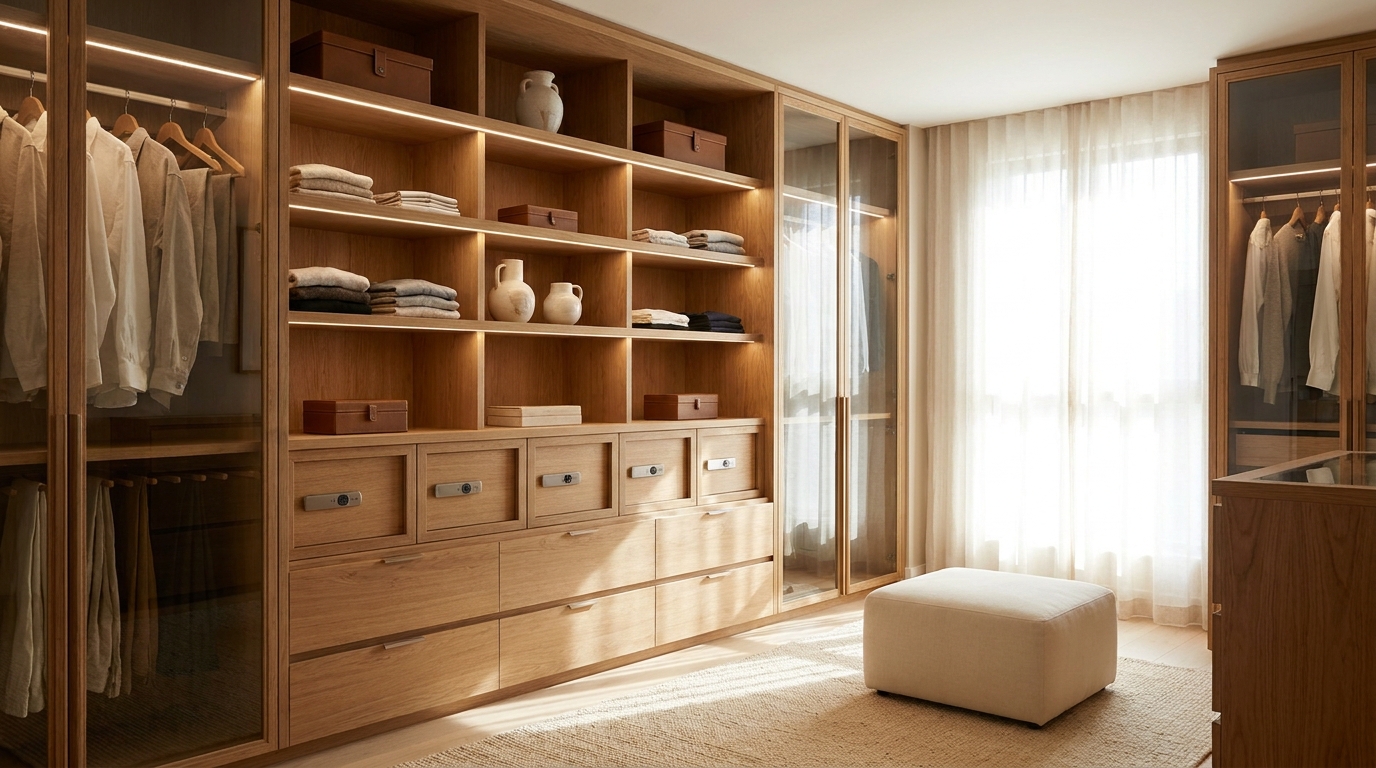
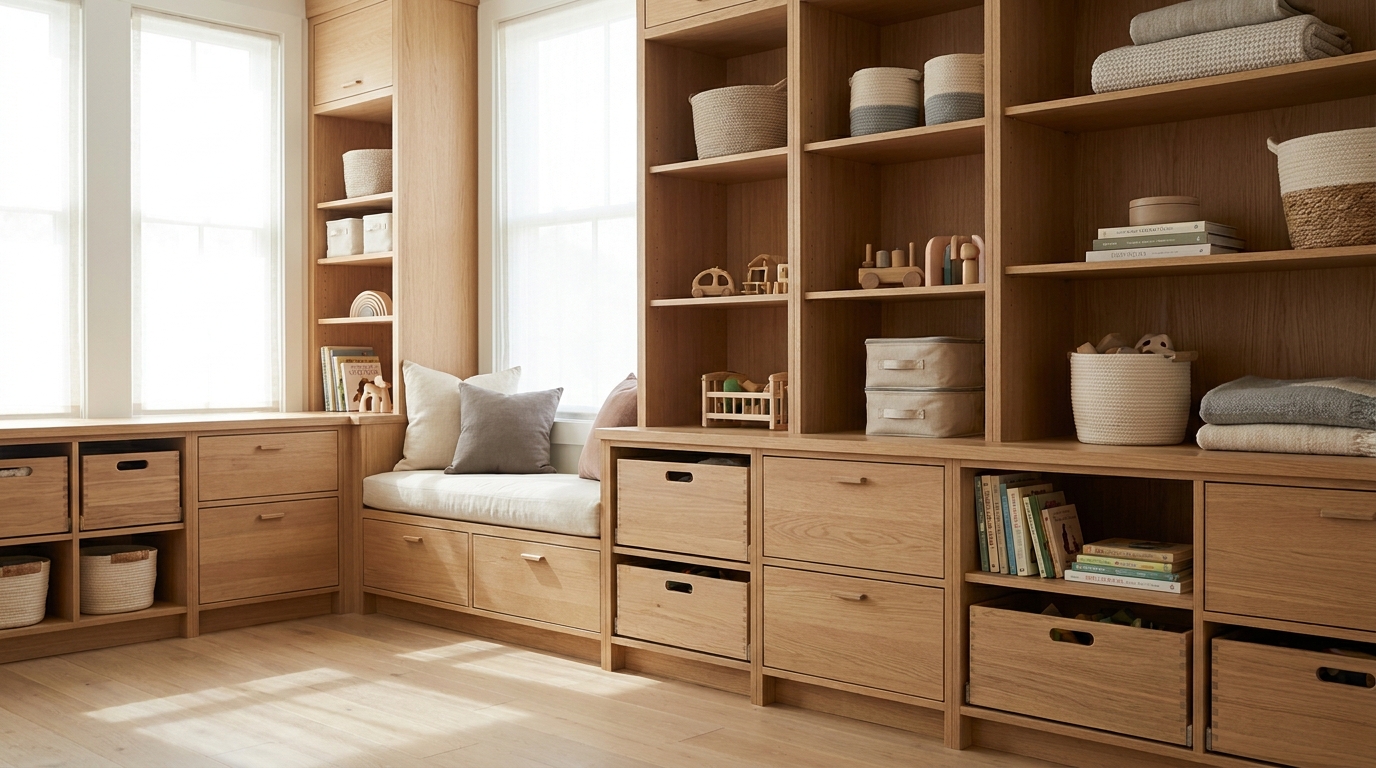
custom storage solutions for flat keepsake drawers
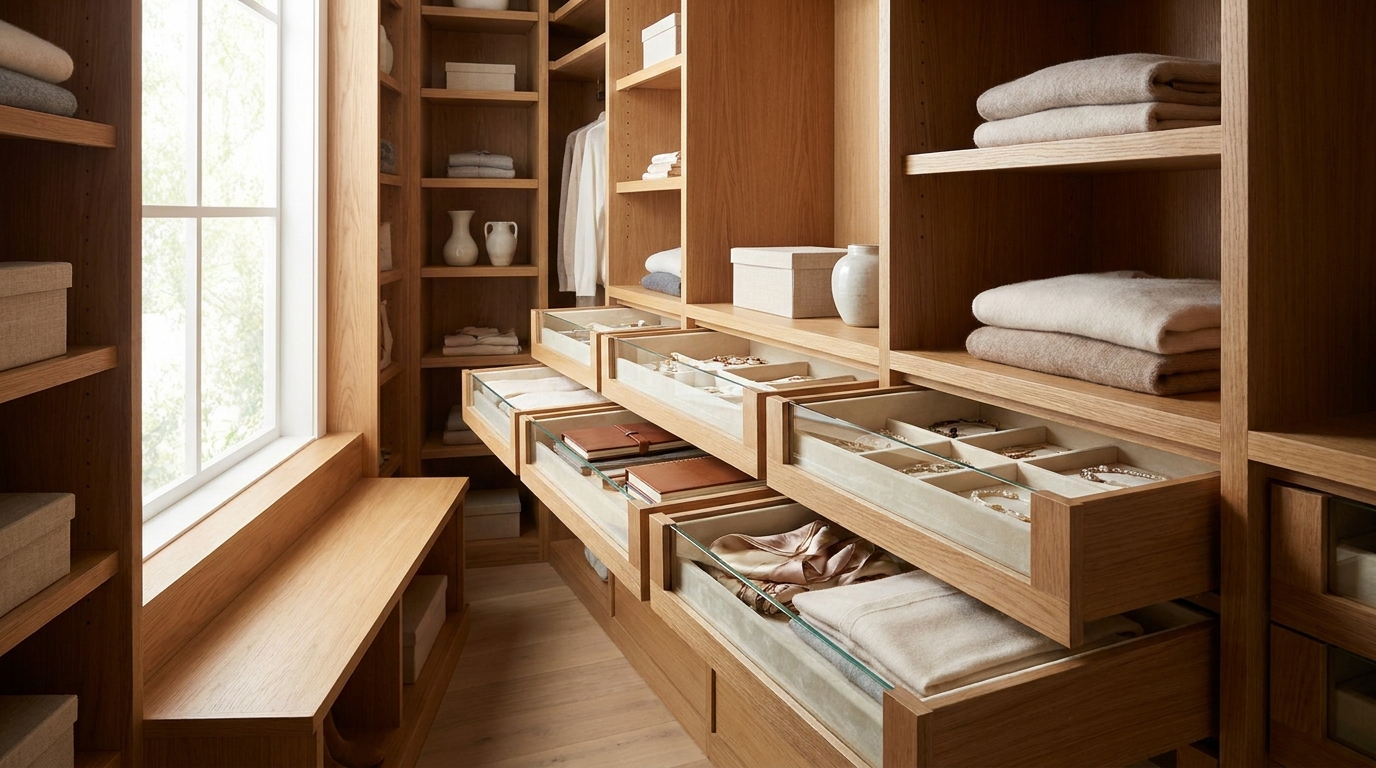
A keepsake drawer is a shallow, wide bay for the papers a family means to keep: children's artwork, photo boxes, and school papers that are too personal to toss and too easy to ruin in a deep bin. It is one of the custom storage solutions we plan into a closet, a hall cabinet, or a home office when the goal is careful storage, not a landing spot for today's mail. The Library of Congress describes good storage for letters and other paper documents as cool, relatively dry, stable, and flat, with as little light as possible [1]. A drawer can support those habits, but it is not a museum vault and it is not cold storage for color film.
1. Give every sheet a flat place to lie
The usual failure is the container. A deep bin invites a fold. A tube looks tidy until the curl sets and the edges crush.
The National Park Service says oversized paper, such as architectural drawings and maps, should be housed in folders and stored in flat file drawers when the sheet will fit [10]. Rolled storage always leaves some curl [10]. In most cases, flattening is preferred over rolling, because a flat sheet is easier to handle and the paper fibers are under less stress [11].
A keepsake drawer is the household version of that shape: wide, shallow, and closed. Museum flat files protect maps, drawings, and other flat artwork from dust, light, and pests [9]. The same guidance says many commercial flat files are not museum quality, and that an overfilled drawer makes access difficult and unsafe [9].
We borrow the shape. We do not pretend a closet drawer is a collections vault.
Let the sheet stay the size it is. The National Archives says the container should be big enough for the original to lie flat or stand upright without folding, and snug enough that pieces do not shift [4]. If a painting is wider than the drawer, do not crease it. Use a wider bay, or a careful roll only when flat storage will not fit [10].
Pastel, chalk, brittle paper, and sheets with many tears should stay flat. The Park Service says those materials should not be rolled [10].
Leave fragile curls to a conservator. The Park Service says photographs, brittle sheets, iron gall ink, and paper in poor condition should be flattened only by a conservator [11]. We design the drawer so the next stack is never folded. Tape is not a repair.
2. Keep heat, damp, and light off the stack
Cool and steady beats a hot hiding place. Cooler temperatures slow chemical decay, and the National Archives asks families to keep papers and photographs below 75 degrees Fahrenheit [4]. Relative humidity should stay below 65 percent to limit mold and insects, and it should not drop below 15 percent, which can make paper brittle [4]. A Library of Congress answer updated on August 4, 2026, sets a tighter range for letters and documents: room temperature or below, and about 35 to 50 percent relative humidity, away from attics, basements, radiators, and vents [1].
An interior closet can help. An attic or garage cannot. Many institutions keep storage near 65 to 70 degrees Fahrenheit and 35 to 50 percent relative humidity, and some use cold vaults for color photographs and older film [5]. The National Archives says those conditions are not easily kept in a home [5].
Choose the coolest, driest spot that stays that way all year [5]. Finished basements are usually too damp for photographs unless they are dehumidified, and dampness makes prints stick together and encourages mold [5]. Above-ground interior closets hold a fairly steady temperature, and the Archives says they should be considered [5]. Keep papers out of damp basements, garages, and hot attics, away from pipes, windows, and known roof leaks, and up off the floor so a leak does not soak the stack [4].
Summer heat around Charlotte is a placement problem. At Charlotte Douglas International Airport, the 1991-2020 climate normals from NOAA's National Centers for Environmental Information list a July average high of 90.3 degrees Fahrenheit and a July average temperature of 80.1 degrees Fahrenheit [12]. Those figures are outdoor air, not the air inside a closet.
They are why we do not put keepsake drawers in an unconditioned attic for households in Charlotte, Fort Mill, and Rock Hill. The drawer belongs on an interior wall of a room you heat and cool.
The drawer does not dry the house. The Environmental Protection Agency says molds can grow on wood, paper, carpet, and food when moisture is present, and it recommends reducing indoor humidity to 30 to 60 percent [7]. Another EPA page says to keep indoor relative humidity below 60 percent, and ideally between 30 and 50 percent [8].
In warm and humid climates, warmer outdoor air can bring moisture indoors, and if indoor humidity stays above 60 percent, the house needs a dehumidification plan [8]. Dry anything that gets wet within 24 to 48 hours [7].
Color photographs need an honest limit. Acetate negatives and color negatives, slides, and prints can fade within decades at room temperature [4]. Cold storage slows that change, and it needs special packaging, not a standard closet drawer [4]. A keepsake drawer can keep a snapshot dark, flat, and out of the attic, but it does not replace cold storage for a print or negative you could not stand to lose.
3. Decide what belongs in the drawer
This drawer has one job. Kindergarten paintings, a class photo, and a story from third grade belong here. Today's mail, a calendar, and a charging shelf are a different project.
Passports and tax files want a secure spot with different rules. Holiday bins want height, not a shallow file. Mixing those jobs turns a keepsake drawer into a junk drawer with better hardware.
Hang a copy, and keep the original in the dark. All light, visible and ultraviolet, can fade paper and photographs or darken them [6]. The National Archives says the best protection is to display a copy and keep the original in a box, and that a color scan or a color photocopy can be a good display copy [6].
Drawings left on display lost a purple marker except where one sheet covered another [6]. The Library of Congress says that, over time, every photograph exposed to light suffers irreversible damage even behind ultraviolet-filtering glass, and that a print of personal value is safer as a framed copy with the original kept in storage [3].
A scan is not a substitute. Guidance last reviewed on July 25, 2025, says not to throw original film and prints away after digitizing, because a file can be lost when the storage medium deteriorates and old software can make it hard to open [5]. A related page last reviewed in 2021 says a flat original must fit fully on the scanner, because the lid can crease anything that hangs off the glass [13]. After the scan, the original still needs the drawer.
4. Build the bay so paper is not crushed
Leave the drawer partly empty. Overstuffing a photo box damages prints when they are pulled out or filed, and an underfilled box lets them slump and curl [5]. It is also easy to pack a flat file until access is difficult and unsafe [9]. We leave room to lift a folder, and we fit a slide stop so the drawer cannot come all the way out, following the Park Service caution for flat files [9].
Size the opening to the largest sheet. Photos larger than 8 by 10 inches, and prints with brittle or torn edges, should lie flat in small stacks [5]. Same-size snapshots of the same type may be stored vertically or horizontally together [5]. If the drawing you care about is bigger than the drawer, the drawer is wrong, so we measure that sheet before we build the bay.
Choose a calm wall. An above-ground interior closet stays relatively even in temperature [5]. A hall cabinet works on an inside wall, clear of windows and pipes [4]. In a home office with built-in storage, our team separates everyday file drawers from a shallower keepsake bank, so artwork and school papers stay out of the weekly shuffle.
Label the folder, not the drawing. One folder per child, per school year, is usually enough. Alkaline buffered folders can neutralize acids as paper ages, but some media are sensitive to alkaline pH, so a neutral folder is the safer guess when you are unsure [1].
Polyester sleeves can hold a static charge that lifts pastel, charcoal, pencil, and flaking paint [1]. An opaque paper folder blocks light, which matters more for a crayon drawing you rarely open [2].
5. Choose folders and sleeves that will not stain the contents
Use materials that pass the Photographic Activity Test. Paper enclosures for prints and negatives should be acid-free and lignin-free, buffered or neutral, and tested for photographic activity [2]. Buffered paper is recommended for some brittle prints on poor mounts and for some deteriorated film negatives, and it is not recommended for contemporary color materials [2]. The National Archives asks for the same test on anything that touches heirloom photographs [4].
Skip the fasteners that stain. Glue, rubber cement, pressure-sensitive tape, magnetic albums, paper clips, rubber bands, and polyvinyl chloride plastics are on the Archives avoid list [4]. Mount a print without adhesive on the photograph itself, using a sleeve or a corner of acid-free paper or a stable plastic such as polyester, polypropylene, or polyethylene [4]. Self-stick tape is a poor shortcut on an album page as well [2].
One sheet to a sleeve, and only in a dry room. A brittle, torn, or often-handled sheet can go in a polyester L-sleeve that is larger than the original, with one item per sleeve [4]. Do not put those sleeves in a bound book, because the stiff edge can cut the page [4].
A photographic emulsion can stick to slick plastic when relative humidity is high [2]. If the closet runs damp in summer, stay with paper folders until the room is under control. When you still have negatives, keep them separate from prints, and do not house glass-plate, nitrate, or acetate negatives in plastic [2].
6. Edit the stack once a year
A short stack is the point. At the end of the school year, keep the pieces you would be sad to lose and let the rest go. The drawer works because it stays partly empty. Label the front by child or by year so you are not shuffling every sheet, since every extra pass is another chance to crease a corner.
Know what the drawer cannot do. It keeps paper flat, dark, and off the floor in a lived-in room, but it does not filter the air and it is not cold storage. Light damage to a photograph is irreversible, so a copy can go on the wall and the original stays in the drawer [3]. If a piece is moldy, stuck to another sheet, or flaking, stop and ask a conservator before you flex it.
Practical takeaways
- Store artwork, photo boxes, and school papers flat in a shallow covered drawer, not folded in a deep bin or rolled in a tube.
- Use an above-ground interior closet or an inside wall in a hall or home office. Skip attics, garages, damp basements, and spots under pipes or windows.
- Keep papers below 75 degrees Fahrenheit when you can [4], and keep indoor humidity in the ranges cited above. A drawer does not dry a damp closet.
- Treat color negatives, slides, and prints as a special case. Room-temperature storage, even in a good drawer, is not cold storage.
- Choose acid-free, lignin-free folders. For photographs, use materials that have passed the Photographic Activity Test, and skip tape, rubber bands, paper clips, and magnetic albums.
- Display a copy. Keep the original in the drawer, and do not throw the original away just because you scanned it.
- Leave the drawer partly empty so you can lift a folder instead of dragging it. Edit the stack once a year.
How we can help
Have more questions or want to get in touch? Our team designs shallow keepsake drawers for closets, hall built-ins, and home offices, and we can look at the wall you have in mind during a free, no-obligation in-home design consultation. A designer will come to your home. Call (704) 604-3870 or email design@theclosetrehab.com, or send a note through our contact page.
Citations
- Library of Congress, "How do I preserve my letters or paper documents?" (2026-08-04)
- Library of Congress, "How do I preserve my photographs and negatives?" (2025-03-04)
- Library of Congress, "How can I safely frame my photographs?" (2025-03-04)
- U.S. National Archives and Records Administration, "Storing Family Papers and Photographs" (2025-09-18)
- U.S. National Archives and Records Administration, "Family Archives: General Guidance" (2025-07-25)
- U.S. National Archives and Records Administration, "Displaying Family Papers and Photographs" (2025-07-01)
- U.S. Environmental Protection Agency, "What are ten things I need to know about mold?" (2026-09-08)
- U.S. Environmental Protection Agency, "Biological Contaminants and Indoor Air Quality" (2026-04-01)
- National Park Service, "Conserve O Gram 4/1d: Museum Storage Flat Files" (2026-07-08)
- National Park Service, "Conserve O Gram 13/5: Rolled Storage for Oversized Paper Materials" (2025-07-02)
- National Park Service, "Conserve O Gram 13/2: How to Flatten Folded or Rolled Paper Collections" (2025-07-02)
- NOAA National Centers for Environmental Information, "1991-2020 Monthly Climate Normals, Charlotte Douglas AP, NC (USW00013881)" (1991-2020)
- U.S. National Archives and Records Administration, "Digitizing Family Papers and Photographs" (2021-05-26)