Playroom Built-In Storage: Labeled Bins, Clear Play Path
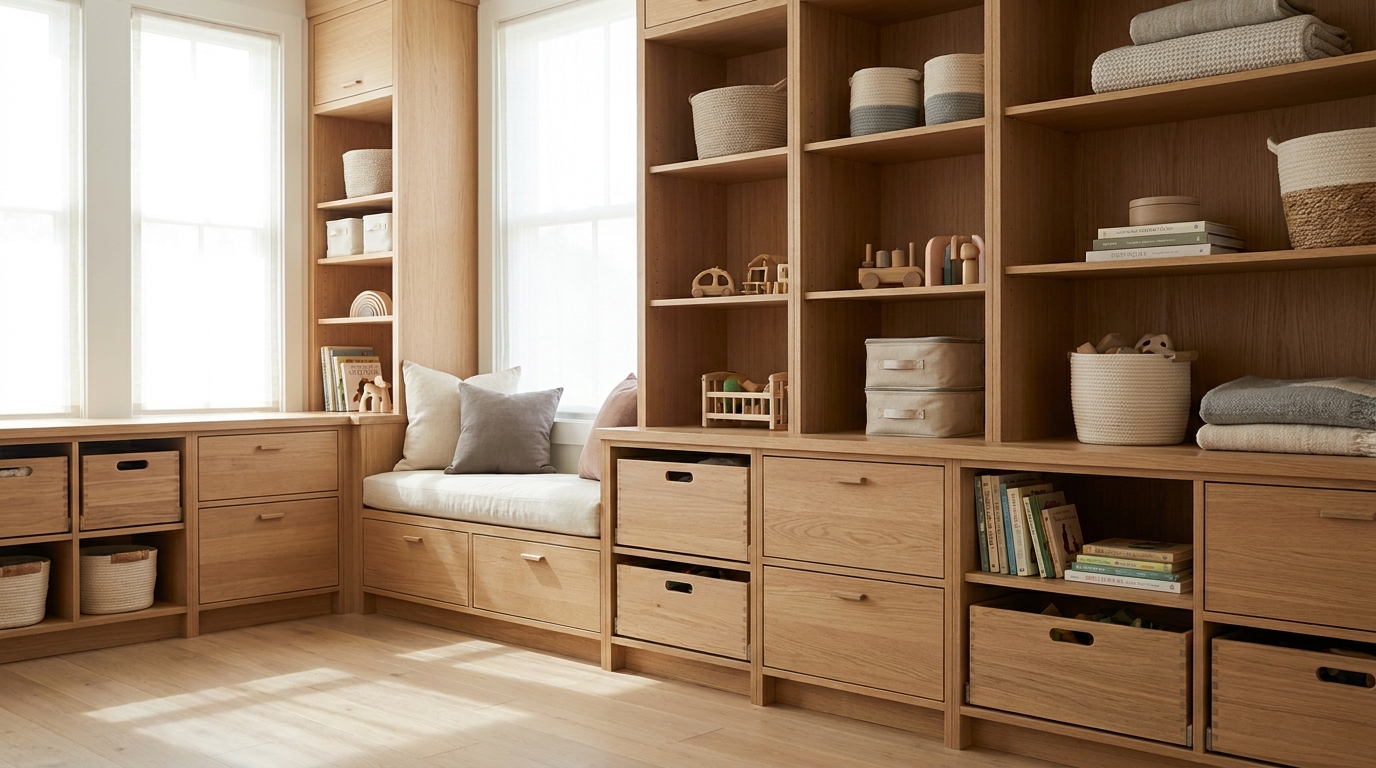
A playroom works when the floor is a play path, not a dump. Playroom built-in storage does that job with labeled bins at kid height, a closed overflow bay, a short display row, and wall-attached cabinetry that does not walk like a free-standing dresser. That mix is a closet-style wall for toys, not a kids bedroom wardrobe and not a shop window of clutter. CPSC’s 2023 tip-over report estimated 17,800 emergency-department injuries a year from television, furniture, and appliance tip-overs in 2020 through 2022, and 44 percent of those injured were children under 18.[1]
1. Treat the floor as a play path, not a toy dump
The playroom floor has one job: give kids a clear run for blocks, cars, and pretend kitchens. Toys left in the walkway turn that run into a trip course for children, grandparents, and anyone carrying a laundry basket through the bonus room.
CDC’s STEADI home checklist (the version still posted for families) tells people to pick objects off the floor, keep objects off the floor, and move furniture so the path through a room is clear.[2] University of Nevada, Reno Extension repeats the same household rule: minimize clutter and tripping hazards in the places you walk, and keep magazines, books, shoes, boxes, and other objects off the floor.[3]
We apply that guidance to playrooms in Charlotte, Fort Mill, and Ballantyne the same way we apply it to a pantry aisle. If a parent has to sidestep a pile to reach the window, the storage failed. Built-ins pull daily toys into a wall of cubbies so the middle of the room stays open.
A clear play path also means we do not park a low toy chest in the doorway, run cords across the rug, or leave a rolling bin in the only lane to the hall. Those pieces look helpful for a week. Then they become the thing everyone trips over at bedtime.
What we keep off the floor
- Daily toys that have a labeled bin on the wall
- Puzzle boxes, game lids, and stray pieces that belong in a closed bay
- Empty gift bags and cardboard that tend to land “just for now”
- Extra chairs and ottomans that shrink the play rectangle
The room should still feel like a playroom. A rug for sitting is fine. A permanent scatter of figures, tracks, and stuffed animals is not a play style. It is unfinished storage.
2. Labeled bins at child reach: playroom built-in storage that kids can reset
Kid-height bins are the daily system. If a four-year-old cannot put the cars away without asking an adult to open a tall door, the cars will live on the floor. Playroom built-in storage starts with cubbies and bins a child can reach, labeled by category, not by “misc.”
Nevada Extension’s home-safety guidance is written for older adults, yet the reach rule travels well: keep items you use often within easy reach so nobody needs a stool, and store frequently used cabinet and shelf items on a level you can actually get to.[3] STEADI says the same in kitchen language: keep things you use often on the lower shelves, about waist high.[2] In a playroom, “often” means the toys in rotation this month. Those go in the low band.
We set that band to the child who actually uses the room. Toddlers need open cubbies they can see into. Early elementary kids can handle bins with simple picture-plus-word labels. Shared playrooms in Rock Hill or Indian Land often get two low columns so siblings are not fighting over the same row.
Categories that hold up after a Saturday
- Vehicles (cars, trains, planes)
- Building (blocks, magnetic tiles, construction sets)
- Pretend (food, dolls, figures)
- Art-for-now (chunky crayons, stickers, paper, not the bead kit)
- Soft toys (a limited number, not every stuffed animal in the house)
- Puzzles and games with complete pieces
Labels beat memory. A picture of a car on the bin, plus the word, means a visiting cousin can help reset the room. We prefer bins that slide fully into the cubby so the face of the wall stays flush. Deep, overfilled baskets that spill when pulled are just floor clutter with a handle.
This is not a kids closet. Clothing, backpacks, and tomorrow’s outfit belong in a bedroom or mudroom system. The playroom wall is for play goods. Mixing coats into the toy cubbies is how the play path fills back up.
3. Closed upper bays for overflow and small-parts toys
The low band cannot hold everything. Seasonal toys, duplicates, and sets with dozens of tiny pieces need a closed overflow bay that takes an adult hand to open.
CPSC classifies children’s products intended for children under 3 that present a choking, aspiration, or ingestion hazard because of small parts as banned hazardous substances.[4] A small part, under that rule, is any object that fits entirely (without compressing, in any orientation) into a test cylinder that approximates the fully expanded throat of a child under three.[4] The ban is about what may be sold as a toy for under-threes. It is not a storage-height code. Families still have older-kid sets (building kits, mini figures, beads, marbles) that include pieces in that size range. Those sets do not belong in a toddler’s open cubby.
We put small-parts toys behind doors or in drawers above the child reach band, with a latch a parent can operate and a child cannot. Overflow for bulky items (play kitchens accessories, costume bins, extra track) can live in the same closed run. The goal is simple: the floor stays clear because extras have a home that is not “the corner.”
What goes up and closed
- Sets with pieces that would fail a small-parts cylinder test
- Toys labeled for ages 3+ that a younger sibling still mouths
- Collections that only come out on weekends
- Craft kits that do not belong in the art-for-now bin
- Gift overflow you are not ready to donate
Do not use the top of the cabinet as a parking deck. CPSC’s Anchor It campaign tells families to remove items that might tempt kids to climb, such as toys and remote controls, from the top of TVs and furniture.[5] A 2026 CPSC consumer alert repeats the same point: avoid storing tempting items such as toys and remotes on higher shelves where children may try to climb to reach them, and keep heavier items on lower shelves.[6] Closed doors beat a row of colorful boxes on the crown.
4. Limited display so the room does not become a shop window
Open display has a place. One short shelf for a favorite dollhouse, a rotating art clip, or a handful of books is enough. A full wall of open cubes becomes a shop window. Every gift, every incomplete puzzle, and every plastic figure ends up “on display,” which is another word for visual noise and dust.
We usually cap open display at a minority of the wall. The rest is bins and doors. That split keeps the room from looking busy the moment you turn on the light. It also reduces the number of tempting objects at climb height.
If you want a library look, use a single row of facing books at seated height, not a tower a child will scale for the top title. If you want a trophy shelf, pick a few objects and change them with the seasons. The rest goes into the labeled system.
Parents in Waxhaw and Wesley Chapel often ask for glass doors. Glass is fine when the contents are curated. It is a poor choice for the overflow bay, because then the mess is still the first thing you see. Solid doors hide the work-in-progress. Open bins show the daily toys a child is allowed to grab.
5. Wall-attached built-ins vs free-standing dressers
A playroom dresser that is not attached to the building is still a clothing-storage-style box with drawers a child can pull and climb. That is a different product from a built-in wall.
Federal rules for clothing storage units apply to free-standing furniture. CPSC’s clothing-storage guidance states that a clothing storage unit is free-standing, at least 27 inches tall, at least 30 pounds, and at least 3.2 cubic feet of enclosed storage, and that products not in scope include built-in units intended to be permanently attached to the building.[7] 16 CFR part 1261, which took effect for units manufactured after September 1, 2023, incorporates ASTM F2057-23 as the mandatory stability standard.[7] CPSC adopted that ASTM standard under the STURDY law to protect children up to 72 months old, with tests that include loaded drawers, multiple drawers open, carpet, and a simulated child weight up to 60 pounds.[8]
That built-in exclusion is not a free pass. It means the tip-over rule was written around free-standing dressers, not around a cabinet that is fastened to wall structure. We still design playroom walls to be attached to the building so the run cannot walk, rock, or act like a ladder. Drawers, if we use them at all in a playroom, are not a climbing surface. We specify hardware and layout so a child is not invited to stand in an open drawer to reach a high bin.
CPSC’s Anchor It campaign is blunt about why this matters: children like to climb on furniture, and for them the home is a playground.[5] Unsecured TVs, furniture, and appliances are hidden hazards in every room, including the playroom.[5] For any leftover free-standing piece (a bookcase that came with the house, a dresser you still use for costumes), CPSC tells consumers to anchor furniture securely to the wall, install the anti-tip devices that ship with new dressers, and use anti-tip brackets on existing pieces.[5][8] We do not treat a sticker as the safety plan. We treat climbing as a behavior the room should not reward.
CPSC staff, in the 2023 tip-over report, estimated 6,400 emergency-department injuries a year among children under 18 involving furniture, including about 1,800 involving chests, bureaus, or dressers and about 1,000 involving shelving, shelving units, or bookcases (2020 through 2022 averages).[1] From January 2013 through July 2023, CPSC received 217 reports of tip-over fatalities tied to TVs, furniture, or appliances; 155 of those deaths (71 percent) involved children under 18.[1] In a separate CSU-focused count, CPSC staff were aware of 234 clothing-storage-unit tip-over fatalities from January 2000 through April 2022, including 199 child fatalities, plus an estimated 84,100 CSU tip-over injuries treated in U.S. emergency departments from 2006 through 2021 (about 5,300 a year).[8]
Honesty checklist for a playroom wall
- Fasten the built-in run to wall structure. Do not leave it as a tall, free-standing box.
- Keep daily toys in low, labeled bins so kids do not climb for them.
- Put small-parts and overflow behind adult-reach doors.
- Do not let children climb the wall. CPSC says children like to climb on furniture, and toys on top of a unit invite that climb.[5]
- Anchor any leftover free-standing dresser or bookcase. The STURDY standard does not retire that advice for pieces already in the house.[5][7]
- Keep the heaviest items low, and keep toys off the cabinet top.[5][6]
A playroom is not a wardrobe. We will still use closet methods (vertical zones, labeled categories, closed vs open) because those methods keep a room usable. The difference is the inventory: toys, not hang rods full of clothes.
6. How we plan a playroom wall in Charlotte-area homes
Most bonus rooms and playrooms we see from Charlotte to Fort Mill, Rock Hill, Ballantyne, Waxhaw, Wesley Chapel, and Indian Land share the same three problems. Toys have no categories. The only “storage” is a free-standing cube unit or a hand-me-down dresser. The floor is the overflow bay.
Our process looks like a closet consult, because the wall is a closet-style system. We measure the room, list the toy types, and map a play rectangle that stays empty. Then we assign the low band, the closed overflow, and a short display. If the family also needs a custom closet for kids’ clothing, that is a separate wall in the bedroom. Mixing the two programs in one opening is how backpacks end up on top of the train table.
A typical playroom elevation
- Base: kick space and a continuous toekick so bins are not sitting in dust
- Kid band: open cubbies with labeled bins, two or three rows high
- Work ledge (optional): a shallow counter for puzzles, not a dumping shelf
- Adult band: closed doors for small-parts, extras, and gift overflow
- Display: one open niche, not a full grid
Lighting and power matter. A playroom wall that blocks the only outlet will grow extension cords, and cords across a play path are another trip hazard STEADI calls out.[2] We plan device charging and a small lamp inside the design so the floor stays a floor.
Families sometimes ask for a cheap cube kit “for now.” Those kits are free-standing, easy to pull over, and quick to overload. We would rather build the wall once, attach it, and give every category a home. That is the custom job. It is also the safer job.
If a toddler and a school-age child share the room, we split by height and by latch, not by hope. The older child’s small-parts sets go up. The toddler’s chunky toys stay in the open cubbies. Labels keep the split honest after a sleepover.
Practical takeaways
- Keep the center of the playroom empty. Storage lives on the wall so the floor can be the play path.[2][3]
- Put daily toys in labeled, kid-height bins a child can reset without a stool.[2][3]
- Close the overflow. Seasonal toys and small-parts sets belong behind adult-reach doors, not on the cabinet top.[4][5]
- Limit open display to a short, curated row. A full grid of open cubes turns into a shop window of clutter.
- Specify wall-attached built-ins. The federal clothing-storage tip-over rule covers free-standing units and excludes built-ins meant to be permanently attached, which is why we fasten the playroom run to structure and still anchor leftover dressers.[7][8]
- Do not let kids climb drawers or shelves. Remove climb bait, keep heavy items low, and use Anchor It hardware on any free-standing piece that remains.[5][6]
- Treat the playroom as its own program, separate from a kids bedroom closet, a nursery, or a craft-supply wall.
How we can help
Have more questions or want to get in touch? Our team designs playroom walls the same way we design closets: around what you own, who can reach it, and a floor that stays clear. Contact The Closet Rehab to talk through a playroom, closet, pantry, or garage plan. Call (704) 604-3870 or email design@theclosetrehab.com.
Citations
- U.S. Consumer Product Safety Commission, "Product Instability or Tip-Over Injuries and Fatalities Associated with Televisions, Furniture, and Appliances: 2023 Report" (2024-02)
- Centers for Disease Control and Prevention, STEADI, "Check for Safety: A Home Fall Prevention Checklist for Older Adults" (2017)
- University of Nevada, Reno Extension, "Preventing Falls in Your Home" (2024)
- U.S. Consumer Product Safety Commission, "Small Parts Ban and Choking Hazard Labeling" (page live 2026)
- U.S. Consumer Product Safety Commission, "AnchorIt.gov" (page live 2026)
- U.S. Consumer Product Safety Commission, "CPSC Urges Fans: Anchor TVs and Furniture Before Super Bowl LX" (2026-02-05)
- U.S. Consumer Product Safety Commission, "Clothing Storage Units" (page live 2026)
- U.S. Consumer Product Safety Commission, "CPSC Adopts Final Consumer Product Safety Standard to Prevent Tip-overs of Dressers and Other Clothing Storage Units" (2023-04-19)