Formalwear Closet Storage in One Long-Hang Bay
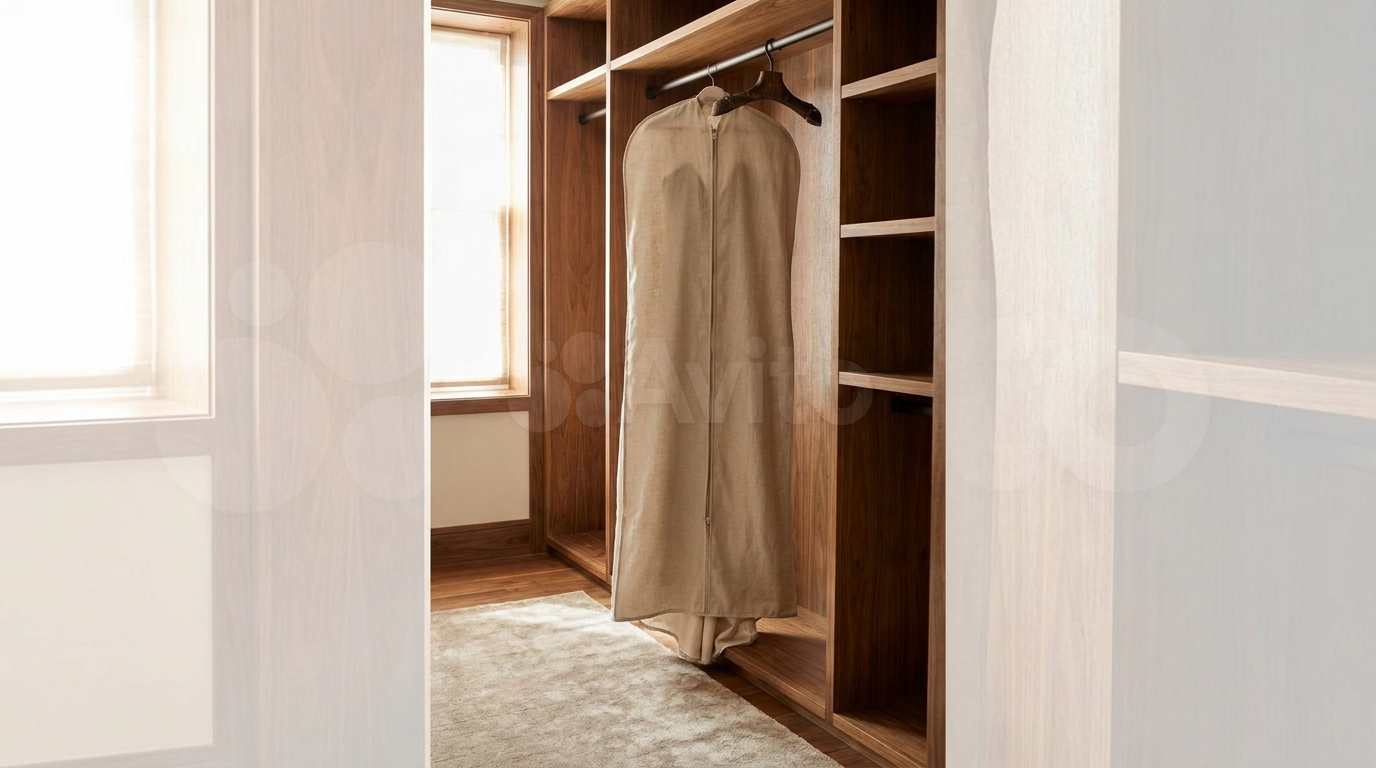
Formalwear closet storage for gowns and suits in garment bags belongs in one long-hang bay, not on the rod you use every morning. The hook has to sit high enough, and the floor under it has to stay clear, so the hem does not puddle, snag, or take a crease from the base. We set that height from the longest gown or bagged suit you own, rather than from one hem height meant to fit every dress. Dust on the skirt, and moisture trapped in a sealed cleaner bag, are the other two problems this bay is built to avoid.
1. Why a shared rod crushes the hem
A gown on an everyday rod looks fine the night you hang it. By the next season the hem is on the shoe shelf or the carpet, and the skirt has a gray line where it dragged. A suit still zipped into the cleaner bag presses into the dress beside it, and pulling one piece means sliding the others.
Hanging puts the weight in a small place. A 2020 National Park Service Conserve O Gram says that when garments hang vertically, stress concentrates on the shoulders, neck, and bodice [1]. Sturdy, structured, or tailored garments generally can hang on padded hangers if they are in good condition [1]. The same note says not to hang pieces that are fragile, in poor condition, simply constructed, heavily embellished, or unstable in shape, including knits and clothing cut on the bias [1].
Heirloom advice is stricter than a closet you dress from. A 2008 University of Kentucky Extension publication says to store textiles flat whenever possible, so weight and gravity do not strain shoulder seams and waistbands [2]. It treats a hanger as the choice when flat storage is not available, and it says to use a well-padded hanger rather than thin wire, which may rust [2]. A wearable gown can still hang, but it cannot be crushed.
University of Georgia Cooperative Extension says not to hang a very fragile garment [3]. If the garment is in good condition, the hanger should be well padded and covered with washed muslin, and other clothes should not press against it [3]. If hanging causes too much strain, that page says to move the piece to flat storage [3].
A 2001 National Park Service note adds three checks for a fitted garment: strong, intact shoulder seams, shoulder fabric free of splits or holes, and a waist that supports itself without straining the shoulders [4]. Dresses, bodices, coats, and jackets in good condition are the examples it gives [4].
2. What this bay is for
This is not a plan for every rod, and it is not a ratio of double-hang to long-hang. The bay has one job. Gowns, and suits that live in bags, hang full length so the hem never rests on a surface.
- Gowns you still wear. Evening dresses with sound shoulders and a skirt that can hang without dragging. Fragile or heavily embellished pieces stay out [1].
- Suits that come home in a bag. The bay holds the suit. The sealed cleaner film does not stay on for the season.
- One hook, one garment. A second gown gets its own hook, with air between the skirts.
- What stays out. Everyday shirts keep their own rod. Handbags and off-season bins are different jobs.
In Charlotte, the bay usually sits at one end of the primary closet, beside everyday hanging and not mixed into it. We plan the same end bay in Waxhaw houses where the closet is wide but the rod was set for shirts. Our custom closets cover the rest of the wardrobe. This bay is only the long stretch for formal pieces.
3. Set the hook so the hem stays off the floor
We do not use one drop for every formal dress. At the measure we want the longest gown and the longest bagged suit, on the hangers you actually use. The rod goes high enough that each hem clears the floor, any base, and the top of a shoe shelf. That clearance is our design practice, not a code dimension.
Depth matters as much as height. A skirt that clears the floor but presses into the back wall still takes a crease. We size the bay so the hanger sits forward of the wall and the skirt can hang in its own shape. If the bag is longer than the clothes inside it, we measure the bag, because the bag is what hits the floor.
The hook should not jam the shoulder into the rod. The 2020 Park Service note says to use smooth, long-necked hooks so the garment does not rest high on the hanger and touch the hanging bar [1]. In a home closet that bar is the rod, so a short hook lets the shoulder ride up against it.
4. Support the shoulder before you worry about the skirt
A thin hanger puts a sharp ridge in a structured shoulder. The 2020 Park Service note says a finished padded hanger should follow a natural shoulder and extend slightly into the sleeve past the sleeve-cap seam, when the garment has one [1]. It says to start a little smaller than the shoulder, because padding adds width, and that a hanger which is too large can distort the garment [1].
Hanger material is where the notes disagree, and we will not pretend they do not. The 2020 museum note says not to use wooden hangers, because they off-gas volatile acids that damage collections, and it points to stable plastics such as polypropylene or acrylic [1]. The 2008 Kentucky publication tells households to be wary of plastic hangers, because many decompose, release fumes, and can turn brittle and snap [2]. University of Georgia Extension allows wood, plastic, or metal only when the hanger is padded and covered with washed muslin [3].
Our hanger is wide, padded, and covered, so cloth does not sit on a bare edge or a bare wire. The 2020 note says a dress with a heavy skirt or a bustle may need support from the waist to the hanger, and it says to ask a textile conservator [1]. That does not cancel the same note's list of heavy or heavily embellished garments as better stored flat [1].
- Sound tailored pieces can hang. Suits and structured gowns in good condition match what these notes allow [1] [4].
- Weak, knit, or bias-cut pieces should not. The 2020 note says to keep those off a hanger [1]. If hanging is already straining a piece, move it to flat storage [3].
- One padded hanger per garment. A wire slipped inside a padded hanger still carries the weight on the wire. A new ridge after a week means the hanger is too narrow, or the dress is too heavy to hang.
5. Use a cover that blocks dust and still lets air move
Dust is not only a gray film. University of Georgia Extension says dirt particles can cut fibers through friction and abrasion [3]. The 2008 Kentucky publication says tiny particles lodged in cloth can abrade it, and that a dust wrap should not be plastic, because plastic makes static that attracts more dust [2]. It also says to cover textiles loosely so air can move and the cloth is less likely to snag [2].
A museum dust cover is cloth, not the film from the cleaner. The 2001 Park Service note says these covers guard against dust and light, oils and acids from hands, dye transfer, snagged metallic embroidery, and abrasion when pieces are moved [4]. That 2001 note names washed, 100 percent cotton muslin as the basic cover [4].
That 2001 pattern allows the garment plus 1 to 2 inches of air inside the cover [4]. The gap is not a rule for how high a hem sits above a floor. Side ties are the better opening when beads or braid would be abraded by pulling a bag down over them [4].
Plastic film is the habit we design against. University of Georgia Extension says not to wrap textiles in plastic, because it blocks air and can lead to mold and mildew, attracts dust with static, can give off chemicals, and does not block light when it is clear [3]. The 2008 Kentucky publication says plastic bags cut off air, may let moisture condense, and can release acidic fumes as they age [2]. It also says printing on cleaner bags can come off and permanently stain the object [2].
The suit can live in this bay, and the cleaner bag should not. Film is for the ride home, then it comes off. In the closet the suit hangs on the padded hanger under a loose cloth cover, or open if the cabinet itself blocks dust. A cloth garment bag is the household version of that muslin cover, cut so its hem clears the floor.
- Take the cleaner bag off. Printed film can transfer ink, which the 2008 Kentucky note names directly [2].
- Use a loose cloth cover. Washed cotton or muslin is what those pages describe [2] [3] [4].
- Do not seal a damp garment in. A closed bag holds moisture against the cloth.
- Make the cover easy to open. The 2001 note says hidden storage still needs a look inside for pests [4].
6. Keep moisture out of a closed bay
A long-hang bay only helps if the clothes go in dry. The U.S. Environmental Protection Agency's mold guide, reprinted in 2012 and still posted on a page last updated February 18, 2026, says the key to mold control is moisture control, and it says to dry water-damaged items within 24 to 48 hours [5]. If damp materials are dried in that window after a leak or spill, in most cases mold will not grow [5]. The same guide says molds gradually destroy the things they grow on [5].
A gown bagged after an event, still slightly damp, is a small version of that problem. Plastic holds moisture in the folds and at the hem, so the dress should be aired and fully dry before it takes a hook. University of Georgia Extension says storing soiled textiles raises the chance of insect, mold, or mildew problems [3]. The 2008 Kentucky publication says to clean items before storing, because soil can attract insects and set stains [2].
The humidity numbers are not identical, so we quote them separately. The 2008 Kentucky publication says humidity over 55 percent promotes mildew, and it gives an ideal textile-storage temperature of 65 to 70 degrees Fahrenheit with relative humidity of 40 to 50 percent [2]. A 2022 NC State Extension checklist says household humidity should stay below 60 percent, ideally 30 to 50 percent [6]. The 2012 EPA guide uses that same below-60, ideally 30-to-50 range for the home [5].
None of those figures is a closet code. They are reasons to put this bay in a room heated and cooled with the house. The 2022 NC State checklist says mold in a closet may come from poor ventilation, that an open door can add airflow, and that a full closet may need about one-third of its contents removed so air can move [6].
University of Georgia Extension says not to store textiles in attics, basements, or rooms left unheated in winter or uncooled in summer, and it says a too-humid spot promotes mold and mildew [3]. It also says to keep storage free of dust, ventilated, and, when you can, off an outside wall and away from the kitchen and laundry [3].
- Dry the piece before it is covered. A hem that is still cool from the evening air is not ready for a bag.
- Skip the outside wall when another wall works. An exterior closet can run colder and damper than the bedroom.
- Keep laundry moisture out. Humidity from a nearby dryer is a vent problem, not a reason to hang more clothes here.
- Leave empty hook space. A bay with no spare air is the full closet that 2022 checklist describes [6].
7. How we plan the bay
We start with your garments, on their hangers, in the closet you have. The longest hem sets the rod. The fullest skirt sets the gap. A weak shoulder tells us what should not hang here at all.
- A distinct stretch of rod. Tall and separate from the shirt rod, so everyday clothes cannot take it over.
- Nothing stored under the hems. A shelf or a shoe cubby under a gown is how puddling starts.
- Padded, covered hangers. Wide enough for the shoulder you measured, with a hook that clears the rod [1].
- Cloth covers, not sealed film. Loose muslin or a breathable bag, long enough to clear the floor [2] [3] [4].
- A condition check. A split shoulder, or a waist that cannot carry the skirt, is a reason not to hang the piece [1] [4]. A heavy skirt that still hangs needs a conservator's advice before any extra support is added [1]. Leave empty hooks so one more gown does not press the hems together.
If the only wall is damp, outside, or too short for the longest dress, we will say so before we draw a bay that cannot do the job. A folded hem in a section labeled long is the shared rod with a taller name.
Practical takeaways
- Give gowns and bagged suits one long-hang bay, and keep every hem off the floor, the base, and any shelf. Measure the longest piece, bag included.
- Hang sound, structured garments only. Fragile, heavily embellished, knit, or bias-cut pieces are a poor match for a hook [1] [3] [4].
- Use a wide, padded, covered hanger and a long-necked hook so the shoulder does not ridge or ride into the rod [1] [3].
- Take the dry-cleaner film off. A 2008 Kentucky publication says plastic bags cut off air, can hold condensation, can age into acidic fumes, and can transfer printing onto cloth [2].
- Keep the bay in a conditioned closet, and do not hang a damp gown. The dated humidity ranges above are the ones we use [2] [5] [6].
- Leave spare hooks empty. A 2022 NC State checklist ties a full, poorly ventilated closet to mold, and it says removing contents can let air move [6].
How we can help
Our team designs primary closets with a real long-hang bay for the gowns and suits you wear, hung so the hem stays off the floor and the cover can breathe. If you want that bay drawn into the rest of the closet, bring the longest dress and the longest suit bag to the conversation.
Have more questions or want to get in touch? Visit our contact page, call (704) 604-3870, or email design@theclosetrehab.com.
Citations
- National Park Service, "Conserve O Gram 4/5: Storage Techniques for Hanging Garments: Padded Hangers" (2020)
- University of Kentucky Cooperative Extension, "Caring for Your Textile Heirlooms" (2008)
- University of Georgia Cooperative Extension, "Heirlooms" (n.d.)
- National Park Service, "Conserve O Gram 4/15: Storage Techniques for Hanging Garments: Dust Covers" (2001)
- U.S. Environmental Protection Agency, "A Brief Guide to Mold, Moisture and Your Home" (2012)
- NC State Extension, "Mold and Moisture Checklist" (2022)