Pantry Container Storage: Drawers for Bases and Lids
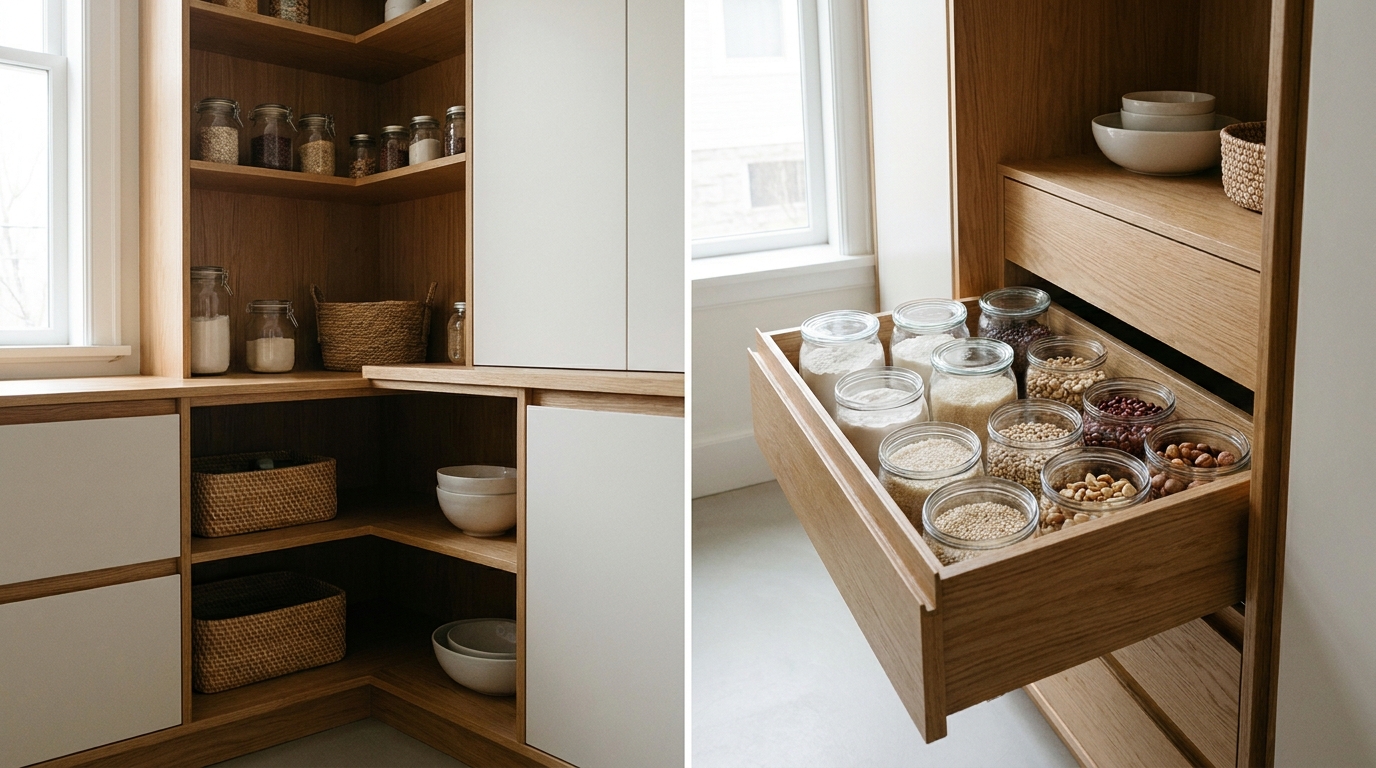
The drawer holds the empty containers. The refrigerator holds the food. Nest the bases in one deep pull-out, and lay the matching lids in a shallow tray in the same cabinet, so you are not hunting a cover while a pot of soup sits on the counter. FDA guidance current as of March 2024 says to divide leftovers into shallow containers and to refrigerate or freeze them within 2 hours [1].
1. Why the counter pile fails on a weeknight
A tower of tubs beside the toaster is only ugly until you have a hot pot and no matching lid. The FDA refrigerator-thermometer page, current as of March 2024, says leftovers need to be refrigerated or frozen within 2 hours, and within 1 hour if the air is above 90 °F [1]. That page also says that at room temperature, the numbers of bacteria that cause foodborne sickness can double every 20 minutes [1]. The clock does not pause while you match a blue lid to a clear base from a different set.
The container you grab because it is the only one in reach is often too deep, and it holds the whole pot. Kansas State University Extension, in a November 2024 note from food scientist Karen Blakeslee, says never to place a large container of hot food, such as soup, into the refrigerator, because it cools very slowly and bacteria that may be present can multiply [2].
The repair is a drawer that puts a shallow base and its own lid in your hand. Filled leftovers still go in the refrigerator, not in that drawer.
2. What a safe leftover container has to do
"Shallow" is the word the federal page uses, and it does not give an inch depth. The FDA page current as of March 2024 says to divide leftovers into smaller containers before they go into the refrigerator, and to divide large amounts into shallow containers for quicker cooling [1]. It also says that putting hot food in the refrigerator does not harm the appliance [1]. You should not move the food as one deep, steaming mass.
Extension pages add a depth FDA does not state. In November 2024, K-State suggested containers about two inches in depth so hot leftovers cool faster [2]. A Clemson Extension leftovers fact sheet, revised in November 2016, says to put liquid foods such as hot soup or chili in shallow containers no more than 2 inches deep, then refrigerate or freeze them quickly [4].
Those are two university recommendations, not a building code for the cabinet. The two-inch figure describes the container the food sits in. The pantry drawer can still be deep, because it stores empty bases nested inside each other.
A few limits belong on the same card.
- Use a short clock. Refrigerate or freeze leftovers within 2 hours, or within 1 hour above 90 °F [1].
- Hold the fridge cold enough. FDA's March 2024 page says to keep the refrigerator at 40 °F or below and the freezer at 0 °F, and it says few refrigerator controls show the actual temperature, so an appliance thermometer is worth using [1].
- Know the refrigerator window. K-State reported in November 2024 that leftovers can be kept safely in the refrigerator for 3 to 4 days [2]. University of Minnesota Extension, in a November 2024 holiday note, says to use refrigerated leftovers within three to four days [3].
- Treat the freezer as a safety hold. FDA states that foods stay safe indefinitely in the freezer, while quality and taste may be affected [1]. K-State says frozen leftovers are safe indefinitely, but they can lose moisture and flavor when stored longer than 3 to 4 months [2].
- Reheat with a thermometer. K-State says reheated food should reach 165 degrees Fahrenheit, then rest, because heat is still rising after microwave heating [2]. Minnesota Extension's November 2024 note says to reheat hot foods to at least 165 degrees Fahrenheit [3].
- An ice bath is optional. K-State describes setting the smaller containers in an ice water bath to speed chilling, and still says to store leftovers within two hours after cooking [2].
The two-inch figure is about the food container, not the cabinet. The drawer only has to make that low container, and its lid, easy to grab.
3. A deep drawer for nested bases
Bases want height. A quart from one family nests inside the next size up. A deep pull-out brings the back row forward, which a fixed shelf will not do. Our pantry layouts use pull-out drawers for that reason.
Keep one family together. Lids from one brand rarely seal another. K-State's November 2024 guidance says to plan ahead and use containers that can go in the freezer [2]. A piece that warps when frozen does not earn a place in the working nest.
Put the low, wide pieces in front. Those are the ones that can hold hot soup or chili in the shallow layer K-State and the 2016 Clemson sheet describe [2][4]. Taller squares can sit behind them for food that is already cold. If the front row is all deep buckets, the drawer has rebuilt the pot problem in plastic.
Keep glass and plastic in separate stacks. They can share the drawer. The rims do not match, so they should not share a nest. We size the opening to the containers you will keep.
Leave the meal in the fridge. FDA says not to overpack the refrigerator, because cold air has to circulate around the food [1]. This drawer stores empties only. Wash and dry them before you nest, or a wet lid will not lie flat in the tray.
4. A shallow tray for the lids
Lids are flat, they look alike from the edge, and a tall stack hides the rim that fits. A shallow tray, one layer deep, shows the shape. Group square with square and round with round, small lids in front of large ones.
The tray can sit in the drawer above the bases, or in a slim pull-out directly over them. You should be able to pick the lid with the hand that is not holding the hot container.
The lid has a job during cooling, and it is not "clamp it shut at once." University of Minnesota Extension's November 2024 holiday guidance says not to overfill the container, to leave room for air, to put the filled container in the refrigerator with the lid cracked open so heat can escape, and to secure the lid once the food has cooled [3]. That sequence works only if the lid is already in your hand.
After the food is cold, the cover stays on for a different reason. The FDA page current as of March 2024 says to store refrigerated foods in covered containers or sealed storage bags, and to check leftovers daily for spoilage [1].
A base with no matching lid cannot do that job. It leaves the working set.
The same tray keeps a date readable. The 2016 Clemson fact sheet says to put tape on the container and write the date [4]. Write it on the lid, face up in the fridge, so the 3-to-4-day window is not a memory test [2][3].
When you reheat, K-State says to rotate or stir the food and to let the lid vent steam [2].
5. Which containers earn a place in the drawer
FDA describes a food contact substance as something that touches food and is not meant to change the food, including packaging, equipment, preparation surfaces, and cookware [6]. A food contact substance that is a food additive must be authorized before it is marketed in the United States [6]. That rule is for manufacturers. The household version is on a Penn State Extension page updated in August 2025: food must be stored in food-grade containers at all times [5].
Penn State says to skip pieces that were not made for food. The page points to trash bags as a bad stand-in, and it points to zip-top bags and reusable plastic food-storage containers as pieces designed for food [5]. The same page says never to store food in a container that originally held cleaning chemicals or other non-food products [5].
Microwave use is a second filter. FDA's microwave oven page says to use microwave-safe cookware made for the microwave, and it warns that some plastics melt from the heat of the food [7]. Microwaves pass through glass, paper, ceramic, and plastic, but the container can still get hot from the food [7].
Generally, metal pans should not be used, because the microwaves are reflected and the food can cook unevenly [7]. The 2016 Clemson sheet says not to reheat in Styrofoam or restaurant carry-out containers, because they can warp or melt and possibly transfer harmful chemicals into the food [4]. Clemson also says the dish should indicate if it is microwave-safe [4]. Leave chemical tubs out of the drawer [5], and do not keep restaurant carry-out containers as the reheat set [4].
6. Where this drawer sits in the pantry
Place the pair on the path between the range and the refrigerator. Full-extension slides matter more than a fancy front. If you can see every base when the drawer is open, you will use the shallow ones.
Keep the bay to containers and lids. Other pantry jobs have their own homes, and mixing them turns the lid tray into a junk tray. A reach-in can do this with two drawers. A walk-in can do it with a bank near counter height.
We measure the containers you will keep before we set the depths. A drawer that is a little too tight bows the lids, and bowed lids do not seal.
Practical takeaways
- Split the cabinet by shape. Nest empty bases in one deep drawer, and keep lids flat, in one layer, in a shallow tray.
- Move food on a short clock. Refrigerate or freeze leftovers within 2 hours, or within 1 hour above 90 °F, and keep the refrigerator at 40 °F or below [1].
- Use a low container for hot soup or chili. K-State, in November 2024, suggests about two inches in depth, and a 2016 Clemson fact sheet says no more than 2 inches deep for those liquids [2][4].
- Split a large pot. Do not put one large container of hot soup into the refrigerator, and divide the food so it can cool [1][2].
- Crack the lid, then close it and date it. Cool in the refrigerator with the lid cracked, then secure the lid [3]. Tape the date on the container [4]. Use refrigerated leftovers within 3 to 4 days [2][3].
- Reheat and vent the lid. K-State says to reheat leftovers to 165 degrees Fahrenheit and to vent the lid [2]. Do not microwave Styrofoam or restaurant carry-out containers [4].
- Keep the drawer food-grade. Do not reuse tubs that held cleaners or other non-food products [5][6].
How we can help
We build the drawer and the lid tray into custom pantries for homes in Charlotte, Fort Mill, and nearby towns, sized to the containers you will keep. See the layouts on our custom pantry page. Have more questions or want to get in touch? Use our contact page, call (704) 604-3870, or email design@theclosetrehab.com.
Citations
- U.S. Food and Drug Administration, "Refrigerator Thermometers - Cold Facts about Food Safety" (2024-03-05)
- Kansas State University Research and Extension, "K-State food scientist shares tips for safe leftovers" (2024-11-26)
- University of Minnesota Extension, "From prep to plate: Food safety tips for the holidays" (2024-11-15)
- Clemson Cooperative Extension, Home & Garden Information Center, "Leftovers" (HGIC 3606, revised 2016-11-15)
- Penn State Extension, "Unacceptable Food Storage Containers" (2025-08-25)
- U.S. Food and Drug Administration, "Food Packaging & Other Substances that Come in Contact with Food - Information for Consumers" (2024-07-24)
- U.S. Food and Drug Administration, "Microwave Ovens" (2023-10-12)