Custom Closet Accessories: Valet Rods, Ties, Mirrors
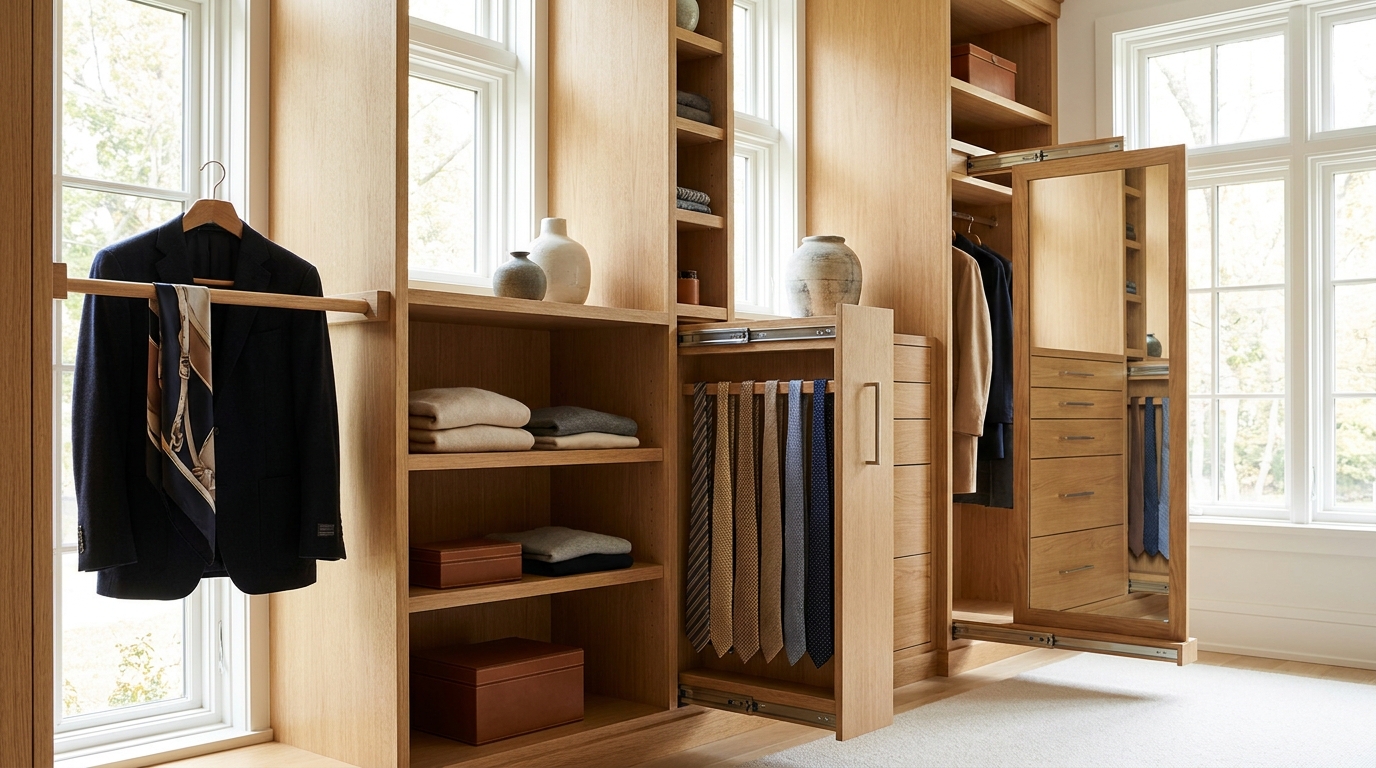
The closet accessories that actually shorten a weekday morning sit outside the drawer. A valet rod holds tomorrow's outfit at standing height, a tie or belt pull-out shows the full row in one motion, and a pull-out mirror lets you check the look without leaving the room. Those three pieces of custom closet accessories cut the hunting, the second-guessing, and the extra trip down the hall. They are not jewelry trays and they are not shoe displays. They are daily-use hardware on the cabinet face or beside the hanging rod, where your hands already go. A 2008 Journal of Personality and Social Psychology study found that making many choices later reduced self-control (less stamina, less persistence, more procrastination). [1] Staging the outfit the night before, and seeing ties or belts in a single pull, turns morning work into follow-through instead of a new round of decisions.
1. Why hardware outside the drawer speeds the morning
A drawer is a good place to park things you do not need to see. It is a poor place to park things you must compare at 6:45 a.m. Each extra open-rummage-close cycle is another choice. In a 2000 field study at a grocery tasting booth, shoppers who faced 24 jam flavors were more likely to stop, yet only 3% bought a jar, while about 30% of shoppers who faced six flavors made a purchase [2]. A closet is not a jam aisle, but a weekday wardrobe with no short list has the same problem.
The morning job is retrieval, not browsing. The valet rod, the tie pull-out, and the belt pull-out give you a list you already made. Cornell University's workstation guide (last revised in 2015) says to put the things you use most often closest, so they can be reached comfortably. [4] We mount daily hardware at standing height beside the hanging section, not on a high shelf.
Oregon State Parks textile guidance is blunt about long-term hanging of knits: do not hang knits, because they stretch and sag, and that damage is irreversible. [8] A valet rod is a short hang for tonight's shirt, not a sweater warehouse.
2. Valet rods: stage tomorrow tonight
A valet rod is a slim bar that slides out of a cabinet side, a hanging panel, or the underside of a shelf. You hang one complete outfit, push the rod back so the aisle stays clear, and dress from that bar in the morning.
Mount it where you already stand. NIOSH's 2007 ergonomic guidelines for manual material handling describe a "power zone" for work: above the knees, below the shoulders, and close to the body. [3] A valet rod at chest-to-shoulder height for the person who uses the closet sits in that zone. A rod above the top hanging pole forces a reach. A rod at knee height forces a stoop, and a long garment then drags.
Use it as a one-night station, not extra hanging capacity. The bar is for a shirt, a jacket, trousers, or a dress on a proper hanger. Oregon's hanging notes favor padded hangers and, for pants and skirts, a trouser hanger rather than a thin crossbar. [8]
Put one rod per person who dresses in that closet. Two short rods beat one long bar that becomes a dump. University of Kentucky Extension notes that clothes moth larvae prefer dark, undisturbed places where woolens sit for long periods, and that clothing in regular use is seldom infested. [9] A rod that turns over every day is the opposite of that forgotten bin. It does not replace cleaning or sealed seasonal storage.
3. Tie and belt pull-outs: see the whole set at once
A hook on the back of a door holds three ties and hides the rest. A pull-out rack brings the full row into the light. You scan, pick, and slide it shut. The same hardware works for belts, and we often spec a pair so the two do not share prongs.
Visibility is the feature, not density. You can store more ties on a crowded hook. You cannot see them. The 2000 jam study is a reminder that a large, poorly structured set makes people less likely to finish a choice. [2] Twenty ties in one plane is a structured set. A dark cluster of knots is not.
Keep the pull-out in the power zone. NIOSH's language is a workplace standard, not a homeowner code, but the mechanics still apply: frequent work above the knees, below the shoulders, and close to the body. [3] A rack at eye-to-chest height is a glance. A rack at the floor is a squat. Cornell's "keep it close" rule is the horizontal version. [4] We mount pull-outs on a hanging-section side wall or in a narrow cabinet that opens into the aisle.
Do not treat a pull-out as a jewelry drawer. This is face-of-cabinet hardware, not a felt tray and not a shoe fence. If it starts holding sunglasses and a lint roller, the morning scan is gone. A loaded pull-out is a cantilever. It should miss the door swing, the island, and a person at the valet rod.
4. Pull-out mirrors: check the outfit without leaving the closet
A pull-out or pivot mirror hides in a panel and comes out for a full-length look. In a walk-in it can live on the end of a run. In a reach-in it often lives on a side wall, or on the back of a solid door if the swing is clear. The job is to confirm the outfit you already staged, then go.
Light the face and the fabric, not only the ceiling. ENERGY STAR's Lamps Version 2.1 specification requires a color rendering index (Ra) of at least 80 for solid-state lamps, with an R9 value greater than 0. [10] That is a floor for honest color. Navy, charcoal, and black still need light on the garment and on your face. A single overhead can put your shadow on the glass. Side light or a listed closet luminaire at the dressing spot works better than a bare bulb over the rod.
Respect closet fixture clearances. The 2024 International Residential Code (E4003.12) limits luminaire types in clothes closets and sets clearances from storage. Surface-mounted LED luminaires with a completely enclosed light source need at least 12 inches from the nearest point of a storage space unless the luminaire is identified as suitable for use inside that storage area. Recessed enclosed LED luminaires need at least 6 inches. Open incandescent lamps and pendant luminaires are prohibited. [11] If the mirror slides toward a fixture, we keep storage and the lamp on the right sides of that gap.
Stand square to the glass. Cornell's monitor note is about screens, but the posture still helps: keep what you are looking at in front of you, at a comfortable height, so you are not twisting your neck. [4] We spec a height that covers shoes to collar, out of the door's arc.
5. Height, reach, and who actually uses the closet
Shared closets fail when every accessory is set for one person's shoulder height. NIOSH's power zone is relative to the person doing the work, not to a catalog number. [3] We note who dresses in the space, whether anyone has a shoulder or back limit, and whether kids will grab belts. Cornell's first workstation question is who will use the setup. [4]
Kids change the map. CPSC's July 2025 Anchor It anniversary release still tells households to avoid storing appealing items where children may climb, and to store heavier items on lower shelves. [7] A tie pull-out at toddler eye level is a climbing invitation. Put adult hardware in the adult power zone. Two valet rods are worth it when two people dress at the same time. One shared mirror can serve both if the aisle is wide. The expensive mistake is one rod in the middle that both people treat as a dump.
6. Safety: pull-outs, remaining dressers, and what STURDY actually covers
Custom closet systems that are built in and permanently attached to the building are a different product class from a free-standing dresser. CPSC's clothing-storage-unit guidance, implementing the STURDY law at 16 CFR part 1261 for units manufactured after September 1, 2023, defines a clothing storage unit as free-standing bedroom furniture at least 27 inches tall, at least 30 pounds, and at least 3.2 cubic feet of enclosed storage. Built-in units intended to be permanently attached to the building are outside that scope. [6]
Free-standing pieces still need to be anchored. In April 2023 CPSC reported 234 fatalities from clothing-storage-unit tip-overs from January 2000 through April 2022, including 199 child fatalities, and estimated 84,100 emergency-department injuries (about 5,300 per year) from 2006 through 2021. The Commission recommends that consumers anchor furniture, including dressers, securely to the wall. [5] If a bedroom still has a dresser next to a built-in, that dresser is the piece the rule is written for.
Extendible hardware changes the load path. STURDY's tests include loaded drawers, multiple drawers open, and a 60-pound child-weight test on the front of a door or extendible element. [5] [6] A pull-out mirror or loaded tie rack on a free-standing cabinet is that kind of element. On a built-in, the cantilever still has to land in a panel fastened to the wall or to a secured gable. We do not hang a pull-out on a floating filler.
Close it when you leave. An extended valet rod is a snag in a dark room. A mirror left in the aisle is a corner at face height. CPSC's 2025 campaign recap notes a nearly 50-percent decline in tip-over-related injuries and deaths associated with Anchor It and the later mandatory standard, and still repeats: anchor furniture, keep tempting items out of climb range, put heavier items lower. [7]
7. How we spec the three together
The three accessories work as a loop. Night: hang the outfit, pick the tie or belt, glance in the mirror. Morning: dress from the rod, confirm, leave. The rest of the closet can stay packed because the day's choice already happened.
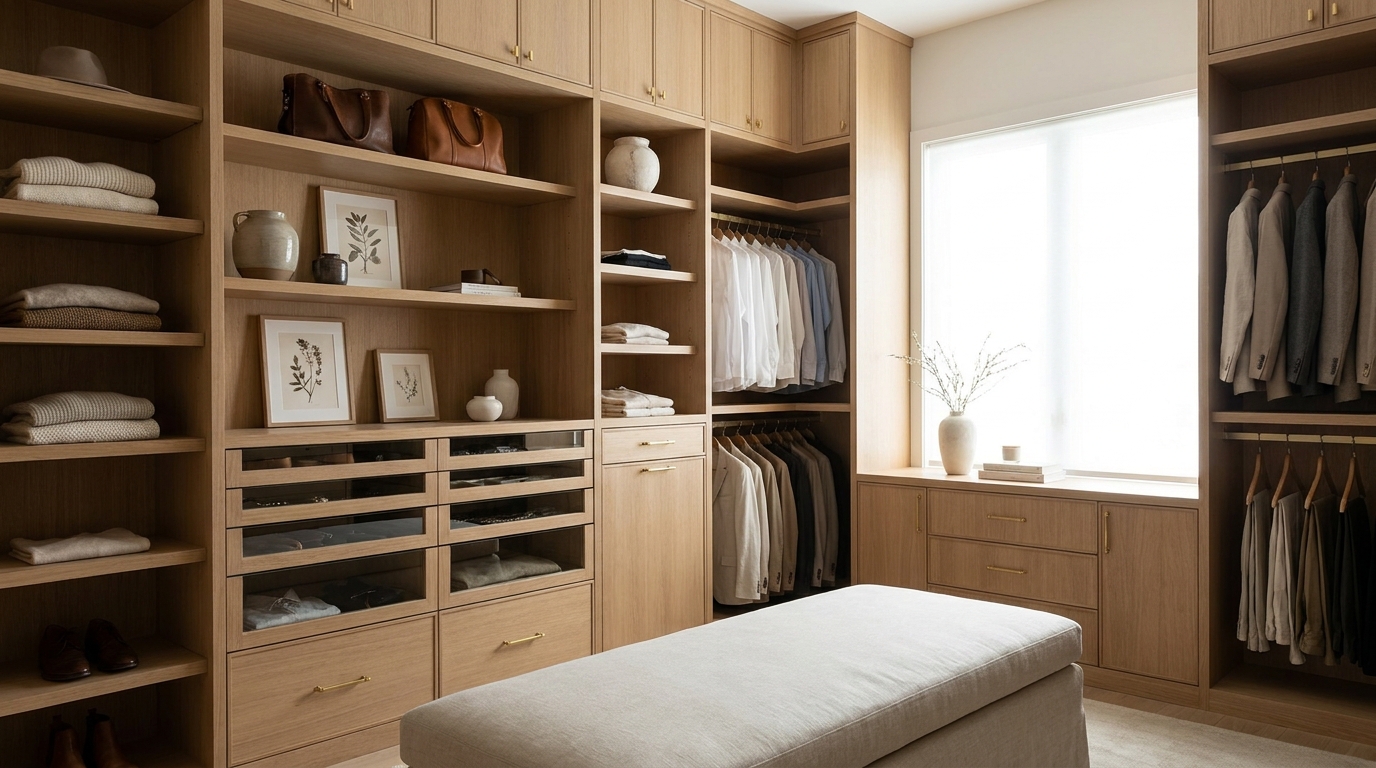
Walk-in layout. Valet rod at the end of the primary hanging run, tie and belt pull-outs in a narrow cabinet beside it, mirror on the opposite panel or island end. Lighting hits the rod and the glass. The aisle stays a walk path when everything is pushed in.
Reach-in layout. The valet rod often mounts just inside the jamb or under a shelf. Pull-outs sit on a side panel. The mirror may be a full-length pull-out or door-mounted glass if the door is solid. Reach-ins in older Charlotte and Fort Mill homes are often 24 inches deep. That is enough for a slim pull-out. It is not enough for a jewelry stack plus a mirror plus a shoe display in the same opening.
Jewelry trays belong in a shallow drawer. Shoe displays belong on an angled shelf or cubby. On our cabinet accessories page you will see valet rods, tie racks, and belt racks as face hardware. On our custom closets page we treat those accessories as part of the hang-space conversation.
Practical takeaways
- Stage tonight, dress tomorrow. One valet rod per person, at that person's chest-to-shoulder height, for a single outfit on a proper hanger. [3] [8]
- Show the full row. Use a tie pull-out and a belt pull-out you can scan without squatting. Keep them in the power zone (above the knees, below the shoulders, close to the body). [3] [4]
- Check in the closet. Spec a pull-out or full-length mirror you can stand square to, with listed closet lighting that clears storage by the code distances (12 inches for many surface LEDs, 6 inches for many recessed enclosed LEDs). [11]
- Use lamps that render color honestly. ENERGY STAR's lamp spec sets CRI (Ra) at 80 or higher for LED lamps, with R9 greater than 0. Treat that as a minimum when matching navy and black. [10]
- Do not hang knits on the valet rod for weeks. Oregon textile guidance: knits stretch and sag, and that change does not reverse. Clean wool before long storage. Clothes moth larvae prefer dark, undisturbed piles, not clothing in regular use. [8] [9]
- Cut the choice set. A 2000 study found people were far more likely to complete a purchase from 6 options than from 24. [2]
- Anchor leftover dressers. Built-in closets are outside STURDY's free-standing CSU definition. Free-standing dressers still need wall anchors. CPSC estimated about 5,300 clothing-storage-unit tip-over injuries a year from 2006 through 2021. [5] [6] [7]
How we can help
Our team designs walk-in and reach-in closets around the way you actually dress, including valet rods, tie and belt pull-outs, and pull-out mirrors as daily hardware (not as drawer trays or shoe walls). We measure the people who use the space, set accessory heights in a comfortable reach band, and keep lighting and pull-out travel inside a clear aisle.
Have more questions or want to get in touch? https://theclosetrehab.com/contact-us/ · (704) 604-3870 · design@theclosetrehab.com
Citations
- American Psychological Association / Vohs et al., "Making Choices Impairs Subsequent Self-Control: A Limited-Resource Account of Decision Making, Self-Regulation, and Active Initiative" (2008)
- Iyengar and Lepper, University of Washington faculty reprint, "When Choice Is Demotivating: Can One Desire Too Much of a Good Thing?" (2000)
- NIOSH / CDC, "Ergonomic Guidelines for Manual Material Handling, DHHS (NIOSH) Publication No. 2007-131" (2007)
- Cornell University Ergonomics Web, "Ergonomic Guidelines for arranging a Computer Workstation - 10 steps for users" (revised 2015-06-13)
- U.S. Consumer Product Safety Commission, "CPSC Adopts Final Consumer Product Safety Standard to Prevent Tip-overs of Dressers and Other Clothing Storage Units" (2023-04-19)
- U.S. Consumer Product Safety Commission, "Clothing Storage Units" business guidance (16 CFR part 1261 / ASTM F2057, units manufactured after 2023-09-01)
- U.S. Consumer Product Safety Commission, "CPSC Anchor It! Campaign Marks 10 Years: Fewer Furniture Tip-Overs Lead to Safer American Households" (2025-07-29)
- Oregon Parks and Recreation Department, "Caring for Textiles: Cleaning and Garment Hanging" (Oregon Heritage Bulletin)
- University of Kentucky Entomology / Michael F. Potter, "ENTFACT-609: Clothes Moths" (revised 2026-03)
- U.S. EPA ENERGY STAR, "ENERGY STAR Program Requirements for Lamps - Eligibility Criteria Version 2.1," section 9.7 Color Rendering (solid-state Ra >= 80, R9 > 0)
- International Code Council, 2024 IRC via UpCodes, "2024 International Residential Code, Chapter 40 Devices and Luminaires, E4003.12 Luminaires in Clothes Closets" (2024)