Pantry Organization Zones That Keep Cooking Fast
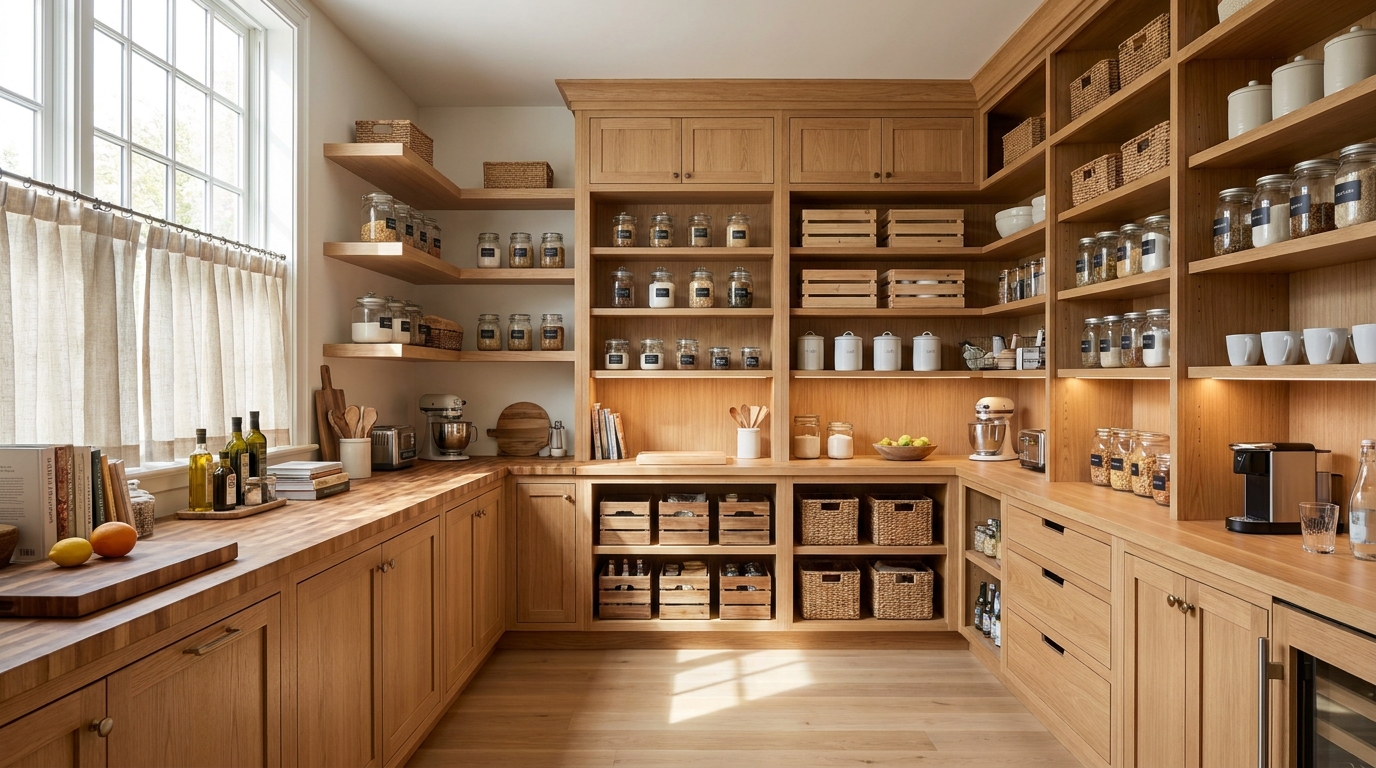
A family pantry cooks faster when it is zoned around real meals, not matching bins. Put weeknight staples at adult arm's reach, give baking its own shelf run, and keep a kid-height snack band that is food only. North Carolina Cooperative Extension describes this as grouping a pantry into utility zones (including a baking zone) and rotating stock first-in, first-out so older food stays visible [1]. The same map works in a walk-in and a tight reach-in. This is everyday kitchen storage, not a butler's pantry or scullery.
1. Zone the pantry by how you cook, not by package size
Start with the week's meals, then assign shelves. If Tuesday is pasta, Thursday is tacos, and Saturday is muffins, those ingredients should live in predictable places. Illinois Extension's pantry guidance is simple: organize by category so you can see what you already have, and use first-in, first-out so the oldest box or can sits in front [2]. That is the backbone of pantry organization zones.
Utility beats matching labels. N.C. Cooperative Extension's "strategic pantry" advice is to skip arranging by size or looks and instead build zones by task: a baking zone for flours, sugars, and leaveners, a quick-fix zone for marinara, tuna, and fast noodles, and a flavor zone for oils and vinegars [1]. Add a breakfast band or lunch-packing strip if that is how your kitchen actually runs. The cook should not hunt three shelves for the one can that finishes dinner.
Walk-in and reach-in use the same four bands. A walk-in spreads the map across walls. A reach-in stacks it from floor to header: kid snacks low, everyday cooking in the middle, baking to one side, bulk and backup up high or in the deepest bay. Door racks catch spices and packets. Either layout fails when everything shares one "food" pile.
Check what you own before you shop. FDA consumer guidance on cutting waste is blunt: plan meals, use a list, and check the fridge and pantry so you do not buy what you already own [8]. Confusion over date phrases such as "best if used by" accounts for an estimated 20 percent of consumer food waste, according to that 2024 FDA page [8]. Zones make that check a glance at one band.
2. Everyday cooking reach: the weeknight band
This is the only band that has to work on a tired weeknight. Oils, everyday spices, pasta, rice, canned tomatoes, beans, broth, and the two or three sauces you actually use belong between waist and eye height for the person who cooks most. If you kneel for olive oil or climb for salt, the zone is wrong. Pull-out trays, tiered risers, and shallow spice ledges keep the front row honest.
Keep the working set small and current. Illinois Extension notes that risers help you see canned goods and spices without moving a stack, and that first-in, first-out stops you from opening a second jar of the same thing [2]. Virginia Cooperative Extension says the same: put new purchases behind what is already on the shelf, and check printed dates when food arrives from more than one store [3]. Two open ketchups is a delay, not a system.
Leave landing space. A short clear strip on a pantry counter, or one sturdy pull-out shelf, gives you a place to set tonight's cans. In Charlotte-area kitchens we often see that shelf already claimed by paper towels and school flyers.
Do not park leftovers in the dry pantry. FDA storage guidance keeps perishable food on a two-hour clock at room temperature (one hour if the air is above 90°F) and tells you to refrigerate or freeze items that need cold as soon as you get home [4]. Cooked leftovers belong in labeled, covered containers in the refrigerator, where Virginia Extension recommends using them within 3 to 4 days or freezing them [3]. The pantry holds shelf-stable food you can grab without thinking.
3. Baking zone: flour, sugar, and project ingredients
Give baking its own address. N.C. Cooperative Extension calls out a baking zone for flours, sugars, and leavening agents so you can see what a recipe still needs [1]. Group flour, sugars, baking powder, baking soda, cocoa, chips, extracts, and mixer attachments in one vertical run. Saturday baking should not raid the weeknight pasta shelf.
Cool and dry matter more than pretty canisters. Virginia Extension tells consumers to store dry foods such as flour, crackers, cake mixes, seasonings, and canned goods in original packages or tightly closed airtight containers below 85°F, with 50°F to 70°F as the better range [3]. Humidity above 60 percent can make dry foods cake and stale, and it can rust cans [3]. A baking zone next to a dishwasher vent, oven side panel, or sunny window fights that advice.
Whole grains and little-used flours need extra care. Virginia Extension notes that whole wheat flour and other whole grains keep longer in the refrigerator or freezer because their natural oils can go rancid at room temperature [3]. UC Statewide IPM adds: store infrequently used flours, spices, and grains in the freezer when you can, and do not mix old product into a new bag [6]. Daily flour can live in airtight canisters. Cake flour you use twice a year can live in a labeled freezer bin.
Sealed containers are pest control, not just style. USDA Agricultural Research Service, in 2023 reporting on the Indian meal moth, recommends keeping flour, grains, and other pantry items in thick plastic or glass containers with airtight lids, and skipping damaged packages at the store [5]. UC IPM is just as direct: plastic bags are not enough, lids should fit tightly, and you should wash old containers before you refill them [6].
4. Kid-height snacks: a food-only band
Put approved snacks where kids can reach them without climbing. A low drawer, a pull-out bin, or the bottom two shelves can hold pretzels, applesauce pouches, granola bars, and the cereal you are willing to see at 7 a.m. Parents still choose what lives there. Kids then serve themselves without dragging a chair to the chocolate chips.
This band is food only. No exceptions. FDA storage guidance says to keep food away from poisons and not to store non-perishable foods near household cleaning products and chemicals [4]. Virginia Extension is equally clear: store food separately from non-food items such as household cleaners and insecticides, because contamination of food or utensils can cause chemical poisoning [3]. Dish tabs, stainless spray, vitamins, and pet medicines do not belong under the granola bars.
Use height as a parent tool. Heavy glass jars, large cans, and anything you do not want handled without help stay above kid reach. The snack band should be light packages in bins a child can pull forward without a cascade. If a toddler can open the snack drawer, that drawer cannot also hold the floor cleaner. Extra cookies and baking chocolate belong in the baking zone or on a higher overflow shelf, not in the self-serve strip.
5. Overflow and bulk: backups that do not block dinner
Backup stock is a fourth zone, not a second copy of the everyday band. Club-size pasta, the case of beans, extra paper goods, and pet food belong on the highest safe shelf, in a deep pull-out, or on a far wall of a walk-in. The everyday band holds one working supply. Overflow holds the rest.
Rotate on the day you unpack groceries. First-in, first-out is the method both N.C. Cooperative Extension and Illinois Extension teach for home pantries: older jars and boxes come forward, new purchases go behind [1][2]. Virginia Extension adds that if food arrives from more than one source, check the printed dates so you know the order [3]. A strip of painter's tape with the month you opened a bag of flour or rice makes that rotation visible.
Bulk dry goods need thicker walls than the bag they arrived in. USDA ARS notes that Indian meal moths can move through tiny openings in plastic or cardboard and will feed on cereal, pet food, flour, cornmeal, and dried fruit [5]. UC IPM tells households to store bulk goods such as pet food in containers with tight-fitting lids, not plastic bags, and to keep storage units dry because moisture favors pantry pests [6]. EPA's consumer pest-prevention page repeats the first step: store food in sealed plastic or glass containers, and do not leave pet food out overnight [7].
Check the overflow zone before you shop. FDA's waste-reduction tips start with knowing what you already have and avoiding impulse or bulk buys you will not use [8]. If you cannot see the back of a deep bay, the zone is too deep without a pull-out.
6. Cool, dry, sealed: the rules that keep every zone honest
Aim for a cool, dry cabinet, not a warm alcove. Virginia Extension's consumer storage publication, revised in 2025, sets dry-food storage below 85°F and names 50°F to 70°F as the better range [3]. If the pantry shares a wall with an oven or sits over a dishwasher, keep oils, chocolate, and whole-grain flours on the coolest shelf, or move them to a nearby cabinet closer to that range.
Inspect cans the way you inspect produce. FDA tells consumers to reject or discard cans that swell, leak, puncture, fracture, rust deeply, or dent badly enough that they will not stack or open normally, and to treat stickiness on a can as a possible leak [4]. That check belongs in the overflow zone, where cans sit longest.
Treat moths and beetles as a package problem, not a dirty-house problem. UC IPM explains that pantry pests usually arrive in an infested package, that the Indian meal moth is the most common moth on home food products, and that by the time you see adults they have often spread [6]. USDA ARS reported in 2023 that a mature female Indian meal moth may lay up to 300 eggs on a food source once grain is at least 50°F [5]. If you find webbing, holes, or larvae, bag and trash the package, vacuum corners, and wash shelves. UC IPM does not recommend spraying pesticides on or near food [6].
Clutter is habitat. EPA's pest-prevention do's and don'ts tell households to remove food, water, and shelter, store food in sealed containers, take garbage out regularly, and clear stacks of newspapers, magazines, or cardboard that give pests places to hide [7]. Break down boxes after you decant.
7. What a custom pantry can hold that bins cannot
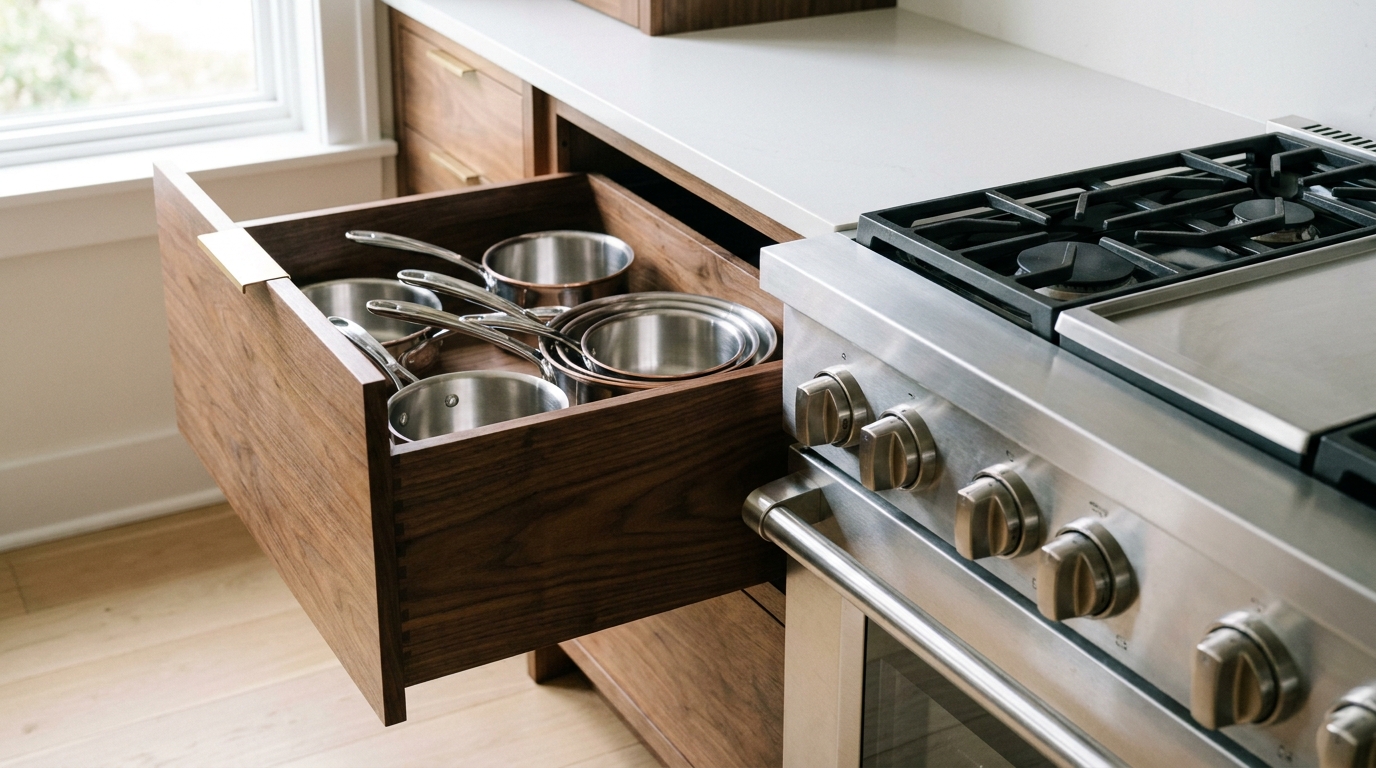
Zones need hardware that matches the job. Adjustable shelves let a cereal box and a can riser share a bay. Pull-out drawers show the back of the everyday band. A door-mounted spice rack keeps weeknight seasonings in the cook's hand. A low drawer is a better kid snack band than a stack of baskets a child will pull over.
We design pantry organization zones around the household, not a catalog layout. On our custom pantry page you will see the same ideas in built-in form: pull-out drawers, canned-goods rows, spice organization, appliance parking, and adjustable shelves for walk-in and reach-in rooms. A mixer garage belongs near the baking zone. For the measure-to-install sequence, see how it works.
Measure the people, then the packages. The cook's shoulder height sets the everyday band. The tallest cereal box and the shortest spice tin set shelf spacing. The youngest child who is allowed to snack sets the top of the kid band. A reach-in can still run all four zones with slim pull-outs, door racks, and one deep drawer. If your kitchen cannot spare a walk-in, the map does not change. Only the furniture does.
Practical takeaways
- Draw four pantry organization zones before you buy a single bin: everyday cooking at adult reach, baking in one vertical run, kid-height snacks that are food only, and overflow or bulk up high or in a deep pull-out.
- Group by how you cook (pasta night, baking day, lunch packing), not by package color. Extension guidance on utility zones and category grouping is built for that habit [1][2].
- Rotate first-in, first-out every grocery trip. New food goes behind. Opened duplicates get used before you crack a third jar [1][2][3].
- Keep dry staples cool, dry, and sealed. Target the 50°F to 70°F range when you can, watch humidity, and use thick plastic or glass with tight lids for flour, grains, and pet food [3][5][6].
- Never store cleaners, insecticides, or medicines with food. The snack band is for parent-approved food, not for "under the sink" overflow [3][4].
- Check the pantry before you shop. Date labels are mostly about quality, not a hard safety cliff (infant formula is the exception) [3][8].
- If you see moths, webbing, or pinholes, throw out the affected package and wash the bay. Do not spray pesticide on food shelves [6][7].
How we can help
Have more questions or want to get in touch? Our team will map pantry organization zones to the way your household actually cooks, then build the shelves, pull-outs, and kid-height drawers that hold that map. Start on our contact page, call (704) 604-3870, or email design@theclosetrehab.com.
Citations
- N.C. Cooperative Extension, Brunswick County Center, "Strategic Pantry" (2026-06-03)
- University of Illinois Extension, Eat.Move.Save., "Prep Your Pantry" (n.d.)
- Virginia Cooperative Extension, "Food Storage Guidelines For Consumers" (2025-10)
- U.S. Food and Drug Administration, "Are You Storing Food Safely?" (2023-01-18)
- USDA Agricultural Research Service, "USDA Research Identifies and Tracks Moth Species That Can Destroy Packaged Food" (2023-07-25)
- University of California Statewide IPM Program, "Pantry Pests" (UC ANR Publication 7452)
- U.S. Environmental Protection Agency, "Do's and Don'ts of Pest Control" (2026-05-05)
- U.S. Food and Drug Administration, "How to Cut Food Waste and Maintain Food Safety" (2024-03-05)