Garage Ceiling Storage: Racks vs Cabinets
Charlotte-area homeowners can use garage ceiling storage for holiday bins, camping totes, and off-season gear without crowding the parking bays, as long as the rack or cabinet sits outside the door's travel path, above the tallest vehicle, and clear of lights, openers, and hanging appliances. Overhead racks suit lightweight, lidded bins you rarely need. Closed ceiling cabinets suit dusty or odd-shaped items you still want contained. Either choice fails if it clips a door, a roof, or a car. North Carolina's 2024 Residential Code still requires gypsum fire separation on the garage side of the house, including a thicker Type X ceiling when living space sits over the bays, so fasteners have to land in framing, not in finish drywall. [1]
1. Measure the parking envelope first
Before anyone talks about racks versus cabinets, we measure four things in the same session: finished floor to the lowest ceiling obstruction, the door header height, the full travel of the door and opener, and the height of the tallest vehicle that actually parks there (including roof racks, bikes, and cargo boxes).
The useful number is leftover lift, not total ceiling height. The inches between a truck roof and an opener rail are not all storage. You still need a buffer for people walking around the hood, for the door's last inches of travel, and for a bin that is not perfectly square.
Park the cars, then look up, with the door fully open. From inside the garage, the door, the horizontal tracks, the opener rail, and the light fixtures are the real ceiling, not the drywall plane. DASMA's inspector checklist asks whether the door fully opens and stops above the opening, and whether it stays in the fully open position. [8] If a proposed rack would answer "no" to either question, it does not belong there. A 1990s two-car in Wesley Chapel or Fort Mill can have a tight header. A newer three-car in Indian Land may have extra height in the third bay and almost none over the door.
2. How the door, opener, and lights claim the ceiling
A sectional door does not vanish when it opens. On a standard-lift track it rises, turns, and then travels back along the ceiling. That horizontal run is the most common place overhead storage gets into trouble. A side-mounted (jackshaft) opener can free the center of the ceiling because there is no rail, yet the door still has to move without hitting a cabinet.
Treat the door, track, and opener as one system. DASMA warns that reuse of old track with a new door can fail when section thickness, door weight, required headroom, or opener location changes. [9] If the current lift is already tight, we look at wall storage first, or we keep ceiling units over the rear of the bays.
Leave the safety devices alone. DASMA's opener guidance (the "six-inch rule" and the "five-foot rule") puts photoelectric sensors no higher than six inches off the floor and the wall button at least five feet above any adjacent walking surface. [7] A 2023 DASMA checklist also calls for a red manual-release handle no more than six feet above the floor while still clearing vehicles, and for a contact reverse test with a 1-1/2-inch object (a 2x4 laid flat) under the door. [8] Storage should never become a reason to relocate those devices.
A 1992 CPSC rulemaking on automatic residential garage door openers, still the backbone of UL 325 listing, urged owners to confirm a reversing feature and then test it monthly. If the door fails to reverse, stop using it until it is adjusted or repaired. [6] North Carolina's 2024 Residential Code requires automatic garage door openers, when provided, to be listed and labeled to UL 325. [1] DASMA also puts a blunt warning at the top of its residential checklist: keep people clear of the opening while the door is moving. [8] Fetch bins with the door fully open and parked, or fully closed, never in the travel path. Surface-mounted lights become the lowest obstruction. A full bin should not sit in the beam.
3. Overhead racks versus ceiling cabinets
This is not the same choice as wall cabinets versus open wall shelving. Up high, the question is containment versus air, and weight versus access.
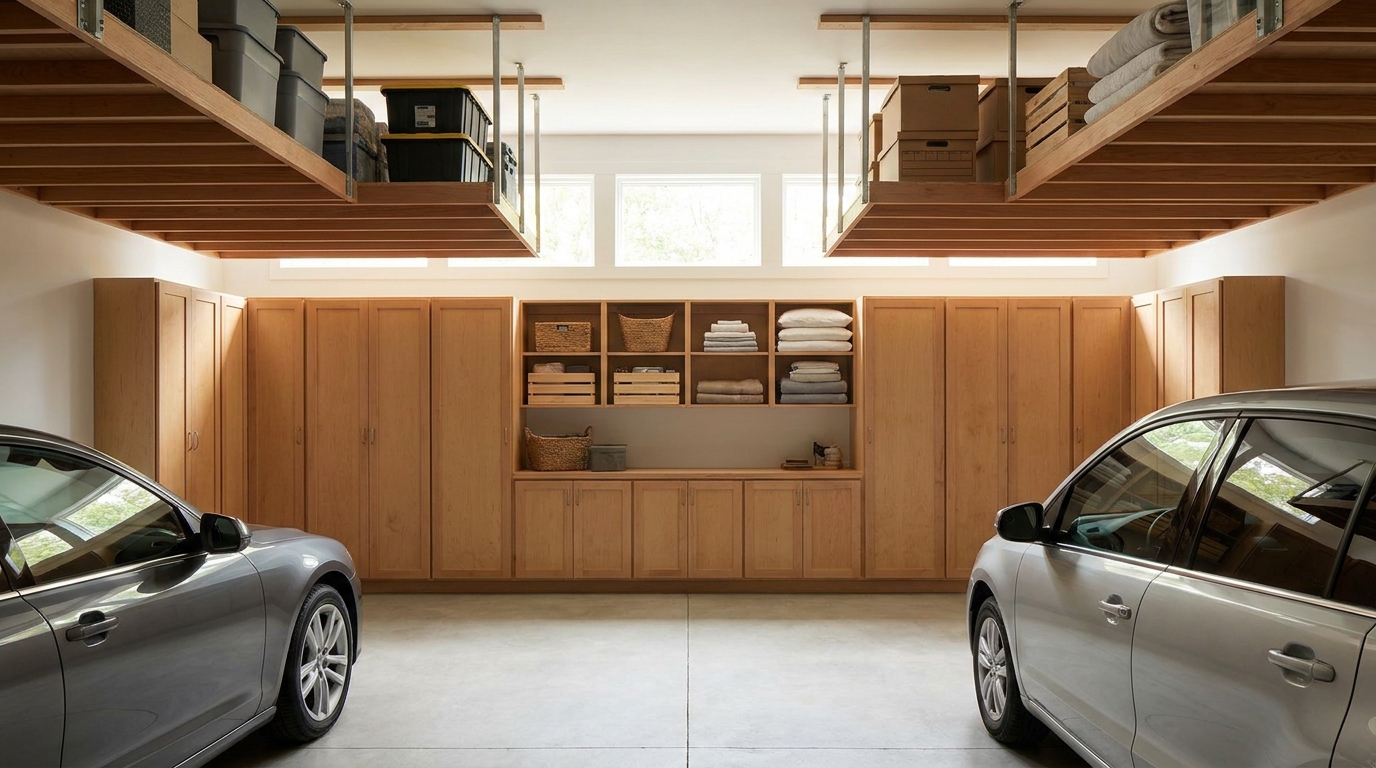
Overhead racks (open platforms or grids) work best for lidded plastic totes, seasonal decorations, camping bins, and other light, stackable loads you touch a few times a year. The structure is usually shallower, which helps in a low-lift garage. The tradeoff is dust and anything that is not strapped or boxed. OSHA's construction storage rule is a workplace standard, not a homeowner code, but the stacking logic still applies: materials stored in tiers should be racked, blocked, or otherwise secured to prevent sliding, falling, or collapse, and the weight should stay inside the structure's safe load. [4]
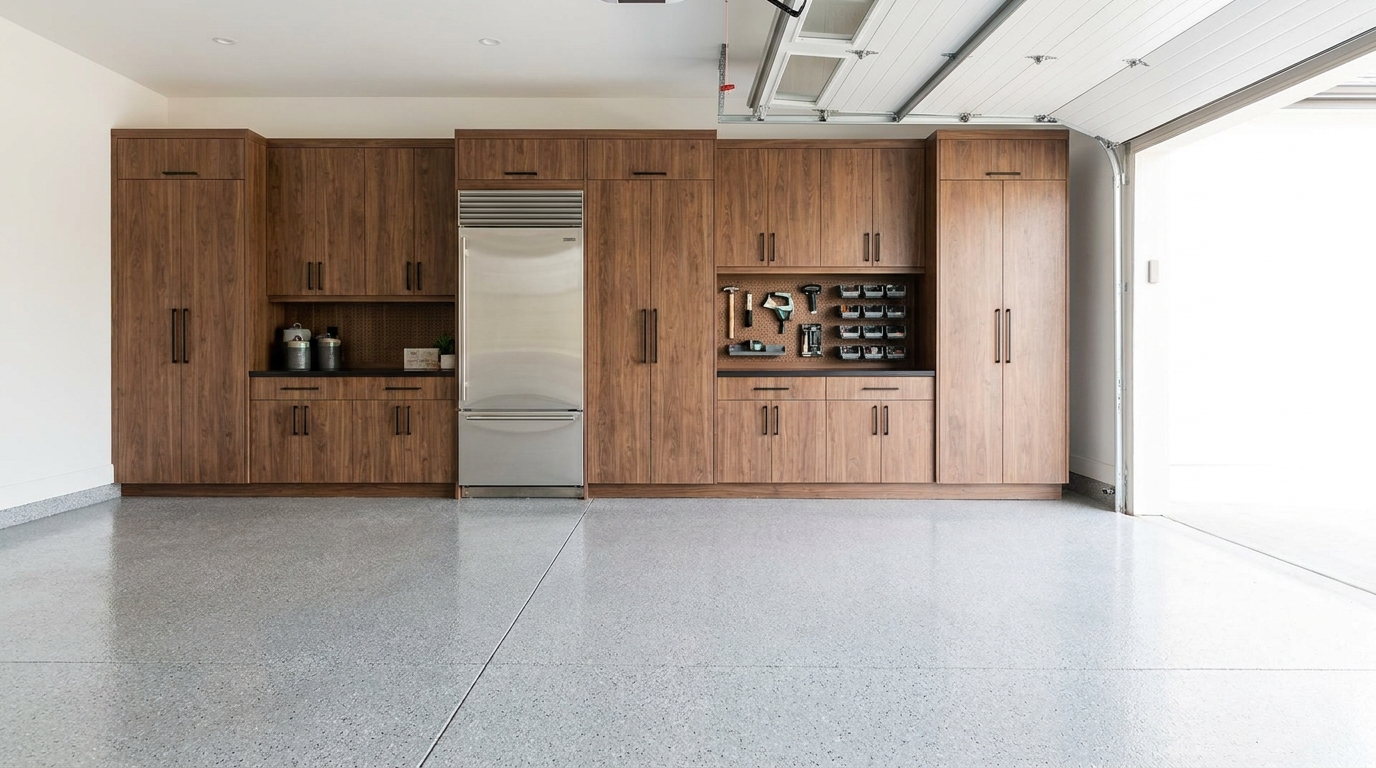
Ceiling-mounted cabinets (closed boxes) work best for items you want out of sight, or odd shapes that will not sit honestly on a grid. Doors contain a spill and keep a loose ball from becoming a falling object over a windshield. The tradeoff is weight and depth. Cabinets are heavier before you load them, and a deeper box eats lift height faster than a slim rack.
A mixed ceiling is usually the honest plan. We often put a shallow rack over the rear third of the bays for labeled bins, then keep closed cabinets along a side wall or over a non-parking strip beside a freezer or workbench. The parking lanes stay a clear tunnel. If you only have a few inches of leftover lift, skip cabinets overhead. Move bulk storage to the wall and leave the ceiling for a single shallow rack, or for nothing.
4. What belongs up there, and what should stay on the wall
Ceiling space is for things that are light, boxed, and rare. The wall is for things that are heavy, sharp, chemical, or used every week.
Put overhead: holiday décor in lidded, labeled totes; off-season clothing and camping kits; lightweight sports gear in bins (not loose); archive boxes you can identify from the floor.
Keep on the wall or in base cabinets: daily tools; bikes, golf bags, and strollers; paint, solvents, fertilizers, and auto fluids; gasoline and propane (these should not live in a ceiling box over a car, and they should not sit next to ignition sources); tires and hard-cornered luggage; anything you cannot lift safely on a ladder.
OSHA's general industry storage rule, again a workplace standard, states the principle plainly: storage should not create a hazard, and bags, containers, and bundles stored in tiers should be stacked, blocked, interlocked, and limited in height so they stay stable. [5] If a tote takes two people to lift at chest height, it does not belong over a hood.
North Carolina Fire Code Section 315.3 requires storage in buildings to be orderly, with stable stacks, and with combustible materials kept far enough from heaters that ignition cannot occur. Section 315.3.3 goes further: combustible material is not to be stored in boiler rooms, mechanical rooms, or electrical equipment rooms. [3] That is why we do not treat the alcove around a furnace, water heater, or panel as bonus overhead storage.
5. Framing, fire separation, and honest load limits
The ceiling is a rated assembly in many attached garages, not a blank field of drywall. Table R302.6 of the 2024 North Carolina Residential Code calls for not less than 1/2-inch gypsum (or equivalent) on the garage side of the separation from the residence and attics, and not less than 5/8-inch Type X gypsum (or equivalent) from habitable rooms above the garage. Supporting structure for that floor/ceiling assembly also gets at least 1/2-inch gypsum. [1]
A 2023 Fine Homebuilding code roundup on the 2021 IRC makes the fire logic plain: heat and flame rise, so a ceiling under living space needs the heavier Type X layer, and walls or posts that carry that space need protection as well. Ducts through the separation should be at least 26-gauge steel if they are not covered by drywall, and other penetrations need fireblocking. [2]
Anchor to framing. Lag into joists or into a ledger that is itself fastened to framing. Toggle bolts in gypsum are not a storage system. We do not lay random plywood across truss bottom chords and call it a loft. Trusses are engineered for the loads they were drawn for. OSHA's construction storage standard requires that stored weight not exceed maximum safe load limits, and it notes that posting those limits is not required in single-family residential structures. [4] The exemption from a posted sign is not an exemption from physics. If the load is large or concentrated, it needs an engineer, not a guess from a product carton.
Leave fire-sprinkler and ceiling clearances when they apply. North Carolina Fire Code Section 315.3.1 requires storage to stay at least 2 feet below the ceiling in nonsprinklered areas, or at least 18 inches below sprinkler deflectors in sprinklered areas. Storage along walls has listed exceptions. A rack hanging in the middle of a bay is not "along a wall." [3] The two-foot figure is still a useful planning buffer when an opener rail already occupies that space.
6. Appliances, heaters, and the path the car actually takes
Many Charlotte-area garages still share space with a water heater or furnace. The 2024 IRC fuel-gas provisions (G2408.3) require appliances in private garages to be installed with a minimum clearance of 6 feet above the floor, unless they are protected from motor vehicle impact and installed with the ignition-source rules in G2408.2. G2408.2 separately requires ignition sources in private garages to sit at least 18 inches above the floor, unless the appliance is listed as flammable-vapor-ignition resistant. [10]
Fine Homebuilding's 2023 garage-code guide matches that picture: water heaters and other appliances need that 18-inch ignition elevation unless they are FVIR-listed, and appliances subject to vehicle damage need protection (an alcove, a closet, or bollards). Attached garages that open into the dwelling also trigger carbon monoxide alarms outside sleeping areas. [2]
A ceiling cabinet that drops the effective clearance over a water heater, or a rack that hides a shutoff, is a conflict. Keep combustibles off the appliance and keep overhead units out of the bumper strike zone. Overhead storage can live beside the driving path or above the rear of the bays. It should not hang in the first several feet inside the door, where the door itself is still moving.
7. Getting bins down without a fall
The ceiling is only useful if you can retrieve a bin without becoming a statistic. CDC's National Institute for Occupational Safety and Health notes that not all ladder injuries happen at work. Many happen at home. In 2020 there were 161 workplace fatalities from ladders and 22,710 workplace ladder injuries. About 40% of ladder-related injuries involve the base sliding out because of an incorrect setup angle. Other common causes include the wrong ladder for the job, poor inspection, and improper use such as overreaching or carrying objects while going up or down. [11]
Plan the retrieval, not just the stash. Use a ladder rated for the user plus the bin, set at the right angle, on a dry, level slab. Keep three points of contact. Do not carry a tote down in your hands; hand it to a second person. If a household cannot safely use a ladder, that household should not use ceiling storage. Wall cabinets at chest height will do more good.
Practical takeaways
- Measure leftover lift with the door fully open and the tallest vehicle in place, then subtract a real buffer before you pick a rack depth.
- Keep the door, track, opener rail, photo eyes, wall button, and manual release in their designed locations. [7][8]
- Test the door's reversing feature monthly, as CPSC has urged since its 1992 garage-door-opener rulemaking. [6]
- Use open overhead racks for light, lidded, rare-use bins. Use closed cabinets when you need containment. Use the wall for heavy, chemical, or weekly items.
- Fasten to framing. North Carolina still specifies 1/2-inch garage-side gypsum, and 5/8-inch Type X under habitable rooms. [1][2]
- Stay 2 feet below a nonsprinklered ceiling (or 18 inches below sprinkler deflectors) unless you are on a wall that meets the fire-code exceptions. [3]
- Leave 6 feet of appliance clearance above the floor in a private garage unless the unit is impact-protected and installed to the ignition-source rules. [10]
- If a tote is hard to fetch safely from a ladder, it does not belong on the ceiling. [11]
How we can help
Our team designs custom garage storage around the vehicles you actually park, the door you already have, and the seasonal gear you want off the slab. We will measure lift height, map the door and opener path, and place overhead racks or cabinets only where they leave an honest parking envelope, with daily items on the wall where you can reach them. Have more questions or want to get in touch? https://theclosetrehab.com/contact-us/ · (704) 604-3870 · design@theclosetrehab.com
Citations
- North Carolina Office of State Fire Marshal / ICC, "2024 North Carolina State Building Code: Residential Code, Chapter 3 Building Planning (Table R302.6, R309.4)" (2024)
- Fine Homebuilding, "Code Guidelines for Garages" (2023-11-22)
- North Carolina Fire Code / ICC, via UpCodes, "North Carolina Fire Code 2024, Chapter 3 General Requirements, Section 315 General Storage" (2024)
- Occupational Safety and Health Administration, "29 CFR 1926.250 General requirements for storage" (current)
- Occupational Safety and Health Administration, "29 CFR 1910.176 Handling materials - general" (current)
- U.S. Consumer Product Safety Commission, "Safety Commission Publishes Final Rules For Automatic Garage Door Openers" (1992-12-03)
- DASMA, "Safety Tips For Garage Door Openers" (undated page; accessed 2026-08-24)
- DASMA, "Technical Data Sheet #167: Residential Sectional Garage Door and Electric Operator Checklist for Home Inspectors and Consumers" (2023-04)
- DASMA, "Safety Tips For Garage Doors" (undated page; accessed 2026-08-24)
- International Code Council / 2024 IRC, via UpCodes, "2024 International Residential Code, Chapter 24 Fuel Gas, G2408.2 and G2408.3" (2024)
- CDC / NIOSH, "Ladder Safety | Falls" (2024-01-23)