Garage Refrigerator Storage: Vented Bay Beside the Stall
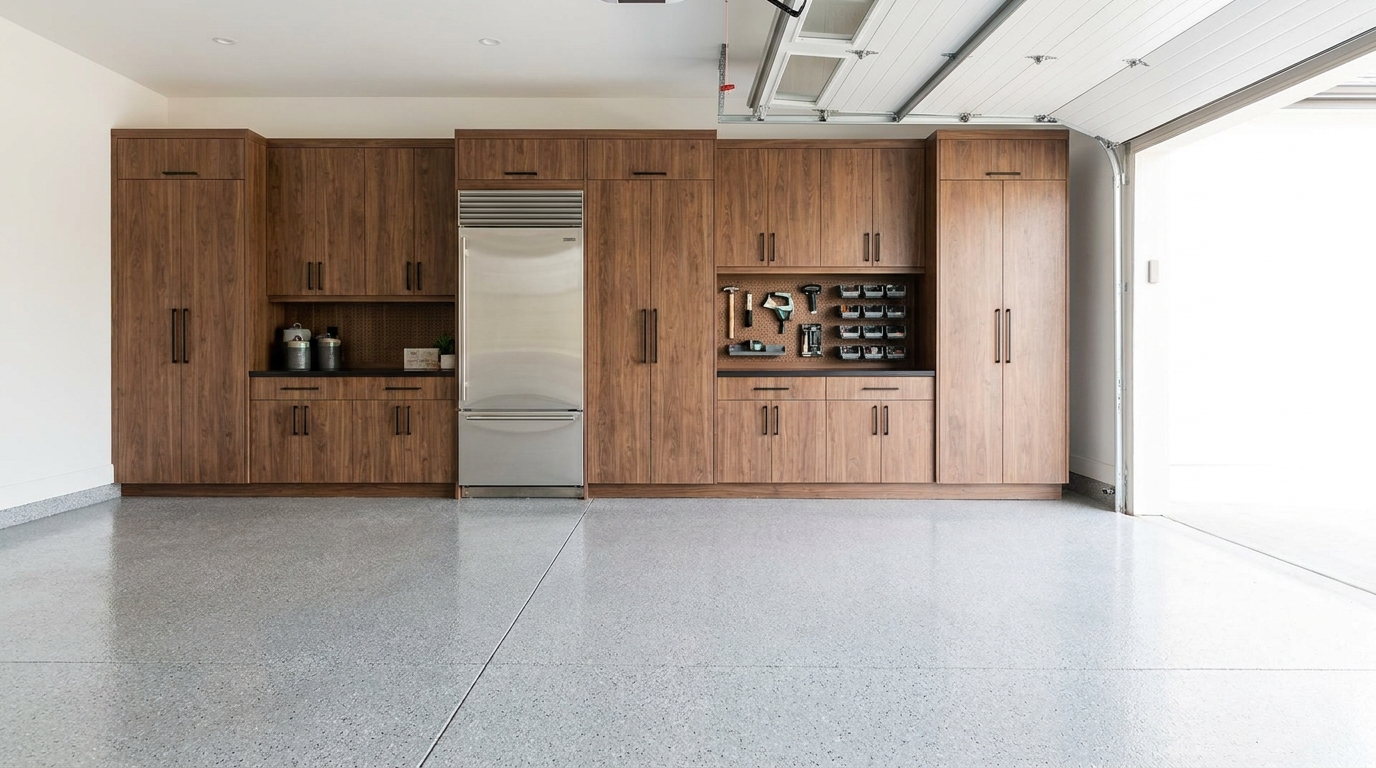
A garage refrigerator cabinet is a shallow, vented cold bay on a side wall or at the back of the stall, sized so a fridge or freezer can hold drinks, overflow groceries, and bulk frozen goods without claiming a parking space. The bay has to leave manufacturer clearance for airflow, and ENERGY STAR asks you to leave a few inches between the wall and the refrigerator so condenser coils can dump heat [1]. Food only belongs in that unit if it can hold 40°F (4°C) or below in the fresh-food section and 0°F (-18°C) in the freezer. If it cannot, the food does not belong there [4][5].
1. Measure the parking stall first, then the fridge envelope
The first measurement is not the appliance. It is the car.
We start every garage refrigerator storage plan with the stall you still need to park in. Tape the vehicle’s parked footprint, including mirrors, plus the swing of the driver door and the path from the house door to the driver’s seat. Only then do we measure the leftover wall: width, height, depth to the studs, and the location of a dedicated outlet.
A typical upright refrigerator is deeper than a pantry cabinet. Door swing adds more. If you park the fridge on the stall floor “just for now,” the stall is gone. The cabinet has to live beside the stall, not in it.
In two-car garages we see around Charlotte, NC, and Fort Mill, SC, the useful leftover is often a side-wall strip, a shallow bay at the rear, or the space beside a bulkhead. That leftover is enough for a cold bay if we do not also try to park a mower, a sports wall, and a workbench in the same strip.
What we record before we draw
- Stall width and depth with both vehicles in their real parked positions, not the brochure pose.
- Fridge or freezer width, depth with the door open, and hinge side.
- Outlet location. A major appliance should sit on a nearby receptacle, not on a cord across the walkway.
- Headroom under openers, lights, and any existing overhead rack. This bay is not a ceiling rack.
If the leftover strip is too shallow for the unit plus clearance, we do not force it. We look at the opposite wall, a rear alcove, or a slightly narrower appliance. The parking stall is the non-negotiable.
2. Garage refrigerator storage: a cold bay with ventilation, not a boxed-in appliance
The cabinet is a frame around a working appliance. It is not a sealed box.
ENERGY STAR’s refrigerator guidance is to place the unit in a cooler spot, away from ovens, dishwashers, and direct sun, and to allow air circulation behind it [1]. That is the brief for the garage bay: a few inches at the back, open or louvered sides or a grille where the manufacturer vents, and a toe space that does not choke a bottom condenser. We read the owner’s manual for the exact gaps. We do not invent them.
A closed, unvented surround is how a compressor overheats in a Carolina summer. The cabinet can still look finished. We use a raised, level platform so the unit sits plumb, a vented fascia or open grille at the condenser (usually low-front or rear, never a solid kick), and, if there is a decorative door, one that does not trap heat. Many of our bays skip that door and let the appliance face sit proud, with pantry doors only on the dry cabinet beside it. A small landing shelf above or beside the unit is for a cooler bag, not for paint cans.
This bay is distinct from the rest of the garage system. It is not a lockable chemical cabinet, not a sports wall, not a workbench, and not an overhead rack. Those jobs stay in their own zones so the cold bay can do one thing: keep food cold and leave the cars a stall.
ENERGY STAR also notes that a second refrigerator you actually need year-round should be a current certified model, not an old kitchen hand-me-down parked in the garage [1]. A 2024 ENERGY STAR fact sheet puts a number on that habit: keeping a second refrigerator in a basement or garage could waste about $90 per year, and an old refrigerator uses about 20 percent more energy than a new ENERGY STAR model [2]. That 2024 figure is a reason to specify a unit that matches the space, not a reason to skip the bay.
3. Garage temperature and what the owner’s manual actually allows
Carolinas garages swing. Attached garages in Ballantyne, NC, and Rock Hill, SC, heat up when the door faces west. They also drop on a January night if the space is uninsulated.
ENERGY STAR’s guidance on uninsulated garages is blunt. A refrigerator in that setting will use a lot more energy in hot months, and it may not operate correctly if the space gets too cold [3]. ENERGY STAR estimates that each 1°F change in ambient temperature from a normal kitchen changes energy use by about 2.25 to 2.5 percent, so a unit in a 90°F space can use 45 to 50 percent more energy than the same unit in a 70°F space [3]. If ambient air falls below about 40°F, the thermostat may not run cooling and defrost cycles for the right amount of time, and a below-freezing garage can freeze food that should stay only cold [3].
ENERGY STAR’s instruction after that is the one we follow in the field: check the owner’s manual for the manufacturer’s ambient range [3]. Some manufacturers publish a garage installation range. GE Appliances, for example, warns against running a refrigerator at temperature extremes, notes that oil can thicken below 32°F and break down above 110°F, and points to garage-specified top-freezer models it rates from 38°F to 110°F. For ordinary units, GE does not recommend installation below 60°F unless the owner’s manual says otherwise, and it does not recommend aftermarket “garage kits” [10]. That is manufacturer guidance, used here only to show why the manual matters. It is not a substitute for ENERGY STAR’s rule: match the unit to the room you actually have.
What we do with that in a cabinet plan
- Ask what the garage actually does in July and January.
- Specify a unit whose published ambient range covers those readings, then build the bay around that envelope.
- Keep the bay off sun-struck doors and away from water heaters, in line with ENERGY STAR’s “place your fridge in a cool place” tip [1].
- Leave the clearance the manual names.
If the garage routinely falls outside the manual’s range, cabinetry will not fix physics. The honest options are a unit specified for that range, a different location, or not storing perishable food in that appliance.
4. Food safety: only store food in a unit that holds 40°F
The cabinet can look perfect and still be the wrong place for milk.
The U.S. Food and Drug Administration tells households to keep the refrigerator at or below 40°F (4°C) and the freezer at 0°F (-18°C), and to check those temperatures with an inexpensive appliance thermometer because few controls show the real number [4][5]. ENERGY STAR’s energy tip is tighter still: keep the fresh-food section around 35 to 38°F [1]. We treat 40°F as the food-safety ceiling, not a target to drift above.
At room temperature, bacteria that cause foodborne illness can double every 20 minutes [5]. FDA’s two-hour rule is the practical companion: meat, poultry, seafood, eggs, produce that needs refrigeration, leftovers, and take-out should not sit out more than two hours, or more than one hour if the air is above 90°F [4][5]. A hot garage is not a place to leave those bags on the floor while you park.
If the garage unit cannot hold 40°F, do not store perishable food in it. That is the whole rule. Drinks that are only there to be cold, and foods you would keep in a pantry anyway, are a different conversation. Chicken, milk, leftovers, and ice cream are not.
FDA also warns against packing a refrigerator so tightly that air cannot circulate [4]. A garage bay packed with warehouse-club boxes, with no space around packages, fights the same airflow the condenser needs on the outside. We spec adjustable shelves and a little empty volume, not a Tetris wall of meat.
Keep an appliance thermometer in the fresh-food section and another in the freezer, and glance at them when you unload the car [5]. If a storm knocks out power, FDA notes that a closed refrigerator holds cold for about four hours. Discard refrigerated perishable food that has been above 40°F for four hours or more once power returns [4].
5. A dry pantry cabinet beside the fridge, chemicals in a different lockable bay
The cold bay needs a neighbor. That neighbor is a dry pantry cabinet, not the paint shelf.
Bulk snacks, paper goods, pet food in sealed containers, and extra beverages that do not need 40°F sit in a dry cabinet beside the fridge. The walk from the house door can then be: grab a frozen pack, grab the chips, go. FDA’s storage basics include a simple split for the rest of the house: keep food away from poisons, and do not store non-perishable foods near household cleaning products and chemicals [4].
Pesticides, fuels, and many garage chemicals do not belong in that pantry, and they do not belong beside open food. EPA’s pesticide-storage page is specific: never store pesticides in cabinets with or near food, animal feed, or medical supplies. If possible, keep them in a locked cabinet in a well-ventilated utility area or garden shed, in original labeled containers, out of reach of children and pets [6]. EPA also says to store flammable liquids outside the living area and far from ignition sources such as a furnace, car, grill, or lawn mower [6]. The fridge bay sits next to parked cars. That is the wrong neighbor for a gas can.
The U.S. Consumer Product Safety Commission’s fuel-container guidance matches the split. Store gas cans and other portable fuel containers in well-ventilated, cool areas only. Never store gas cans inside a house, basement, or near sources of ignition such as fuel-burning appliances, open flames, pilot lights, stoves, heaters, or electric mowers [7].
A 2019 New Mexico State University Extension guide on household chemicals makes the food split ordinary: do not store household chemicals on shelves normally used for foods, do not store them in food containers, keep them out of children’s reach, and do not store incompatible products together (flammables never with corrosives) [9]. That is why we will not add a can of stain to the dry pantry next to the sodas.
How we lay out the split in Wesley Chapel, NC, and Indian Land, SC, garages
- Cold bay: fridge or freezer, vented, thermometer visible, dedicated outlet.
- Dry pantry: doors, shelves for sealed food and paper, no drain cleaners, no pesticides, no paint.
- Lockable chemical cabinet: a different run of boxes, ideally on another wall, for paints, solvents, oils, and garden chemicals, with original labels and no food.
- Fuel: not in the food run, not beside the compressor, in a cool ventilated spot that follows the CPSC and EPA notes above [6][7].
The chemical cabinet can lock. The fridge bay should not be the lockable toxic locker. Those are two products, two locations.
6. A trip-free path from the house door to the car
A cold bay that steals the walk is a bad bay.
CDC’s 2017 STEADI “Check for Safety” checklist is written for older adults at home, and the floor section is the one we borrow for garage circulation. When you walk through a room, you should not have to walk around furniture. Move it so the path is clear. Pick up papers, shoes, books, and other objects. Always keep objects off the floor. Coil or tape cords next to the wall so you cannot trip [8].
We apply that to the house-door-to-car line:
- The fridge door should not open into the only walking lane.
- Cooler bags, cases of water, and recycling do not live on the floor in front of the bay. They get a shelf or they go inside.
- Power cords for the appliance stay short and against the wall, not as a jumper across the stall.
- Overhead storage, if you have it, stays over the hood line, not over the walking strip.
In Waxhaw, NC, and Fort Mill, SC, homes, the garage is often the real front door. Groceries come in this way. A vented fridge cabinet on the side wall, a dry pantry beside it, and a clear center aisle is the layout that still lets both cars park. The cold bay should not share that aisle with a sports rack or a workbench that sheds cords. Each zone keeps its floor.
Practical takeaways
- Park first. Tape the stall, the door swings, and the house-door path. The leftover wall is the only land the fridge may occupy.
- Build a vented envelope, not a sealed box. Follow the owner’s manual and ENERGY STAR’s few inches of rear clearance [1][3].
- Match the unit to garage temperatures. ENERGY STAR says uninsulated garages raise summer energy use and can stop correct operation in the cold. Read the manual’s ambient range before you buy [3].
- Food requires 40°F or below in the fresh-food section and 0°F in the freezer. Use appliance thermometers. If the unit cannot hold those temperatures, do not store perishable food in it [4][5].
- Put a dry pantry beside the fridge for sealed overflow that does not need refrigeration. Keep food away from cleaners and chemicals [4].
- Put paints, pesticides, and fuels in a different lockable, ventilated cabinet, never in the food run and never beside the compressor or the car [6][7][9].
- Keep the floor clear from the house door to the driver’s seat [8].
- Do not reuse an old kitchen fridge as a “free” garage unit if you need the bay year-round. ENERGY STAR’s 2024 fact sheet flags the extra cost of a second garage or basement refrigerator [2].
How we can help
We design custom garage storage around the cars you actually park, including a vented refrigerator cabinet, a dry pantry beside it, and a separate lockable run for chemicals. Have more questions or want to get in touch? Visit our contact page, call (704) 604-3870, or email design@theclosetrehab.com. We will measure the stall with you and leave room to park.
Citations
- ENERGY STAR, "Refrigerators" (2026)
- ENERGY STAR, "Flip Your Fridge & Save with ENERGY STAR" (2024-07)
- ENERGY STAR Support, "Can I put a refrigerator in an uninsulated garage which is subject to winter and summer extreme temperatures?" (2025-06-26)
- U.S. Food and Drug Administration, "Are You Storing Food Safely?" (2023-01-18)
- U.S. Food and Drug Administration, "Refrigerator Thermometers: Cold Facts about Food Safety" (2026)
- U.S. Environmental Protection Agency, "Storing Pesticides Safely" (2025-10-09)
- U.S. Consumer Product Safety Commission, "Fuel Container, Gasoline and Other Liquid Fuel Safety" (2026)
- Centers for Disease Control and Prevention, STEADI, "Check for Safety: A Home Fall Prevention Checklist for Older Adults" (2017)
- New Mexico State University Cooperative Extension Service, "Safe Use and Disposal of Household Chemicals (Guide G-312)" (2019-02)
- GE Appliances, "Refrigerator - Installation Location and Temperature" (manufacturer support)