Garage Sports Equipment Storage That Parks Two Cars
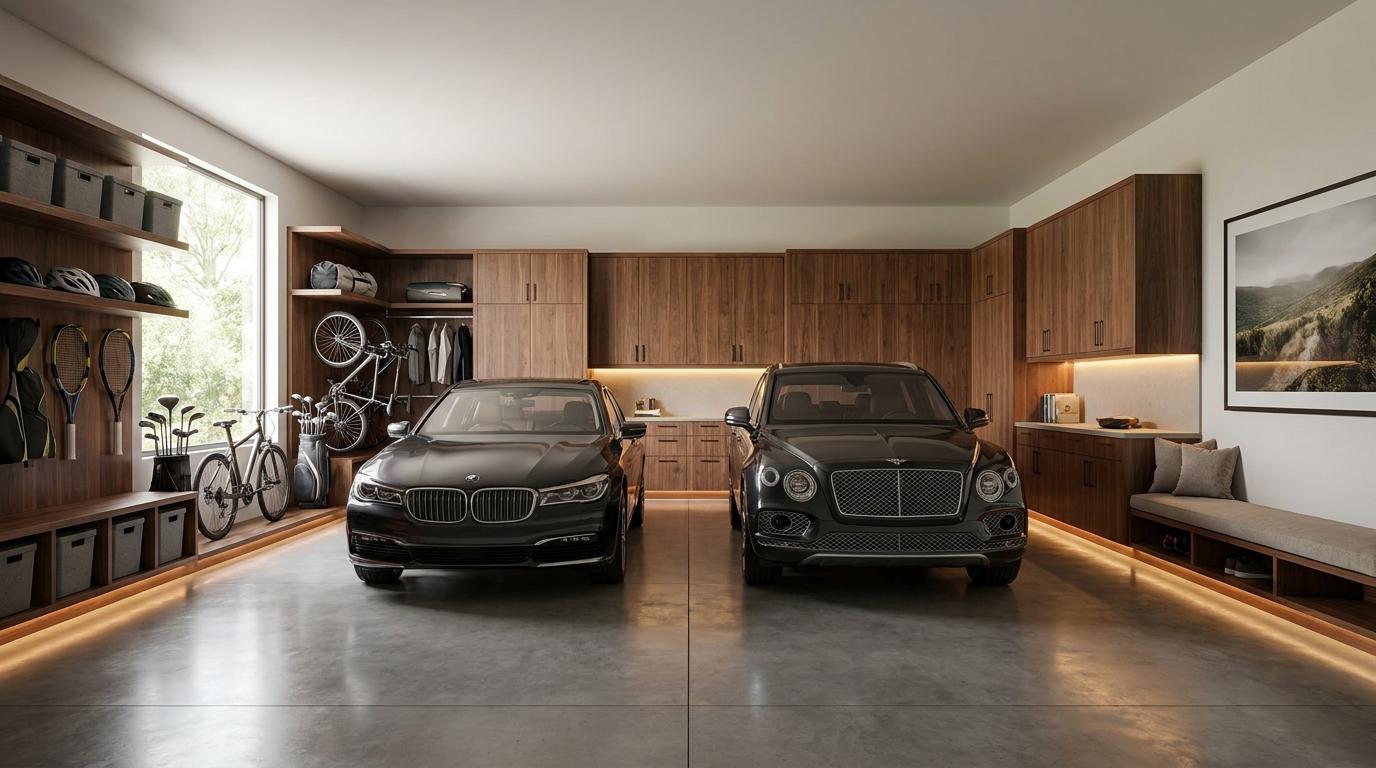
Garage sports equipment storage works when bikes, golf bags, bats, balls, and seasonal gear live on the walls, not in the parking bays. Two cars still need a full stall on each side, a clear path to the house door, and enough room to open doors without hitting a handlebar or a bag. Federal materials-handling rules treat floor piles as trip hazards, and a university extension fall-prevention guide tells households to keep objects off walking surfaces, including garage floors.[1][3] Dedicated wall racks sized to the gear, and kept shallow enough that they do not steal the parking footprint, are how we keep both cars inside.
1. The parking bay is for cars, not for bats and bikes
A two-car garage fails the moment sports gear starts living where the vehicles need to sit. Golf bags lean into a bumper. A bike occupies the second stall all week. Soccer balls roll under a car. Someone steps over a bat on the way to the house door. That is not a storage plan. It is a daily obstacle course.
OSHA's general materials-handling standard, written for workplaces, still states the principle in plain language. Aisles and passageways shall be kept clear, with no obstruction that could create a hazard. Storage of material shall not create a hazard. Storage areas shall be kept free from accumulation of materials that constitute hazards from tripping, fire, explosion, or pest harborage.[1] OSHA's walking-working-surfaces rule adds that floors and passageways should stay clean and orderly, and that each walking-working surface must be able to support the maximum intended load for that surface.[2]
A home garage is not a factory. The same physics still apply. If the floor is the storage system, people trip, cars cannot park, and gear gets crushed. University of Nevada, Reno Extension, citing CDC data from a July 2024 report, notes that one out of four older adults has experienced at least one fall, and it lists "minimize clutter and tripping hazards from stairs and places where you walk" among the first home changes to make. The same page tells readers to keep boxes and other objects off the floor, and it flags unexpected spills on the garage floor as a fall hazard.[3] CDC's STEADI home-fall checklist likewise tells households to always keep objects off the stairs and to pick up papers, shoes, books, and other objects from the floor.[4]
That is the case for wall-mounted sports storage. Get the gear off the slab so the parking bays stay parking bays.
2. How much width two cars actually need
Before we hang a single hook, we size the parking footprint. The 2024 International Zoning Code sets a standard parking stall at a minimum 9 feet wide and 20 feet long.[5] The same section adds a detail that matters for garage walls: the width of a parking stall shall be increased 10 inches for obstructions located on either side of the stall within 14 feet of the access aisle.[5]
Read that as a design brief. If a bike hangs on the side wall next to a car, that wall is an obstruction beside the stall. The stall wants extra width, or the rack needs to fold flat, sit high enough to clear the door, or move to a wall that is not beside the door swing.
Vehicle mix makes the extra inches more important, not less. EPA's Automotive Trends Report for model year 2024 found that 34 percent of new vehicles were cars and 66 percent were trucks under NHTSA's regulatory definitions, with truck SUVs alone accounting for half of new-vehicle production.[6] Vehicle size, measured as footprint (the area enclosed by the four tires), has generally increased since EPA began tracking it in 2008.[6] Families in Charlotte, Fort Mill, Rock Hill, Ballantyne, Waxhaw, Wesley Chapel, and Indian Land are parking the same mix: crossovers, SUVs, and trucks that fill a 9-foot stall quickly.
A practical two-car layout:
- Treat each bay as a 9-foot by 20-foot parking stall, then add the extra 10 inches the zoning code asks for if a wall rack sits beside the stall.[5]
- Keep hanging gear inside the wall zone, not in the door-swing zone.
- Leave a clear walkway from the vehicle door to the house door. That path is an aisle, and it should stay as clear as the parking stall.
- Do not use the second bay as overflow storage "until we get around to it." If two cars are the goal, both stalls stay empty of gear.
3. Wall racks sized for bikes, golf, bats, balls, and seasonal gear
The storage has to match the object. A golf bag is not a bike. A bat is not a ball bag. Generic hooks collect clutter. Dedicated wall stations return each item to a known home so it leaves the parking bay every time.
Bikes (vertical and parallel-to-wall)
- Hang bikes parallel to the wall when the side wall sits next to a parking stall. That keeps handlebars and pedals from claiming a foot of stall width.
- Use vertical (wheel-up) mounts on a back wall or on a side wall that is not beside a car door, where the bike's length uses wall height instead of bay width.
- Fold-down or swing-away arms help when the same wall has to stay flush while a car is parked.
- Keep helmets, pumps, and shoes on adjacent wall hooks or shallow shelves so they do not land on the floor after a ride.
Golf bags
- Give each bag a vertical slot or cradle on the wall, not a lean against the drywall.
- Keep the slot deep enough that the bag cannot tip into the parking bay, and shallow enough that it does not become the 10-inch obstruction the zoning code warns about.[5]
- Store shoes, gloves, and range balls on a small wall shelf or cubby above the bags, at grab height.
Bats, sticks, and long-handled gear
- Use a horizontal bat rack or vertical sleeve so bats cannot roll under a tire.
- Hockey sticks, lacrosse sticks, and fishing rods belong in the same family: long, easy to knock over, and dangerous on the floor.
- Mount the rack high enough that a car door cannot strike the handles, and low enough that a child or shorter adult can still return the item.
Balls and small gear
- Wall-mounted cages, bins, or mesh bags stop soccer balls, basketballs, and baseballs from becoming rolling trip hazards.
- One bin per sport beats one mixed pile. Mixed piles overflow onto the slab.
- Keep gloves, helmets, and pads on labeled wall hooks next to the bin so the set stays together.
Seasonal sports gear
- In-season items sit at waist to shoulder height, which matches the extension advice to keep frequently used items within easy reach and to avoid standing on chairs to get them.[3]
- Off-season gear (ski bags in July, baseball in January) goes higher on the same wall, still on the wall, still out of the parking bay.
- Do not park off-season bags in the second stall "just for a month." That month becomes the new normal.
Our custom garage storage work includes dedicated racks, hooks, and bins sized for bikes, golf bags, bats, balls, and seasonal sports gear. The point of that wall is not to look busy. It is to leave two clear parking footprints.
4. Keep the floor clear so no one trips on the way to the car
A garage is a walking surface every morning and every evening. Balls, bat bags, and bike pedals on the slab are the same class of hazard as shoes left in a hallway. University of Nevada, Reno Extension is direct: keep things off the floor, remove anything blocking passageways, and treat garage-floor spills and loose objects as fall hazards.[3] OSHA's housekeeping language is just as direct for storage areas: keep them free from accumulation of materials that constitute tripping hazards.[1]
For sports gear, that means:
- Nothing long and round lives on the slab. Bats, clubs, and sticks roll.
- Nothing with wheels lives in the walking path. A bike on its kickstand is still occupying the aisle.
- Return is part of the design. If the wall hook is harder to use than the floor, the floor wins. Place daily-use mounts where someone can hang the bike without threading it around a bumper.
- Treat the path from the overhead door, past both cars, to the house door as an aisle that stays empty.
Clear floor space also protects the cars. A ball under a tire or a pedal against a fender is damage waiting for the next reverse.
5. Do not mix fuels and chemicals with sports gear
Garages collect gasoline, two-cycle mix, solvents, cleaners, and lawn chemicals in the same room as helmets, gloves, and golf shoes. Those two groups should not share a shelf.
The International Fire Code language, as adopted in the 2021 Portland Fire Code at section 5704.3.4.4, allows no more than 10 gallons of flammable and combustible liquids used for maintenance and equipment to sit outside a liquid storage cabinet, and only in approved containers located in private garages or other approved locations. Quantities above 10 gallons belong in listed liquid storage cabinets.[7] That is a quantity and container rule, not an invitation to line gas cans up next to the bike helmets.
EPA's household hazardous waste guidance tells people to follow label storage instructions, keep products in original containers, and never mix leftover household hazardous waste with other products, because incompatible products might react, ignite, or explode.[8] Soft goods, foam liners, and fabric bags do not belong in that chemical zone.
Helmets make the separation personal. CPSC's January 2026 helmet brochure says that, without manufacturer guidance, it may be prudent to replace a helmet within 5 to 10 years of purchase, a decision based in part on how the helmet was used, how it was cared for, and where it was stored.[9] The federal bicycle-helmet standard also requires a warning that the helmet can be damaged by contact with common substances (for example, certain solvents such as ammonia, and cleaners such as bleach), and that this damage may not be visible.[10]
A clean wall plan:
- Sports wall: bikes, bags, bats, balls, helmets, shoes.
- Fuel and chemical zone: approved cans and original containers, away from the sports wall, away from ignition sources, and within the quantity limits your local fire code allows.[7][8]
- No shared bins. Do not drop a rag with solvent into a ball bag. Do not park a gas can under a hanging bike.
6. Hang the load on the wall the wall can actually carry
Wall storage only helps if it stays on the wall. A bike, two golf bags, and a loaded ball cage are a real load. OSHA's walking-working-surfaces rule requires that a surface support its maximum intended load, and the materials-handling rule requires that storage not create a hazard and that stacked material stay stable against sliding or collapse.[1][2] Those are workplace rules, but they describe the same failure we see when a hook pulls out of drywall and a bike lands in a parking bay.
Design the hanging load on purpose:
- Anchor into studs or a rated wall system, not a single hollow-wall anchor asked to hold a bicycle.
- Match hardware to the item. An e-bike is heavier than a child's bike. A loaded golf bag is heavier than an empty one. Size the bracket for the heaviest item that will live there.
- Do not crush helmets. CPSC notes that bicycle helmets are single-impact products whose foam crushes to absorb energy, and that storage location is part of the replacement decision.[9] Hang helmets so nothing sits on them, and keep them off the chemical shelf.[10]
- Keep the projection shallow. A deep shelf beside a stall is the obstruction that costs 10 inches of stall width.[5]
If the wall cannot take the load, we change the wall (a full slatwall or rail system tied to studs) rather than asking one hook to pretend.
7. A wall layout that still parks two cars
A good sports wall is a parking plan with storage on the edges.
Side walls (along the cars)
- Shallow only: fold-down bike arms, slim bat racks, ball cages that sit close to the wall.
- Nothing at door-handle height that can meet a swinging door.
- If the stall is already tight, move bikes off this wall entirely.
Back wall (opposite the overhead door)
- Best home for vertical bikes and golf bags, because this wall usually does not sit beside a door swing.
- Keep the center of the back wall clear if you still need to walk a mower or a stroller through. Sports storage can live in the corners.
House-entry wall
- Daily grab zone: the one helmet, the one glove bag, the one kid bike used after school.
- Keep this path as an aisle. OSHA's language about clear passageways is the right test.[1]
What this layout is not
- It is not a workbench plan.
- It is not a ceiling-rack plan. Overhead storage can hold bins, but it is the wrong primary home for daily bikes and golf bags you need to grab without a ladder.
- It is not a debate about closed cabinets versus open hooks. The thesis is simpler: dedicated wall storage, sized to the sport, that leaves two parking bays empty.
For a Charlotte-area two-car garage, that usually means one sports wall for bikes and bags, a second shallow rail for bats and balls, and a separate, code-aware spot for fuels that never shares a hook with a helmet.
Practical takeaways
- Put garage sports equipment storage on the walls so both parking bays stay empty.
- Size each bay like a 9-by-20-foot stall, and add 10 inches if a rack sits beside the stall as an obstruction.[5]
- Plan for today's vehicles: in model year 2024, 66 percent of new vehicles were trucks under NHTSA's definitions, and vehicle footprint has generally grown since 2008.[6]
- Use dedicated bike, golf, bat, and ball stations, not one mixed hook row.
- Keep the floor clear. Extension guidance treats clutter on walking surfaces, including garage floors, as a trip hazard.[3]
- Separate fuels and chemicals from sports gear. Stay within the fire-code quantity for liquids in a private garage, keep products in original containers, and never mix leftovers.[7][8]
- Hang helmets where they will not be crushed or exposed to solvents.[9][10]
- Anchor racks into studs or a rated wall system so the hanging load cannot collapse into a parking bay.[1][2]
- If two cars cannot park after the gear is "put away," the wall plan is not finished.
How we can help
We design garage walls around the vehicles you actually park and the sports your household actually plays. Our team measures stall width, door swing, and hanging load, then specifies bike, golf, bat, and ball storage that leaves both bays clear. If you want a garage that still parks two cars, start with a look at our garage storage systems, then talk with us about a wall plan for your Charlotte, Fort Mill, Rock Hill, Ballantyne, Waxhaw, Wesley Chapel, or Indian Land home.
Have more questions or want to get in touch?
https://theclosetrehab.com/contact-us/ · (704) 604-3870 · design@theclosetrehab.com
Citations
- Occupational Safety and Health Administration, "1910.176 - Handling materials - general" (current)
- Occupational Safety and Health Administration, "1910.22 - General requirements" (Walking-Working Surfaces)
- University of Nevada, Reno Extension, "Preventing Falls in Your Home" (accessed 2026-09-07; cites CDC July 2024)
- Centers for Disease Control and Prevention, "Check for Safety: A Home Fall Prevention Checklist for Older Adults" (STEADI, 2017)
- International Code Council, "2024 International Zoning Code, Chapter 8 General Provisions, Section 801.3 Parking stall dimension"
- U.S. Environmental Protection Agency, "Highlights of the Automotive Trends Report" (updated 2026-02-19; model year 2024 data)
- City of Portland / ICC, "2021 Portland Fire Code, Chapter 57, Section 5704.3.4.4 Liquids for maintenance and operation of equipment"
- U.S. Environmental Protection Agency, "Household Hazardous Waste (HHW)" (updated 2026-06-01)
- U.S. Consumer Product Safety Commission, "Which Helmet for Which Activity?" Publication #349 (2026-01)
- Legal Information Institute, Cornell Law School, "16 CFR 1203.6 - Labeling and instructions" (bicycle helmet chemical-damage warning)