Glass-Front vs Solid Closet Doors for Smaller Charlotte Bedrooms: Light, Privacy, and Scale
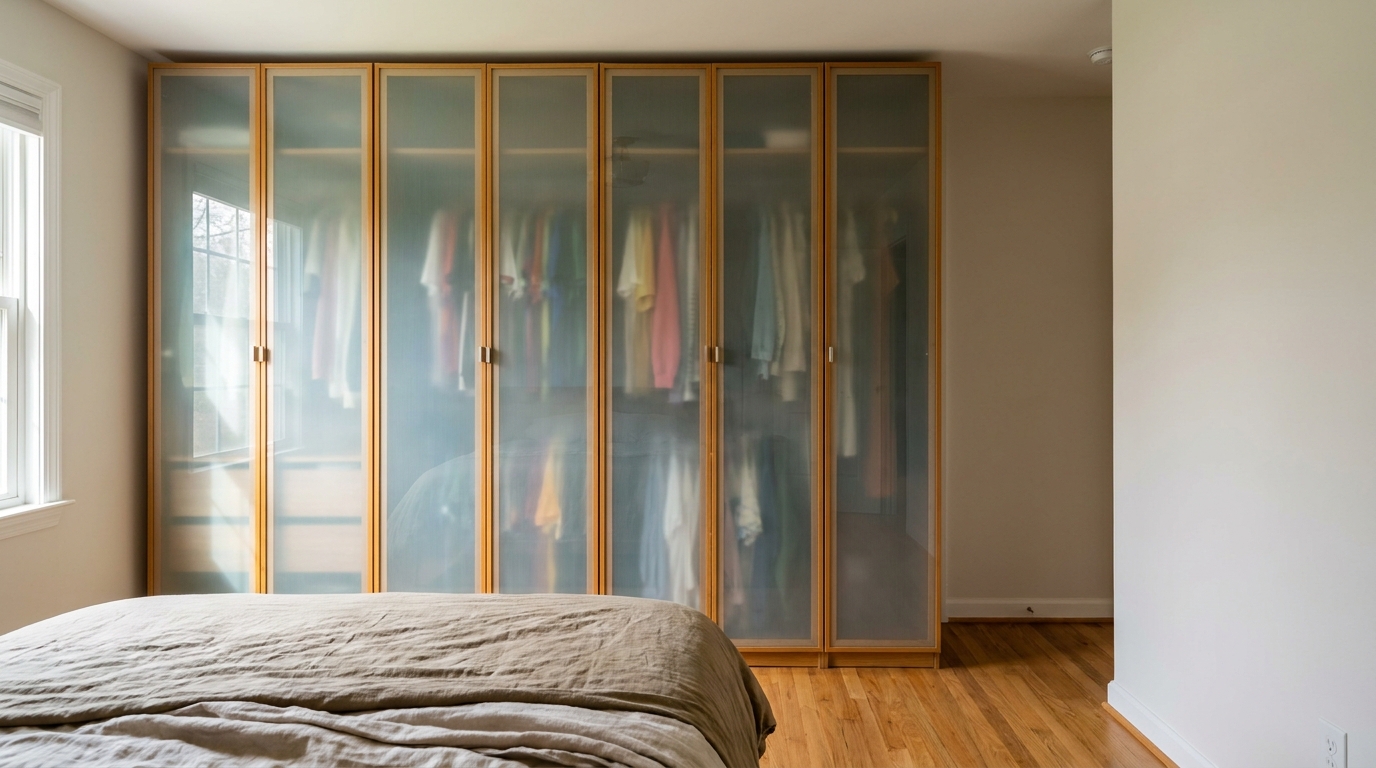
For smaller Charlotte bedrooms, the right closet door is less about fashion and more about how the room feels at human scale. Glass-front doors (clear, frosted, reeded, or mirrored) usually help light move and make a tight plan read larger, while solid doors give stronger visual privacy, quieter visual calm, and better concealment of everyday clutter. Neither choice is universally better. The better door matches your window light, how tidy the closet stays, how much floor clearance you have, and whether you want the closet to disappear or act as a bright wall plane. Daytime light exposure supports alertness and mood, which is one reason daylight-friendly finishes matter in small rooms that already work hard.[1]
Why door face matters more in a compact bedroom
Secondary bedrooms around Charlotte (guest rooms, kids' rooms, townhome secondary suites in Ballantyne, Fort Mill, Indian Trail, and similar pockets) often pack a full-size bed, nightstands, a dresser, and a closet wall into a footprint that leaves little slack. In that layout, the closet elevation is usually the largest unbroken plane after the bed wall. A dark, flat solid door can read as a quiet architectural panel. A reflective or translucent face can bounce or pass light and reduce the "boxy" feel that shows up when only one window feeds the room.
That light math is not only aesthetic. Outdoor daylight is orders of magnitude brighter than typical indoor levels, and natural indoor light is often only a few hundred lux even when a room feels "bright enough."[2] Federal health and research sources also link daytime light exposure to circadian timing, sleep-wake regulation, and well-being, and they note that many people already get limited high-intensity daylight during ordinary indoor days.[3][4] In a small bedroom with one window and a deep reach-in or short walk-in, every surface either steals light or returns it. Closet doors sit right in that trade.
Privacy is the other half of the decision. "Privacy" here is not bathroom privacy. It is visual privacy for hanging clothes, seasonal bulk, laundry baskets, and the imperfect middle of real life. Solid doors win that contest cleanly. Frosted or textured glass softens silhouettes without fully exposing contents. Clear glass or full mirror shows everything and asks for a more curated interior. If your household runs a "closed door, open mind" storage habit, solid fronts are kinder. If the closet is already organized and lit, glass can feel intentional rather than messy.
Glass-front closet doors: light, scale, and the honesty tax
Glass-front doors cover several products that behave differently:
- Clear glass passes the most light and shows the full interior. It is best when the closet is designed as a display system (uniform hang, coordinated bins, intentional lighting), not as overflow storage.
- Frosted, acid-etched, or reeded glass softens outlines and reduces visual noise while still letting light through from a lit closet or from ambient room light reflecting off the panel.
- Mirrored glass does not "open" into the closet the way clear glass does. It reflects the room back at itself, which can enlarge perceived width and double as a dressing mirror on a wall that cannot spare a freestanding piece.
In smaller rooms, mirrored sliding or bifold pairs are a common Charlotte retrofit because they replace a bulky free-standing mirror and return floor area near the dresser. Frosted glass is often a better compromise when you want a modern soft glow without a full reflection of the bed and laundry pile. Clear glass is the rarest good fit for everyday family bedrooms unless the closet interior is finished to the same standard as the room.
Glass also carries practical constraints:
- Weight and hardware. Glass and mirror panels are heavier than hollow-core wood-look doors. Tracks, rollers, and jamb conditions need to match the actual panel weight, not a generic builder-grade bypass set.
- Fingerprints and smudges. High-touch clear and mirror faces show marks faster in kids' rooms and busy primary suites.
- The honesty tax. Glass rewards organization. If the closet is mid-purge or still holding cardboard boxes from a move, solid doors will look more expensive on day one.
- Closet lighting. Frosted glass looks best when the closet has dedicated lighting. Without it, the panel can read flat and grey rather than luminous.
From a light-and-health perspective, glass faces support the same design goal as better window use: keep the room's daytime signal stronger. Researchers and public-health writers emphasize that light is a major cue for biological day and night timing, and that insufficient daytime light paired with poorly timed night light can work against sleep quality.[3][4] Closet glass will not replace a window, but in a room that already struggles for lux, reflecting or transmitting available light is a practical finish strategy rather than a decorative afterthought.
Solid closet doors: calm, concealment, and controlled scale
Solid doors (painted slab, shaker, raised-panel, or solid laminate on sliding/bifold hardware) are the default for a reason. They conceal. They match trim. They do not demand a magazine-ready closet interior. In smaller bedrooms they also create a quieter backdrop for textiles, art, and bedding, which matters when the room already has competing patterns from rugs and window treatments.
Solid doors tend to win when:
- The closet holds mixed storage (sports gear, luggage, overflow linens) that you do not want as wall art.
- The bedroom is used for rest and you prefer fewer reflective surfaces after dark.
- You want the closet to read as millwork architecture rather than a glazed display.
- Dust sensitivity or cleaning habits favor fewer smooth reflective planes.
There is a dust and maintenance angle here that is easy to overstate and important not to invent. Closet doors do not create dust mites. Dust and biological particles settle on surfaces throughout the home, and clothes and soft goods can hold allergen-related material in everyday life. EPA guidance is clear that indoor dust can include outdoor soil, pollen, mold spores, pet dander, dust mites, and skin flakes, and that frequent cleaning and ventilation reduce dust loads.[5] EPA also notes that house dust mites thrive in damp, warm conditions and that regular cleaning can reduce (not eliminate) common allergy-related agents in the home.[6] People also spend a large share of life indoors, so indoor surface habits matter.[7]
What that means for door choice is operational, not magical:
- Solid doors hide dusty tops of hanging rods and the visual mess of a mid-week laundry basket, which can make cleaning feel less urgent even when it still is.
- Glass doors make dust, lint, and smudges more visible, which can prompt more frequent wipe-downs of the door face and, often, a cleaner closet interior.
- Neither door replaces vacuuming, damp dusting, or humidity control. Those remain the real controls for indoor particulate and biological load.[5][6][7]
If anyone in the household has asthma or allergies, prioritize cleanable closet interiors (smooth shelving, closed bins for loose textiles, less open-floor pile) over obsessing about glass versus solid alone. Door face is secondary to what is stored and how often it is cleaned.
Scale: swing, bifold, bypass, and how much room the door steals
Material choice is only half the decision. Operation type decides whether the door fights the bed clearance.
Hinged (swing) doors need a clear arc into the room. In a compact bedroom where the bed foot or a dresser sits close to the closet, a swing door can clip furniture or force an awkward approach path. They do give nearly full-width access when open and feel familiar.
Bifold doors fold in pairs and need less full swing than a wide hinged pair, though stacked panels still project into the room. They can open most of the opening width, which helps when you need both hanging zones at once.
Bypass (sliding) doors stay in plane with the wall and use almost no floor clearance. The tradeoff is that one panel usually covers part of the opening, so you access roughly half the closet at a time unless you use a multi-panel or multi-track setup. For tight rooms, that trade is often worth it.
Pocket doors disappear into the wall cavity when the framing allows. They are excellent for scale but depend on clear wall structure, so they are easier in renovations planned with the framing than in quick door swaps.
Glass and solid both work on all of those systems. The combination that often suits smaller Charlotte bedrooms is solid or frosted glass on a bypass or well-tuned bifold, with hardware rated for the panel weight. Mirrored bypass pairs remain popular where dressing space is scarce. Solid painted slabs suit rooms that want the closet to vanish into the trim package.
A useful field test before you commit: stand at the bed and open each door type you are considering (even with painter's tape mock-ups of swing arcs). If the door path collides with the dresser drawers or the path to the hall, operation type is the real problem, not the glass versus solid debate.
Matching door choice to Charlotte-area room types
Different local layouts push different answers:
Townhome and condo secondary bedrooms often have one window and a long closet wall. Frosted glass or mirror on bypass hardware usually improves the sense of width. Solid doors work if you paint them the wall color and keep hardware quiet so the plane recedes.
Ranch and split-level kids' rooms often need concealment more than sparkle. Solid doors, bins, and a simple dual-hang interior beat glass that turns sports gear into a display.
Guest rooms that also hold overflow benefit from solid fronts or heavily frosted glass. Guests should not be staring at host storage the minute they open their eyes.
Primary suites with limited natural light (interior-facing rooms, tree-shaded lots, or deep plans) are the strongest case for mirrored or light-toned glass if the closet interior is already organized. If the suite already has abundant windows, solid doors can calm the palette without much light penalty.
Closets without internal lighting favor solid or mirror over clear glass. Clear glass into a dark cavity can look like a black rectangle and make the room feel smaller, not larger.
Pair the door decision with the interior layout. A custom system with dual hang, long-hang, shelves, and drawers reduces the pile that glass would expose. That is the real partnership: door face and interior organization should agree about how visible storage is allowed to be. Our custom closet work is built around that agreement, not around a single "trendy" front.
Design details that decide whether glass feels expensive or unfinished
If you lean glass, specify the details that separate a polished installation from a builder special:
- Frame finish that matches nearby metal (matte black, brushed nickel, champagne) rather than a random chrome that fights the room.
- Soft-close or quality rollers so heavy glass does not sound like a train on a Saturday morning.
- Safety glass / tempered panels appropriate to door use and local code practice.
- Interior lighting on a sensor or separate switch so frosted panels glow instead of greying out.
- Consistent interior rhythm (even spacing, matching hang heights, coordinated baskets) so the glass view reads as design, not inventory.
If you lean solid:
- Paint the door the wall color to shrink visual mass in a small room, or choose a soft contrast if you want the millwork to feel intentional.
- Align panel lines with other bedroom millwork (base, casing, built-ins) so the closet feels integrated.
- Consider a slim full-length mirror on an adjacent wall or the back of a bedroom door so you do not lose dressing function when you skip mirrored closet doors.
- Use the solid face as a backdrop for art or a wall sconce only if clearance and swing allow. Most of the time, leaving it clean is better in a small room.
In both cases, think about night mode. Bedrooms need a path to dark for sleep. Mirrored walls can bounce nightstand LEDs and hallway spill. Solid doors and thoughtful window treatments often make the room easier to dim. Health guidance around light emphasizes that daytime light and nighttime darkness are a pair, not a single "more light always" rule.[3][4] Design for both ends of the day.
A practical decision framework (use this on a Saturday walk-through)
Walk the bedroom with these five questions:
- How is the daylight? One weak window favors mirror or light-transmitting glass. Strong multi-window light lets solid doors stay calm without much cost.
- How honest is the closet? If the interior is a work in progress, solid first. Glass after the system and habits catch up.
- What is the clearance? Measure swing arcs and dresser drawer pull. Choose bypass or bifold when inches matter.
- Who uses the room? Kids and heavy multi-use storage usually prefer solid. Adults who dress in the room and want a mirror often prefer mirrored or mixed panels.
- What is the maintenance reality? Glass asks for more wipe-downs. Solid hides more between deep cleans, but the closet still needs the regular cleaning habits EPA recommends for indoor dust and allergen-related particles.[5][6]
A mixed solution is allowed. Many homes do well with a solid panel paired with a mirrored panel on a two-door bypass, or solid doors on the closet and a separate lean mirror. Purity is not the goal. Fit is.
Practical takeaways
- In smaller Charlotte bedrooms, treat closet doors as light and scale tools, not only as style samples.
- Glass (especially frosted or mirrored) helps perceived space and light; solid doors protect privacy and visual calm.
- Daytime light supports alertness, mood, and circadian timing, so light-friendly finishes matter in tight, one-window rooms.[1][3][4]
- Indoor dust and allergen-related particles are managed with cleaning, humidity control, and storage habits, not door material alone.[5][6][7]
- Choose operation type (swing, bifold, bypass, pocket) based on measured clearance, then choose glass versus solid based on honesty of the closet interior.
- Spec hardware for real panel weight, and add closet lighting if you choose frosted glass.
- Match the door face to the room's night behavior as well as its daytime look.
How we can help
We design custom closets for Charlotte-area homes with the door and the interior planned together, so light, privacy, and daily use land in the same solution. If you are weighing glass-front versus solid doors for a smaller bedroom, start with a free in-home design consultation. Bring your measurements, your clutter habits, and the way the room actually lives. We will walk the space, map clearances, and show options that fit your layout rather than a catalog default. Reach us through our contact page or call (704) 604-3870, and we can also walk you through how the process works before any install date is set.
Citations
- CDC / NIOSH - "The Color of the Light Affects Circadian Rhythms" (NIOSH Training for Nurses on Shift Work and Long Work Hours)
- National Toxicology Program / NCBI Bookshelf - "Circadian Regulation and Disruption, Night Shift, and Light at Night: Characterization and Exposure" (natural indoor light about 200-400 lux; outdoor daylight much higher)
- NHLBI / NIH - "Next generation of LED lighting could help improve human sleep cycles" (2017)
- U.S. Department of Energy - "How Electrochromics Improve Health, Productivity, and Efficiency in Buildings" (Dec 2023; daylight linked to sleep-wake regulation, circadian rhythm, well-being)
- U.S. EPA - "Sources of Indoor Particulate Matter (PM)" (Indoor Dust section; frequent cleaning and ventilation; last updated Mar 10, 2026)
- U.S. EPA - "The Inside Story: A Guide to Indoor Air Quality" (biological contaminants, dust mites, regular cleaning)
- U.S. EPA - "Biological Contaminants and Indoor Air Quality" (about 90% of time indoors; source control and regular cleaning; last updated Apr 1, 2026)