Holiday Storage Closet: Vertical Paper, Ribbon, Bins
A holiday storage closet is a year-round home for wrapping paper, ribbon, tape, and labeled decor bins, not a January dump in the garage or under the stairs. Stand paper on end so rolls stay round, park ribbon in shallow drawers, and close bins by holiday so December does not spill into the rest of the house. NFPA Research reports an estimated average of 835 home structure fires per year that began with decorations, excluding Christmas trees, with an annual average of 3 civilian fire deaths, 29 civilian fire injuries, and $18 million in direct property damage [1]. Plan the closet around those materials, then follow the unplug, inspect, and dry-storage steps fire agencies actually publish.
1. Give the holiday storage closet a real job, not a seasonal pile
Most households treat wrapping supplies as leftovers. Rolls go in a trash bag. Ribbon knots itself in a shoebox. Lights land in a plastic tub that never quite closes. By the next November, paper is crushed, tags are missing, and someone is shopping again for tape that already exists. That is not a storage plan. It is a reset you pay for every year.
A dedicated closet changes the job. The space can be a hall reach-in, a spare bedroom closet, or a slice of a larger custom closet that we zone for gift wrap instead of off-season clothes. The point is a conditioned interior, with shelves and drawers sized to the inventory, so the wrapping station is ready before the first school party invitation arrives.
University of Delaware art conservation faculty put the climate case in plain language in December 2025: store objects in a cool, dry, climate-controlled space away from direct sunlight or heat sources, and treat interior closets as ideal [3]. They advise avoiding attics and basements when you can, because humidity and temperature swings damage materials [3]. Wrapping paper, tissue, ribbon, and fabric stockings are exactly the kinds of paper and textile objects that suffer in a hot attic or a damp basement. A hall closet in a Charlotte or Ballantyne home already has the climate. It just needs the right internals.
If overflow still lives in the garage, treat that as a last resort. A garage can be organized (our garage storage work is built for tools, sports gear, and closed cabinets), but it is a poor climate for paper and electrical cords. Keep the wrapping closet inside.
2. Vertical paper slots keep rolls round
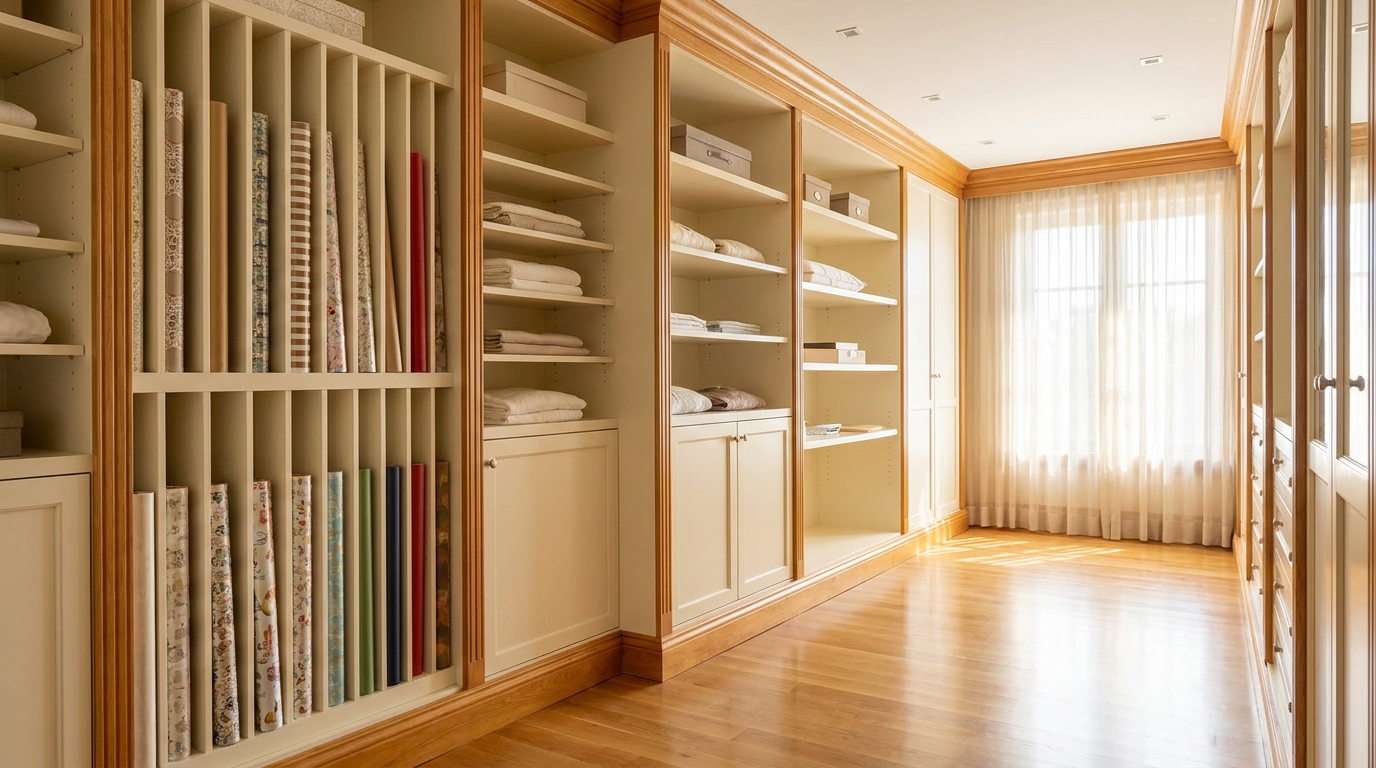
Horizontal stacking is what flattens gift wrap. The bottom roll takes the weight of everything above it. Once a roll is oval, it never feeds cleanly through a cutter, and you waste a sheet every time you wrap a box. Vertical slots fix that with geometry, not with another product bin.
Build upright bays the height of a standard roll plus a little clearance at the top so you can lift a roll without bending it. A typical consumer roll is about 30 inches long. Give it a slot that is a little taller, a little deeper than the roll diameter, and narrow enough that neighboring rolls cannot lean into each other. Group by finish: solid colors in one bay, patterns in another, extra-wide rolls in a deeper slot so they do not bow.
Add a small lip or a rod at the front of each slot so a roll cannot walk out when someone grabs the one next to it. In Fort Mill and Rock Hill homes with shallow reach-ins, we often run vertical slots on the left, drawers in the center, and bin shelves on the right. Keep a nearby counter as the wrapping surface so the closet does not become the table.
3. Shallow drawers for ribbon, tape, tags, and scissors
Ribbon fails in deep drawers. Spools bury other spools. Curling ribbon becomes a knot. You buy a fourth roll of kraft twine because you cannot see the first three. Shallow drawers (think one spool high, not a sweater drawer) keep every roll visible and every cutter in reach.
Divide each drawer:
- Ribbon and twine: pegs or low dividers so spools stand on end or lie in a single layer.
- Tape and adhesives: a tray for clear tape, double-sided tape, washi, and glue dots. Do not mix these with ornaments.
- Tags, cards, and tissue: a flat tray so cards do not curl under a heavy spool.
- Tools: scissors, a bone folder or straightedge, a pen, and spare cutter blades.
If you wrap for several households (grandparents in Waxhaw, a sibling in Wesley Chapel, a classroom in Indian Land), label the front of each drawer with the actual contents, not a cute holiday word. "Red grosgrain / baker's twine" is more useful in November than "Merry." When the drawer is full, stop buying. The closet is telling you the inventory is already there.
Put heavy, dense items (ceramic villages, boxed figurines, spare cords in a closed bin) on lower shelves. Save the upper drawers for light ribbon and paper goods.
4. Closed, labeled bins by holiday
Open baskets look tidy on install day and collect dust, pet hair, and mystery cords by March. Closed bins with labels that survive a year of darkness are the rule for anything that is not paper or ribbon.
Sort by holiday, not by color. Halloween lights do not belong in the same bin as Valentine's tabletop pieces, even if both are orange. A useful label is specific: "Halloween porch lights, inspected 2026" or "Thanksgiving table linens." When the bin comes down, you should know whether it is the right one before you open it.
University of Delaware conservators note that wool is attractive to moths and that wool stockings should go in a tightly sealed container away from windows [3]. They also note that plant-based decor can attract pests and recommend placing tissue-wrapped items in a food-safe plastic bag before storage [3]. Closed bins plus a dry closet do more for fabric stockings and corn-husk figures than a pretty open cube.
Keep wrapping paper out of those holiday bins. Mixing rolls with ornaments is how a glass ball punches a hole in next year's paper. Fragile glass can be padded with tissue and nested, which is the method UD faculty describe for glittered and handblown ornaments [3]. Plan shelf height around the bin you actually own. A 12-inch bin on a 10-inch shelf becomes a pile on the floor. We measure the bins first, then set the shelves.
5. Lights and electrical decor: unplug, inspect, store dry
Lights are not "just another bin." They are electrical products that go back on a tree, a mantle, or a porch. Store them as if you intend to plug them in again, because you will.
NFPA's January 2026 guidance for packing lights is specific. Use the gripping area on the plug when you unplug electrical decorations. Never pull the cord to unplug a device, because that can harm the wire and insulation and raise the risk of shock or electrical fire [4]. As you pack light strings, inspect each line for damage and throw out sets with loose connections, broken sockets, or cracked or bare wires [4]. Wrap each set of lights and put them in individual plastic bags, or wrap them around a piece of cardboard [4]. Store electrical decorations in a dry place away from children and pets, where they will not be damaged by water or dampness [4].
That last sentence is why this closet belongs inside the house. A damp garage corner is the opposite of a dry place. Individual bags (or cardboard wraps) stop a damaged strand from tangling with a good one. Label the bag with the location: "living room tree, 2 strands" beats a mystery knot.
The U.S. Fire Administration tells households to inspect holiday lights each year before putting them up and to throw away strands with frayed or pinched wires [5]. Read the manufacturer's instructions for the number of light strands to connect [5]. CPSC's November 2024 holiday safety release is just as direct: never string together more than three sets of incandescent lights, and never overload electrical outlets [2].
CPSC also reported about 160 Christmas decorating-related injuries each day during the holiday season, with nearly half of those injuries involving falls, and about 14,900 people treated in emergency rooms for holiday decorating-related injuries in the 2023 holiday season (November 1, 2022 through January 31, 2023) [2]. A labeled light bin at chest height is safer than a tottering stack you climb a chair to retrieve.
Keep spare fuses, extra bulbs, and outdoor-rated cords in a small closed box on the same shelf as the lights. Do not store candles against electrical cords. NFPA notes that year-round, one-third (33%) of home decoration fires were started by candles, and that share jumped to 49% in December [1]. In its December 2025 release, NFPA reported that nearly half (47 percent) of decoration fires (excluding Christmas trees) occurred because decorations were too close to a heat source, such as a candle or other heat-producing equipment, using annual averages for 2020 through 2024 [6]. UD conservators also flag old electrical wiring as a fire hazard when they discuss older decorations [3]. If a strand fails inspection, it does not go back in the closet. It goes in the trash [4].
6. Keep walkways clear and put weight on lower shelves
A wrapping closet that blocks a hallway is a trip hazard dressed as organization. USFA holiday guidance says to keep a Christmas tree at least 3 feet from heat sources such as fireplaces, radiators, space heaters, candles, or heat vents, and to make sure the tree does not block exits [5]. The same logic applies to the closet: the door must open fully, the hall must stay walkable, and bins cannot become a second wall in a means of egress.
Do not store overflow in front of the closet or run extension cords across the hall. If the closet is under a stair, keep the lowest zone for bins you rarely need, and keep the walk-out clear.
Put weight on lower shelves. CPSC's February 2026 tip-over reminder is blunt: keep heavier items on lower shelves, and avoid storing tempting items on higher shelves where children may try to climb [7]. Ceramic villages, boxed trains, and full bins of glass belong low. Tissue and empty gift bags can live higher. That layout also makes the unit more stable, which matters if the closet uses a free-standing tower instead of a built-in.
7. Built-in vs free-standing: be honest about tip-over risk
A built-in closet fastened to wall studs is not the same object as a tall, free-standing tower of bins. We prefer built-ins for this work because the vertical paper bays, shallow drawers, and bin shelves can be locked to the architecture. They do not walk. They do not lean when a full bin comes off the top shelf.
Free-standing furniture is a different story. CPSC's Anchor It campaign exists because unsecured TVs, furniture, and appliances are hidden hazards, and children climb [8]. Existing furniture can be anchored with anti-tip brackets. New furniture such as dressers is sold with anti-tip devices, and those devices should be installed right away [8]. CPSC also tells households to anchor furniture such as bookcases and dressers securely to the wall [7].
From 2020 through 2022, CPSC estimates that U.S. emergency departments treated an average of 17,800 injuries from tip-overs each year, and 44% of victims were under 18 [7]. That is why we do not treat a tall, unanchored tower as a finished holiday closet. If a homeowner already owns a free-standing unit, we talk about anchoring, lowering the heavy bins, and keeping climbable objects off the top. For new work in Wesley Chapel or Indian Land, we design a built-in that is fastened, with the heavy inventory low.
A built-in is not magic. A top shelf stacked with dense bins is still a bad idea, and anti-tip hardware on a dresser-style unit still needs to be installed. The closet should make the safe layout the easy layout.
Practical takeaways
- Zone one interior closet for wrap and decor. Do not default to the attic, basement, or garage. Interior closets are the better climate for paper, textiles, and electrical decorations [3] [4].
- Stand wrapping paper on end in vertical slots with a front lip so rolls do not crush or walk out.
- Use shallow, divided drawers for ribbon, tape, tags, and tools. Label the drawer with what is inside.
- Close and label bins by holiday. Keep wool textiles and plant-based decor in sealed containers [3]. Keep paper out of ornament bins.
- Unplug lights by the plug, not the cord. Inspect every strand. Discard damaged sets. Wrap each set separately and store it dry, away from children and pets [4] [5].
- Do not overload outlets when the lights come back out, and do not string together more than three sets of incandescent lights [2].
- Keep the closet door and the hall clear. Do not block exits with trees, bins, or wrapping overflow [5].
- Heavy bins go low. Tempting objects stay off the top. Anchor free-standing towers and dresser-style units [7] [8].
How we can help
Have more questions or want to get in touch? We design holiday wrap and decor closets for homes in Charlotte, Ballantyne, Waxhaw, Wesley Chapel, Fort Mill, Rock Hill, and Indian Land, with vertical paper slots, shallow ribbon drawers, and labeled bin shelves that stay put after the season. Reach us through our contact page, call (704) 604-3870, or email design@theclosetrehab.com.
Citations
- National Fire Protection Association, "Winter holidays" (2026)
- U.S. Consumer Product Safety Commission, "Happy Holidays Start with Safety: CPSC Urges Families to Cook, Decorate and Select Toys with Care This Season" (2024-11-19)
- University of Delaware, "Preserving decor" (2025-12-18)
- National Fire Protection Association, "More than one-third of Christmas tree home fires occur in January" (2026-01-05)
- U.S. Fire Administration, "Holiday Fire Safety" (2026)
- National Fire Protection Association, "December among leading months of the year for U.S. home fires" (2025-12-04)
- U.S. Consumer Product Safety Commission, "CPSC Urges Fans: Anchor TVs and Furniture Before Super Bowl LX" (2026-02-05)
- U.S. Consumer Product Safety Commission, "AnchorIt.gov" (2026)